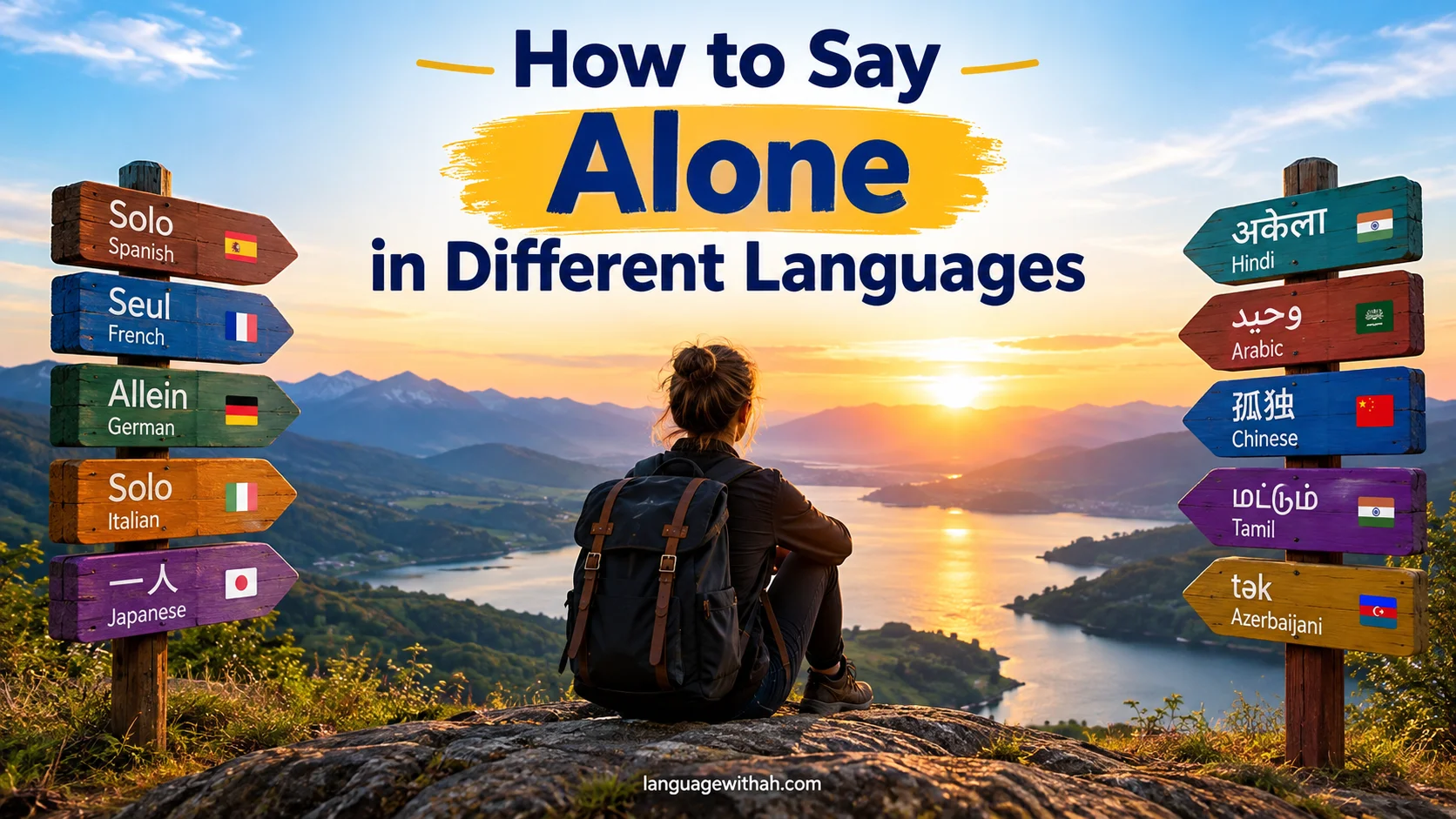
The word “alone” describes being by yourself, without another person accompanying you. It can be completely neutral—such as spending an evening alone—or carry a more emotional meaning when someone is talking about isolation or loneliness. Learning how to say Alone in 70 Different Languages is useful for travelers, language learners, writers, couples, students, and anyone who wants to communicate naturally across cultures.
Although “alone” seems like a simple English word, other languages do not always use one direct equivalent. Some languages distinguish between being physically alone and feeling lonely, while others change the wording according to gender, number, formality, or sentence structure. In several languages, the most natural translation is closer to “by myself,” “on my own,” or “one person alone.”
This guide focuses primarily on the meaning of being alone or by oneself, rather than the separate emotional idea of being lonely. You will find translations, pronunciation help, natural example sentences, regional information, and cultural notes for 80 languages and language varieties.
Interesting Facts About Alone
- “Alone” and “lonely” are not the same idea. A person can enjoy being alone without feeling lonely. Many languages have separate words or expressions for these concepts.
- Some languages express “alone” through an adverbial phrase, such as “by oneself,” rather than through a single adjective.
- In languages such as Spanish, French, Italian, and Portuguese, the form may change according to the person’s grammatical gender.
- In Mandarin Chinese, an expression such as 一个人 (yí gè rén) literally refers to being “one person” and naturally conveys being alone in many contexts.
- Japanese commonly uses 一人で (hitori de) for doing something alone, showing how the grammar of the surrounding sentence affects the translation.
- In some languages, saying that someone is alone can be completely factual, while another expression is preferred when describing emotional loneliness.
- Regional speech can change the most natural wording. This is particularly important for broad languages such as Arabic, Chinese, English, and Kurdish.
What Does Alone Mean?
Alone generally means being without other people present or accompanying you.
For example:
- “I am alone at home” means nobody else is with me.
- “She traveled alone” means she traveled without companions.
- “He lives alone” means he lives without other people in his household.
- “I want to be alone” means I want other people to leave me by myself.
The word can also have an emotional association, but being alone does not automatically mean being lonely. Someone may deliberately choose solitude for rest, privacy, study, travel, creativity, or personal time.
In another language, the natural expression may therefore depend on whether you mean physical solitude, doing something independently, or emotional isolation.
Why Can Alone Have Different Translations?
There is no single translation strategy that works perfectly for every language.
The English word “alone” can function differently depending on the sentence. A translator may choose a word meaning “alone,” “by myself,” “on my own,” “one person,” or another natural construction.
Important factors include:
- Context: “I am alone” can differ from “I traveled alone.”
- Grammar: Some languages require a gender-specific form.
- Formality: Spoken language may use a shorter or more conversational expression.
- Region: A standard-language form may differ from a local dialect.
- Number: Some languages distinguish singular and plural forms.
- Culture: Natural expressions may focus on the action rather than the state of being alone.
- Literal versus natural translation: A word-for-word translation may sound unnatural even when every individual word is technically correct.
The tables below therefore prioritize natural usage rather than mechanically translating the English word.
European Languages
Europe contains several major language families, so the idea of being alone is expressed in different grammatical ways. Some languages use an adjective, while others commonly use an adverbial construction meaning “alone” or “by oneself.” Gender distinctions are especially important in several Romance and Slavic languages.
English Varieties
American English 🇺🇸
Translation: alone
Pronunciation: uh-LOHN
Example: “I stayed alone at home for the evening.”
Meaning: The speaker stayed without anyone else.
British English 🇬🇧
Translation: alone
Pronunciation: uh-LONE
Example: “She prefers to travel alone.”
Meaning: She prefers traveling without companions.
Australian English 🇦🇺
Translation: alone
Pronunciation: uh-LONE
Example: “He was alone at the beach.”
Meaning: He was at the beach without anyone else.
American, British, and Australian English use the same standard spelling alone. Differences are mainly related to accent, pronunciation, and surrounding vocabulary, not a different translation of the word.
European Language Table
| 🌍 Language | Country/Region | Translation | Pronunciation | Example Sentence |
| English | International | alone | uh-LOHN | I am alone at home. |
| Spanish | Spain, Latin America | solo / sola | SOH-loh / SOH-lah | Estoy solo en casa. — I am alone at home. |
| French | France, Belgium, Canada | seul / seule | suhl / suhl | Je suis seul chez moi. — I am alone at home. |
| German | Germany, Austria, Switzerland | allein | ah-LINE | Ich bin allein zu Hause. — I am alone at home. |
| Italian | Italy, Switzerland | solo / sola | SOH-loh / SOH-lah | Sono solo a casa. — I am alone at home. |
| Portuguese | Portugal, Brazil | sozinho / sozinha | soh-ZEEN-yoo / soh-ZEEN-yah | Estou sozinho em casa. — I am alone at home. |
| Dutch | Netherlands, Belgium | alleen | ah-LAYN | Ik ben alleen thuis. — I am alone at home. |
| Swedish | Sweden, Finland | ensam | EN-sam | Jag är ensam hemma. — I am alone at home. |
| Norwegian | Norway | alene | ah-LEH-neh | Jeg er alene hjemme. — I am alone at home. |
| Danish | Denmark | alene | ah-LEH-neh | Jeg er alene hjemme. — I am alone at home. |
| Finnish | Finland | yksin | ÜK-sin | Olen yksin kotona. — I am alone at home. |
| Icelandic | Iceland | einn / ein | aytn / ayn | Ég er einn heima. — I am alone at home. |
| Irish | Ireland | liom féin | lim fayn | Tá mé liom féin. — I am by myself. |
| Welsh | Wales | ar fy mhen fy hun | ar vuh men vuh hin | Rwy’n ar fy mhen fy hun. — I am on my own. |
| Polish | Poland | sam / sama | sam / SAH-mah | Jestem sam w domu. — I am alone at home. |
| Czech | Czech Republic | sám / sama | saam / SAH-mah | Jsem sám doma. — I am alone at home. |
| Slovak | Slovakia | sám / sama | saam / SAH-mah | Som sám doma. — I am alone at home. |
| Ukrainian | Ukraine | сам / сама | sam / sah-MAH | Я сама вдома. — I am alone at home. |
| Russian | Russia and neighboring regions | один / одна | ah-DEEN / ah-NAH | Я одна дома. — I am alone at home. |
| Romanian | Romania, Moldova | singur / singură | SEEN-goor / SEEN-goo-ruh | Sunt singur acasă. — I am alone at home. |
| Hungarian | Hungary | egyedül | ED-yeh-dool | Egyedül vagyok otthon. — I am alone at home. |
| Greek | Greece, Cyprus | μόνος / μόνη | MOH-nos / MOH-nee | Είμαι μόνος στο σπίτι. — I am alone at home. |
| Bulgarian | Bulgaria | сам / сама | sam / sah-MAH | Аз съм сам вкъщи. — I am alone at home. |
| Croatian | Croatia, Bosnia and Herzegovina | sam / sama | sam / SAH-mah | Sam sam kod kuće. — I am alone at home. |
| Serbian | Serbia, Bosnia and Herzegovina, Montenegro | sam / sama | sam / SAH-mah | Sam sam kod kuće. — I am alone at home. |
| Slovenian | Slovenia | sam / sama | sam / SAH-mah | Sam sem doma. — I am alone at home. |
| Lithuanian | Lithuania | vienas / viena | VYEH-nas / VYEH-nah | Esu vienas namuose. — I am alone at home. |
| Latvian | Latvia | viens / viena | vyens / VYEH-nah | Es esmu viens mājās. — I am alone at home. |
| Estonian | Estonia | üksi | ÜK-see | Ma olen üksi kodus. — I am alone at home. |
| Albanian | Albania, Kosovo, North Macedonia | vetëm | VEH-tuhm | Jam vetëm në shtëpi. — I am alone at home. |
| Bosnian | Bosnia and Herzegovina | sam / sama | sam / SAH-mah | Sam sam kod kuće. — I am alone at home. |
| Catalan | Catalonia, Valencia, Balearic Islands | sol / sola | sol / SOH-lah | Estic sol a casa. — I am alone at home. |
European Cultural and Grammar Notes
In many European languages, gender affects the form of “alone.” Spanish solo/sola, French seul/seule, Italian solo/sola, Portuguese sozinho/sozinha, and several Slavic languages illustrate this pattern.
In other languages, such as German allein, Finnish yksin, Hungarian egyedül, and Estonian üksi, the common form does not change according to the speaker’s gender.
For Welsh and Irish, the most natural construction can be closer to “by myself” or “on my own” than a single direct adjective. This is a good example of why literal translation is not always the best approach.
Read More: How to Say What Time Is It in Different Languages
Asian Languages
Asia contains an enormous range of language families and writing systems. The natural translation of alone can be a single word, a phrase meaning “one person,” or an adverbial construction. Gender, sentence structure, and whether the expression refers to an activity or a personal state can all influence the wording.
Asian Language Table
| 🌍 Language | Country/Region | Translation | Pronunciation | Example Sentence |
| Mandarin Chinese | China, Taiwan, Singapore | 一个人 | yí gè rén | 我一个人在家。 — I am alone at home. |
| Cantonese | Hong Kong, Guangdong | 一個人 | jat1 go3 jan4 | 我一個人喺屋企。 — I am alone at home. |
| Japanese | Japan | 一人で | hitori de | 一人で家にいます。 — I am alone at home. |
| Korean | South Korea, North Korea | 혼자 | hon-ja | 저는 집에 혼자 있어요. — I am alone at home. |
| Hindi | India | अकेला / अकेली | akelā / akelī | मैं घर पर अकेला हूँ। — I am alone at home. |
| Urdu | Pakistan, India | اکیلا / اکیلی | akelā / akelī | میں گھر میں اکیلا ہوں۔ — I am alone at home. |
| Bengali | Bangladesh, India | একা | eka | আমি বাড়িতে একা আছি। — I am alone at home. |
| Punjabi | India, Pakistan | ਇਕੱਲਾ / ਇਕੱਲੀ | ikallā / ikallī | ਮੈਂ ਘਰ ਵਿੱਚ ਇਕੱਲਾ ਹਾਂ। — I am alone at home. |
| Gujarati | India | એકલો / એકલી | eklo / ekli | હું ઘરે એકલો છું. — I am alone at home. |
| Marathi | India | एकटा / एकटी | ektā / ektī | मी घरी एकटा आहे. — I am alone at home. |
| Tamil | India, Sri Lanka, Singapore | தனியாக | taṉiyāka | நான் வீட்டில் தனியாக இருக்கிறேன். — I am alone at home. |
| Telugu | India | ఒంటరిగా | onṭarigā | నేను ఇంట్లో ఒంటరిగా ఉన్నాను. — I am alone at home. |
| Kannada | India | ಒಬ್ಬನೇ / ಒಬ್ಬಳೇ | obbanē / obbaḷē | ನಾನು ಮನೆಯಲ್ಲಿ ಒಬ್ಬನೇ ಇದ್ದೇನೆ. — I am alone at home. |
| Malayalam | India, Kerala | ഒറ്റയ്ക്ക് | oṟṟaykku | ഞാൻ വീട്ടിൽ ഒറ്റയ്ക്കാണ്. — I am alone at home. |
| Nepali | Nepal, India | एक्लै | eklai | म घरमा एक्लै छु। — I am alone at home. |
| Sinhala | Sri Lanka | තනියම | taniyama | මම ගෙදර තනියම ඉන්නවා. — I am alone at home. |
| Thai | Thailand | คนเดียว | khon diao | ฉันอยู่บ้านคนเดียว — I am alone at home. |
| Vietnamese | Vietnam | một mình | moht minh | Tôi ở nhà một mình. — I am alone at home. |
| Indonesian | Indonesia | sendirian | sen-dee-ree-ahn | Saya sendirian di rumah. — I am alone at home. |
| Malay | Malaysia, Brunei, Singapore | bersendirian | ber-sen-dee-ree-an | Saya bersendirian di rumah. — I am alone at home. |
| Filipino/Tagalog | Philippines | mag-isa | mag-ee-SAH | Mag-isa ako sa bahay. — I am alone at home. |
| Burmese | Myanmar | တစ်ယောက်တည်း | ta-yauk-teh | အိမ်မှာ တစ်ယောက်တည်းရှိတယ်။ — I am alone at home. |
| Khmer | Cambodia | ម្នាក់ឯង | mneak aeng | ខ្ញុំនៅផ្ទះម្នាក់ឯង។ — I am alone at home. |
| Mongolian | Mongolia | ганцаараа | gant-sa-rah | Би гэртээ ганцаараа байна. — I am alone at home. |
| Kazakh | Kazakhstan and Central Asia | жалғыз | zhal-GHYZ | Мен үйде жалғызбын. — I am alone at home. |
| Uzbek | Uzbekistan and Central Asia | yolgʻiz | yol-GHIZ | Men uyda yolgʻizman. — I am alone at home. |
| Turkish | Turkey, Cyprus | yalnız | yah-LUHN-uhz | Evde yalnızım. — I am alone at home. |
Asian Cultural and Grammar Notes
Mandarin Chinese often uses 一个人 (yí gè rén) when describing being alone. The expression literally involves the idea of one person, but it is a natural way to communicate solitude in many everyday contexts.
In Japanese, 一人で (hitori de) is especially useful when describing doing something alone. For example, 一人で旅行する means “to travel alone.” This makes it more useful than trying to force a single English-style adjective into every sentence.
In Hindi and Urdu, grammatical gender can affect the form. अकेला / अकेली and اکیلا / اکیلی correspond broadly to masculine and feminine forms.
In Korean, 혼자 (honja) is a common everyday expression for being alone or doing something alone. The sentence ending changes according to politeness and context, while 혼자 itself remains unchanged.
African Languages
Africa is home to thousands of languages and numerous language families. The expressions below represent several widely spoken or regionally important languages. As elsewhere, the most natural translation can depend on whether the speaker means physical solitude, an independent activity, or emotional isolation.
African Language Table
| 🌍 Language | Country/Region | Translation | Pronunciation | Example Sentence |
| Swahili | Kenya, Tanzania, Uganda, East Africa | peke yangu | PEH-keh YAHN-goo | Niko peke yangu nyumbani. — I am alone at home. |
| Afrikaans | South Africa, Namibia | alleen | ah-LEEN | Ek is alleen by die huis. — I am alone at home. |
| Zulu | South Africa | ngedwa | nge-DWEH | Ngisekhaya ngedwa. — I am alone at home. |
| Xhosa | South Africa | ndedwa | ndeh-DWEH | Ndisekhaya ndedwa. — I am alone at home. |
| Amharic | Ethiopia | ብቻ | bicha | ቤት ብቻዬን ነኝ። — I am alone at home. |
| Yoruba | Nigeria, Benin | nikan | nee-KAHN | Mo wà nikan ní ilé. — I am alone at home. |
| Igbo | Nigeria | naanị | nah-NYEE | Anọ m naanị m n’ụlọ. — I am alone at home. |
| Hausa | Nigeria, Niger and West Africa | ni kaɗai | nee kah-DYE | Ina gida ni kaɗai. — I am alone at home. |
| Somali | Somalia, Somaliland, Djibouti | kaligay | kah-lee-GAY | Guriga kaligay ayaan joogaa. — I am alone at home. |
| Shona | Zimbabwe | ndega | NDEH-gah | Ndiri ndega kumba. — I am alone at home. |
| Sesotho | Lesotho, South Africa | ke le mong | keh leh MONG | Ke le mong hae. — I am alone at home. |
| Setswana | Botswana, South Africa | ke le nosi | keh leh NOH-see | Ke le nosi kwa gae. — I am alone at home. |
| Kinyarwanda | Rwanda | njyenyine | jyen-YEH-nee-neh | Ndi mu rugo njyenyine. — I am alone at home. |
| Malagasy | Madagascar | irery | ee-REH-ree | Irery ao an-trano aho. — I am alone at home. |
African Cultural and Language Notes
Swahili commonly uses peke yangu for “by myself” or “alone” when the speaker is referring to themselves. The form changes with the person being referred to, so other pronouns produce different forms.
In several Southern African languages, the idea of being alone is expressed through a word or phrase meaning “alone by oneself” or “without another person.”
It is important not to treat one African language as representative of the continent. Swahili, Yoruba, Amharic, Zulu, Hausa, Somali, and the other languages above belong to different linguistic traditions, and their grammar and vocabulary should be learned individually.
Middle Eastern Languages
The Middle East includes several distinct language families and traditions. Even within one language, everyday speech can vary considerably between countries and communities. Arabic deserves particular attention because Modern Standard Arabic and regional spoken varieties do not always use identical vocabulary or pronunciation.
Middle Eastern Language Table
| 🌍 Language | Country/Region | Translation | Pronunciation | Example Sentence |
| Arabic — Modern Standard Arabic | Arab world | وحيد / وحيدة | wa-HEED / wa-HEE-dah | أنا وحيد في البيت. — I am alone at home. |
| Persian | Iran, Afghanistan, Tajikistan | تنها | tan-HA | من در خانه تنها هستم. — I am alone at home. |
| Hebrew | Israel | לבד | le-VAD | אני לבד בבית. — I am alone at home. |
| Kurdish — Kurmanji | Türkiye, Syria, Iraq | tenê | teh-NEH | Ez li malê tenê me. — I am alone at home. |
| Armenian | Armenia, Armenian communities worldwide | մենակ | meh-NAK | Ես տանը մենակ եմ։ — I am alone at home. |
| Turkish | Turkey, Cyprus | yalnız | yah-LUHN-uhz | Evde yalnızım. — I am alone at home. |
Arabic: A Useful Distinction
In Modern Standard Arabic, وحيد (waḥīd) and وحيدة (waḥīda) can describe a person as alone, with masculine and feminine agreement.
However, spoken Arabic varies by region. Everyday expressions in Egyptian Arabic, Levantine Arabic, Gulf Arabic, Iraqi Arabic, and other varieties can differ from Modern Standard Arabic. Therefore, Modern Standard Arabic should not be treated as the only way Arabic speakers express the idea of being alone.
For a simple international written reference, Modern Standard Arabic is useful, but travelers should learn the local spoken variety when conversational accuracy matters.
Other World Languages
Some languages outside the main regional sections offer especially interesting ways to express solitude. These examples show that the concept of being alone is widespread, but the grammar used to express it can be quite different.
| 🌍 Language | Country/Region | Translation | Pronunciation | Example Sentence |
| Māori | New Zealand | ko au anake | koh ow AH-nah-keh | Ko au anake i te kāinga. — I am alone at home. |
| Samoan | Samoa, American Samoa | naʻo aʻu | now AH-oo | Naʻo aʻu i le fale. — I am alone at home. |
| Tongan | Tonga | toko taha | TOH-koh TAH-hah | ʻOku ou toko taha ʻi ʻapi. — I am alone at home. |
| Hawaiian | Hawaii | hoʻokahi | ho-oh-kah-hee | Hoʻokahi au ma ka hale. — I am alone at home. |
| Quechua | Andes, especially Peru and Bolivia | sapallay | sah-pahl-LYE | Sapallaymi wasi-pi kani. — I am alone at home. |
| Guarani | Paraguay and neighboring regions | che año | cheh ah-NYOH | Che año aime. — I am alone. |
| Haitian Creole | Haiti | pou kont mwen | poo kohnt mwen | Mwen pou kont mwen lakay. — I am alone at home. |
| Esperanto | International constructed language | sola | SOH-lah | Mi estas sola hejme. — I am alone at home. |
Note: Indigenous and regional languages can have substantial local variation. The forms above are useful representative forms, but learners should consult local speakers or language resources when a particular community or dialect is important.
Cultural Notes About Saying Alone
The word alone is often emotionally neutral in one context and emotionally sensitive in another.
For example:
- “I traveled alone” usually describes an independent activity.
- “I live alone” describes a living arrangement.
- “Leave me alone” is a request for privacy or space.
- “I feel alone” can suggest emotional isolation and may be closer in meaning to “I feel lonely.”
- “She was alone in the room” simply describes a physical situation.
Because of these differences, translating the word without considering the surrounding sentence can produce the wrong tone.
A person learning a language should pay special attention to whether the target-language expression sounds neutral, emotional, formal, conversational, or literary.
Pronunciation Guidelines for Alone in Different Languages
Pronunciation guides in this article are designed for ordinary learners rather than as replacements for formal phonetic transcription.
A few points are particularly important:
- Mandarin Chinese: yí gè rén uses Mandarin tones. The tone marks are meaningful and should not simply be ignored.
- Cantonese: Jyutping numbers such as jat1 go3 jan4 indicate tones.
- Japanese: hitori de is pronounced as separate syllables rather than like an English word.
- Korean: honja is approximately “hon-jah,” but Korean pronunciation should ideally be learned from audio.
- Arabic and Persian: Romanization can represent sounds that do not have exact English equivalents.
- Hindi and Urdu: The masculine and feminine forms differ, so pronunciation should match the grammatical form being used.
- French: seul and seule have similar pronunciation in ordinary speech despite their different spellings.
- Spanish and Italian: solo and sola differ primarily in the final vowel according to gender.
- Portuguese: Brazilian and European pronunciation can differ, even when the written word is the same.
For serious language learning, native audio is preferable to relying entirely on an English-style pronunciation spelling.
Quick Reference: Alone in Different Languages
| Language | Translation |
| English | alone |
| American English | alone |
| British English | alone |
| Australian English | alone |
| Spanish | solo / sola |
| French | seul / seule |
| German | allein |
| Italian | solo / sola |
| Portuguese | sozinho / sozinha |
| Dutch | alleen |
| Swedish | ensam |
| Norwegian | alene |
| Danish | alene |
| Finnish | yksin |
| Icelandic | einn / ein |
| Irish | liom féin |
| Welsh | ar fy mhen fy hun |
| Polish | sam / sama |
| Czech | sám / sama |
| Slovak | sám / sama |
| Ukrainian | сам / сама |
| Russian | один / одна |
| Romanian | singur / singură |
| Hungarian | egyedül |
| Greek | μόνος / μόνη |
| Bulgarian | сам / сама |
| Croatian | sam / sama |
| Serbian | sam / sama |
| Slovenian | sam / sama |
| Lithuanian | vienas / viena |
| Latvian | viens / viena |
| Estonian | üksi |
| Albanian | vetëm |
| Bosnian | sam / sama |
| Catalan | sol / sola |
| Mandarin Chinese | 一个人 |
| Cantonese | 一個人 |
| Japanese | 一人で |
| Korean | 혼자 |
| Hindi | अकेला / अकेली |
| Urdu | اکیلا / اکیلی |
| Bengali | একা |
| Punjabi | ਇਕੱਲਾ / ਇਕੱਲੀ |
| Gujarati | એકલો / એકલી |
| Marathi | एकटा / एकटी |
| Tamil | தனியாக |
| Telugu | ఒంటరిగా |
| Kannada | ಒಬ್ಬನೇ / ಒಬ್ಬಳೇ |
| Malayalam | ഒറ്റയ്ക്ക് |
| Nepali | एक्लै |
| Sinhala | තනියම |
| Thai | คนเดียว |
| Vietnamese | một mình |
| Indonesian | sendirian |
| Malay | bersendirian |
| Filipino/Tagalog | mag-isa |
| Burmese | တစ်ယောက်တည်း |
| Khmer | ម្នាក់ឯង |
| Mongolian | ганцаараа |
| Kazakh | жалғыз |
| Uzbek | yolgʻiz |
| Turkish | yalnız |
| Swahili | peke yangu |
| Afrikaans | alleen |
| Zulu | ngedwa |
| Xhosa | ndedwa |
| Amharic | ብቻ |
| Yoruba | nikan |
| Igbo | naanị |
| Hausa | ni kaɗai |
| Somali | kaligay |
| Shona | ndega |
| Sesotho | ke le mong |
| Setswana | ke le nosi |
| Kinyarwanda | njyenyine |
| Malagasy | irery |
| Arabic | وحيد / وحيدة |
| Persian | تنها |
| Hebrew | לבד |
| Kurdish (Kurmanji) | tenê |
| Armenian | մենակ |
| Māori | ko au anake |
| Samoan | naʻo aʻu |
| Tongan | toko taha |
| Hawaiian | hoʻokahi |
| Quechua | sapallay |
| Guarani | che año |
| Haitian Creole | pou kont mwen |
| Esperanto | sola |
How to Choose the Right Translation
The best translation of alone depends on what you actually want to communicate.
1. Consider the situation
If you mean physically without company, choose the ordinary word or phrase used for being alone.
If you mean emotionally isolated, look for the target language’s expression for loneliness rather than automatically using its word for “alone.”
2. Consider your relationship with the listener
A casual conversation may use a short everyday expression, while formal writing may use a more complete grammatical construction.
3. Check gender
Languages such as Spanish, French, Italian, Portuguese, Hindi, Urdu, and several Slavic languages can require a different form depending on the person’s grammatical gender.
4. Consider the region
A standard-language translation may be understood throughout a country but may not be the phrase people normally use in casual conversation.
5. Look at the whole sentence
“I am alone,” “I live alone,” “I traveled alone,” and “Leave me alone” do not necessarily translate using exactly the same construction.
Context is more important than a dictionary-style one-word substitution.
Common Mistakes When Translating Alone
1. Confusing “alone” with “lonely”
This is the most important distinction. Alone describes the absence of company, while lonely generally describes an emotional experience.
2. Translating every sentence with the same word
A language may use one expression for “alone” and another for “by myself” or “on my own.”
3. Ignoring gender
In languages with grammatical gender, using the masculine form when a feminine form is required can make a sentence grammatically incorrect.
4. Ignoring regional speech
A textbook expression may be perfectly correct but less common in everyday conversation in a particular region.
5. Treating literal translation as natural translation
For example, Mandarin Chinese often uses 一个人 in contexts where English simply says “alone.” The natural structure is not necessarily a direct word-for-word match.
6. Using an incorrect pronunciation
Romanization is only a guide. Languages such as Mandarin and Cantonese contain tones, while other languages contain sounds that may not exist in English.
7. Forgetting sentence grammar
Some languages express “alone” through an adjective, while others use an adverb or phrase. The surrounding sentence determines the correct form.
8. Assuming one language equals one country
Spanish, Portuguese, Arabic, English, French, Chinese, and many other languages are spoken across multiple countries and regions.
Why Learn Alone in Different Languages?
Learning how to express alone in another language gives you more than another vocabulary item.
It helps you understand how different languages describe independence, solitude, privacy, and companionship. A traveler may need to explain that they are traveling alone. A student may want to describe studying alone. Someone writing a personal message may need to distinguish between being physically alone and feeling lonely.
It can also make language learning more practical. Short, everyday expressions such as alone, “together,” “with me,” and “by yourself” appear frequently in real conversations.
Most importantly, comparing these expressions reveals that languages do not always organize ideas in the same way. Learning those differences can encourage greater cultural awareness and more natural communication.
FAQs:
How do you say alone in different languages?
The translation depends on the language. Common examples include solo in Spanish, seul/seule in French, allein in German, 一人で in Japanese, 혼자 in Korean, một mình in Vietnamese, and sendirian in Indonesian.
What is the most natural translation of alone?
There is no single universally best translation. The natural choice depends on the language, sentence, speaker, gender, region, and intended meaning.
Is “alone” the same as “lonely”?
No. Alone usually describes being without other people, while lonely describes an emotional feeling of isolation. Someone can enjoy being alone without being lonely.
Can the translation of alone change by country?
Yes. Languages spoken across several countries can have regional vocabulary, dialects, and pronunciation differences. Arabic is a particularly clear example because spoken varieties differ substantially between regions.
Does pronunciation change between regions?
It can. English, Portuguese, Spanish, Arabic, Chinese, and many other widely spoken languages have regional pronunciation differences. The written translation may remain the same even when pronunciation changes.
Conclusion:
Learning how to say alone in different languages is a useful way to explore how languages describe solitude, independence, and personal space. Although the English word seems simple, other languages may use different forms depending on gender, grammar, region, context, and whether the speaker means physical solitude or emotional loneliness.
The most important lesson is to avoid assuming that a literal translation is always the most natural one. Expressions such as “by myself,” “on my own,” and “one person” may communicate the same idea more naturally in another language. Pronunciation also deserves attention, particularly in languages with tones or unfamiliar sounds.














1 thought on “How to Say Alone in Different Languages”