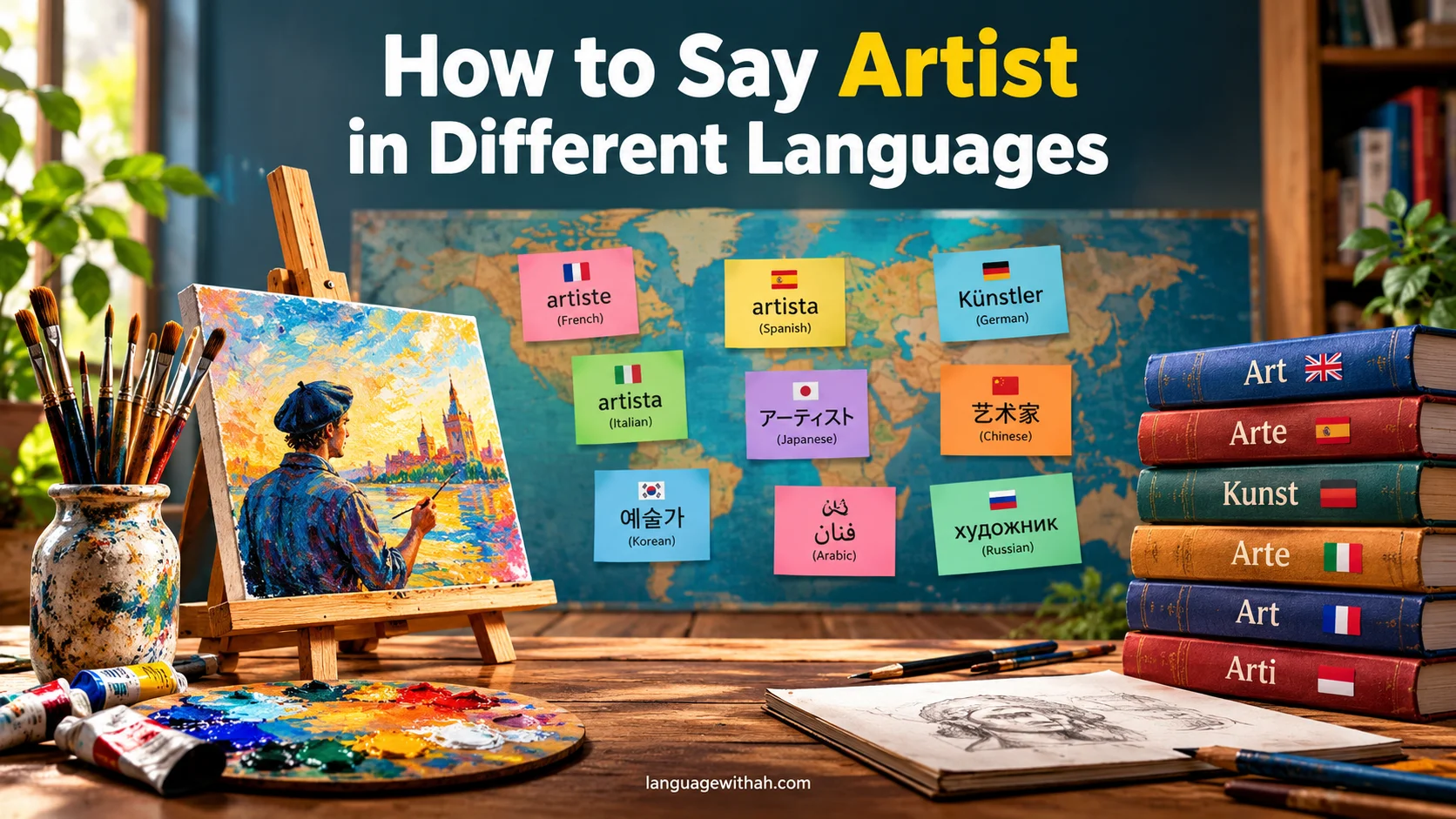
An artist is someone who uses creativity, imagination, and skill to express ideas or emotions through painting, drawing, music, sculpture, photography, dance, writing, or other forms of art. The word artist can describe a professional creator, a talented performer, or anyone who makes something expressive and meaningful. Learning how to say artist in 70 different languages helps you discover how cultures describe creativity and the people who bring artistic ideas to life.
Although many languages have a word for an artist, the most natural translation depends on the kind of work someone does. A painter may be described differently from a musician, actor, or sculptor. Some languages also distinguish between a fine artist and a performing artist, while others use a broader word that covers several creative professions.
These distinctions are useful when learning vocabulary, traveling, studying foreign languages, talking with international artists, or writing a message for a creative friend. This guide explores translations, pronunciations, example sentences, and regional differences across languages from Europe, Asia, Africa, the Middle East, and other parts of the world. Context matters: gender, grammatical structure, dialect, and professional usage can all influence which expression sounds most natural.
Interesting Facts About Artist
- Artist has a broad meaning: The word can refer to painters, illustrators, sculptors, musicians, actors, photographers, and other creative professionals.
- Some languages distinguish artistic roles: A language may use separate words for a visual artist, a performer, and a craftsperson.
- Grammatical gender can matter: French, Spanish, Italian, and several other languages may change the form of a word depending on the person’s gender.
- Not every language uses the same word structure: Some use a single noun, while others use a descriptive expression meaning someone who creates art.
- Pronunciation can be surprising: Words that look similar across languages may have different sounds, stress patterns, or endings.
- Writing systems add another learning dimension: Chinese, Japanese, Korean, Arabic, and other languages may use scripts that require romanization for English-speaking learners.
- Artistic identity is context-dependent: Someone called an artist in a gallery may be described more specifically as a singer, actor, or designer in another setting.
What Does Artist Mean?
An artist is a person who creates, interprets, or performs work using creative skill and imagination. The term commonly refers to someone who makes visual art, such as paintings, drawings, illustrations, and sculptures, but it also applies to musicians, dancers, actors, photographers, and other creative professionals.
The meaning depends on context. In a museum, artist often refers to the person who created a painting or sculpture. In the music industry, it can mean a singer, instrumentalist, or recording performer. In everyday conversation, it can also describe someone with an exceptional creative ability.
For example:
- Visual artist: A person who creates paintings, drawings, or sculptures.
- Performing artist: Someone who expresses ideas through music, dance, or acting.
- Digital artist: A creator who produces artwork using digital tools.
- Creative artist: A broad description of someone who makes original artistic work.
When translating artist, it is important to preserve the intended meaning rather than assume that every language uses the same word for every artistic profession.
Why Can Artist Have Different Translations?
The English word artist does not have one identical equivalent in every language. Translations can change according to several factors:
- Art form: A painter, musician, actor, and craftsperson may have different professional titles.
- Gender: Some languages use different noun forms for men and women, while others use one form for everyone.
- Formality: A formal professional description may differ from an everyday expression.
- Regional usage: Speakers in different countries may prefer different words for particular creative professions.
- Cultural context: The boundaries between fine art, performance, design, and traditional crafts are not identical everywhere.
- Literal versus natural translation: A dictionary equivalent may be understandable but less natural in a particular sentence.
- Written versus spoken language: A professional biography may use a more specific title than casual conversation.
For this article, the translations generally refer to a person who creates art or works as an artist. Where a language commonly distinguishes visual art from performing art, the relevant qualification is noted.
European Languages
European languages belong to several language families, including Romance, Germanic, Slavic, and Uralic. Their words for artist reflect different grammatical traditions and professional distinctions. The translations below generally describe a person who creates art, with more specific words used when the context calls for them.
| 🌍 Language | Country/Region | Translation | Pronunciation | Example Sentence |
| English | International | Artist | AR-tist | She is an artist. |
| American English 🇺🇸 | United States | Artist | AR-tist | She is a talented artist. |
| British English 🇬🇧 | United Kingdom | Artist | AH-tist | He is a local artist. |
| Australian English 🇦🇺 | Australia | Artist | AH-tist | My friend is an artist. |
| Spanish | Spain, Latin America | Artista | ar-TEES-ta | Mi hermana es artista. — My sister is an artist. |
| French | France, Belgium, Canada | Artiste | ar-TEEST | C’est une artiste. — This is an artist. |
| German | Germany, Austria | Künstler / Künstlerin | KOONST-ler / KOONST-le-rin | Sie ist eine Künstlerin. — She is an artist. |
| Italian | Italy, Switzerland | Artista | ar-TEES-ta | Lei è un’artista. — She is an artist. |
| Portuguese | Portugal, Brazil | Artista | ar-TEESH-ta (Brazilian approximation) | Ela é uma artista. — She is an artist. |
| Dutch | Netherlands, Belgium | Kunstenaar / kunstenares | KOON-stuh-naar / KOON-stuh-na-res | Zij is een kunstenaar. — She is an artist. |
| Swedish | Sweden, Finland | Konstnär | KONST-nair | Hon är konstnär. — She is an artist. |
| Norwegian | Norway | Kunstner | KOONST-ner | Hun er kunstner. — She is an artist. |
| Danish | Denmark | Kunstner | KOONST-ner | Hun er kunstner. — She is an artist. |
| Finnish | Finland | Taiteilija | TIE-tey-lee-ya | Hän on taiteilija. — They are an artist. |
| Icelandic | Iceland | Listamaður / listakona | LIS-ta-ma-thur / LIS-ta-ko-na | Hún er listakona. — She is an artist. |
| Irish | Ireland | Ealaíontóir | al-EE-un-tohr | Is ealaíontóir í. — They are an artist. |
| Welsh | Wales | Artist | AR-tist | Mae hi’n artist. — She is an artist. |
| Polish | Poland | Artysta / artystka | ar-TIS-ta / ar-TIS-tka | Ona jest artystką. — She is an artist. |
| Czech | Czechia | Umělec / umělkyně | OO-myeh-lets / OO-myel-kee-nyeh | Je to umělkyně. — She is an artist. |
| Slovak | Slovakia | Umelec / umelkyňa | OO-meh-lets / OO-mel-kee-nya | Je to umelkyňa. — She is an artist. |
| Ukrainian | Ukraine | Митець / мисткиня | my-TETS / mys-TKYN-ya | Вона мисткиня. — She is an artist. |
| Russian | Russia, other Russian-speaking communities | Художник / художница | khu-DOZH-nik / khu-DOZH-ni-tsa | Она художница. — She is an artist. |
| Romanian | Romania, Moldova | Artist / artistă | ar-TEEST / ar-TEES-tuh | Ea este artistă. — She is an artist. |
| Hungarian | Hungary | Művész | MOO-vays | Ő művész. — They are an artist. |
| Greek | Greece, Cyprus | Καλλιτέχνης / καλλιτέχνιδα | ka-lee-TEKH-nees / ka-lee-TEKH-nee-tha | Είναι καλλιτέχνιδα. — She is an artist. |
| Bulgarian | Bulgaria | Художник / художничка | khu-DOZH-nik / khu-DOZH-nich-ka | Тя е художничка. — She is an artist. |
| Croatian | Croatia | Umjetnik / umjetnica | oom-YET-nik / oom-YET-nee-tsa | Ona je umjetnica. — She is an artist. |
| Serbian | Serbia, Balkans | Уметник / уметница | oo-MET-nik / oo-MET-nee-tsa | Она је уметница. — She is an artist. |
| Slovenian | Slovenia | Umetnik / umetnica | oo-MET-nik / oo-MET-nee-tsa | Ona je umetnica. — She is an artist. |
| Lithuanian | Lithuania | Menininkas / menininkė | meh-nee-NINK-as / meh-nee-NIN-keh | Ji yra menininkė. — She is an artist. |
| Latvian | Latvia | Mākslinieks / māksliniece | MAHKS-lee-neeks / MAHKS-lee-nee-e-tseh | Viņa ir māksliniece. — She is an artist. |
| Estonian | Estonia | Kunstnik | KOONST-nik | Ta on kunstnik. — They are an artist. |
European language note: Several languages use gendered forms, such as German Künstler/Künstlerin and Polish artysta/artystka. In Russian, художник is especially associated with a visual artist or painter; a musician or actor may have a different professional title. English varieties use the same spelling, artist, although pronunciation differs slightly by accent.
Read More: How to Say Army in Different Languages
Asian Languages
Asia has a wide variety of languages, scripts, and grammatical systems. Some translations of artist are broad terms for creative people, while others more strongly suggest visual art or performance. Romanizations are approximate learning aids; tones and unfamiliar sounds may require additional listening practice.
| 🌍 Language | Country/Region | Translation | Pronunciation | Example Sentence |
| Mandarin Chinese | China, Taiwan, Singapore | 艺术家 (艺术家) | yì-shù-jiā | 她是一位艺术家。 — She is an artist. |
| Cantonese | Hong Kong, Guangdong | 藝術家 | ngai⁶ seot⁶ gaa¹ | 佢係一位藝術家。 — They are an artist. |
| Japanese | Japan | 芸術家 | gei-jutsu-ka | 彼女は芸術家です。 — She is an artist. |
| Korean | South Korea, North Korea | 예술가 | ye-sul-ga | 그녀는 예술가입니다. — She is an artist. |
| Hindi | India | कलाकार | ka-laa-kaar | वह एक कलाकार है। — They are an artist. |
| Urdu | Pakistan, India | فنکار | fun-kaar | وہ ایک فنکار ہے۔ — They are an artist. |
| Bengali | Bangladesh, India | শিল্পী | shil-pee | তিনি একজন শিল্পী। — They are an artist. |
| Punjabi | Pakistan, India | ਕਲਾਕਾਰ / ਕਲਾਕਾਰ (Gurmukhi); کلاکار (Shahmukhi variant) | ka-laa-kaar | ਉਹ ਇੱਕ ਕਲਾਕਾਰ ਹੈ। — They are an artist. |
| Gujarati | India | કલાકાર | ka-laa-kaar | તે એક કલાકાર છે. — They are an artist. |
| Marathi | India | कलाकार | ka-laa-kaar | ती एक कलाकार आहे. — She is an artist. |
| Tamil | India, Sri Lanka, Singapore | கலைஞர் | ka-lai-nyar | அவர் ஒரு கலைஞர். — They are an artist. |
| Telugu | India | కళాకారుడు / కళాకారిణి | ka-laa-kaa-ru-du / ka-laa-kaa-ri-ni | ఆమె కళాకారిణి. — She is an artist. |
| Kannada | India | ಕಲಾವಿದ / ಕಲಾವಿದೆ | ka-laa-vi-da / ka-laa-vi-de | ಅವಳು ಕಲಾವಿದೆ. — She is an artist. |
| Malayalam | India | കലാകാരൻ / കലാകാരി | ka-laa-kaa-ran / ka-laa-kaa-ri | അവൾ കലാകാരിയാണ്. — She is an artist. |
| Nepali | Nepal | कलाकार | ka-laa-kaar | उहाँ कलाकार हुनुहुन्छ। — They are an artist. |
| Sinhala | Sri Lanka | කලාකරුවා / කලාකාරිය | ka-laa-ka-ru-waa / ka-laa-kaa-ri-ya | ඇය කලාකාරියකි. — She is an artist. |
| Thai | Thailand | ศิลปิน | sin-la-pin | เธอเป็นศิลปิน — She is an artist. |
| Vietnamese | Vietnam | Nghệ sĩ | ngeh see | Cô ấy là nghệ sĩ. — She is an artist. |
| Indonesian | Indonesia | Seniman | suh-nee-man | Dia seorang seniman. — They are an artist. |
| Malay | Malaysia, Brunei, Singapore | Seniman / artis | suh-nee-man / ar-tees | Dia seorang seniman. — They are an artist. |
| Filipino (Tagalog) | Philippines | Alagad ng sining / artista | a-la-gad ng see-ning / ar-tees-ta | Isa siyang alagad ng sining. — They are an artist. |
| Burmese | Myanmar | အနုပညာရှင် | a-nu-pyin-yin | သူသည် အနုပညာရှင်ဖြစ်သည်။ — They are an artist. |
| Khmer | Cambodia | សិល្បករ | sel-ba-ka | គាត់ជាសិល្បករ។ — They are an artist. |
| Lao | Laos | ສິນລະປິນ | sin-la-pin | ລາວເປັນສິນລະປິນ. — They are an artist. |
| Mongolian | Mongolia | Уран бүтээлч | oo-ran bu-teelch | Тэр уран бүтээлч. — They are an artist. |
| Kazakh | Kazakhstan | Өнерпаз / суретші | ö-ner-paz / su-ret-shi | Ол суретші. — They are a visual artist. |
| Uzbek | Uzbekistan | San’atkor / rassom | san-at-kor / ras-som | U rassom. — They are a visual artist. |
Asian language note: In Chinese, 艺术家 is a broad term for an artist, while 画家 specifically means a painter. Japanese 芸術家 is a general artistic term; 画家 is used for a painter. In Urdu and Hindi, فنکار / कलाकार can refer to a range of creative or performing professions, so a more specific word may be better when describing a painter or musician.
African Languages
Africa is home to hundreds of languages and many distinct artistic traditions. Words for an artist can describe visual creators, performers, or people engaged in creative work. The following examples use representative languages from different parts of the continent.
| 🌍 Language | Country/Region | Translation | Pronunciation | Example Sentence |
| Swahili | Tanzania, Kenya, East Africa | Msanii | m-sa-NEE-ee | Yeye ni msanii. — They are an artist. |
| Afrikaans | South Africa, Namibia | Kunstenaar | KOON-stuh-naar | Sy is ‘n kunstenaar. — She is an artist. |
| Zulu | South Africa | Umculi / umdwebi | oom-GOO-lee / oom-DWEH-bee | Ungumdwebi. — They are an artist who draws or paints. |
| Xhosa | South Africa | Umzobi | oom-ZOH-bee | Ungumzobi. — They are an artist who draws or paints. |
| Amharic | Ethiopia | አርቲስት | ar-TEEST | እሷ አርቲስት ናት። — She is an artist. |
| Yoruba | Nigeria, Benin | Oníṣẹ́ ọnà | oh-nee-sheh oh-na | Ó jẹ́ oníṣẹ́ ọnà. — They are an artist. |
| Igbo | Nigeria | Ọ̀kachá | aw-ka-cha (approximate) | Ọ bụ onye na-ese ihe. — They are someone who creates or draws art. |
| Hausa | Nigeria, Niger, West Africa | Mai fasaha | mai fa-SA-ha | Shi mai fasaha ne. — He is a creative artist. |
| Somali | Somalia, Horn of Africa | Farshaxanle | far-sha-khan-leh | Waa farshaxanle. — They are an artist. |
| Shona | Zimbabwe | Nyanzvi yemifananidzo | nyan-zvee yeh-mee-fa-na-nee-dzo | Iye inyanzvi yemifananidzo. — They are a visual artist. |
| Sesotho | Lesotho, South Africa | Moetsi oa bonono | moh-ET-see wa boh-NOH-noh | Ke moetsi oa bonono. — I am an artist. |
| Malagasy | Madagascar | Mpanakanto | m-pa-na-KAN-too | Mpanakanto izy. — They are an artist. |
African language note: In Swahili, msanii is a broad term for an artist or creative performer. Zulu umdwebi and Xhosa umzobi are more closely associated with drawing, painting, or visual art. These distinctions matter when describing a specific profession.
Middle Eastern Languages
The Middle East includes Arabic, Persian, Hebrew, Kurdish, Turkish, and other language traditions. Some words for artist refer broadly to creative professionals, while others are more closely associated with painting or visual art. Arabic also varies by dialect, so the example below uses Modern Standard Arabic.
| 🌍 Language | Country/Region | Translation | Pronunciation | Example Sentence |
| Arabic (Modern Standard Arabic) | Middle East, North Africa | فنان / فنانة | fan-NAAN / fan-NAA-na | هي فنانة. — She is an artist. |
| Persian (Farsi) | Iran, Persian-speaking communities | هنرمند | hon-ar-MAND | او هنرمند است. — They are an artist. |
| Hebrew | Israel | אמן / אמנית | a-MAN / a-ma-NEET | היא אמנית. — She is an artist. |
| Kurdish (Kurmanji) | Türkiye, Iraq, Syria, Iran | Hunermend | hu-ner-MEND | Ew hunermend e. — They are an artist. |
| Turkish | Türkiye, Cyprus | Sanatçı | sa-nat-CHUH | O bir sanatçı. — They are an artist. |
| Armenian | Armenia, Armenian-speaking communities | Արվեստագետ | ar-ves-ta-GET | Նա արվեստագետ է։ — They are an artist. |
Middle Eastern language note: Arabic فنان is a masculine form and فنانة is a feminine form. Persian هنرمند is a broad term for an artist, literally connected with artistic skill. In Turkish, sanatçı can refer to a range of artists and performers, while ressam specifically means painter.
Other World Languages
The following languages add examples from Oceania, the Americas, and international constructed-language communities.
| 🌍 Language | Country/Region | Translation | Pronunciation | Example Sentence |
| Māori | New Zealand | Kaitoi | kai-TOI | He kaitoi ia. — They are an artist. |
| Samoan | Samoa, Pacific communities | Tufuga | too-FOO-nga | O ia o se tufuga. — They are a skilled creator or artisan. |
| Haitian Creole | Haiti | Atis | a-TEES | Li se yon atis. — They are an artist. |
| Esperanto | International | Artisto | ar-TEES-to | Ŝi estas artisto. — She is an artist. |
| Latin | Historical and academic use | Artifex | AR-ti-feks | Artifex est. — They are an artist or craftsperson. |
Note: Some words in this section have a broader or more specialized meaning than the English word artist. For example, Samoan tufuga can refer to a skilled practitioner or traditional craft specialist, depending on context. Latin artifex can describe a maker or skilled craftsperson, rather than only a modern fine artist.
Quick Reference: Artist in Different Languages
Use this table to look up the main translations quickly. Where a language has distinct masculine and feminine forms, both are shown when useful. Some entries are broad artistic terms, while others are more specific to visual art.
| Language | Translation |
| English | Artist |
| American English | Artist |
| British English | Artist |
| Australian English | Artist |
| Spanish | Artista |
| French | Artiste |
| German | Künstler / Künstlerin |
| Italian | Artista |
| Portuguese | Artista |
| Dutch | Kunstenaar |
| Swedish | Konstnär |
| Norwegian | Kunstner |
| Danish | Kunstner |
| Finnish | Taiteilija |
| Icelandic | Listamaður / listakona |
| Irish | Ealaíontóir |
| Welsh | Artist |
| Polish | Artysta / artystka |
| Czech | Umělec / umělkyně |
| Slovak | Umelec / umelkyňa |
| Ukrainian | Митець / мисткиня |
| Russian | Художник / художница |
| Romanian | Artist / artistă |
| Hungarian | Művész |
| Greek | Καλλιτέχνης / καλλιτέχνιδα |
| Bulgarian | Художник / художничка |
| Croatian | Umjetnik / umjetnica |
| Serbian | Уметник / уметница |
| Slovenian | Umetnik / umetnica |
| Lithuanian | Menininkas / menininkė |
| Latvian | Mākslinieks / māksliniece |
| Estonian | Kunstnik |
| Mandarin Chinese | 艺术家 |
| Cantonese | 藝術家 |
| Japanese | 芸術家 |
| Korean | 예술가 |
| Hindi | कलाकार |
| Urdu | فنکار |
| Bengali | শিল্পী |
| Punjabi | ਕਲਾਕਾਰ / کلاکار |
| Gujarati | કલાકાર |
| Marathi | कलाकार |
| Tamil | கலைஞர் |
| Telugu | కళాకారుడు / కళాకారిణి |
| Kannada | ಕಲಾವಿದ / ಕಲಾವಿದೆ |
| Malayalam | കലാകാരൻ / കലാകാരി |
| Nepali | कलाकार |
| Sinhala | කලාකරුවා / කලාකාරිය |
| Thai | ศิลปิน |
| Vietnamese | Nghệ sĩ |
| Indonesian | Seniman |
| Malay | Seniman / artis |
| Filipino (Tagalog) | Alagad ng sining / artista |
| Burmese | အနုပညာရှင် |
| Khmer | សិល្បករ |
| Lao | ສິນລະປິນ |
| Mongolian | Уран бүтээлч |
| Kazakh | Өнерпаз / суретші |
| Uzbek | San’atkor / rassom |
| Swahili | Msanii |
| Afrikaans | Kunstenaar |
| Zulu | Umculi / umdwebi |
| Xhosa | Umzobi |
| Amharic | አርቲስት |
| Yoruba | Oníṣẹ́ ọnà |
| Igbo | Ọ̀kachá / onye na-ese ihe |
| Hausa | Mai fasaha |
| Somali | Farshaxanle |
| Shona | Nyanzvi yemifananidzo |
| Sesotho | Moetsi oa bonono |
| Malagasy | Mpanakanto |
| Arabic | فنان / فنانة |
| Persian | هنرمند |
| Hebrew | אמן / אמנית |
| Kurdish (Kurmanji) | Hunermend |
| Turkish | Sanatçı |
| Armenian | Արվեստագետ |
| Māori | Kaitoi |
| Samoan | Tufuga |
| Haitian Creole | Atis |
| Esperanto | Artisto |
| Latin | Artifex |
How to Choose the Right Translation
The best translation of artist depends on the person’s creative work, the audience, and the language being used.
- Consider the art form. If you mean a painter, a word specifically meaning “painter” may be more accurate than a general term for artist.
- Check grammatical gender. German, French, Spanish, and other languages may require different forms or articles depending on the sentence.
- Think about the audience. A professional biography may call someone a visual artist, while a casual conversation may use a broader term.
- Check regional usage. Portuguese in Brazil and Portugal, for example, can differ in pronunciation and certain expressions even when the written word is the same.
- Learn the pronunciation. Use romanization as a starting point, then listen to recordings from speakers of the relevant language.
- Use a complete sentence. Learning how to say “She is an artist” can teach you more about grammar and natural usage than memorizing a noun alone.
For a formal publication, professional profile, tattoo, or permanent design, verify the exact wording with a qualified language professional.
Common Mistakes When Translating Artist
Translating artist seems straightforward, but several common mistakes can change the intended meaning.
- Using a word-for-word translation. A word that literally resembles artist may have a narrower meaning or refer mainly to a performer.
- Ignoring the type of art. A painter, musician, actor, and sculptor may need different professional terms.
- Overlooking grammatical gender. Some languages change the noun or surrounding words depending on the person being described.
- Mixing regional forms. Combining vocabulary from different dialects can make a sentence sound inconsistent.
- Mispronouncing unfamiliar sounds. Romanized spellings are approximate, particularly for tonal languages and sounds absent from English.
- Assuming similar words mean exactly the same thing. Related-looking words can differ in usage, emphasis, and professional connotation.
- Treating one translation as universal. A broad term for creative work may not be the right choice for a specialist such as a painter or illustrator.
The key lesson: Translate the intended profession, not just the English word.
Why Learn Artist in Different Languages?
Learning how to say artist in different languages can make communication more meaningful in creative, educational, and professional settings.
- Communicate internationally: Introduce artists and discuss creative work with people from other countries.
- Improve vocabulary: Learn words connected with painting, sculpture, design, photography, and performance.
- Travel with confidence: Recognize useful terms when visiting museums, galleries, and cultural centers.
- Understand cultural expression: Explore how languages categorize artistic work and creative professions.
- Personalize your writing: Use appropriate terms when writing messages, captions, biographies, or introductions for artists.
- Build cross-cultural understanding: Appreciate that different languages may classify creative work in different ways.
You can also practice with simple sentences such as “I am an artist,” “She is a talented artist,” and “The artist created a painting.” These examples help you learn grammar and vocabulary together.
FAQs:
How do you say artist in different languages?
The word artist has different translations around the world. Examples include artista in Spanish, artiste in French, Künstler in German, فنکار in Urdu, कलाकार in Hindi, 艺术家 in Mandarin Chinese, and 芸術家 in Japanese. The most suitable word depends on the type of artistic work.
What is the most natural translation of artist?
There is no single translation that works best in every language and situation. For example, Spanish artista is a broad term, while German Künstler and Künstlerin distinguish masculine and feminine forms. The right choice depends on context and grammar.
Can the translation of artist change by country?
Yes. Countries that share a language may differ in pronunciation, vocabulary, and professional terminology. Portuguese-speaking regions, for example, share the word artista but have some pronunciation differences. Regional context can also affect which specialized artistic term is preferred.
Why do some languages have multiple translations for artist?
Some languages distinguish between visual artists, musicians, actors, craftspeople, and other creative professionals. A broad word may cover all these occupations, while a specialized word identifies one particular type of artist.
Does pronunciation change between regions?
Yes. Accents, stress patterns, and local pronunciation can differ between regions. English is a clear example: American and British speakers pronounce artist somewhat differently, although the spelling and basic meaning remain the same.
Conclusion:
Learning how to say artist in 70 different languages offers more than a list of vocabulary words. It introduces you to the different ways languages describe creativity, artistic skill, and the people who bring ideas to life. From artista in Spanish to 艺术家 in Chinese and msanii in Swahili, each expression provides a useful starting point for exploring another language.
Remember that context is essential. Some translations cover many kinds of creative work, while others refer more specifically to painting, performance, or traditional craftsmanship. Grammatical gender, regional variation, and pronunciation can also influence which word fits a particular situation.