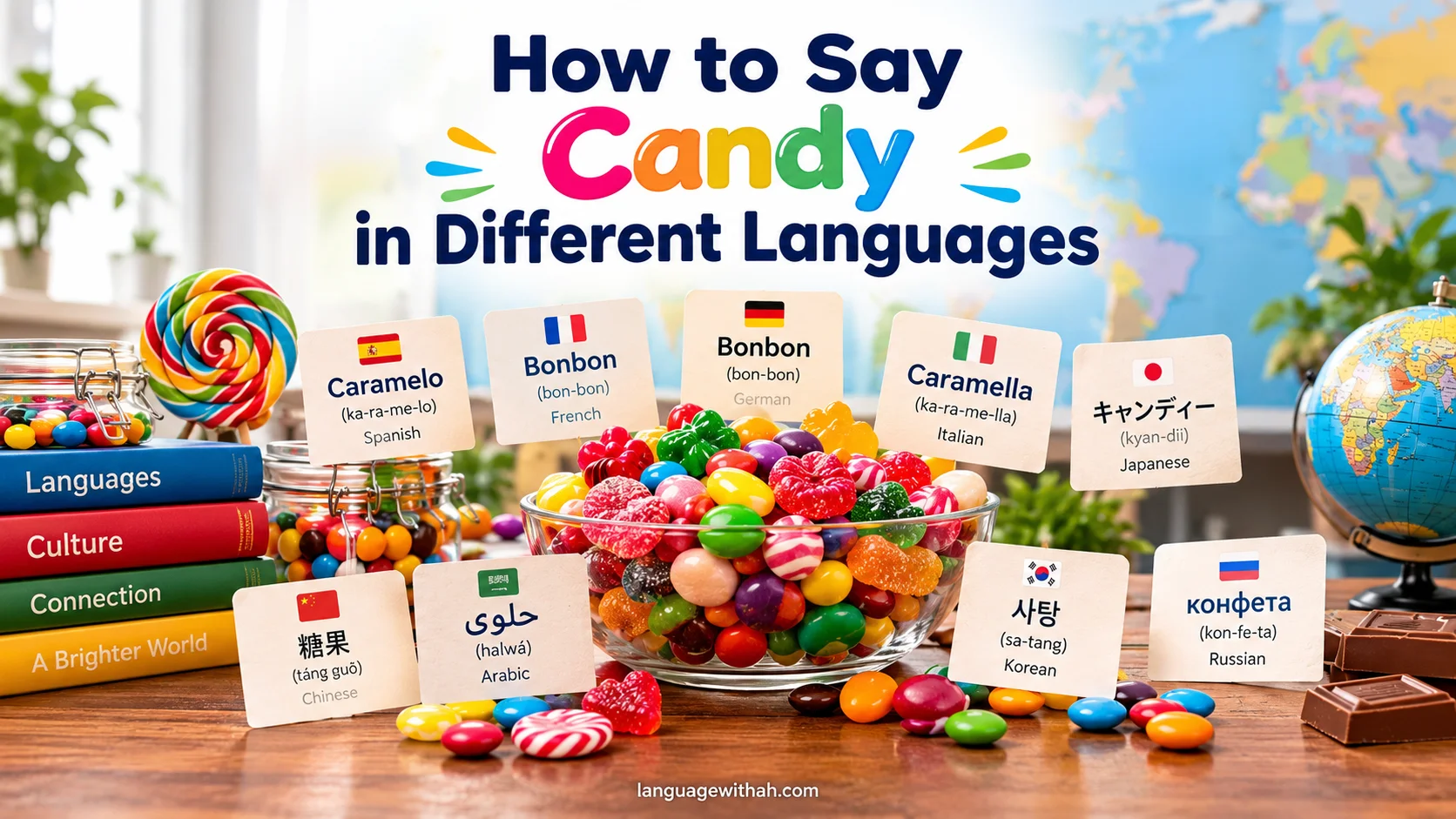
Candy is a sweet treat enjoyed in countless forms, from colorful hard sweets and chewy gummies to chocolate-coated bites and fruit-flavored confections. Learning how to say candy in 70 different languages is a fun way to explore vocabulary, discover cultural differences, and communicate with people around the world. Although English speakers often use the word candy, other languages may distinguish between sweets, sugar-based treats, confectionery, and specific types of sugary snacks.
The right translation depends partly on what you mean. For example, American English commonly uses candy, while British English generally uses sweets. Other languages have their own everyday terms, and some use different words for chocolate, hard candy, or traditional confections. These differences make multilingual vocabulary especially interesting for travelers, families, students, and anyone learning a foreign language.
In this guide, you will discover translations, pronunciation guides, example sentences, regional differences, and useful cultural notes across European, Asian, African, Middle Eastern, and other world languages. The examples focus on ordinary candy and sweet confectionery rather than desserts in general. Because words can vary by region and context, the tables distinguish between common equivalents and expressions that refer to a narrower type of sweet.
Interesting Facts About Candy
- Candy and sweets are regional terms. American English typically uses candy, while British English, Irish English, and Australian English commonly use sweets for many small sugary treats.
- Some languages have broader words for confectionery. A translation may cover several kinds of sweet treats rather than matching the English word candy exactly.
- Chocolate and candy are not always interchangeable. Many languages have a specific word for chocolate, while a general term for sweets may include chocolate products, boiled sweets, and gummies.
- Traditional sweets reflect local ingredients. Honey, fruit, nuts, sesame, rice, and sugar appear in different confectionery traditions around the world.
- Writing systems influence pronunciation guides. Languages such as Japanese, Mandarin Chinese, Korean, Arabic, and Hindi use writing systems that may require romanization to help English readers pronounce a word.
- A familiar word can have regional alternatives. Spanish, Arabic, Chinese, and other widely spoken languages contain regional vocabulary differences, so a word used in one community may not be the usual choice elsewhere.
- The shape of a sweet can affect its name. Some languages distinguish between a wrapped hard sweet, a lollipop, a caramel, and a general confection instead of grouping them under one everyday term.
What Does Candy Mean?
Candy means a sweet food made primarily with sugar or another sweetener, often combined with flavorings, fruit, chocolate, nuts, or other ingredients. Common examples include hard candy, gummies, lollipops, caramels, jelly sweets, and sugar-coated treats.
In American English, candy is a broad everyday word for many such products. The word can refer to a single piece, a packet of sweets, or candy in general. In other English varieties, sweets or confectionery may be more natural.
The word does not mean exactly the same thing as dessert. Dessert can include cakes, puddings, ice cream, and other foods served after a meal, whereas candy usually refers to a particular category of sweet confectionery.
For example:
- “I bought some candy for the children.”
- “Would you like a piece of candy?”
- “This shop sells traditional sweets.”
The appropriate translation depends on whether you mean candy generally, a particular sweet, or a culturally specific confection.
Why Can Candy Have Different Translations?
The word candy does not have one universal equivalent because languages organize food vocabulary differently.
- Context: A general term for candy may differ from the word for a hard sweet or a chocolate bar.
- Regional usage: Speakers in different countries may use distinct everyday words for similar products.
- Formality: A casual word used in conversation may differ from a broader term used on packaging or in a food shop.
- Cultural traditions: Some communities have familiar names for traditional confections that do not translate neatly into English.
- Literal versus natural translation: A dictionary equivalent may be understandable but not the expression someone would ordinarily use when asking for sweets.
- Grammar and sentence structure: The word may change with number, grammatical gender, case, or the surrounding sentence.
- Pronunciation and writing: The same concept may be represented in Latin letters, another alphabet, or a character-based writing system.
For this article, the translations below use the closest practical everyday equivalent for candy or sweet confectionery. Where a word has a narrower meaning or a regional limitation, a note explains the distinction. Pronunciation guides are simplified aids for English readers, not substitutes for hearing the language spoken.
European Languages
European languages belong to several different language families, including Germanic, Romance, Slavic, and Uralic languages. Although many share vocabulary through historical contact, their everyday words for candy and sweets can differ considerably. The translations below focus on familiar confectionery rather than desserts as a whole.
English varieties
| 🌍 Language | Country/Region | Translation | Pronunciation | Example Sentence |
| English (American) 🇺🇸 | United States | Candy | KAN-dee | I bought some candy. — I bought some candy. |
| English (British) 🇬🇧 | United Kingdom | Sweets | SWEETS | I bought some sweets. — I bought some sweets. |
| English (Australian) 🇦🇺 | Australia | Lollies / sweets | LOL-eez / SWEETS | The kids love lollies. — The children love candy. |
Regional note: American candy and British sweets are broadly comparable, but lollies in Australia often refers to candy generally, not just lollipops. Usage varies by speaker and context.
European translations
| 🌍 Language | Country/Region | Translation | Pronunciation | Example Sentence |
| Spanish 🇪🇸 | Spain; Latin America | Dulces / caramelos | Dool-sess / kah-rah-MEH-lohs | Me gustan los dulces. — I like candy. |
| French 🇫🇷 | France; other French-speaking regions | Bonbons | bohn-BOHN | J’aime les bonbons. — I like candy. |
| German 🇩🇪 | Germany; Austria; parts of Switzerland | Süßigkeiten | ZOOS-ikh-khy-ten | Ich mag Süßigkeiten. — I like candy. |
| Italian 🇮🇹 | Italy | Caramelle | kah-rah-MEL-leh | Mi piacciono le caramelle. — I like candy. |
| Portuguese 🇵🇹 | Portugal; Brazil | Doces | DOH-siz (Brazilian approximation) | Eu gosto de doces. — I like sweets. |
| Dutch 🇳🇱 | Netherlands; Belgium | Snoep / snoepjes | SNOOP / SNOOP-yuhs | Ik hou van snoep. — I like candy. |
| Swedish 🇸🇪 | Sweden | Godis | GOH-dees | Jag gillar godis. — I like candy. |
| Norwegian 🇳🇴 | Norway | Godteri | goo-TEH-ree | Jeg liker godteri. — I like candy. |
| Danish 🇩🇰 | Denmark | Slik | SLEEK | Jeg kan godt lide slik. — I like candy. |
| Finnish 🇫🇮 | Finland | Karkki / makeiset | KAR-kkee / MAH-keh-ee-set | Tykkään karkeista. — I like candy. |
| Icelandic 🇮🇸 | Iceland | Sælgæti | SAI-lai-tih | Mér finnst sælgæti gott. — I like candy. |
| Irish 🇮🇪 | Ireland | Milseáin | MIL-shawn (approximate) | Is maith liom milseáin. — I like sweets. |
| Welsh 🏴 | Wales | Melysion | meh-LUHSH-yon | Dw i’n hoffi melysion. — I like sweets. |
| Polish 🇵🇱 | Poland | Cukierki | tsoo-KYER-kee | Lubię cukierki. — I like candy. |
| Czech 🇨🇿 | Czechia | Bonbóny / sladkosti | bom-BOH-nee / SLAHD-kos-tee | Mám rád bonbóny. — I like candy. |
| Slovak 🇸🇰 | Slovakia | Cukríky | tsoo-KREE-kee | Mám rád cukríky. — I like candy. |
| Ukrainian 🇺🇦 | Ukraine | Цукерки (tsukerky) | tsoo-KER-kee | Я люблю цукерки. — I like candy. |
| Russian 🇷🇺 | Russia; other Russian-speaking communities | Конфеты (konfety) | kahm-FYEH-ty | Я люблю конфеты. — I like candy. |
| Romanian 🇷🇴 | Romania; Moldova | Bomboane | bom-BOAH-neh | Îmi plac bomboanele. — I like candy. |
| Hungarian 🇭🇺 | Hungary | Cukorka | TSOO-kor-kaw | Szeretem a cukorkát. — I like candy. |
| Greek 🇬🇷 | Greece; Cyprus | Καραμέλες (karaméles) | kah-rah-MEH-les | Μου αρέσουν οι καραμέλες. — I like candy. |
| Bulgarian 🇧🇬 | Bulgaria | Бонбони (bonboni) | bom-BOH-nee | Обичам бонбони. — I like candy. |
| Croatian 🇭🇷 | Croatia | Bomboni | bom-BOH-nee | Volim bombone. — I like candy. |
| Serbian 🇷🇸 | Serbia; neighboring Serbian-speaking communities | Бомбоне (bombone) | bom-BOH-neh | Волим бомбоне. — I like candy. |
| Slovenian 🇸🇮 | Slovenia | Bonboni | bom-BOH-nee | Rad imam bonbone. — I like candy. |
| Lithuanian 🇱🇹 | Lithuania | Saldainiai | sal-DYE-ny | Aš mėgstu saldainius. — I like candy. |
| Latvian 🇱🇻 | Latvia | Konfektes | kon-FEK-tehs | Man garšo konfektes. — I like candy. |
| Estonian 🇪🇪 | Estonia | Kommid | KOM-mid | Mulle meeldivad kommid. — I like candy. |
Cultural and usage notes
- In Spanish, dulces is a broad word for sweets, while caramelos commonly refers to hard or individually wrapped sweets in Spain. Usage varies across Latin America.
- In French, bonbons is the usual everyday term for candy, while confiseries can refer more broadly to confectionery.
- German Süßigkeiten is a broad category; Bonbons usually refers to particular types of sweets.
- Finnish makeiset is a general confectionery term, while karkki is common in informal speech.
- Slavic languages may distinguish between a general category of sweets and individual candy pieces. The terms in the table are practical everyday equivalents rather than exact matches in every situation.
Read More: How to Say Cool in Different Languages
Asian Languages
Asia includes languages with very different grammatical structures and writing systems. Some use characters, some use alphabets, and others use scripts based on syllables or abugidas. The following translations represent commonly understood words for candy, sweets, or confectionery in the specified language.
| 🌍 Language | Country/Region | Translation | Pronunciation | Example Sentence |
| Mandarin Chinese 🇨🇳 | China; Mandarin-speaking communities | 糖果 (tángguǒ) | tahng-gwaw, with tones | 我喜欢糖果。— I like candy. |
| Cantonese 🇭🇰 | Hong Kong; Guangdong | 糖果 (tòng gwó) | tong-gwoh, approximate Cantonese tones | 我鍾意食糖果。— I like eating candy. |
| Japanese 🇯🇵 | Japan | キャンディー (kyandī) / 飴 (ame) | kyahn-DEE / AH-meh | 私は飴が好きです。— I like candy. |
| Korean 🇰🇷 | South Korea; Korean-speaking communities | 사탕 (satang) | sah-tahng | 저는 사탕을 좋아해요. — I like candy. |
| Hindi 🇮🇳 | India | टॉफ़ी (ṭॉfī; toffee) / मिठाई (mithāī) | TOH-fee / mith-AH-ee | मुझे टॉफ़ी पसंद है। — I like toffee. |
| Urdu 🇵🇰 | Pakistan; Urdu-speaking communities | ٹافی (ṭāfī) / مٹھائی (mithāī) | TAA-fee / mith-AH-ee | مجھے ٹافی پسند ہے۔ — I like toffee. |
| Bengali 🇧🇩 | Bangladesh; West Bengal, India | ক্যান্ডি (kyānḍi) / মিষ্টি (mishti) | KAN-dee / MISH-tee | আমি ক্যান্ডি পছন্দ করি। — I like candy. |
| Punjabi 🇮🇳🇵🇰 | Punjab in India and Pakistan | ਟੌਫ਼ੀ (ṭॉफी; toffee) / ٹافی (ṭāfī) | TOH-fee / TAA-fee | ਮੈਨੂੰ ਟੌਫ਼ੀ ਪਸੰਦ ਹੈ। — I like toffee. |
| Gujarati 🇮🇳 | Gujarat, India | ટોફી (ṭophī) | TOH-fee | મને ટોફી ગમે છે. — I like toffee. |
| Marathi 🇮🇳 | Maharashtra, India | गोळी (goḷī, in some candy contexts) / कँडी (candy) | GOH-lee / KAN-dee | मला कँडी आवडते. — I like candy. |
| Tamil 🇮🇳🇱🇰 | Tamil Nadu, India; Sri Lanka | மிட்டாய் (miṭṭāy) | mit-TAAY | எனக்கு மிட்டாய் பிடிக்கும். — I like candy. |
| Telugu 🇮🇳 | Andhra Pradesh; Telangana | మిఠాయి (miṭhāyi) | mith-HAA-yee | నాకు మిఠాయి ఇష్టం. — I like sweets. |
| Kannada 🇮🇳 | Karnataka, India | ಮಿಠಾಯಿ (miṭhāyi) | mith-HAA-yee | ನನಗೆ ಮಿಠಾಯಿ ಇಷ್ಟ. — I like sweets. |
| Malayalam 🇮🇳 | Kerala, India | മിഠായി (miṭṭāyi) | mit-TAAY-ee | എനിക്ക് മിഠായി ഇഷ്ടമാണ്. — I like sweets. |
| Nepali 🇳🇵 | Nepal | मिठाई (miṭhāī) | mith-AA-ee | मलाई मिठाई मन पर्छ। — I like sweets. |
| Sinhala 🇱🇰 | Sri Lanka | ටොෆි (ṭophi) | TOH-fee | මම ටොෆිවලට කැමතියි. — I like toffee. |
| Thai 🇹🇭 | Thailand | ลูกอม (lūk-om) | look-om, with tones | ฉันชอบลูกอม — I like candy. |
| Vietnamese 🇻🇳 | Vietnam | Kẹo | keh-oh, with a rising/creaky tone | Tôi thích kẹo. — I like candy. |
| Indonesian 🇮🇩 | Indonesia | Permen | PER-men | Saya suka permen. — I like candy. |
| Malay 🇲🇾 | Malaysia; Brunei; Singapore | Gula-gula | GOO-lah GOO-lah | Saya suka gula-gula. — I like candy. |
| Filipino/Tagalog 🇵🇭 | Philippines | Kendi / kendi-kendi (usage varies) | KEN-dee | Gusto ko ang kendi. — I like candy. |
| Burmese 🇲🇲 | Myanmar | သကြားလုံး (tha-kyá-lone) | tha-CHAH-lone, approximate | ကျွန်တော် သကြားလုံး ကြိုက်တယ်။ — I like candy. |
| Khmer 🇰🇭 | Cambodia | ស្ករគ្រាប់ (skor kroap) | skor-kroap | ខ្ញុំចូលចិត្តស្ករគ្រាប់។ — I like candy. |
| Lao 🇱🇦 | Laos | ເຂົ້າໜົມ (khao nom, broader sweets/snacks term) | khao-nom | ຂ້ອຍມັກເຂົ້າໜົມ. — I like sweets. |
| Mongolian 🇲🇳 | Mongolia | Чихэр (chikher) | CHEE-kher | Би чихэрт дуртай. — I like candy. |
| Kazakh 🇰🇿 | Kazakhstan | Кәмпит (kämpit) | kam-PEET | Мен кәмпитті жақсы көремін. — I like candy. |
| Uzbek 🇺🇿 | Uzbekistan | Konfet | kon-FET | Men konfetni yaxshi ko‘raman. — I like candy. |
Cultural and usage notes
- Mandarin 糖果 (tángguǒ) is a general term for candy. In Cantonese, pronunciation differs even when the written characters are the same.
- Japanese 飴 (ame) commonly refers to hard candy, while キャンディー (kyandī) is a borrowed word used for candy more broadly in suitable contexts.
- Hindi and Urdu मिठाई / مٹھائی (mithai) often refers to sweets generally, including traditional South Asian confections. For Western-style candy, टॉफ़ी / ٹافی is more specific to toffee.
- In Thai, Vietnamese, Indonesian, and Malay, the words listed are everyday terms for candy or sweet confectionery. They should not automatically be used for every dessert.
- In the Philippines, English candy is also widely understood, while the use of kendi can vary by speaker and setting.
African Languages
Africa is home to a remarkable range of languages, including Niger-Congo, Afroasiatic, and other language families. Words for candy may refer to sugar sweets, imported confectionery, or a wider category of sweet foods. The examples below use practical equivalents and distinguish borrowed vocabulary from broader local terms where helpful.
| 🌍 Language | Country/Region | Translation | Pronunciation | Example Sentence |
| Swahili 🇹🇿 | Tanzania; Kenya; East Africa | Pipi | PEE-pee | Ninapenda pipi. — I like candy. |
| Afrikaans 🇿🇦 | South Africa; Namibia | Lekkergoed | LEK-er-khoot | Ek hou van lekkergoed. — I like candy. |
| Zulu 🇿🇦 | South Africa | Uswidi (borrowed usage) | oo-SWEE-dee | Ngithanda uswidi. — I like candy. |
| Xhosa 🇿🇦 | South Africa | Iilekese | ee-leh-KEH-seh | Ndiyazithanda iilekese. — I like candy. |
| Amharic 🇪🇹 | Ethiopia | ከረሜላ (keremela) | keh-reh-MEH-lah | ከረሜላ እወዳለሁ። — I like candy. |
| Yoruba 🇳🇬 | Nigeria; neighboring communities | Suwiti (borrowed usage) | soo-WEE-tee | Mo fẹ́ suwiti. — I like candy. |
| Igbo 🇳🇬 | Southeastern Nigeria | Swiiti (borrowed usage) | SWEE-tee | A na m enwe mmasị na swiiti. — I like candy. |
| Hausa 🇳🇬🇳🇪 | Nigeria; Niger; West Africa | Alawa (sweets/confectionery, context-dependent) | ah-LAH-wah | Ina son alawa. — I like sweets. |
| Somali 🇸🇴 | Somalia; Horn of Africa | Nacnac | nahk-NAHK | Waxaan jeclahay nacnac. — I like candy. |
| Shona 🇿🇼 | Zimbabwe | Sweets (borrowed English usage) | SWEETS | Ndinoda sweets. — I like sweets. |
| Sesotho 🇱🇸 | Lesotho; South Africa | Lipompong | lee-pom-PONG | Ke rata lipompong. — I like sweets. |
| Setswana 🇧🇼 | Botswana; South Africa | Dimonamone (sweets; usage may vary) | dee-moh-nah-MOH-neh | Ke rata dimonamone. — I like sweets. |
| Kinyarwanda 🇷🇼 | Rwanda | Bombo (borrowed or colloquial usage; varies) | BOM-boh | Nkunda bombo. — I like candy. |
| Malagasy 🇲🇬 | Madagascar | Vatomamy | vah-too-MAH-mee | Tiako ny vatomamy. — I like candy. |
Cultural and usage notes
- In many African communities, borrowed words from English, French, Portuguese, or other contact languages are used alongside local vocabulary. Usage can vary by age, region, and setting.
- Swahili pipi and Somali nacnac are useful everyday terms for candy. In other languages, the most natural expression may depend on whether the speaker means packaged candy or traditional sweets.
- The table includes broad equivalents, not claims that each language has only one word for every type of confectionery.
Middle Eastern Languages
The Middle East includes several distinct language traditions, among them Arabic, Persian, Hebrew, Kurdish, Armenian, and Turkish. The everyday word for candy can vary between countries, dialects, and particular kinds of sweets. Arabic is especially important to distinguish by register because Modern Standard Arabic and spoken dialects do not always use identical vocabulary.
| 🌍 Language | Country/Region | Translation | Pronunciation | Example Sentence |
| Arabic (Modern Standard Arabic) 🇸🇦 | Widely used across the Arab world | حلوى (ḥalwā) | HAL-wah | أحب الحلوى. — I like sweets. |
| Arabic (Egyptian) 🇪🇬 | Egypt | حلوى / بونبون (ḥalwā / bonbon) | HAL-wah / bon-BON | أنا بحب الحلوى. — I like sweets. |
| Persian (Farsi) 🇮🇷 | Iran; Persian-speaking communities | آبنبات (ābnabāt) | aab-nah-BAAT | من آبنبات دوست دارم. — I like candy. |
| Hebrew 🇮🇱 | Israel | ממתק (mamtak) | mam-TAK | אני אוהב ממתקים. — I like sweets. |
| Kurdish (Kurmanji) | Kurdish-speaking regions of Turkey, Syria, Iraq, and elsewhere | Şîrînî (sweets/confectionery) | shee-ree-NEE | Ez şîrîniyan hez dikim. — I like sweets. |
| Turkish 🇹🇷 | Turkey; Turkish-speaking communities | Şekerleme | sheh-ker-leh-MEH | Şekerlemeleri severim. — I like candy. |
| Armenian 🇦🇲 | Armenia; Armenian-speaking communities | Կոնֆետ (konfet) | kon-FET | Ես կոնֆետ սիրում եմ։ — I like candy. |
Cultural and usage notes
- Arabic حلوى (ḥalwā) is a broad term for sweets and confectionery. The word حلويات (ḥalawiyyāt) can refer to sweets or confections more generally, including some traditional desserts. Everyday vocabulary differs between dialects.
- Persian آبنبات (ābnabāt) is suitable for candy, especially hard candy, while شیرینی (shirinī) can refer to sweets and pastries more broadly.
- Hebrew ממתק (mamtak) means a sweet or confection, with ממתקים (mamtakim) as the plural.
- Turkish şekerleme is a general confectionery term. It is not necessarily the best word for every traditional dessert.
- Kurdish has multiple varieties. The wording here is intended as a broad Kurmanji example rather than a universal expression for all Kurdish speakers.
Other World Languages
Several languages from Oceania, the Americas, and international language communities add further perspectives to this vocabulary. Some have a familiar everyday term for candy, while others may use a descriptive expression or a borrowed word depending on the setting.
| 🌍 Language | Country/Region | Translation | Pronunciation | Example Sentence |
| Māori 🇳🇿 | New Zealand | Kānara (candy; usage may vary) | KAA-nah-rah | He pai ki ahau ngā kānara. — I like candy. |
| Samoan 🇼🇸 | Samoa; Samoan-speaking communities | Lole | LOH-leh | Ou te fiafia i lole. — I like candy. |
| Tongan 🇹🇴 | Tonga | Loli (borrowed usage) | LOH-lee | ʻOku ou saiʻia ʻi he loli. — I like candy. |
| Hawaiian 🇺🇸 | Hawaiʻi | Nā mea ʻono (sweet things; descriptive expression) | naa meh-ah OH-noh | Makemake au i nā mea ʻono. — I like sweet treats. |
| Quechua | Andean regions of Peru, Bolivia, Ecuador, and elsewhere | Caramelo (borrowed Spanish term) | kah-rah-MEH-loh | Munani caramelo-ta. — I like candy. |
| Guarani 🇵🇾 | Paraguay; neighboring regions | Karamélo (borrowed usage) | kah-rah-MEH-loh | Che ahayhu karamelo. — I like candy. |
| Haitian Creole 🇭🇹 | Haiti; Haitian communities abroad | Sirèt | see-RET | Mwen renmen sirèt. — I like candy. |
| Esperanto 🌍 | International constructed language | Bombono | bom-BOH-noh | Mi ŝatas bombonojn. — I like candy. |
Important note: Some entries in this section are borrowed terms or descriptive equivalents, not claims of an ancient or uniquely traditional word for modern packaged candy. Māori, Hawaiian, Quechua, and other languages have regional variation, and vocabulary choices may depend on the speaker and the type of confection.
Quick Reference: Candy in Different Languages
Use this table to find the everyday equivalent quickly. Some translations mean candy specifically, while others mean sweets or confectionery more broadly. The English varieties are grouped separately because they demonstrate regional usage rather than separate languages.
| Language | Translation |
| American English | Candy |
| British English | Sweets |
| Australian English | Lollies / sweets |
| Spanish | Dulces / caramelos |
| French | Bonbons |
| German | Süßigkeiten |
| Italian | Caramelle |
| Portuguese | Doces |
| Dutch | Snoep / snoepjes |
| Swedish | Godis |
| Norwegian | Godteri |
| Danish | Slik |
| Finnish | Karkki / makeiset |
| Icelandic | Sælgæti |
| Irish | Milseáin |
| Welsh | Melysion |
| Polish | Cukierki |
| Czech | Bonbóny / sladkosti |
| Slovak | Cukríky |
| Ukrainian | Цукерки (tsukerky) |
| Russian | Конфеты (konfety) |
| Romanian | Bomboane |
| Hungarian | Cukorka |
| Greek | Καραμέλες (karaméles) |
| Bulgarian | Бонбони (bonboni) |
| Croatian | Bomboni |
| Serbian | Бомбоне (bombone) |
| Slovenian | Bonboni |
| Lithuanian | Saldainiai |
| Latvian | Konfektes |
| Estonian | Kommid |
| Mandarin Chinese | 糖果 (tángguǒ) |
| Cantonese | 糖果 (tòng gwó) |
| Japanese | 飴 (ame) / キャンディー (kyandī) |
| Korean | 사탕 (satang) |
| Hindi | टॉफ़ी (toffee) / मिठाई (mithai) |
| Urdu | ٹافی (toffee) / مٹھائی (mithai) |
| Bengali | ক্যান্ডি (candy) / মিষ্টি (mishti) |
| Punjabi | ਟੌਫ਼ੀ / ٹافی (toffee) |
| Gujarati | ટોફી (ṭophī) |
| Marathi | कँडी (candy) |
| Tamil | மிட்டாய் (miṭṭāy) |
| Telugu | మిఠాయి (miṭhāyi) |
| Kannada | ಮಿಠಾಯಿ (miṭhāyi) |
| Malayalam | മിഠായി (miṭṭāyi) |
| Nepali | मिठाई (mithai) |
| Sinhala | ටොෆි (toffee) |
| Thai | ลูกอม (lūk-om) |
| Vietnamese | Kẹo |
| Indonesian | Permen |
| Malay | Gula-gula |
| Filipino/Tagalog | Kendi |
| Burmese | သကြားလုံး |
| Khmer | ស្ករគ្រាប់ |
| Lao | ເຂົ້າໜົມ |
| Mongolian | Чихэр (chikher) |
| Kazakh | Кәмпит (kämpit) |
| Uzbek | Konfet |
| Swahili | Pipi |
| Afrikaans | Lekkergoed |
| Zulu | Uswidi |
| Xhosa | Iilekese |
| Amharic | ከረሜላ (keremela) |
| Yoruba | Suwiti |
| Igbo | Swiiti |
| Hausa | Alawa |
| Somali | Nacnac |
| Shona | Sweets |
| Sesotho | Lipompong |
| Setswana | Dimonamone |
| Kinyarwanda | Bombo |
| Malagasy | Vatomamy |
| Arabic (Modern Standard Arabic) | حلوى (ḥalwā) |
| Arabic (Egyptian) | حلوى / بونبون |
| Persian | آبنبات (ābnabāt) |
| Hebrew | ממתק (mamtak) |
| Kurdish (Kurmanji) | Şîrînî |
| Turkish | Şekerleme |
| Armenian | Կոնֆետ (konfet) |
| Māori | Kānara |
| Samoan | Lole |
| Tongan | Loli |
| Hawaiian | Nā mea ʻono |
| Quechua | Caramelo (borrowed Spanish term) |
| Guarani | Karamelo |
| Haitian Creole | Sirèt |
| Esperanto | Bombono |
How to Choose the Right Translation
The best translation depends on what kind of candy you mean, where you are, and whom you are speaking to.
- For everyday conversation: Choose the ordinary word used for sweets or candy in the relevant language.
- For travel: If you are shopping, pointing to the product or showing its packaging can help when regional vocabulary differs.
- For a specific sweet: Use a more precise word for a lollipop, caramel, chocolate, or hard candy when necessary.
- For messages and captions: Check whether the word sounds natural in the target language rather than translating each English word separately.
- For formal writing: A broader term such as confectionery may fit a product description, but an everyday word is often clearer in conversation.
- For regional audiences: Consider local vocabulary and spelling. Spanish in Spain, for example, may use caramelos where other Spanish-speaking communities prefer different words.
Practical tip: If accuracy matters, especially on a menu, package, or commercial translation, check the term against the actual product and intended audience.
Common Mistakes When Translating Candy
Translating food vocabulary can be trickier than it appears. Avoid these common errors:
- Assuming every language has an exact equivalent. A general word for sweets may cover a broader range of foods than English candy.
- Confusing candy with dessert. Words for desserts may include cakes, pastries, puddings, or other foods that are not candy.
- Ignoring regional usage. American candy and British sweets illustrate how familiar vocabulary can differ within the same language.
- Treating traditional sweets as identical to packaged candy. A term for a traditional confection may not be the best word for gummies or hard candy.
- Using a borrowed word without checking its meaning. Loanwords are common, but their meanings and frequency can differ between communities.
- Overlooking pronunciation. A written translation may be correct while an incorrect tone or stress pattern makes it difficult to understand.
- Assuming one dialect represents an entire language. This is particularly important for widely spoken languages such as Arabic, Chinese, and Spanish.
- Trusting an approximate pronunciation guide too much. English-style pronunciation hints are only starting points; listening to reliable recordings is better for mastering unfamiliar sounds.
The most useful approach is to identify the product, select the right regional term, and check that the word suits the situation.
Why Learn Candy in Different Languages?
Learning the word for candy in different languages is a simple way to build practical vocabulary and become more comfortable talking about food.
- Everyday communication: You can ask for sweets, understand shop labels, and recognize familiar words while traveling.
- Language learning: Comparing words helps you remember vocabulary and notice how languages categorize similar objects differently.
- Cultural understanding: Candy names can introduce you to regional ingredients, confectionery traditions, and borrowed vocabulary.
- Personal messages: Knowing the appropriate word makes conversations with international friends and family feel more natural.
- Listening practice: Learning both the written form and pronunciation helps you recognize the word when other people use it.
- Greater precision: Distinguishing candy from desserts, pastries, and traditional sweets helps you communicate what you actually want.
Even a small vocabulary item can reveal interesting differences between languages. The goal is not simply to memorize a list, but to understand how people use words in real situations.
FAQs:
How do you say candy in different languages?
The word changes by language. Examples include bonbons in French, caramelle in Italian, snoep in Dutch, 糖果 (tángguǒ) in Mandarin Chinese, 사탕 (satang) in Korean, and pipi in Swahili.
What is the most natural translation of candy?
There is no single translation that works everywhere. The best choice depends on the language, region, and kind of confectionery. For example, candy is common in American English, while sweets is common in British English.
Is candy the same as sweets?
The meanings overlap, but regional usage differs. In American English, candy is the usual general term. In British English, sweets commonly describes similar sugary treats. Neither term necessarily includes every kind of dessert.
Can the word for candy change by country?
Yes. Speakers of the same language may use different words depending on their country or region. Spanish speakers, for example, may choose between dulces, caramelos, and other local terms according to the product and context.
How do you say candy in Spanish?
Dulces is a broad translation for sweets, while caramelos often refers to individual sweets, especially hard candy in Spain. Other Spanish-speaking regions may use different everyday expressions.
Conclusion:
Learning how to say candy in different languages offers a useful introduction to international vocabulary and cultural differences. From French bonbons and Italian caramelle to Mandarin 糖果 (tángguǒ) and Swahili pipi, the words may differ even when people are talking about similar sweet treats. The important lesson is that translation depends on context. Some words describe candy specifically, while others refer to sweets or confectionery more broadly. Regional vocabulary, pronunciation, and local food traditions can all influence which expression sounds most natural.














1 thought on “How to Say Candy in Different Languages”