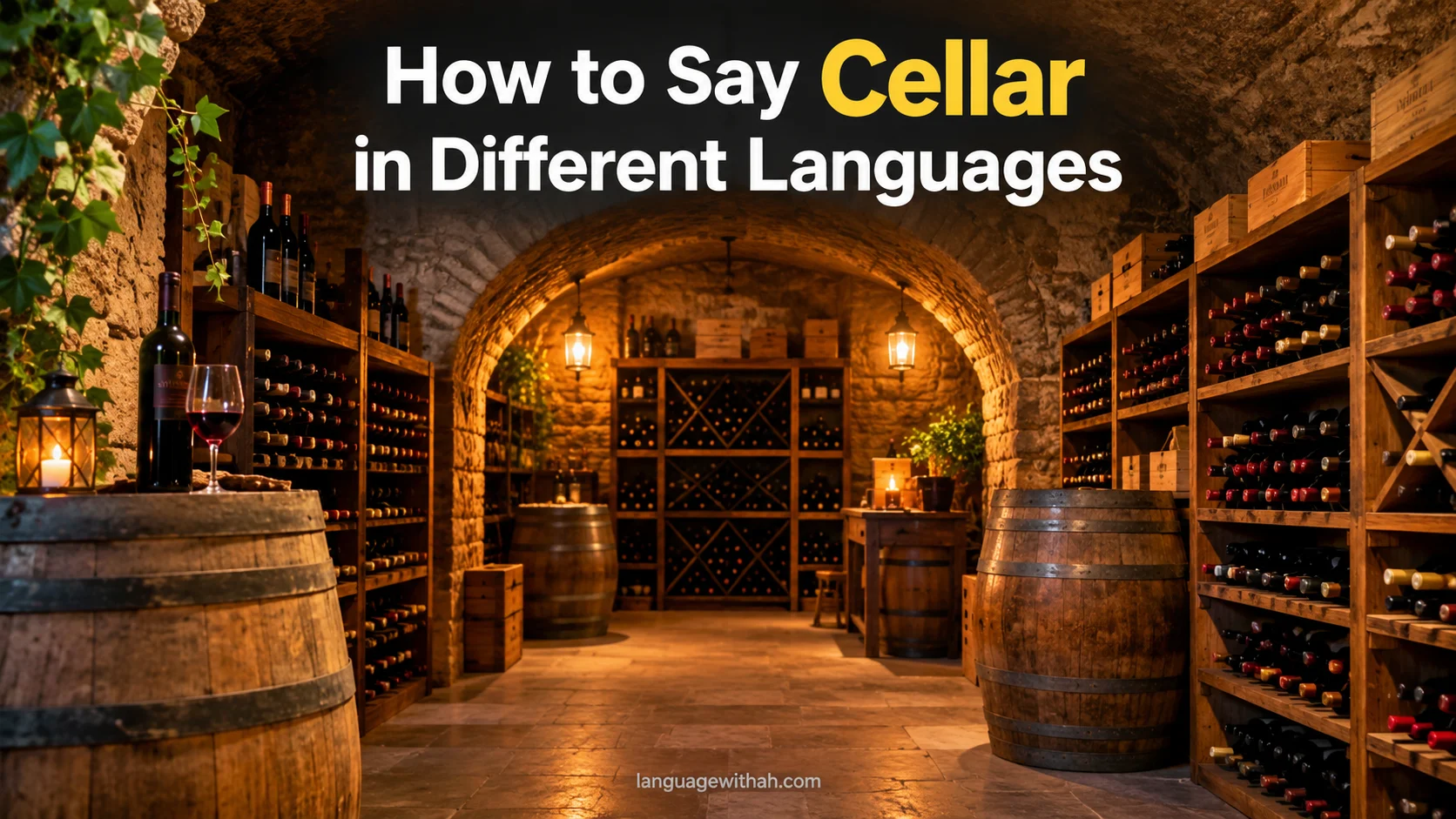
A cellar is a room or space below a building, often used to store food, household supplies, wine, or other items. In some homes, it serves as a cool storage area; in older buildings, it may be a stone-walled room beneath the ground floor. Learning how to say cellar in 70 different languages helps language learners, travelers, homeowners, and anyone interested in architecture or cultural vocabulary describe this useful space more naturally.
Although English uses the word cellar for several kinds of underground rooms, other languages may distinguish between a basement, a wine cellar, a storage room, and a traditional underground pantry. These differences matter because a direct translation does not always communicate the same meaning. For example, a word used for a general basement may not specifically refer to a place where wine is stored.
This guide explores cellar translations across European, Asian, African, Middle Eastern, and other world languages. Each entry includes the language, a representative country or region, the translation, a pronunciation guide, and an example sentence. You will also learn about regional variations, common translation mistakes, and practical ways to choose the right expression for everyday conversations, travel, and language learning.
Interesting Facts About Cellar
- A cellar is not always the same as a basement. A cellar is often associated with storage, while a basement may contain living spaces, laundry facilities, or mechanical equipment.
- Wine storage has its own vocabulary. Some languages use a specialized word for a wine cellar rather than the ordinary word for an underground room.
- Climate influences cellar design. Underground spaces can help moderate temperature changes, although actual conditions depend on insulation, humidity, drainage, and ventilation.
- The same building feature can have different names. A term that describes a cellar in one region may refer more broadly to a basement or underground storage area elsewhere.
- Compound words are common. Some languages combine words meaning “wine” and “cellar” to describe a dedicated wine-storage space.
- Grammar can change the expression. Gender, articles, grammatical cases, and sentence structure can affect how a word for cellar appears in a complete sentence.
- Context makes translations more precise. When discussing architecture, food storage, or wine, adding a descriptive word can prevent confusion.
What Does Cellar Mean?
A cellar is generally a room, often partly or entirely below ground level, used for storage. It may be found beneath a house, restaurant, historic building, or other structure.
The word can refer to several related spaces:
- Storage cellar: A place for keeping supplies, preserved foods, or household items.
- Wine cellar: A room designed to store wine under suitable conditions.
- Root cellar: An underground or partly underground space traditionally used to store root vegetables and other produce.
- Underground room: A broader description that may overlap with the meaning of cellar, depending on the building and language.
The intended meaning matters when translating the word. If you are talking about a room beneath a house, a general cellar or basement term may work. If you mean a dedicated wine-storage room, a more specific expression is usually clearer.
Why Can Cellar Have Different Translations?
There is no single word that perfectly matches cellar in every language and situation. The best translation depends on what the room is used for and how the local language describes buildings.
- Context: A wine cellar may require a different expression from a general storage cellar.
- Regional usage: Speakers in different countries may use different words for underground rooms.
- Formality: Architectural descriptions may use more technical vocabulary than everyday conversations.
- Grammar: The translated word may change form depending on its role in a sentence.
- Cultural conventions: Traditional homes and modern apartments do not necessarily have the same types of storage spaces.
- Literal versus natural translation: A dictionary equivalent may be understandable but less natural than the term commonly used in a particular situation.
For the tables below, the main translation generally refers to a cellar or basement-like storage space. Where a language makes an important distinction, a note identifies the more specific meaning. Pronunciation guides are approximate reader aids rather than substitutes for native-speaker audio.
European Languages
European languages use a variety of terms for underground rooms, basements, and storage cellars. Some have a general word for a room below a building, while others have a more specialized term for a wine cellar. The translations below prioritize ordinary residential or storage contexts.
English varieties
In English, cellar is understood across major varieties, although basement may be more common when describing a full underground floor.
| 🌍 Language | Country/Region | Translation | Pronunciation | Example Sentence |
| English | International | Cellar | SEL-er | The cellar is cool. |
| American English 🇺🇸 | United States | Cellar / basement | SEL-er / BAYSS-ment | We keep our supplies in the basement. |
| British English 🇬🇧 | United Kingdom | Cellar | SEL-er | The old house has a stone cellar. |
| Australian English 🇦🇺 | Australia | Cellar | SEL-er | The cellar is beneath the house. |
The wording is largely the same across these English varieties. Basement often emphasizes the lower floor of a building, particularly in American English, whereas cellar commonly suggests storage or an older underground room.
Other European languages
| 🌍 Language | Country/Region | Translation | Pronunciation | Example Sentence |
| Spanish | Spain, Latin America | Sótano | SOH-tah-noh | El sótano está fresco. — The basement is cool. |
| French | France, Belgium, Canada | Cave | kahv | La cave est fraîche. — The cellar is cool. |
| German | Germany, Austria, Switzerland | Keller | KEL-er | Der Keller ist kühl. — The cellar is cool. |
| Italian | Italy, Switzerland | Cantina | kan-TEE-nah | La cantina è fresca. — The cellar is cool. |
| Portuguese | Portugal, Brazil | Cave / porão | KAHV / poh-ROWN | O porão é fresco. — The basement is cool. |
| Dutch | Netherlands, Belgium | Kelder | KEL-der | De kelder is koel. — The cellar is cool. |
| Swedish | Sweden, Finland | Källare | SHEL-lah-reh | Källaren är sval. — The cellar is cool. |
| Norwegian | Norway | Kjeller | SHEL-ler | Kjelleren er kjølig. — The cellar is cool. |
| Danish | Denmark | Kælder | KEL-ler | Kælderen er kølig. — The cellar is cool. |
| Finnish | Finland | Kellari | KEL-lah-ree | Kellari on viileä. — The cellar is cool. |
| Icelandic | Iceland | Kjallari | KYAT-lah-ree | Kjallarinn er svalur. — The cellar is cool. |
| Irish | Ireland | Íoslach | EES-lukh | Tá an t-íoslach fionnuar. — The cellar is cool. |
| Welsh | Wales | Islawr | iss-LOWR | Mae’r islawr yn oer. — The cellar is cold. |
| Polish | Poland | Piwnica | pee-VNEE-tsah | Piwnica jest chłodna. — The cellar is cool. |
| Czech | Czechia | Sklep | sklehp | Sklep je chladný. — The cellar is cool. |
| Slovak | Slovakia | Pivnica | PEEV-nee-tsah | Pivnica je chladná. — The cellar is cool. |
| Ukrainian | Ukraine | Підвал | pid-VAL | Підвал прохолодний. — The cellar is cool. |
| Russian | Russia and other Russian-speaking regions | Подвал | pad-VAL | Подвал прохладный. — The cellar is cool. |
| Romanian | Romania, Moldova | Pivniță | piv-NEET-suh | Pivnița este răcoroasă. — The cellar is cool. |
| Hungarian | Hungary | Pince | PEEN-tseh | A pince hűvös. — The cellar is cool. |
| Greek | Greece, Cyprus | Υπόγειο | ee-POH-yee-oh | Το υπόγειο είναι δροσερό. — The basement is cool. |
| Bulgarian | Bulgaria | Мазе | mah-ZEH | Мазето е хладно. — The cellar is cool. |
| Croatian | Croatia | Podrum | POH-droom | Podrum je hladan. — The cellar is cool. |
| Serbian | Serbia and neighboring regions | Подрум | POH-droom | Подрум је хладан. — The cellar is cool. |
| Slovenian | Slovenia | Klet | kleht | Klet je hladna. — The cellar is cool. |
| Lithuanian | Lithuania | Rūsys | ROO-sees | Rūsys yra vėsus. — The cellar is cool. |
| Latvian | Latvia | Pagrabs | PAH-grabs | Pagrabs ir vēss. — The cellar is cool. |
| Estonian | Estonia | Kelder | KEL-der | Kelder on jahe. — The cellar is cool. |
| Albanian | Albania, Kosovo | Bodrum | boh-DROOM | Bodrumi është i freskët. — The cellar is cool. |
| Turkish | Türkiye, Cyprus | Bodrum | boh-DROOM | Bodrum serin. — The cellar is cool. |
Cultural and vocabulary notes: French cave can mean a cellar and, in suitable contexts, a wine cellar. Italian cantina is often associated with storage or wine. Portuguese varies regionally: porão is commonly used for a basement in Brazil, while cave is a common choice in Portugal for a cellar. In Czech, sklep means a cellar, although the same spelling has other meanings in different Slavic languages.
Read More: How to Say Ceramic in Different Languages
Asian Languages
Asia includes languages with very different writing systems, grammatical structures, and regional traditions. Some languages distinguish clearly between a basement, an underground storage room, and a wine cellar; others use a broader expression. The following translations focus on the general cellar or basement meaning.
| 🌍 Language | Country/Region | Translation | Pronunciation | Example Sentence |
| Mandarin Chinese | China, Taiwan, Singapore | 地下室 | dìxiàshì | 地下室很凉快。— The basement is cool. |
| Cantonese | Hong Kong, Guangdong | 地庫 | dei6 fu3 | 地庫好凍。— The basement is cold. |
| Japanese | Japan | 地下室 | chika-shitsu | 地下室は涼しいです。— The basement is cool. |
| Korean | South Korea, North Korea | 지하실 | jiha-sil | 지하실은 시원해요. — The basement is cool. |
| Hindi | India | तहखाना | tah-khaa-naa | तहखाना ठंडा है। — The cellar is cool. |
| Urdu | Pakistan, India | تہہ خانہ | teh-khaa-na | تہہ خانہ ٹھنڈا ہے۔ — The cellar is cool. |
| Bengali | Bangladesh, India | ভূগর্ভস্থ ঘর | bhoo-gor-bhostho ghor | ঘরটি ঠান্ডা। — The room is cool. |
| Punjabi | India, Pakistan | ਤਹਿਖਾਨਾ / تہہ خانہ | teh-khaa-naa | ਤਹਿਖਾਨਾ ਠੰਢਾ ਹੈ। — The cellar is cool. |
| Gujarati | India | ભોંયરું | bhon-yu-ru | ભોંયરું ઠંડું છે. — The cellar is cool. |
| Marathi | India | तळघर | tal-ghar | तळघर थंड आहे. — The cellar is cool. |
| Tamil | India, Sri Lanka, Singapore | நிலவறை | nila-varai | நிலவறை குளிர்ச்சியாக இருக்கிறது. — The cellar is cool. |
| Telugu | India | నేలమాళిగ | nēla-māḷiga | నేలమాళిగ చల్లగా ఉంది. — The cellar is cool. |
| Kannada | India | ನೆಲಮಾಳಿಗೆ | nela-māḷige | ನೆಲಮಾಳಿಗೆ ತಂಪಾಗಿದೆ. — The cellar is cool. |
| Malayalam | India | നിലവറ | nila-vara | നിലവറ തണുപ്പാണ്. — The cellar is cool. |
| Nepali | Nepal | भूमिगत कोठा | bhoomigat kotha | भूमिगत कोठा चिसो छ। — The underground room is cool. |
| Sinhala | Sri Lanka | බිම් මහල | bim-mahala | බිම් මහල සිසිල්. — The lower-floor space is cool. |
| Thai | Thailand | ห้องใต้ดิน | hong tai din | ห้องใต้ดินเย็น — The basement is cool. |
| Vietnamese | Vietnam | Hầm | huhm | Căn hầm mát mẻ. — The cellar is cool. |
| Indonesian | Indonesia | Ruang bawah tanah | roo-ang ba-wah ta-nah | Ruang bawah tanah itu sejuk. — That underground room is cool. |
| Malay | Malaysia, Brunei, Singapore | Ruang bawah tanah | roo-ang ba-wah ta-nah | Ruang bawah tanah itu sejuk. — That underground room is cool. |
| Filipino (Tagalog) | Philippines | Silong sa ilalim ng lupa | see-long sa ee-la-lim nang loo-pa | Malamig ang silong. — The space underneath is cool. |
| Burmese | Myanmar | မြေအောက်ခန်း | myè-auk-khan | မြေအောက်ခန်းက အေးတယ်။ — The underground room is cool. |
| Khmer | Cambodia | បន្ទប់ក្រោមដី | bon-top kraom dei | បន្ទប់ក្រោមដីត្រជាក់។ — The basement is cool. |
| Lao | Laos | ຫ້ອງໃຕ້ດິນ | hong tai din | ຫ້ອງໃຕ້ດິນເຢັນ. — The basement is cool. |
| Mongolian | Mongolia | Зоорь | zoor | Зоорь сэрүүн байна. — The cellar is cool. |
| Kazakh | Kazakhstan | Жертөле | zher-TÖ-leh | Жертөле салқын. — The cellar is cool. |
| Uzbek | Uzbekistan | Yerto‘la | yer-to’la | Yerto‘la salqin. — The cellar is cool. |
Cultural and vocabulary notes: Mandarin 地下室 and Japanese 地下室 both describe a basement or underground room. Hindi तहखाना and Urdu تہہ خانہ are closely related expressions for an underground room or cellar. In Thai and Vietnamese, the common terms may refer broadly to underground spaces rather than a traditional food-storage cellar. When discussing wine, it is helpful to specify that the room is intended for wine storage.
African Languages
Africa has hundreds of languages spanning several major language families. Words for a cellar or basement may be borrowed, regionally specific, or expressed descriptively as an underground room. The examples below use general underground-room or storage-room meanings where a single specialized equivalent is not universal.
| 🌍 Language | Country/Region | Translation | Pronunciation | Example Sentence |
| Swahili | Tanzania, Kenya, East Africa | Chumba cha chini ya ardhi | CHOOM-bah cha CHEE-nee yah AR-dee | Chumba cha chini ya ardhi ni baridi. — The underground room is cool. |
| Afrikaans | South Africa, Namibia | Kelder | KEL-der | Die kelder is koel. — The cellar is cool. |
| Zulu | South Africa | Igumbi elingaphansi komhlaba | ee-GOOM-bee eh-lee-ngah-PAHN-see kohm-KLAH-bah | Igumbi lingaphansi komhlaba. — The room is underground. |
| Xhosa | South Africa | Igumbi elingaphantsi komhlaba | ee-GOOM-bee eh-lee-ngah-PAHN-tee kohm-KLAH-bah | Igumbi lingaphantsi komhlaba. — The room is underground. |
| Amharic | Ethiopia | የመሬት ውስጥ ክፍል | yä-meret wist kifil | የመሬት ውስጥ ክፍሉ ቀዝቃዛ ነው። — The underground room is cool. |
| Yoruba | Nigeria, West Africa | Yàrá abẹ́ ilẹ̀ | yah-rah ah-BEH ee-LEH | Yàrá abẹ́ ilẹ̀ náà tutù. — The underground room is cool. |
| Igbo | Nigeria | Ụlọ dị n’okpuru ala | oo-loh dee n-oh-KPOO-roo ah-lah | Ụlọ ahụ dị n’okpuru ala. — That room is underground. |
| Hausa | Nigeria, Niger, West Africa | Ɗaki ƙarƙashin ƙasa | DAH-kee kar-kah-sheen KAH-sah | Ɗakin yana da sanyi. — The room is cool. |
| Somali | Somalia, Horn of Africa | Qol dhulka hoostiisa ah | qohl DHOOL-kah hohs-TEE-sah ah | Qolku waa qabow. — The room is cool. |
| Shona | Zimbabwe | Imba yepasi pevhu | EEM-bah yeh-PAH-see peh-vhoo | Imba yepasi pevhu inotonhorera. — The underground room is cool. |
| Sesotho | Lesotho, South Africa | Kamore e ka tlas’a lefatše | kah-MOH-reh eh kah TLAH-sah leh-fah-TSEH | Kamore eo e pholile. — That room is cool. |
| Setswana | Botswana, South Africa | Phaposi e e kwa tlase ga lefatshe | pah-POH-see eh eh kwa TLAH-seh gah leh-fah-TSEH | Phaposi eo e tsididi. — That room is cool. |
| Kinyarwanda | Rwanda | Icyumba cyo munsi y’ubutaka | ee-CHOOM-bah cho moon-see yoo-boo-TAH-kah | Icyumba kirakonje. — The room is cool. |
| Malagasy | Madagascar | Efitra ambanin’ny tany | eh-FEE-trah ahm-bah-NEEN-ee tahn | Mangatsiaka ilay efitra. — That room is cool. |
Cultural note: In several of these languages, the expressions in the table are descriptive phrases meaning an underground room rather than a single dictionary equivalent specifically reserved for cellar. This distinction is useful when translating architectural descriptions or discussing a traditional storage space.
Middle Eastern Languages
The Middle East includes Arabic, Persian, Hebrew, Kurdish, Turkish, and other distinct language traditions. Vocabulary can differ considerably between everyday speech and formal writing, especially in Arabic. These examples distinguish general underground rooms from more specialized cellar terminology wherever practical.
| 🌍 Language | Country/Region | Translation | Pronunciation | Example Sentence |
| Modern Standard Arabic | Across the Arab world | قبو | qabw | القبو بارد. — The cellar is cold. |
| Egyptian Arabic | Egypt | بدروم | badroom | البدروم بارد. — The basement is cold. |
| Persian (Farsi) | Iran, Persian-speaking communities | زیرزمین | zir-zamin | زیرزمین خنک است. — The basement is cool. |
| Hebrew | Israel | מרתף | mar-TAYF | המרתף קריר. — The cellar is cool. |
| Kurdish (Kurmanji) | Türkiye, Iraq, Syria, Iran | Jêrzemîn | zher-ze-MEEN | Jêrzemîn sar e. — The cellar is cold. |
| Armenian | Armenia and Armenian-speaking communities | Նկուղ | nkooGH | Նկուղը զով է։ — The cellar is cool. |
Cultural note: Arabic قبو is a general term for a cellar or underground room in suitable contexts, while Egyptian Arabic commonly uses بدروم for a basement. Persian زیرزمین literally refers to a space beneath the ground. The exact choice can change with the building type and whether the room is intended for wine, food, or general storage.
Other World Languages
The following languages add useful perspectives from the Pacific, the Americas, and international language learning. Some expressions are descriptive rather than traditional single-word equivalents, so they are best used when the intended meaning is an underground storage room.
| 🌍 Language | Country/Region | Translation | Pronunciation | Example Sentence |
| Māori | New Zealand | Rūma raro i te whenua | ROO-mah RAH-roh ee teh FEH-noo-ah | He mātao te rūma raro i te whenua. — The underground room is cool. |
| Samoan | Samoa, Pacific Islands | Potu i lalo o le eleele | POH-too ee LAH-loh oh leh eh-leh-LEH | E mālū le potu. — The room is cool. |
| Tongan | Tonga | Loki ʻi lalo ʻi he kelekele | LOH-kee ee LAH-loh ee heh keh-leh-KEH-leh | ʻOku mokomoko ʻa e loki. — The room is cool. |
| Hawaiian | Hawaiʻi | Lumi ma lalo o ka ʻāina | LOO-mee mah LAH-loh oh kah EYE-nah | He anu ka lumi. — The room is cold. |
| Quechua | Andes, including Peru and Bolivia | Ukhu wasi | OO-khoo WAH-see | Ukhu wasi chiri. — The underground room is cold. |
| Guarani | Paraguay and neighboring regions | Koty yvy guýpe | koh-TEE uh-vuh goo-EE-peh | Pe koty ro’ysã. — That room is cool. |
| Haitian Creole | Haiti | Kav | kahv | Kav la fre. — The cellar is cool. |
| Esperanto | International constructed language | Kelo | KEH-loh | La kelo estas malvarmeta. — The cellar is cool. |
Cultural note: A descriptive phrase can be more useful than a direct equivalent when a particular type of cellar is uncommon in a region. For a technical translation, especially in construction or real estate, confirm whether the intended space is a basement, underground room, or dedicated storage cellar.
Quick Reference: Cellar in Different Languages
Use this compact table to look up the main term for a cellar or basement-like space. Translations are context-dependent: a general underground room, a wine cellar, and a basement are not always described by the same word.
| Language | Translation |
| English | Cellar |
| American English | Cellar / basement |
| British English | Cellar |
| Australian English | Cellar |
| Spanish | Sótano |
| French | Cave |
| German | Keller |
| Italian | Cantina |
| Portuguese (Portugal) | Cave |
| Portuguese (Brazil) | Porão |
| Dutch | Kelder |
| Swedish | Källare |
| Norwegian | Kjeller |
| Danish | Kælder |
| Finnish | Kellari |
| Icelandic | Kjallari |
| Irish | Íoslach |
| Welsh | Islawr |
| Polish | Piwnica |
| Czech | Sklep |
| Slovak | Pivnica |
| Ukrainian | Підвал |
| Russian | Подвал |
| Romanian | Pivniță |
| Hungarian | Pince |
| Greek | Υπόγειο |
| Bulgarian | Мазе |
| Croatian | Podrum |
| Serbian | Подрум |
| Slovenian | Klet |
| Lithuanian | Rūsys |
| Latvian | Pagrabs |
| Estonian | Kelder |
| Albanian | Bodrum |
| Turkish | Bodrum |
| Mandarin Chinese | 地下室 |
| Cantonese | 地庫 |
| Japanese | 地下室 |
| Korean | 지하실 |
| Hindi | तहखाना |
| Urdu | تہہ خانہ |
| Bengali | ভূগর্ভস্থ ঘর |
| Punjabi | ਤਹਿਖਾਨਾ / تہہ خانہ |
| Gujarati | ભોંયરું |
| Marathi | तळघर |
| Tamil | நிலவறை |
| Telugu | నేలమాళిగ |
| Kannada | ನೆಲಮಾಳಿಗೆ |
| Malayalam | നിലവറ |
| Nepali | भूमिगत कोठा |
| Sinhala | බිම් මහල |
| Thai | ห้องใต้ดิน |
| Vietnamese | Hầm |
| Indonesian | Ruang bawah tanah |
| Malay | Ruang bawah tanah |
| Filipino (Tagalog) | Silong sa ilalim ng lupa |
| Burmese | မြေအောက်ခန်း |
| Khmer | បន្ទប់ក្រោមដី |
| Lao | ຫ້ອງໃຕ້ດິນ |
| Mongolian | Зоорь |
| Kazakh | Жертөле |
| Uzbek | Yerto‘la |
| Swahili | Chumba cha chini ya ardhi |
| Afrikaans | Kelder |
| Zulu | Igumbi elingaphansi komhlaba |
| Xhosa | Igumbi elingaphantsi komhlaba |
| Amharic | የመሬት ውስጥ ክፍል |
| Yoruba | Yàrá abẹ́ ilẹ̀ |
| Igbo | Ụlọ dị n’okpuru ala |
| Hausa | Ɗaki ƙarƙashin ƙasa |
| Somali | Qol dhulka hoostiisa ah |
| Shona | Imba yepasi pevhu |
| Sesotho | Kamore e ka tlas’a lefatše |
| Setswana | Phaposi e e kwa tlase ga lefatshe |
| Kinyarwanda | Icyumba cyo munsi y’ubutaka |
| Malagasy | Efitra ambanin’ny tany |
| Modern Standard Arabic | قبو |
| Egyptian Arabic | بدروم |
| Persian (Farsi) | زیرزمین |
| Hebrew | מרתף |
| Kurdish (Kurmanji) | Jêrzemîn |
| Armenian | Նկուղ |
| Māori | Rūma raro i te whenua |
| Samoan | Potu i lalo o le eleele |
| Tongan | Loki ʻi lalo ʻi he kelekele |
| Hawaiian | Lumi ma lalo o ka ʻāina |
| Quechua | Ukhu wasi |
| Guarani | Koty yvy guýpe |
| Haitian Creole | Kav |
| Esperanto | Kelo |
How to Choose the Right Translation
The best translation depends on what kind of room you mean and who will read or hear the expression.
- For everyday conversation: Choose the ordinary term for a cellar or basement in the language you are learning.
- For wine storage: Use the local expression for a wine cellar if that distinction matters.
- For travel: If asking about a room in a house or hotel, a general basement term may be easier to understand.
- For property descriptions: Check whether the local real-estate vocabulary distinguishes a cellar from a full basement.
- For formal writing: Prefer the standard written term used in that language and region.
- For speaking: Listen to pronunciation from speakers of the relevant variety rather than relying entirely on an English-style guide.
A useful rule: Explain the room’s purpose if you are unsure whether the direct translation is precise enough. A phrase meaning “underground storage room” may communicate your meaning more clearly than a word that has several regional uses.
Common Mistakes When Translating Cellar
1. Assuming cellar and basement are identical
These words overlap, but a basement can be a full floor of a building, whereas a cellar often emphasizes storage. Choose the term that matches the room.
2. Translating wine cellar literally
Some languages have a familiar expression specifically for a wine cellar. A general word for basement might not communicate that purpose.
3. Ignoring regional differences
Portuguese usage, Arabic dialects, and local architectural terminology can vary. Always consider the intended country or region.
4. Treating descriptive phrases as exact single-word equivalents
An expression meaning “underground room” may explain the concept accurately without being the usual dictionary equivalent for cellar. This distinction is particularly important in languages where cellars are not a common feature of homes.
5. Overlooking grammar
In languages with grammatical gender, cases, or noun agreement, the form used in a sentence may differ from the dictionary form.
6. Relying entirely on pronunciation spellings
Romanized pronunciation guides help beginners, but they cannot always represent sounds precisely. For tonal languages, tones and syllable distinctions can affect meaning.
7. Using one translation in every situation
A storage cellar, root cellar, wine cellar, and underground basement may require different expressions. Context is just as important as vocabulary.
Why Learn Cellar in Different Languages?
Learning the word cellar in different languages is a practical way to expand vocabulary related to homes, architecture, travel, and everyday life. It can help you understand property descriptions, follow conversations about building layouts, and communicate more clearly when visiting places where another language is spoken.
Comparing translations also reveals how languages organize similar ideas differently. One language may have a short word for a cellar, while another uses a descriptive phrase for an underground room. These differences are useful reminders that language learning involves more than memorizing vocabulary.
For students, multilingual comparisons provide opportunities to practice pronunciation, scripts, and sentence structure. For travelers and international readers, knowing the right term can make questions about a building or storage space easier to communicate.
Most importantly, learning vocabulary with context helps you choose expressions thoughtfully instead of relying on literal translations.
FAQs:
How do you say cellar in different languages?
The word varies by language. Examples include Keller in German, cave in French, sótano in Spanish, piwnica in Polish, and 地下室 (dìxiàshì) in Mandarin Chinese. The most suitable term depends on whether you mean a storage cellar, wine cellar, or general basement.
What is the difference between a cellar and a basement?
A cellar is commonly associated with storage and may be partly or entirely underground. A basement generally refers to a lower level of a building and can include living areas, utility rooms, or storage spaces. The distinction varies by region.
What is the French word for cellar?
The French word is cave, pronounced approximately kahv. Depending on context, it can refer to a cellar or a wine-storage space.
What is the German word for cellar?
The German word is Keller, pronounced approximately KEL-er. It can refer to a cellar or basement, depending on the building and context.
What is the Spanish word for cellar?
Sótano, pronounced SOH-tah-noh, is a common Spanish word for a basement or underground room. A specialized wine cellar may be described more specifically.
Conclusion:
Learning how to say cellar in different languages reveals how a familiar part of a building can be described in many different ways. Terms such as German Keller, French cave, Spanish sótano, and Mandarin 地下室 provide useful starting points for understanding international vocabulary related to homes and storage.
However, the best translation depends on context. A general basement, a traditional storage cellar, and a dedicated wine cellar are not necessarily described by the same word in every language. Paying attention to regional variation, pronunciation, grammar, and intended meaning can help you avoid misunderstandings.














1 thought on “How to Say Cellar in Different Languages”