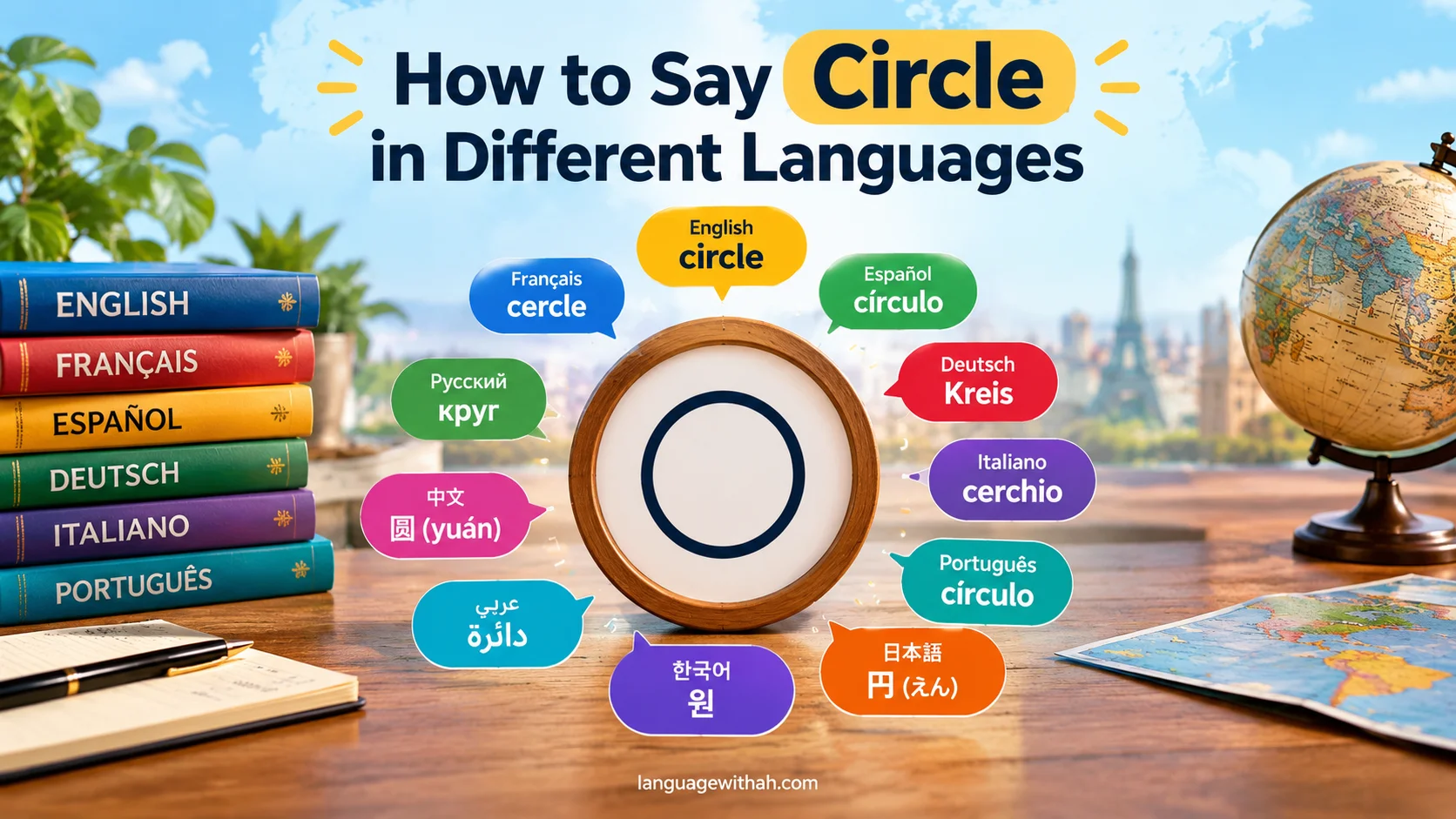
A circle is a simple geometric shape made from a continuous curved line, with every point on the boundary the same distance from its center. Yet when you explore circle in 70 different languages, you quickly discover that languages do not always organize or describe shapes in exactly the same way.
People may want to know how to say circle in another language for schoolwork, travel, language learning, drawing instructions, design projects, or everyday conversation. Learning the word in a foreign language can also make it easier to understand native vocabulary and recognize familiar concepts in different writing systems.
The word may be used in mathematics, art, geometry, maps, signs, or casual descriptions. In some languages, the ordinary word for a circle differs slightly from a word meaning a ring, loop, cycle, or circular group. That distinction matters when choosing a natural translation.
This guide covers 80 languages and English varieties, with translations, pronunciation help, regional information, and natural examples. Forms can vary according to region, grammar, context, and language variety, so the most useful translation is not always a strict word-for-word equivalent.
Interesting Facts About Circle
- A circle is a geometric figure defined by a set of points that are equally distant from a central point.
- Many languages distinguish between a geometric circle and a ring or circular object, even when English uses related vocabulary.
- In languages such as Mandarin Chinese, Japanese, Korean, Hindi, and Arabic, the word for a circle may appear in several related forms depending on whether the context is mathematical or everyday.
- Some languages use a single common noun for both ordinary and geometric descriptions, while others prefer a more technical form in mathematics.
- The pronunciation of circle can change considerably from one language to another because languages use different sound systems.
- A number of languages use non-Latin writing systems, including Chinese characters, Japanese kana and kanji, Korean Hangul, Arabic script, Hebrew, and Georgian script.
- Learning shape vocabulary such as circle, square, triangle, and rectangle is a useful way to build practical language-learning vocabulary.
What Does Circle Mean?
A circle is a round geometric shape whose boundary is made up of points that are all the same distance from its center. In mathematics, the boundary itself is called a circle, while the area enclosed by it is commonly called a disk.
In everyday English, however, people may use “circle” more broadly for a round shape, a circular mark, or something arranged in a circular form.
For example:
- “Draw a circle around the answer.”
- “The children sat in a circle.”
- “The logo contains a blue circle.”
- “A circle has no corners.”
The intended meaning is important when translating because some languages have separate words for a geometric circle, a ring-shaped object, or a circular arrangement.
Why Can Circle Have Different Translations?
There is no single universal word that works identically in every language. A translation depends on context and usage.
For example, a mathematics textbook may use a more technical term, while a child drawing a round shape may use an everyday word. Some languages also distinguish between the boundary of a circle, a filled circular area, and a ring-shaped object.
Other factors include:
- Formal vs. informal language
- Mathematical vs. everyday context
- Regional vocabulary
- Grammatical gender
- Singular and plural forms
- Native writing system
- Spoken vs. written language
- Literal vs. natural translation
The tables below use the ordinary, contextually appropriate word for the geometric concept of a circle wherever possible.
European Languages
Europe contains several major language families, so the word for circle can look and sound very different from one language to another. Romance languages often share related vocabulary, while Germanic, Slavic, Celtic, and Baltic languages use their own forms. The translations below focus on the ordinary geometric noun and a natural way to ask how to say it.
English Varieties
American English 🇺🇸
Translation: How do you say “circle”?
Pronunciation: How do you say SUR-kuhl?
Example: “Draw a circle around the correct answer.”
British English 🇬🇧
Translation: How do you say “circle”?
Pronunciation: How do you say SUR-kuhl?
Example: “Please draw a circle around the correct answer.”
Australian English 🇦🇺
Translation: How do you say “circle”?
Pronunciation: How do you say SUR-kuhl?
Example: “Draw a circle around the number.”
The wording is essentially the same in American, British, and Australian English. Differences are more noticeable in accent and some vocabulary outside this particular word.
European Language Table
| 🌍 Language | Country/Region | Translation | Pronunciation | Example Sentence |
| Spanish | Spain, Latin America | ¿Cómo se dice “círculo”? | KOH-moh seh DEE-seh SEER-koo-loh | Dibuja un círculo. — Draw a circle. |
| French | France, Belgium, Canada | Comment dit-on « cercle » ? | koh-MAHN dee-TOHN SER-kluh | Dessine un cercle. — Draw a circle. |
| German | Germany, Austria, Switzerland | Wie sagt man „Kreis“? | vee zahkt mahn KRICE | Zeichne einen Kreis. — Draw a circle. |
| Italian | Italy, Switzerland | Come si dice “cerchio”? | KOH-meh see DEE-cheh CHER-kyoh | Disegna un cerchio. — Draw a circle. |
| Portuguese | Portugal, Brazil | Como se diz “círculo”? | KOH-moo seh DEEZ SEER-koo-loo | Desenhe um círculo. — Draw a circle. |
| Dutch | Netherlands, Belgium | Hoe zeg je “cirkel”? | hoo zek yuh SIR-kuhl | Teken een cirkel. — Draw a circle. |
| Swedish | Sweden, Finland | Hur säger man “cirkel”? | hoor SEH-yer mahn SIR-kehl | Rita en cirkel. — Draw a circle. |
| Norwegian | Norway | Hvordan sier man “sirkel”? | VOOR-dahn see-er mahn SIR-kehl | Tegn en sirkel. — Draw a circle. |
| Danish | Denmark | Hvordan siger man “cirkel”? | VOOR-dahn SEE-er mahn SIR-kuhl | Tegn en cirkel. — Draw a circle. |
| Finnish | Finland | Miten sanotaan “ympyrä”? | MEE-ten sah-noh-TAHN UHM-puh-rah | Piirrä ympyrä. — Draw a circle. |
| Icelandic | Iceland | Hvernig segir maður „hringur“? | KVEHR-nig SAY-yir MAI-thur HRING-ur | Teiknaðu hring. — Draw a circle. |
| Irish | Ireland | Conas a deirtear “ciorcal”? | KUN-us uh DYIR-tar KEER-kul | Tarraing ciorcal. — Draw a circle. |
| Welsh | Wales | Sut mae dweud “cylch”? | sit my dow-id KULKH | Tynnwch gylch. — Draw a circle. |
| Polish | Poland | Jak powiedzieć „koło”? | yak poh-VYEH-jetch KOH-woh | Narysuj koło. — Draw a circle. |
| Czech | Czech Republic | Jak se řekne „kruh“? | yak seh RZHEK-neh KROOKH | Nakresli kruh. — Draw a circle. |
| Slovak | Slovakia | Ako sa povie „kruh“? | AH-koh sah POH-vyeh KROOKH | Nakresli kruh. — Draw a circle. |
| Ukrainian | Ukraine | Як сказати «коло»? | yak skah-ZAH-ty KOH-loh | Намалюй коло. — Draw a circle. |
| Russian | Russia and neighboring regions | Как сказать «круг»? | kak skah-ZAHT KROOK | Нарисуй круг. — Draw a circle. |
| Romanian | Romania, Moldova | Cum se spune „cerc”? | koom seh SPOO-neh CHERK | Desenează un cerc. — Draw a circle. |
| Hungarian | Hungary | Hogyan mondjuk, hogy „kör”? | HODH-yahn MON-dyook khoer | Rajzolj egy kört. — Draw a circle. |
| Greek | Greece, Cyprus | Πώς λέμε «κύκλος»; | pos LEH-me KEE-kloos | Σχεδίασε έναν κύκλο. — Draw a circle. |
| Bulgarian | Bulgaria | Как се казва „кръг“? | kak seh kah-ZVAH kruhk | Начертай кръг. — Draw a circle. |
| Croatian | Croatia | Kako se kaže “krug”? | KAH-koh seh KAH-zhe kroog | Nacrtaj krug. — Draw a circle. |
| Serbian | Serbia and neighboring areas | Како се каже „круг“? | KAH-koh seh KAH-zhe kroog | Нацртај круг. — Draw a circle. |
| Slovenian | Slovenia | Kako rečemo “krog”? | KAH-koh REH-cheh-moh krog | Nariši krog. — Draw a circle. |
| Lithuanian | Lithuania | Kaip pasakyti „apskritimas“? | kaip pah-sah-KEE-tee aps-kree-TEE-mahs | Nubrėžk apskritimą. — Draw a circle. |
| Latvian | Latvia | Kā teikt “aplis”? | kah taykt AH-plis | Uzzīmē apli. — Draw a circle. |
| Estonian | Estonia | Kuidas öelda “ring”? | KOO-ee-dahs OEL-dah ring | Joonista ring. — Draw a circle. |
| Albanian | Albania, Kosovo | Si thuhet “rreth”? | see THOO-het rreth | Vizato një rreth. — Draw a circle. |
| Macedonian | North Macedonia | Како се вели „круг“? | KAH-koh seh VEH-lee kroog | Нацртај круг. — Draw a circle. |
| Catalan | Catalonia, Valencia, Balearic Islands | Com es diu “cercle”? | kom es DEE-oo SER-kluh | Dibuixa un cercle. — Draw a circle. |
| Basque | Basque Country | Nola esaten da “zirkulu”? | NOH-lah eh-SAH-ten dah seer-KOO-loo | Marraztu zirkulu bat. — Draw a circle. |
| Galician | Galicia | Como se di “círculo”? | KOH-moh seh dee SEER-koo-loh | Debuxa un círculo. — Draw a circle. |
European Cultural and Usage Notes
The Romance-language words círculo, cercle, cerchio, and círculo are historically related, but their pronunciation and spelling differ.
In several Slavic languages, words such as Russian круг, Polish koło, Czech kruh, and Ukrainian коло are not simply interchangeable across languages even though the concepts are closely related.
For practical communication, use the ordinary word shown above unless your context is a specialized mathematics or geometry lesson.
Read More: How to Say Cinder in Different Languages
Asian Languages
Asia includes languages from many unrelated families, along with several major writing systems. A circle may be expressed with an everyday noun, a technical mathematical term, or a word whose meaning depends on whether the object is an outline, a filled shape, or a ring. Romanization is included where it helps readers pronounce the native script.
| 🌏 Language | Country/Region | Translation | Pronunciation | Example Sentence |
| Mandarin Chinese | China, Taiwan, Singapore | 怎么说“圆”? | zěnme shuō “yuán” | 画一个圆。— Draw a circle. |
| Cantonese | Hong Kong, Guangdong | 點樣講「圓」? | dim2 joeng6 gong2 “jyun4” | 畫一個圓。— Draw a circle. |
| Japanese | Japan | 「円」は何と言いますか? | “en” wa nan to iimasu ka? | 円を描いてください。— Please draw a circle. |
| Korean | South Korea, North Korea | “원”을 어떻게 말해요? | “won”eul eotteoke malhaeyo? | 원을 그리세요. — Draw a circle. |
| Hindi | India | “वृत्त” को कैसे कहते हैं? | vritt ko kaise kehte hain? | एक वृत्त बनाइए। — Draw a circle. |
| Urdu | Pakistan, India | “دائرہ” کو کیسے کہتے ہیں؟ | daaira ko kaise kehte hain? | ایک دائرہ بنائیں۔ — Draw a circle. |
| Bengali | Bangladesh, India | “বৃত্ত” কীভাবে বলা হয়? | brit-to ki-bha-be bo-la hoy? | একটি বৃত্ত আঁকো। — Draw a circle. |
| Punjabi | India, Pakistan | “ਵਰਤੁਲ” ਨੂੰ ਕਿਵੇਂ ਕਹਿੰਦੇ ਹਨ? | vartul nu kiven kehnde han? | ਇੱਕ ਵਰਤੁਲ ਬਣਾਓ। — Draw a circle. |
| Gujarati | India | “વર્તુળ” કેવી રીતે કહે છે? | vartuḷ kevi rite kahe chhe? | એક વર્તુળ દોરો. — Draw a circle. |
| Marathi | India | “वर्तुळ” कसे म्हणतात? | vartuḷ kase mhaṇtāt? | एक वर्तुळ काढा. — Draw a circle. |
| Tamil | India, Sri Lanka | “வட்டம்” என்று எப்படி சொல்வது? | vaṭṭam enru eppaṭi solvatu? | ஒரு வட்டம் வரையுங்கள். — Draw a circle. |
| Telugu | India | “వృత్తం” ఎలా అంటారు? | vr̥ttam elā anṭāru? | ఒక వృత్తం గీయండి. — Draw a circle. |
| Kannada | India | “ವೃತ್ತ” ಎಂದು ಹೇಗೆ ಹೇಳುತ್ತಾರೆ? | vr̥tta endu hēge hēḷuttāre? | ಒಂದು ವೃತ್ತವನ್ನು ಬಿಡಿಸಿ. — Draw a circle. |
| Malayalam | India | “വൃത്തം” എങ്ങനെ പറയുന്നു? | vr̥ttam engane parayunnu? | ഒരു വൃത്തം വരയ്ക്കുക. — Draw a circle. |
| Nepali | Nepal | “वृत्त” लाई कसरी भनिन्छ? | vritta lai kasari bhaninchha? | एउटा वृत्त बनाउनुहोस्। — Draw a circle. |
| Sinhala | Sri Lanka | “වෘත්තය” කියන්නේ කොහොමද? | vr̥ttaya kiyanne kohomada? | වෘත්තයක් අඳින්න. — Draw a circle. |
| Thai | Thailand | พูดว่า “วงกลม” อย่างไร? | phûut wâa “wong-klom” yàang-rai? | วาดวงกลมหนึ่งวง — Draw one circle. |
| Vietnamese | Vietnam | “hình tròn” nói thế nào? | hinh chon noi the nao? | Hãy vẽ một hình tròn. — Draw a circle. |
| Indonesian | Indonesia | Bagaimana mengatakan “lingkaran”? | bah-gai-mah-nah meng-ah-tah-kahn ling-kah-rahn | Gambarlah sebuah lingkaran. — Draw a circle. |
| Malay | Malaysia, Brunei, Singapore | Bagaimana hendak mengatakan “bulatan”? | bah-gai-mah-nah hen-dak meng-ah-ta-kan boo-la-tan | Lukis sebuah bulatan. — Draw a circle. |
| Filipino/Tagalog | Philippines | Paano sabihin ang “bilog”? | pah-AH-noh sah-BIH-hin ang BEE-log | Gumuhit ng bilog. — Draw a circle. |
| Burmese | Myanmar | “စက်ဝိုင်း” ကို ဘယ်လိုပြောလဲ? | set-wine go beh-lo pyaw-leh? | စက်ဝိုင်းတစ်ခု ဆွဲပါ။ — Draw a circle. |
| Khmer | Cambodia | តើ “រង្វង់” និយាយថាម៉េច? | tae “rong-vong” ni-yiey tha mech? | គូររង្វង់មួយ។ — Draw a circle. |
| Lao | Laos | ເວົ້າວ່າ “ວົງມົນ” ແນວໃດ? | vao va “vong-mon” naew-dai? | ແຕ້ມວົງມົນ. — Draw a circle. |
| Mongolian | Mongolia | “тойрог” гэж яаж хэлэх вэ? | toi-rog gej yaaj khe-lekh ve? | Тойрог зур. — Draw a circle. |
Asian Language Notes
In Mandarin Chinese, 圆 (yuán) is widely used for the idea of a round shape or circle. In mathematical contexts, related terminology can become more specific.
Japanese uses 円 (en) for a circle in geometric contexts, while 丸 (maru) is also common when referring to something round or circular in everyday contexts. These words should not be treated as perfectly interchangeable.
Korean 원 (won) is the standard geometric term for a circle. Likewise, Hindi वृत्त (vritt) is particularly suitable for mathematical or geometric contexts, while other words can describe roundness more generally.
In South Asian languages, regional and educational vocabulary can vary, so a school textbook may use a more formal mathematical term than everyday conversation.
African Languages
Africa has exceptional linguistic diversity, with languages belonging to several different families. Words for a geometric circle may differ substantially even between neighboring languages. The examples below use commonly understandable forms and representative regions rather than suggesting that one language represents an entire country.
| 🌍 Language | Country/Region | Translation | Pronunciation | Example Sentence |
| Swahili | Kenya, Tanzania, East Africa | Unasemaje “duara”? | oo-nah-SEH-mah-jeh doo-AH-rah | Chora duara. — Draw a circle. |
| Afrikaans | South Africa, Namibia | Hoe sê ’n mens “sirkel”? | hoo say un mens SIR-kuhl | Teken ’n sirkel. — Draw a circle. |
| Zulu | South Africa | Uthi “indilinga” kanjani? | oo-tee in-dee-LING-ah KAHN-ya-nee | Dweba indilinga. — Draw a circle. |
| Xhosa | South Africa | Uthi “isangqa” njani? | oo-tee ee-SAHNG-kha njani | Zoba isangqa. — Draw a circle. |
| Amharic | Ethiopia | “ክብ” እንዴት ይባላል? | kəb endet yibalal? | ክብ ሳል። — Draw a circle. |
| Yoruba | Nigeria, Benin | Bawo ni a ṣe ń sọ “iyíka”? | bah-woh nee ah sheh n shaw ee-YEE-kah | Ya iyika kan. — Draw a circle. |
| Igbo | Nigeria | Kedu ka e si ekwu “okirikiri”? | KEH-doo kah eh see EK-woo oh-kee-ree-kee-ree | See okirikiri. — Draw a circle. |
| Hausa | Nigeria, Niger, West Africa | Yaya ake cewa “da’ira”? | YAH-yah ah-keh CHEH-wah DAI-rah | Zana da’ira. — Draw a circle. |
| Somali | Somalia, Somaliland, Horn of Africa | Sidee loo yiraahdaa “goobo”? | SEE-deh loo yee-rah-HAA-dah GOH-boh | Sawir goobo. — Draw a circle. |
| Shona | Zimbabwe | “denderedzwa” rinonzi sei? | den-deh-RED-zwa ree-NON-zee say | Dhirowa denderedzwa. — Draw a circle. |
| Sesotho | Lesotho, South Africa | “selikalikoe” ho thoe’ng? | seh-lee-kah-lee-KOH-eh hoh THWAYNG | Thala selikalikoe. — Draw a circle. |
| Kinyarwanda | Rwanda | “uruziga” bivugwa gute? | oo-roo-ZEE-gah bee-VOOG-wah goo-teh | Shushanya uruziga. — Draw a circle. |
African Language Notes
The Swahili word duara is useful across much of East Africa, while regional languages have their own vocabulary. In South Africa, terms such as Zulu indilinga and Xhosa isangqa demonstrate why a country should not automatically be treated as linguistically uniform.
For practical communication, always consider the specific language community rather than assuming that a neighboring language will use the same word.
Middle Eastern Languages
The Middle East contains several distinct language families and writing traditions. Arabic alone includes Modern Standard Arabic and many regional varieties. Persian, Hebrew, Kurdish, Armenian, and Georgian also have their own vocabulary for geometric shapes.
| 🌍 Language | Country/Region | Translation | Pronunciation | Example Sentence |
| Arabic | Middle East, North Africa | كيف نقول “دائرة”؟ | kayfa naqulu “daa’irah”? | ارسم دائرة. — Draw a circle. |
| Persian | Iran, Afghanistan, Tajikistan | چگونه میگوییم «دایره»؟ | cheh-GOO-neh mee-GOO-eem DAA-yeh-reh | یک دایره بکش. — Draw a circle. |
| Hebrew | Israel | איך אומרים “מעגל”? | eikh om-REEM ma-a-GAL? | צייר מעגל. — Draw a circle. |
| Kurdish | Kurdistan regions | چۆن دەڵێین «بازنە»؟ | chon de-leyn “bazna”? | بازنەیەک بکێشە. — Draw a circle. |
| Armenian | Armenia | «շրջան» ինչպես է ասվում։ | shrjan inchpes e asum? | Շրջան նկարիր։ — Draw a circle. |
| Georgian | Georgia | როგორ ვთქვათ „წრე“? | rogor vtkvat “ts’re”? | დახატე წრე. — Draw a circle. |
Middle Eastern Cultural Notes
In Arabic, دائرة (dā’irah) is a standard word for a circle. The example uses a broadly understandable form rather than a particular regional dialect.
Persian دایره (dāyereh) is likewise the ordinary word for a circle. In Kurdish, terminology can vary between Kurdish varieties, so the form shown here should not be treated as universal across every Kurdish-speaking community.
Other World Languages
Some languages outside the four main regional groupings provide useful additional examples. These entries also show how unrelated languages can express the same geometric concept with completely different vocabulary.
| 🌎 Language | Country/Region | Translation | Pronunciation | Example Sentence |
| Māori | New Zealand | Me pēhea te kī “porowhita”? | meh PEH-heh teh kee poh-roh-WHEE-tah | Tuhia he porowhita. — Draw a circle. |
| Esperanto | International constructed language | Kiel oni diras “cirklo”? | kee-EL OH-nee DEE-ras SEER-kloh | Desegnu cirklon. — Draw a circle. |
Cultural and Context Notes
The word circle can describe several related ideas in English, but those meanings should not automatically be combined in another language.
For example:
- Circle as a geometric shape: the tables above focus on this meaning.
- Ring: may require a different noun in many languages.
- Circular group: may use a different expression.
- Cycle: is usually translated differently from the geometric shape.
- Round object: can use an adjective or another noun rather than the mathematical term.
This distinction is especially important when translating instructions such as “draw a circle”, because a word meaning “ring” may sound unnatural or change the intended meaning.
Quick Reference: Circle in Different Languages
| Language | Translation |
| American English | circle |
| British English | circle |
| Australian English | circle |
| Spanish | círculo |
| French | cercle |
| German | Kreis |
| Italian | cerchio |
| Portuguese | círculo |
| Dutch | cirkel |
| Swedish | cirkel |
| Norwegian | sirkel |
| Danish | cirkel |
| Finnish | ympyrä |
| Icelandic | hringur |
| Irish | ciorcal |
| Welsh | cylch |
| Polish | koło |
| Czech | kruh |
| Slovak | kruh |
| Ukrainian | коло |
| Russian | круг |
| Romanian | cerc |
| Hungarian | kör |
| Greek | κύκλος |
| Bulgarian | кръг |
| Croatian | krug |
| Serbian | круг |
| Slovenian | krog |
| Lithuanian | apskritimas |
| Latvian | aplis |
| Estonian | ring |
| Albanian | rreth |
| Macedonian | круг |
| Catalan | cercle |
| Basque | zirkulu |
| Mandarin Chinese | 圆 |
| Cantonese | 圓 |
| Japanese | 円 |
| Korean | 원 |
| Hindi | वृत्त |
| Urdu | دائرہ |
| Bengali | বৃত্ত |
| Punjabi | ਵਰਤੁਲ |
| Gujarati | વર્તુળ |
| Marathi | वर्तुळ |
| Tamil | வட்டம் |
| Telugu | వృత్తం |
| Kannada | ವೃತ್ತ |
| Malayalam | വൃത്തം |
| Nepali | वृत्त |
| Sinhala | වෘත්තය |
| Thai | วงกลม |
| Vietnamese | hình tròn |
| Indonesian | lingkaran |
| Malay | bulatan |
| Filipino/Tagalog | bilog |
| Burmese | စက်ဝိုင်း |
| Khmer | រង្វង់ |
| Lao | ວົງມົນ |
| Mongolian | тойрог |
| Swahili | duara |
| Afrikaans | sirkel |
| Zulu | indilinga |
| Xhosa | isangqa |
| Amharic | ክብ |
| Yoruba | iyika |
| Igbo | okirikiri |
| Hausa | da’ira |
| Somali | goobo |
| Shona | denderedzwa |
| Sesotho | selikalikoe |
| Kinyarwanda | uruziga |
| Arabic | دائرة |
| Persian | دایره |
| Hebrew | מעגל |
| Kurdish | بازنە |
| Armenian | շրջան |
| Georgian | წრე |
| Māori | porowhita |
| Esperanto | cirklo |
How to Choose the Right Translation
The best translation depends on what you mean by circle and who you are speaking to.
Consider these points:
- Think about context. A geometry lesson may require a technical term, while everyday conversation may use a simpler word.
- Check the region. A language spoken across several countries can have regional vocabulary differences.
- Consider formality. A classroom, textbook, conversation, and children’s activity may use slightly different expressions.
- Use the noun for a geometric circle rather than automatically choosing a word meaning ring or loop.
- Check pronunciation. Correct spelling does not always make the pronunciation obvious.
- Look at the native script. Learning both the written form and pronunciation can make the vocabulary easier to remember.
For a message or conversation, the most useful form is usually the ordinary everyday word understood by speakers of that language.
Common Mistakes When Translating Circle
1. Translating Word for Word
A direct translation can produce a word that means something related to circularity but is not the normal word for a geometric circle.
2. Confusing a Circle With a Ring
A circle and a ring are not necessarily the same concept. Some languages make this distinction very clearly.
3. Ignoring Regional Variation
Languages such as Arabic, Chinese, Kurdish, and English have regional varieties. A word can be understandable but less natural in a particular region.
4. Using the Wrong Mathematical Term
Everyday vocabulary and geometry vocabulary can differ. A textbook may use a more precise term than casual speech.
5. Forgetting Pronunciation
Seeing a word in its original script does not always tell an English speaker how to pronounce it. This is especially important for Arabic, Chinese, Japanese, Korean, and other non-Latin scripts.
6. Assuming Similar Words Are Identical
Spanish círculo, French cercle, and Italian cerchio are related in form, but their pronunciation and grammar are different.
Why Learn Circle in Different Languages?
Learning the word circle across languages may seem simple, but it provides useful vocabulary for everyday communication and language study.
It can help you:
- Build practical foreign-language vocabulary.
- Recognize geometric terms while studying.
- Understand instructions when traveling or learning abroad.
- Describe drawings, logos, signs, and objects.
- Compare how different languages name familiar concepts.
- Become more comfortable with different writing systems.
- Notice regional and grammatical differences.
- Make educational conversations more accessible.
- Develop curiosity about multilingual communication.
Simple nouns such as circle, square, line, and triangle are especially useful for beginners because they appear in school, art, design, maps, games, and everyday descriptions.
FAQs:
How do you say circle in different languages?
The word changes from language to language. For example, círculo is Spanish, cercle is French, Kreis is German, cerchio is Italian, círculo is Portuguese, круг is Russian, 円 (en) is Japanese, and دائرة (dā’irah) is Arabic.
What is the most natural translation of circle?
There is no single translation that works for every language. The most natural choice depends on whether you mean a geometric circle, ring, circular object, or circular arrangement.
Can the translation change by country?
Yes. A language spoken in multiple countries can have differences in vocabulary, pronunciation, and preferred terminology. These differences are often small but can matter in particular contexts.
Why do some languages have multiple translations for circle?
A language may distinguish between a mathematical circle, a round object, a ring, a loop, or a circular group. Different contexts can therefore require different words.
Does pronunciation change between regions?
It can. The written word may remain identical while pronunciation changes because of regional accents or dialects.
Conclusion:
Learning how to say circle in different languages is a small but useful way to explore how languages describe familiar concepts. The basic geometric idea remains the same, but the vocabulary, pronunciation, writing system, and surrounding grammar can change considerably.
The most important lesson is that a good translation is more than a word-for-word replacement. Context matters. A mathematical circle may require a precise term, while a casual description of something round may use different vocabulary. Regional variation can also influence pronunciation and everyday usage.














1 thought on “How to Say Circle in Different Languages”