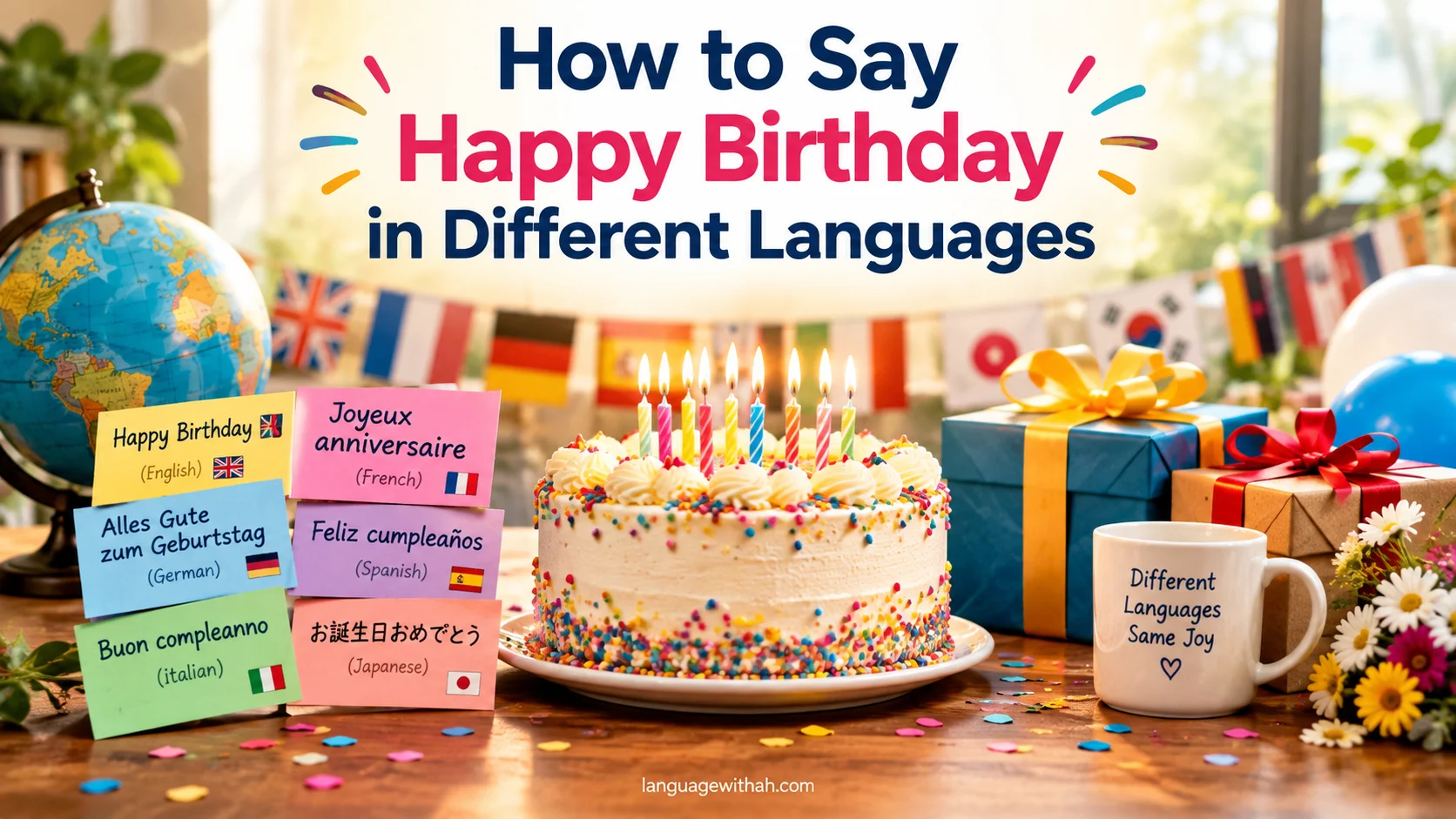
A birthday greeting can carry warmth, affection, friendship, and good wishes in just a few words. Learning how to say Happy Birthday in 70 Different Languages gives you more than a list of translations: it shows how different communities express celebration and personal connection.
A birthday message in someone’s native language can feel especially thoughtful when you are speaking with a friend, family member, partner, classmate, or colleague from another culture. Although the basic idea is similar everywhere, the natural expression is not always a direct word-for-word translation.
Some languages use a short phrase, while others use a form that literally means something closer to “good wishes for your birthday” or “may your birthday be happy.” Formality, grammar, regional usage, and pronunciation can also affect the wording.
Interesting Facts About Happy Birthday
- “Happy Birthday” is usually a fixed social expression, so a natural translation may not follow the English word order.
- Many languages use a phrase equivalent to “happy birthday,” “good birthday,” “joyful birthday,” or “congratulations on your birthday.”
- Some languages have formal and informal versions, particularly when speaking to older people, teachers, customers, or people you do not know well.
- In several languages, the birthday greeting changes according to grammar, politeness, or the relationship between speakers, rather than because the birthday itself is different.
- Some cultures commonly use a birthday expression alongside good wishes for health, happiness, or a long life.
- Pronunciation matters when using a birthday greeting in another language. A short greeting can sound much more natural when its rhythm and sounds are close to the target language.
- Languages using scripts such as Arabic, Chinese, Japanese, Korean, Hindi, Greek, Hebrew, and Thai can be especially useful for learners because the written form may look very different from its English equivalent.
- A literal translation is not always the best translation. For example, some languages naturally say something equivalent to “Congratulations on your birthday” rather than translating every English word separately.
What Does Happy Birthday Mean?
Happy Birthday is a friendly expression used to congratulate someone on the anniversary of their birth and to wish them happiness on that day.
Its basic meaning is a positive wish: “I hope you have a happy birthday.” People commonly say it to friends, relatives, children, partners, classmates, coworkers, and other people celebrating their birthday.
The expression can carry different emotional tones depending on the relationship. With a close friend, it may be followed by jokes, affection, or a personal message. With a coworker or acquaintance, a short “Happy Birthday!” may be enough. In a romantic relationship, the same greeting can become more personal when combined with affectionate words.
In other languages, the equivalent may use a slightly different structure. Some expressions focus on happiness, while others emphasize good wishes, congratulations, or celebration.
Why Can Happy Birthday Have Different Translations?
There is no single grammatical pattern for birthday greetings across the world’s languages. A phrase that sounds natural in English may sound unusual when translated word for word.
The best translation can depend on:
- Context: A birthday card may use a different tone from casual conversation.
- Formality: Some languages distinguish formal and informal speech.
- Relationship: Friends may use a shorter or more relaxed expression.
- Region: Different countries can prefer different birthday formulas.
- Grammar: Gender, case, honorifics, or verb forms may affect the wording.
- Dialect: Spoken varieties may use different expressions from the standard language.
- Written vs spoken language: A written birthday message can be longer than a spoken greeting.
- Literal vs natural translation: The most useful translation is normally the phrase a speaker would actually use.
For that reason, the entries below prioritize natural usage rather than forcing every language into the exact English structure.
European Languages
Europe contains several major language families, including Germanic, Romance, Slavic, Celtic, Baltic, Uralic, and Hellenic languages. Birthday greetings therefore vary considerably in grammar, pronunciation, and style. Some are short wishes, while others use a phrase meaning congratulations or good wishes for the person’s birthday.
English Varieties
| 🌍 Language | Country/Region | Translation | Pronunciation | Example Sentence |
| English | International | Happy Birthday! | HAP-ee BURTH-day | Happy Birthday! I hope you have a wonderful day. — Happy Birthday! |
| American English 🇺🇸 | United States | Happy Birthday! | HAP-ee BURTH-day | Happy Birthday, Emma! Have a great celebration. — Happy Birthday, Emma! |
| British English 🇬🇧 | United Kingdom | Happy Birthday! | HAP-ee BURTH-day | Happy Birthday! I hope you have a lovely day. — Happy Birthday! |
| Australian English 🇦🇺 | Australia | Happy Birthday! | HAP-ee BURTH-day | Happy Birthday, mate! Have a fantastic day. — Happy Birthday, friend! |
American, British, and Australian English do not normally require three different birthday translations. The expression is essentially the same. Differences are more likely to appear in accent, surrounding vocabulary, and conversational style.
European Birthday Expressions
| 🌍 Language | Country/Region | Translation | Pronunciation | Example Sentence |
| Spanish | Spain, Latin America | Feliz cumpleaños | feh-LEES koom-pleh-AHN-yos | ¡Feliz cumpleaños! Espero que tengas un día maravilloso. — Happy Birthday! I hope you have a wonderful day. |
| French | France, Belgium, Switzerland, other Francophone regions | Joyeux anniversaire | zhwa-YUH ah-nee-vair-SAIR | Joyeux anniversaire, Marie ! Passe une très belle journée. — Happy Birthday, Marie! Have a very lovely day. |
| German | Germany, Austria, Switzerland | Alles Gute zum Geburtstag | AL-les GOO-teh tsoom geh-BOORTS-tahk | Alles Gute zum Geburtstag! Ich wünsche dir einen schönen Tag. — Happy Birthday! I wish you a lovely day. |
| Italian | Italy, Switzerland | Buon compleanno | bwohn kom-pleh-AHN-noh | Buon compleanno! Ti auguro una giornata speciale. — Happy Birthday! I wish you a special day. |
| Portuguese | Portugal, Brazil, other Lusophone regions | Feliz aniversário | feh-LEEZ ah-nee-ver-SAH-ryoo | Feliz aniversário! Espero que aproveites o teu dia. — Happy Birthday! I hope you enjoy your day. |
| Dutch | Netherlands, Belgium | Gefeliciteerd met je verjaardag | gheh-feh-lee-see-TAIRT met yuh fer-YAHR-dahkh | Gefeliciteerd met je verjaardag! Ik wens je een fijne dag. — Happy Birthday! I wish you a lovely day. |
| Swedish | Sweden, Finland Swedish-speaking areas | Grattis på födelsedagen | GRAT-tis poh FUH-del-ser-dah-gen | Grattis på födelsedagen! Hoppas du får en fin dag. — Happy Birthday! I hope you have a nice day. |
| Norwegian | Norway | Gratulerer med dagen | grah-too-LEH-rer med DAH-gen | Gratulerer med dagen! Håper du får en flott dag. — Happy Birthday! I hope you have a great day. |
| Danish | Denmark | Tillykke med fødselsdagen | til-LUH-keh meh FUHD-sels-dah-en | Tillykke med fødselsdagen! Jeg håber, du får en dejlig dag. — Happy Birthday! I hope you have a lovely day. |
| Finnish | Finland | Hyvää syntymäpäivää | HUH-vah SUHN-tu-ma-pai-vah | Hyvää syntymäpäivää! Toivottavasti sinulla on hieno päivä. — Happy Birthday! I hope you have a great day. |
| Icelandic | Iceland | Til hamingju með afmælið | til HA-ming-yoo meth AV-my-lith | Til hamingju með afmælið! Vonandi áttu góðan dag. — Happy Birthday! I hope you have a good day. |
| Irish | Ireland | Lá breithe shona duit | law BREH-heh HUN-ah ditch | Lá breithe shona duit! Bain sult as do lá. — Happy Birthday! Enjoy your day. |
| Welsh | Wales | Pen-blwydd hapus | pen-bloo-ith HAP-is | Pen-blwydd hapus! Gobeithio y cewch ddiwrnod gwych. — Happy Birthday! I hope you have a great day. |
| Polish | Poland | Wszystkiego najlepszego z okazji urodzin | fshist-KYE-goh nah-LEP-shay-go z oh-KAH-zhee oo-ROH-dzeen | Wszystkiego najlepszego z okazji urodzin! — Happy Birthday! |
| Czech | Czech Republic | Všechno nejlepší k narozeninám | FSHEKH-noh NAY-lep-shee k nah-roh-zeh-NEE-nahm | Všechno nejlepší k narozeninám! Ať se ti splní všechna přání. — Happy Birthday! May all your wishes come true. |
| Slovak | Slovakia | Všetko najlepšie k narodeninám | FSHEHT-koh NAH-yep-shee k nah-roh-DEH-nee-nahm | Všetko najlepšie k narodeninám! Uži si svoj deň. — Happy Birthday! Enjoy your day. |
| Ukrainian | Ukraine | З днем народження! | Z dnem nah-roh-JEN-nyah | З днем народження! Бажаю тобі щастя. — Happy Birthday! I wish you happiness. |
| Russian | Russia and Russian-speaking communities | С днём рождения! | s dnyom razh-DEH-nee-yah | С днём рождения! Желаю тебе счастья и радости. — Happy Birthday! I wish you happiness and joy. |
| Romanian | Romania, Moldova | La mulți ani! | lah MOOLTS ahn | La mulți ani! Să ai o zi minunată. — Happy Birthday! Have a wonderful day. |
| Hungarian | Hungary | Boldog születésnapot! | BOL-dog SOO-let-esh-nah-pot | Boldog születésnapot! Kívánok neked egy szép napot. — Happy Birthday! I wish you a beautiful day. |
| Greek | Greece, Cyprus | Χρόνια πολλά! | CHROH-nyah poh-LAH | Χρόνια πολλά! Να έχεις μια υπέροχη μέρα. — Happy Birthday! Have a wonderful day. |
| Bulgarian | Bulgaria | Честит рожден ден! | cheh-STEE-t roh-ZHDEHN den | Честит рожден ден! Пожелавам ти много щастие. — Happy Birthday! I wish you lots of happiness. |
| Croatian | Croatia | Sretan rođendan! | SREH-tan roh-JEN-dan | Sretan rođendan! Želim ti puno sreće. — Happy Birthday! I wish you lots of happiness. |
| Serbian | Serbia and Serbian-speaking communities | Срећан рођендан! | SREH-chan roh-JEN-dan | Срећан рођендан! Желим ти пуно среће. — Happy Birthday! I wish you lots of happiness. |
| Slovenian | Slovenia | Vse najboljše za rojstni dan | vseh nah-BOL-sheh zah ROY-stnee dahn | Vse najboljše za rojstni dan! Želim ti čudovit dan. — Happy Birthday! I wish you a wonderful day. |
| Lithuanian | Lithuania | Su gimtadieniu! | soo gim-tah-DYEH-nyoo | Su gimtadieniu! Linkiu tau nuostabios dienos. — Happy Birthday! I wish you a wonderful day. |
| Latvian | Latvia | Daudz laimes dzimšanas dienā! | dowdz LIE-mes DZEEM-sha-nas dee-eh-NAH | Daudz laimes dzimšanas dienā! Lai tev skaista diena. — Happy Birthday! Have a beautiful day. |
| Estonian | Estonia | Palju õnne sünnipäevaks! | PAL-yoo URR-neh SOON-nee-pai-vaks | Palju õnne sünnipäevaks! Soovin sulle ilusat päeva. — Happy Birthday! I wish you a beautiful day. |
| Albanian | Albania, Kosovo and Albanian-speaking communities | Gëzuar ditëlindjen! | guh-ZOO-ar dee-teh-LIND-yen | Gëzuar ditëlindjen! Të uroj shumë lumturi. — Happy Birthday! I wish you much happiness. |
| Macedonian | North Macedonia | Среќен роденден! | SREH-kyen roh-DEN-den | Среќен роденден! Ти посакувам многу среќа. — Happy Birthday! I wish you lots of happiness. |
| Bosnian | Bosnia and Herzegovina | Sretan rođendan! | SREH-tan roh-JEN-dan | Sretan rođendan! Želim ti mnogo sreće. — Happy Birthday! I wish you lots of happiness. |
Cultural Notes for European Languages
The wording La mulți ani! in Romanian is especially interesting because it literally conveys a wish for “many years” and is also used on other celebratory occasions. Similarly, Greek Χρόνια πολλά! literally relates to “many years” and is a common celebratory expression.
In German, Alles Gute zum Geburtstag is a natural birthday wish rather than a literal mirror of English. In Dutch, Gefeliciteerd met je verjaardag includes the idea of congratulating someone on their birthday.
Slavic languages also show interesting variation. Russian С днём рождения!, Ukrainian З днем народження!, Serbian Срећан рођендан!, Croatian Sretan rođendan!, and Polish Wszystkiego najlepszego z okazji urodzin all express the same social purpose while using different grammatical structures.
Read More: How to Say I Am Fine in Different Languages
Asian Languages
Asia contains hundreds of languages and many different writing systems. Birthday expressions can appear in Chinese characters, Japanese kana and kanji, Korean Hangul, Indic scripts, Arabic-derived scripts, and Southeast Asian scripts. The examples below use widely understandable forms while noting useful differences where appropriate.
| 🌍 Language | Country/Region | Translation | Pronunciation | Example Sentence |
| Mandarin Chinese | China, Taiwan, Singapore and Chinese-speaking communities | 生日快乐 | Shēngrì kuàilè | 生日快乐!祝你今天开心。 — Happy Birthday! I hope you are happy today. |
| Cantonese | Hong Kong, Macau, Guangdong and Cantonese-speaking communities | 生日快樂 | saang1 jat6 faai3 lok6 | 生日快樂!祝你日日開心。 — Happy Birthday! I wish you happiness every day. |
| Japanese | Japan | お誕生日おめでとうございます | o-tan-jō-bi o-me-de-tō go-zai-mas | お誕生日おめでとうございます!素敵な一日を。 — Happy Birthday! Have a wonderful day. |
| Korean | South Korea, North Korea, Korean-speaking communities | 생일 축하해요 | saeng-il chu-ka-hae-yo | 생일 축하해요! 좋은 하루 보내세요. — Happy Birthday! Have a good day. |
| Hindi | India | जन्मदिन मुबारक हो | jan-ma-din mu-BAA-rak ho | जन्मदिन मुबारक हो! आपका दिन बहुत अच्छा रहे। — Happy Birthday! May you have a very good day. |
| Urdu | Pakistan, India and Urdu-speaking communities | سالگرہ مبارک ہو | saal-gir-HAH mu-BAA-rak ho | سالگرہ مبارک ہو! اللہ آپ کو خوش رکھے۔ — Happy Birthday! May you always be happy. |
| Bengali | Bangladesh, India | শুভ জন্মদিন | SHOO-bho jon-mo-din | শুভ জন্মদিন! তোমার দিনটি সুন্দর হোক। — Happy Birthday! May your day be beautiful. |
| Punjabi | India, Pakistan | ਜਨਮਦਿਨ ਮੁਬਾਰਕ | janam-din mu-BAA-rak | ਜਨਮਦਿਨ ਮੁਬਾਰਕ! ਤੁਹਾਡਾ ਦਿਨ ਖੁਸ਼ੀਆਂ ਭਰਿਆ ਹੋਵੇ। — Happy Birthday! May your day be full of happiness. |
| Gujarati | India | જન્મદિવસની શુભેચ્છાઓ | jan-ma-di-vaas-ni shu-bhech-chhaa-o | જન્મદિવસની શુભેચ્છાઓ! તમારો દિવસ સુંદર રહે. — Happy Birthday! May your day be wonderful. |
| Marathi | India | वाढदिवसाच्या हार्दिक शुभेच्छा | vaadh-di-va-saach-yaa haar-dik shub-hech-chhaa | वाढदिवसाच्या हार्दिक शुभेच्छा! तुमचा दिवस आनंदी जावो. — Happy Birthday! May your day be joyful. |
| Tamil | India, Sri Lanka, Tamil-speaking communities | பிறந்தநாள் வாழ்த்துக்கள் | pi-ran-tha-naal vaazh-thu-kal | பிறந்தநாள் வாழ்த்துக்கள்! உங்கள் நாள் இனிமையாக அமையட்டும். — Happy Birthday! May your day be sweet and wonderful. |
| Telugu | India | పుట్టినరోజు శుభాకాంక్షలు | put-ti-na-ro-ju shu-bhaa-kaan-ksha-lu | పుట్టినరోజు శుభాకాంక్షలు! మీ రోజు ఆనందంగా ఉండాలి. — Happy Birthday! May your day be joyful. |
| Kannada | India | ಹುಟ್ಟುಹಬ್ಬದ ಶುಭಾಶಯಗಳು | hut-tu-hab-ba-da shu-bhaa-sha-ya-ga-lu | ಹುಟ್ಟುಹಬ್ಬದ ಶುಭಾಶಯಗಳು! ನಿಮಗೆ ಸಂತೋಷದ ದಿನವಾಗಲಿ. — Happy Birthday! May you have a happy day. |
| Malayalam | India, Kerala and Malayalam-speaking communities | ജന്മദിനാശംസകൾ | jan-ma-di-naa-sham-sa-kal | ജന്മദിനാശംസകൾ! സന്തോഷകരമായ ഒരു ദിവസം ആശംസിക്കുന്നു. — Happy Birthday! Wishing you a happy day. |
| Nepali | Nepal, India | जन्मदिनको शुभकामना | jan-ma-di-nko shu-bha-kaa-ma-naa | जन्मदिनको शुभकामना! तपाईंको दिन सुखद रहोस्। — Happy Birthday! May your day be pleasant. |
| Sinhala | Sri Lanka | සුභ උපන්දිනයක් | su-bha u-pan-di-na-yak | සුභ උපන්දිනයක්! ඔබට සතුටින් පිරි දිනයක් වේවා. — Happy Birthday! May you have a day full of happiness. |
| Thai | Thailand | สุขสันต์วันเกิด | sùk-sǎn wan-gèrt | สุขสันต์วันเกิด! ขอให้มีความสุขมาก ๆ — Happy Birthday! May you be very happy. |
| Vietnamese | Vietnam | Chúc mừng sinh nhật | chook mung sin nyut | Chúc mừng sinh nhật! Chúc bạn một ngày thật vui. — Happy Birthday! I wish you a very happy day. |
| Indonesian | Indonesia | Selamat ulang tahun | seh-LAH-mat oo-LANG tah-hoon | Selamat ulang tahun! Semoga harimu menyenangkan. — Happy Birthday! I hope your day is enjoyable. |
| Malay | Malaysia, Brunei, Singapore and Malay-speaking communities | Selamat hari jadi | seh-LAH-mat HAH-ree JAH-dee | Selamat hari jadi! Semoga hari awak bahagia. — Happy Birthday! I hope you have a happy day. |
| Filipino/Tagalog | Philippines | Maligayang kaarawan | ma-lee-ga-YANG ka-a-ra-WAN | Maligayang kaarawan! Sana maging masaya ang araw mo. — Happy Birthday! I hope your day is happy. |
| Burmese | Myanmar | မွေးနေ့မင်္ဂလာပါ | mway-nay ming-ga-la-ba | မွေးနေ့မင်္ဂလာပါ! ပျော်ရွှင်သောနေ့လေး ဖြစ်ပါစေ။ — Happy Birthday! May it be a joyful day. |
| Khmer | Cambodia | រីករាយថ្ងៃកំណើត | rik-ree-yie thngai kam-naet | រីករាយថ្ងៃកំណើត! សូមឱ្យអ្នកមានសុភមង្គល។ — Happy Birthday! May you have happiness. |
| Lao | Laos | ສຸກສັນວັນເກີດ | suk-san van-geert | ສຸກສັນວັນເກີດ! ຂໍໃຫ້ມີຄວາມສຸກ. — Happy Birthday! May you be happy. |
Cultural Notes for Asian Languages
In Japanese, お誕生日おめでとうございます is a polite form. With close friends or family, お誕生日おめでとう is a more casual alternative.
Korean similarly changes according to politeness. 생일 축하해요 is polite and friendly, while 생일 축하합니다 is more formal. Close friends may use the casual 생일 축하해.
Mandarin Chinese uses 生日快乐 (Shēngrì kuàilè) widely. Cantonese uses the same characters in traditional form, 生日快樂, but pronunciation and some surrounding vocabulary differ.
South Asian languages often use birthday expressions that combine good wishes, blessings, or congratulations. The appropriate wording can also vary between formal and informal speech.
Middle Eastern and West Asian Languages
The Middle East and neighboring West Asian regions contain several distinct linguistic traditions. Arabic itself has many regional varieties, while Persian, Hebrew, Kurdish, Turkish, and Armenian have their own grammar and vocabulary. For Arabic, the expression below is Modern Standard Arabic, while everyday speech may vary by country.
| 🌍 Language | Country/Region | Translation | Pronunciation | Example Sentence |
| Arabic | Middle East and North Africa | عيد ميلاد سعيد | Eid mee-LAAD sa-EED | عيد ميلاد سعيد! أتمنى لك يوماً جميلاً. — Happy Birthday! I wish you a beautiful day. |
| Persian | Iran, Afghanistan, Tajikistan and Persian-speaking communities | تولدت مبارک | tava-LA-det mo-BAA-rak | تولدت مبارک! امیدوارم سال خوبی داشته باشی. — Happy Birthday! I hope you have a good year. |
| Hebrew | Israel and Hebrew-speaking communities | יום הולדת שמח | yom hoo-LE-det sa-ME-ach | יום הולדת שמח! שיהיה לך יום נפלא. — Happy Birthday! May you have a wonderful day. |
| Kurdish (Kurmanji) | Kurdistan regions and Kurdish-speaking communities | Rojbûna te pîroz be | roj-BOO-na te pee-ROZ beh | Rojbûna te pîroz be! Hêvî dikim ku rojeka xweş derbas bikî. — Happy Birthday! I hope you have a lovely day. |
| Turkish | Türkiye and Turkish-speaking communities | Doğum günün kutlu olsun | doh-OOM goo-NOON KOOT-loo OL-soon | Doğum günün kutlu olsun! Umarım harika bir gün geçirirsin. — Happy Birthday! I hope you have a wonderful day. |
| Armenian | Armenia and Armenian-speaking communities | Ծնունդդ շնորհավոր! | tsnoondt shnor-ha-VOR | Ծնունդդ շնորհավոր! Մաղթում եմ քեզ երջանկություն։ — Happy Birthday! I wish you happiness. |
Cultural Notes for Middle Eastern Languages
Arabic birthday greetings can differ in everyday conversation because dialects vary substantially across Arab countries. عيد ميلاد سعيد is a broadly understandable standard expression, while a speaker in Egypt, the Levant, the Gulf, or North Africa may use a regional form in casual speech.
Persian تولدت مبارک is a natural informal birthday wish. Hebrew יום הולדת שמח follows a straightforward “happy birthday” structure, while Turkish Doğum günün kutlu olsun literally expresses a wish that the person’s birthday be blessed or fortunate.
African Languages
Africa is one of the world’s most linguistically diverse regions, with languages from many unrelated families. A birthday greeting can therefore look and sound very different from one country or community to another. The examples below represent specific languages rather than treating any one expression as representative of an entire country.
| 🌍 Language | Country/Region | Translation | Pronunciation | Example Sentence |
| Swahili | Kenya, Tanzania, Uganda and East Africa | Heri ya siku ya kuzaliwa | HEH-ree ya SEE-koo ya koo-za-LEE-wa | Heri ya siku ya kuzaliwa! Nakutakia furaha nyingi. — Happy Birthday! I wish you lots of happiness. |
| Afrikaans | South Africa, Namibia | Gelukkige verjaardag | gheh-LUK-ki-ghe fer-YAHR-dakh | Gelukkige verjaardag! Ek hoop jy het ‘n wonderlike dag. — Happy Birthday! I hope you have a wonderful day. |
| Zulu | South Africa | Usuku lokuzalwa oluhle | oo-SOO-koo lo-koo-ZWAH-loh oo-LUH-leh | Usuku lokuzalwa oluhle! Ngikufisela injabulo. — Happy Birthday! I wish you happiness. |
| Xhosa | South Africa | Usuku lokuzalwa olumnandi | oo-SOO-koo lo-koo-ZWAH-loh oh-LOOM-ahn-dee | Usuku lokuzalwa olumnandi! Ndikunqwenelela ulonwabo. — Happy Birthday! I wish you happiness. |
| Amharic | Ethiopia | መልካም ልደት | mel-kam li-det | መልካም ልደት! ደስታ የተሞላበት ቀን ይሁንልዎ። — Happy Birthday! May it be a joyful day. |
| Yoruba | Nigeria, Benin and Yoruba-speaking communities | Ẹ kú ọjọ́ ìbí | eh koo oh-jaw ee-BEE | Ẹ kú ọjọ́ ìbí! Ọjọ́ rẹ á dùn. — Happy Birthday! May your day be joyful. |
| Igbo | Nigeria and Igbo-speaking communities | Ezi ụbọchị ọmụmụ | EH-zee oo-boo-ahs oh-MOO-moo | Ezi ụbọchị ọmụmụ! Ka ụbọchị gị bụrụ nke ọṅụ. — Happy Birthday! May your day be joyful. |
| Hausa | Nigeria, Niger and Hausa-speaking communities | Barka da ranar haihuwa | BAR-ka da RA-nar hai-HOO-wa | Barka da ranar haihuwa! Allah ya ƙara maka farin ciki. — Happy Birthday! May you have more happiness. |
| Somali | Somalia, Somaliland, Djibouti and Somali-speaking communities | Dhalasho wacan | dha-LA-sho WA-can | Dhalasho wacan! Waxaan kuu rajaynayaa farxad badan. — Happy Birthday! I wish you much happiness. |
| Shona | Zimbabwe and Shona-speaking communities | Makorokoto ezuva rekuzvarwa | ma-ko-ro-KO-to eh-ZOO-va reh-koo-ZVAR-wa | Makorokoto ezuva rekuzvarwa! Ndinokushuvira mufaro. — Happy Birthday! I wish you happiness. |
| Sesotho | Lesotho, South Africa | Letsatsi le monate la tsoalo | leh-TAH-tsee leh moh-NAH-teh la TSO-ah-lo | Letsatsi le monate la tsoalo! Ke u lakaletsa thabo. — Happy Birthday! I wish you happiness. |
Cultural Notes for African Languages
Africa does not have one shared birthday expression. Swahili, Yoruba, Hausa, Amharic, Zulu, Xhosa, and other languages belong to different linguistic traditions, so their birthday greetings should be learned individually.
In multilingual African communities, people may also switch between a local language and languages such as English, French, Portuguese, or Arabic depending on the country and social setting. A greeting in someone’s preferred or native language can therefore be a thoughtful choice, but the appropriate language depends on the person and community.
Other World Languages
Several languages outside the major regional groups also have distinctive birthday expressions. These examples show how the same basic idea can be communicated across Polynesian, Indigenous, and constructed-language contexts.
| 🌍 Language | Country/Region | Translation | Pronunciation | Example Sentence |
| Māori | New Zealand | Rā whānau | rah FAA-noh | Rā whānau! Kia hari tō rā. — Happy Birthday! Have a happy day. |
| Samoan | Samoa, American Samoa and Samoan communities | Manuia lou aso fanau | ma-noo-EE-ah loh AH-soh fa-NOW | Manuia lou aso fanau! Ia fiafia tele. — Happy Birthday! Be very happy. |
| Hawaiian | Hawaiʻi | Hauʻoli lā hānau | how-OH-lee lah HAH-now | Hauʻoli lā hānau! Hauʻoli kou lā. — Happy Birthday! Have a happy day. |
| Georgian | Georgia and Georgian-speaking communities | გილოცავ დაბადების დღეს! | gee-LO-tsav da-ba-DE-bis dghes | გილოცავ დაბადების დღეს! ბედნიერებას გისურვებ. — Happy Birthday! I wish you happiness. |
Quick Reference: Happy Birthday in Different Languages
| Language | Translation |
| English | Happy Birthday! |
| American English | Happy Birthday! |
| British English | Happy Birthday! |
| Australian English | Happy Birthday! |
| Spanish | Feliz cumpleaños |
| French | Joyeux anniversaire |
| German | Alles Gute zum Geburtstag |
| Italian | Buon compleanno |
| Portuguese | Feliz aniversário |
| Dutch | Gefeliciteerd met je verjaardag |
| Swedish | Grattis på födelsedagen |
| Norwegian | Gratulerer med dagen |
| Danish | Tillykke med fødselsdagen |
| Finnish | Hyvää syntymäpäivää |
| Icelandic | Til hamingju með afmælið |
| Irish | Lá breithe shona duit |
| Welsh | Pen-blwydd hapus |
| Polish | Wszystkiego najlepszego z okazji urodzin |
| Czech | Všechno nejlepší k narozeninám |
| Slovak | Všetko najlepšie k narodeninám |
| Ukrainian | З днем народження! |
| Russian | С днём рождения! |
| Romanian | La mulți ani! |
| Hungarian | Boldog születésnapot! |
| Greek | Χρόνια πολλά! |
| Bulgarian | Честит рожден ден! |
| Croatian | Sretan rođendan! |
| Serbian | Срећан рођендан! |
| Slovenian | Vse najboljše za rojstni dan |
| Lithuanian | Su gimtadieniu! |
| Latvian | Daudz laimes dzimšanas dienā! |
| Estonian | Palju õnne sünnipäevaks! |
| Albanian | Gëzuar ditëlindjen! |
| Macedonian | Среќен роденден! |
| Bosnian | Sretan rođendan! |
| Mandarin Chinese | 生日快乐 |
| Cantonese | 生日快樂 |
| Japanese | お誕生日おめでとうございます |
| Korean | 생일 축하해요 |
| Hindi | जन्मदिन मुबारक हो |
| Urdu | سالگرہ مبارک ہو |
| Bengali | শুভ জন্মদিন |
| Punjabi | ਜਨਮਦਿਨ ਮੁਬਾਰਕ |
| Gujarati | જન્મદિવસની શુભેચ્છાઓ |
| Marathi | वाढदिवसाच्या हार्दिक शुभेच्छा |
| Tamil | பிறந்தநாள் வாழ்த்துக்கள் |
| Telugu | పుట్టినరోజు శుభాకాంక్షలు |
| Kannada | ಹುಟ್ಟುಹಬ್ಬದ ಶುಭಾಶಯಗಳು |
| Malayalam | ജന്മദിനാശംസകൾ |
| Nepali | जन्मदिनको शुभकामना |
| Sinhala | සුභ උපන්දිනයක් |
| Thai | สุขสันต์วันเกิด |
| Vietnamese | Chúc mừng sinh nhật |
| Indonesian | Selamat ulang tahun |
| Malay | Selamat hari jadi |
| Filipino/Tagalog | Maligayang kaarawan |
| Burmese | မွေးနေ့မင်္ဂလာပါ |
| Khmer | រីករាយថ្ងៃកំណើត |
| Lao | ສຸກສັນວັນເກີດ |
| Arabic | عيد ميلاد سعيد |
| Persian | تولدت مبارک |
| Hebrew | יום הולדת שמח |
| Kurdish | Rojbûna te pîroz be |
| Turkish | Doğum günün kutlu olsun |
| Armenian | Ծնունդդ շնորհավոր! |
| Swahili | Heri ya siku ya kuzaliwa |
| Afrikaans | Gelukkige verjaardag |
| Zulu | Usuku lokuzalwa oluhle |
| Xhosa | Usuku lokuzalwa olumnandi |
| Amharic | መልካም ልደት |
| Yoruba | Ẹ kú ọjọ́ ìbí |
| Igbo | Ezi ụbọchị ọmụmụ |
| Hausa | Barka da ranar haihuwa |
| Somali | Dhalasho wacan |
| Shona | Makorokoto ezuva rekuzvarwa |
| Sesotho | Letsatsi le monate la tsoalo |
| Māori | Rā whānau |
| Samoan | Manuia lou aso fanau |
| Hawaiian | Hauʻoli lā hānau |
| Georgian | გილოცავ დაბადების დღეს! |
How to Choose the Right Translation
The best birthday translation depends on who you are speaking to and where the person uses the language.
- Check the region: Spanish in Spain and Spanish in Latin America are highly mutually understandable, but vocabulary and surrounding expressions can vary.
- Consider formality: Japanese and Korean provide particularly clear examples of how politeness affects everyday expressions.
- Think about your relationship: A close friend may prefer a casual expression, while a teacher, customer, or older relative may call for a more respectful form.
- Use the person’s preferred variety: Someone who speaks a regional language or dialect may appreciate that expression more than a standardized alternative.
- Check pronunciation: Knowing the written translation is useful, but saying it naturally requires attention to pronunciation.
- Consider the medium: A birthday card, text message, social-media post, and spoken greeting can use slightly different wording.
- Keep the message natural: You do not need to translate an entire English birthday message word for word. A short, culturally natural greeting is often better.
Common Mistakes When Translating Happy Birthday
1. Translating Every Word Literally
A literal translation can produce a sentence that is grammatically possible but unnatural. Birthday greetings are often fixed expressions, so learn the phrase speakers actually use.
2. Ignoring Formality
Some languages distinguish between casual, polite, and formal forms. Japanese お誕生日おめでとう and お誕生日おめでとうございます illustrate how the relationship between speakers can influence the greeting.
3. Treating One Dialect as Universal
Arabic, Kurdish, Chinese varieties, and many other languages have regional differences. A standard expression may be broadly understood without being the only expression used in everyday speech.
4. Assuming Similar Languages Use Identical Phrases
Croatian, Serbian, Bosnian, and other closely related languages can share vocabulary while still having differences in spelling, pronunciation, and preferred forms.
5. Ignoring Pronunciation
A correctly written greeting can still be difficult to understand if the pronunciation is far from the target language. Listen to native speech when possible and pay attention to rhythm and sounds.
6. Forgetting Grammatical Context
Some expressions change depending on politeness, gender, number, case, or sentence structure. A dictionary entry alone may not explain how the phrase works in a real conversation.
7. Copying an English Sentence Structure
The purpose of a translation is to communicate the same idea naturally. A good translation may look completely different from the English original while still expressing the same birthday wish.
Why Learn Happy Birthday in Different Languages?
Learning Happy Birthday in different languages is a small but practical way to explore vocabulary, pronunciation, and cultural expression.
For travelers, it can provide an easy way to participate in a celebration. For language learners, birthday greetings are useful because they introduce common vocabulary related to people, celebrations, wishes, happiness, and special occasions.
It can also make a message more personal. Sending Feliz cumpleaños, Joyeux anniversaire, 生日快乐, or another appropriate expression to someone who speaks that language shows that you have taken time to communicate in a form connected to their language and culture.
Most importantly, multilingual greetings encourage curiosity and respectful communication. A birthday phrase may be short, but understanding how it works can reveal differences in grammar, politeness, pronunciation, and cultural conventions.
FAQs:
How do you say Happy Birthday in different languages?
You can say Happy Birthday in many ways depending on the language. Examples include Feliz cumpleaños in Spanish, Joyeux anniversaire in French, Buon compleanno in Italian, 生日快乐 in Mandarin Chinese, 생일 축하해요 in Korean, and عيد ميلاد سعيد in Arabic.
What is the most natural translation of Happy Birthday?
There is no single translation that is natural in every language. The best expression is the conventional birthday greeting used by speakers of that language. For example, German commonly uses Alles Gute zum Geburtstag, while Romanian commonly uses La mulți ani!
Can the translation change by country?
Yes. A language may be spoken across several countries or regions, and speakers may prefer different expressions. Arabic is a clear example because everyday speech differs considerably between Arab countries.
Why do some languages have multiple birthday translations?
Languages can have several natural expressions because speakers use different levels of formality, regional vocabulary, dialect, and social style. A formal birthday card may use a different phrase from a casual message between friends.
Does pronunciation change between regions?
It can. The written form may remain similar while pronunciation changes according to the local accent or dialect. This is particularly relevant for widely spoken languages such as English, Spanish, Arabic, and Chinese varieties.
Conclusion:
Learning how to say Happy Birthday in different languages is a simple way to make celebrations more personal while discovering how languages express good wishes. Although the basic idea is universal, the natural wording can vary greatly. Some languages focus on happiness, some on congratulations, and others use expressions connected with long life or good wishes.
The most important lesson is that literal translation is not always natural translation. Context, formality, regional usage, pronunciation, and the relationship between speakers can all influence the best expression. Taking a moment to learn the correct wording can help you avoid awkward translations and communicate more respectfully.













1 thought on “How to Say Happy Birthday in Different Languages”