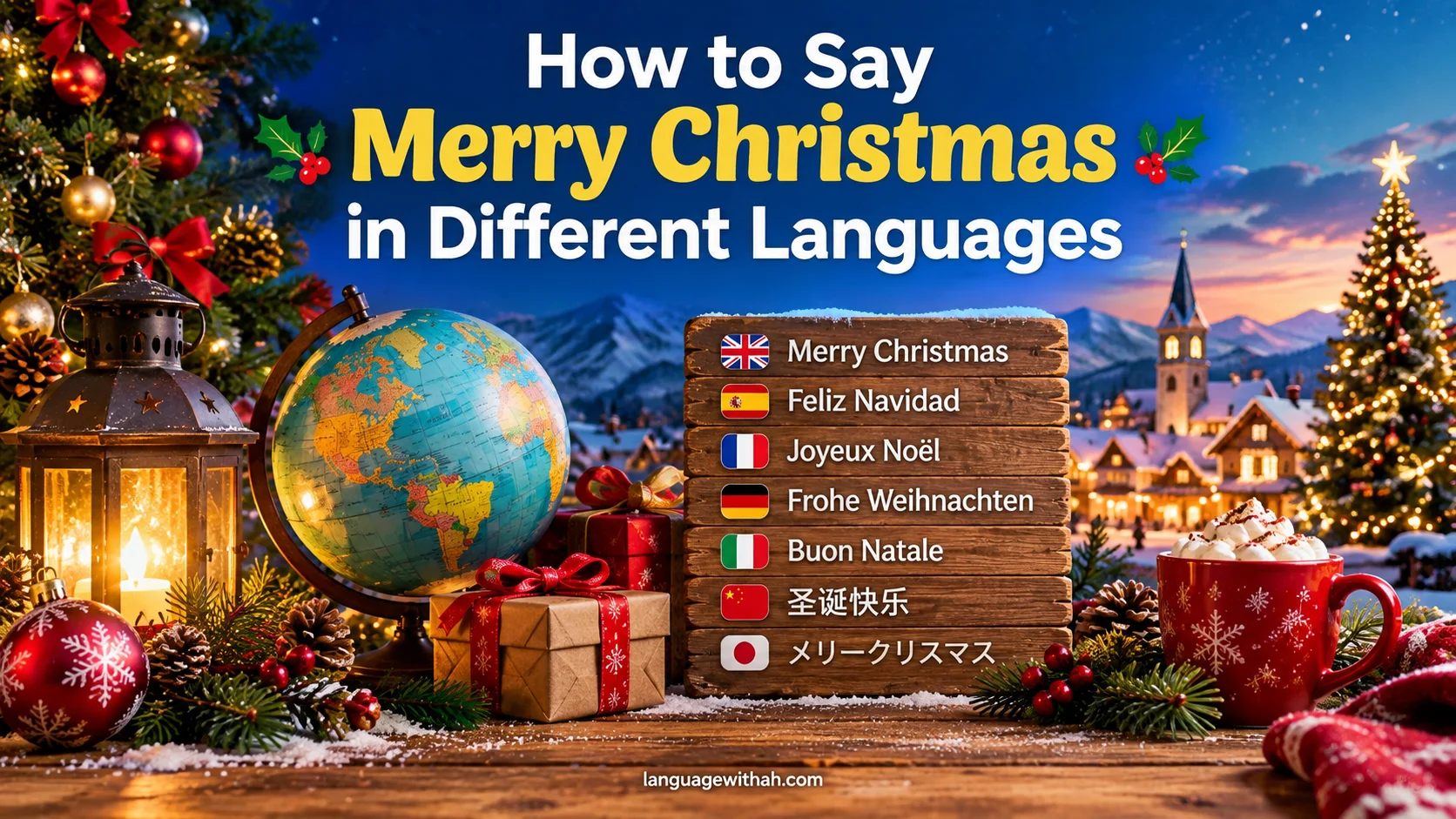
Merry Christmas is a warm seasonal greeting used to share good wishes during Christmas. Saying Merry Christmas in 70 different languages is also a simple way to explore how people around the world express celebration, goodwill, family connection, and religious or cultural traditions. While the basic message remains familiar, the wording can change considerably from one language to another.
Learning how to say Merry Christmas in another language can be useful when writing a holiday card, sending a message to an international friend, traveling during the festive season, or simply learning more about another culture. Some languages use a direct equivalent of “Merry Christmas,” while others use an expression closer to “Happy Christmas,” “Blessed Christmas,” or a traditional Christmas greeting.
The tables below cover languages from Europe, Asia, Africa, the Middle East, and other parts of the world. Each entry includes the natural greeting, pronunciation, region, and an example. Keep in mind that wording can vary according to dialect, formality, religious tradition, country, and local usage. A literal translation is not always the most natural way to express the same seasonal wish.
Interesting Facts About Merry Christmas
- “Merry Christmas” is a seasonal greeting, rather than a sentence normally used to describe an event. Its purpose is to offer good wishes around Christmas.
- Different languages may use words meaning happy, joyful, blessed, peaceful, or good rather than translating “merry” literally.
- In some languages, the Christmas greeting is closely connected with the religious meaning of Christmas, while in others it is commonly used as a general seasonal greeting.
- Some languages have more than one natural form. The choice may depend on region, relationship, formality, or religious tradition.
- In several languages, Christmas greetings are influenced by local traditions and may mention Christ’s birth, Christmas celebrations, or the holiday season rather than using a direct equivalent of the English phrase.
- Languages with different writing systems can express the same greeting in very different visual forms. For example, Chinese uses Chinese characters, Japanese uses katakana, Korean uses Hangul, and Arabic uses the Arabic script.
- In countries where more than one language is widely spoken, people may choose different Christmas greetings depending on their community, family background, or region.
What Does Merry Christmas Mean?
Merry Christmas is a friendly expression used to wish someone happiness and enjoyment during the Christmas season.
The word “merry” conveys an idea of happiness, cheer, and celebration. “Christmas” refers to the Christian festival commemorating the birth of Jesus Christ. In everyday communication, however, the greeting can be used simply as a warm seasonal wish between friends, relatives, colleagues, neighbors, and other people.
The phrase can be used in several situations:
- Greeting someone in person during the Christmas season.
- Ending a holiday conversation.
- Writing a Christmas card.
- Sending a text or social-media message.
- Adding a personal wish to a gift.
- Greeting family members or friends.
- Wishing travelers or international colleagues a pleasant Christmas.
The exact wording differs between languages. Some expressions are close to “Merry Christmas,” while others are closer to “Happy Christmas” or “Blessed Christmas.”
Why Can Merry Christmas Have Different Translations?
There is not always one perfect word-for-word translation of Merry Christmas.
Languages organize meaning differently, and Christmas greetings are often shaped by local usage. A translation can change according to:
- Context: A greeting on a card may differ from a spoken greeting.
- Formality: Some languages distinguish between informal and polite forms.
- Region: A language can have different Christmas expressions in different countries.
- Religion: Christian communities may use traditional religious greetings that differ from secular holiday wording.
- Grammar: Adjectives, nouns, and endings may change according to grammatical gender, number, or case.
- Natural usage: A phrase that is technically understandable may not be the expression people normally use.
- Writing system: Some languages require a native script plus a romanized pronunciation for English-speaking learners.
For this reason, the translations below focus on natural expressions used to convey the Christmas greeting, rather than forcing every language into the same grammatical structure.
European Languages
Europe contains several major language families, including Germanic, Romance, Slavic, Celtic, Baltic, and Uralic languages. Christmas greetings therefore vary in vocabulary, grammar, pronunciation, and cultural style. Some are direct equivalents of “Merry Christmas,” while others use expressions meaning “Happy Christmas” or “Good Christmas.”
The forms below represent commonly understandable greetings rather than claiming that one expression is the only possible form in each language.
European Languages Table
| 🌍 Language | Country/Region | Translation | Pronunciation | Example Sentence |
| English | International | Merry Christmas | MEH-ree KRIS-məs | Merry Christmas! I hope you have a wonderful holiday. |
| Spanish | Spain, Latin America | Feliz Navidad | feh-LEES nah-vee-DAHD | ¡Feliz Navidad! Espero que disfrutes de las fiestas. — Merry Christmas! I hope you enjoy the holidays. |
| French | France, Belgium, Canada, other Francophone regions | Joyeux Noël | zhwa-YUH no-EL | Joyeux Noël ! Profitez bien des fêtes. — Merry Christmas! Enjoy the holidays. |
| German | Germany, Austria, Switzerland | Frohe Weihnachten | FROH-eh VY-nahk-ten | Frohe Weihnachten! Ich wünsche dir schöne Feiertage. — Merry Christmas! I wish you happy holidays. |
| Italian | Italy, Switzerland | Buon Natale | bwohn nah-TAH-leh | Buon Natale! Ti auguro tanta felicità. — Merry Christmas! I wish you lots of happiness. |
| Portuguese | Portugal, Brazil, other Lusophone regions | Feliz Natal | feh-LEEZ nah-TAHL | Feliz Natal! Desejo-lhe muita alegria. — Merry Christmas! I wish you much joy. |
| Dutch | Netherlands, Belgium | Vrolijk kerstfeest | VROH-lək KERST-fayst | Vrolijk kerstfeest! Ik wens je fijne feestdagen. — Merry Christmas! I wish you happy holidays. |
| Swedish | Sweden, Finland Swedish communities | God jul | goo yool | God jul! Hoppas du får en fin jul. — Merry Christmas! I hope you have a lovely Christmas. |
| Norwegian | Norway | God jul | goo yool | God jul! Jeg håper du får en fin julefeiring. — Merry Christmas! I hope you have a lovely Christmas celebration. |
| Danish | Denmark | Glædelig jul | GLEH-the-lee yool | Glædelig jul! Jeg ønsker dig en dejlig jul. — Merry Christmas! I wish you a wonderful Christmas. |
| Finnish | Finland | Hyvää joulua | HOO-vah YOH-loo-ah | Hyvää joulua! Toivottavasti vietät mukavan joulun. — Merry Christmas! I hope you have a nice Christmas. |
| Icelandic | Iceland | Gleðileg jól | GLEH-theh-leg yohl | Gleðileg jól! Vonandi verður jólin þín góð. — Merry Christmas! I hope your Christmas is good. |
| Irish | Ireland | Nollaig Shona | NOL-ig HUN-ah | Nollaig Shona! Églaí? Nollaig Shona duit. — Merry Christmas to you. |
| Welsh | Wales | Nadolig Llawen | nah-DOL-ig HLOW-en | Nadolig Llawen! Gobeithio y cewch Nadolig hyfryd. — Merry Christmas! I hope you have a lovely Christmas. |
| Scottish Gaelic | Scotland | Nollaig Chridheil | NOL-ig KREE-el | Nollaig Chridheil! Tha mi a’ guidhe Nollaig mhath dhut. — Merry Christmas! |
| Polish | Poland | Wesołych Świąt | veh-SOH-wikh shvyont | Wesołych Świąt! Życzę ci spokojnych i radosnych świąt. — Merry Christmas! I wish you peaceful and joyful holidays. |
| Czech | Czech Republic | Veselé Vánoce | VEH-seh-leh VAA-no-tseh | Veselé Vánoce! Přeji vám krásné svátky. — Merry Christmas! I wish you wonderful holidays. |
| Slovak | Slovakia | Veselé Vianoce | VEH-seh-leh VYA-no-tseh | Veselé Vianoce! Prajem vám pokojné sviatky. — Merry Christmas! I wish you peaceful holidays. |
| Ukrainian | Ukraine | З Різдвом! | z riz-DVOM | З Різдвом! Бажаю вам миру та радості. — Merry Christmas! I wish you peace and joy. |
| Russian | Russia and Russian-speaking communities | С Рождеством! | s razh-dee-STVOM | С Рождеством! Желаю вам мира и радости. — Merry Christmas! I wish you peace and joy. |
| Belarusian | Belarus | З Калядамі! | z ka-LYA-da-mee | З Калядамі! Жадаю вам шчасця і міру. — Merry Christmas! I wish you happiness and peace. |
| Romanian | Romania, Moldova | Crăciun fericit | kruh-CHOON feh-ree-CHEET | Crăciun fericit! Îți doresc sărbători frumoase. — Merry Christmas! I wish you beautiful holidays. |
| Hungarian | Hungary | Boldog karácsonyt | BOL-dog ka-RAACH-ont | Boldog karácsonyt! Kellemes ünnepeket kívánok. — Merry Christmas! I wish you pleasant holidays. |
| Greek | Greece, Cyprus | Καλά Χριστούγεννα | ka-LA khri-STOO-yeh-na | Καλά Χριστούγεννα! Σας εύχομαι χαρά και υγεία. — Merry Christmas! I wish you joy and health. |
| Bulgarian | Bulgaria | Весела Коледа | VEH-seh-la ko-LEH-da | Весела Коледа! Пожелавам ви много радост. — Merry Christmas! I wish you much joy. |
| Croatian | Croatia, Bosnia and Herzegovina | Sretan Božić | SREH-tan BOH-zhich | Sretan Božić! Želim vam puno mira i radosti. — Merry Christmas! I wish you much peace and joy. |
| Serbian | Serbia and Serbian-speaking communities | Srećan Božić | SREH-chan BOH-zhich | Srećan Božić! Želim vam zdravlje i sreću. — Merry Christmas! I wish you health and happiness. |
| Slovenian | Slovenia | Vesel božič | VEH-sel BOH-zhich | Vesel božič! Želim ti mirne praznike. — Merry Christmas! I wish you peaceful holidays. |
| Lithuanian | Lithuania | Linksmų Kalėdų | LINK-smoo ka-LEH-doo | Linksmų Kalėdų! Linkiu jums jaukių švenčių. — Merry Christmas! I wish you cozy holidays. |
| Latvian | Latvia | Priecīgus Ziemassvētkus | PRYEH-tsi-goos ZYEH-mahs-sveh-tkoos | Priecīgus Ziemassvētkus! Lai jums jauki svētki. — Merry Christmas! Have a lovely holiday. |
| Estonian | Estonia | Häid jõule | hayd YOH-leh | Häid jõule! Soovin teile rahulikke pühi. — Merry Christmas! I wish you peaceful holidays. |
| Albanian | Albania, Kosovo and Albanian-speaking communities | Gëzuar Krishtlindjen | guh-ZOO-ar krisht-LIND-yen | Gëzuar Krishtlindjen! Ju uroj shumë gëzim. — Merry Christmas! I wish you much joy. |
| Armenian | Armenia and Armenian communities | Շնորհավոր Սուրբ Ծնունդ | shnor-ha-VOR soorp tsuh-NOOND | Շնորհավոր Սուրբ Ծնունդ! Մաղթում եմ խաղաղություն և ուրախություն։ — Merry Christmas! I wish you peace and joy. |
| Georgian | Georgia | შობას გილოცავთ | SHO-bas gi-lo-TSAVT | შობას გილოცავთ! ბედნიერებას გისურვებთ. — Merry Christmas! I wish you happiness. |
| Catalan | Catalonia, Valencia, Balearic Islands | Bon Nadal | bon nah-DAHL | Bon Nadal! Que passeu unes bones festes. — Merry Christmas! Have a wonderful holiday. |
| Basque | Basque Country | Eguberri on | eh-goo-BEH-ree on | Eguberri on! Zoriontasuna opa dizut. — Merry Christmas! I wish you happiness. |
| Galician | Galicia, Spain | Bo Nadal | boh nah-DAHL | Bo Nadal! Que teñades unhas festas felices. — Merry Christmas! Have happy holidays. |
| Maltese | Malta | Il-Milied it-Tajjeb | il-MEE-lee-ed it-TYEH-yeb | Il-Milied it-Tajjeb! Nawguralk Milied sabiħ. — Merry Christmas! I wish you a beautiful Christmas. |
| Luxembourgish | Luxembourg | Schéine Chrëschtdag | SHAY-neh KRESH-tahk | Schéine Chrëschtdag! Ech wënschen Iech schéi Feierdeeg. — Merry Christmas! I wish you happy holidays. |
| Esperanto | International constructed language | Ĝojan Kristnaskon | ZHO-yan kris-NAS-kon | Ĝojan Kristnaskon! Mi deziras al vi pacajn festojn. — Merry Christmas! I wish you peaceful holidays. |
| West Frisian | Netherlands, Friesland | Noflike Krystdagen | NOF-li-ke KRIST-da-ghen | Noflike Krystdagen! Ik winskje jo in moaie Kryst. — Merry Christmas! I wish you a lovely Christmas. |
| Faroese | Faroe Islands | Gleðilig jól | GLEH-li-lig yohl | Gleðilig jól! Vónandi fáa tit ein góðan jól. — Merry Christmas! I hope you have a good Christmas. |
| Macedonian | North Macedonia | Среќен Божиќ | SREH-kyen BOH-zhik | Среќен Божиќ! Ви посакувам мир и радост. — Merry Christmas! I wish you peace and joy. |
| Turkish | Turkey, Cyprus and surrounding regions | Mutlu Noeller | MOOT-loo NO-el-ler | Mutlu Noeller! Size huzurlu bir Noel diliyorum. — Merry Christmas! I wish you a peaceful Christmas. |
English Varieties
American English 🇺🇸
Merry Christmas is the standard Christmas greeting in American English. The wording itself does not need to change simply because the speaker is American.
Example: Merry Christmas! I hope you and your family have a wonderful holiday.
British English 🇬🇧
British English commonly uses Merry Christmas, and Happy Christmas is also well established, particularly in everyday British usage.
Example: Merry Christmas! Have a lovely Christmas with your family.
Australian English 🇦🇺
Australian English commonly uses Merry Christmas. The expression remains the same, although accent and surrounding vocabulary may differ from American or British English.
Example: Merry Christmas! Hope you have a great Christmas and a relaxing break.
The important point is that these are regional varieties of English, not separate languages with completely different Christmas translations.
Read More: How to Say Let’s Go in Different Languages
Asian Languages
Asia contains hundreds of languages and numerous writing systems. Christmas greetings can therefore look and sound very different across the region. Some expressions are direct translations, while others are borrowed forms, traditional religious greetings, or locally natural seasonal expressions.
The following examples represent commonly understandable forms.
| 🌏 Language | Country/Region | Translation | Pronunciation | Example Sentence |
| Mandarin Chinese | China, Taiwan, Singapore and Chinese-speaking communities | 圣诞快乐 | Shèngdàn kuàilè | 圣诞快乐! 祝你和家人度过一个美好的圣诞节。 — Merry Christmas! Have a wonderful Christmas with your family. |
| Cantonese | Hong Kong, Macau, Guangdong | 聖誕快樂 | sing daan faai lok | 聖誕快樂! 祝你聖誕節開心。 — Merry Christmas! Have a happy Christmas. |
| Japanese | Japan | メリークリスマス | merī kurisumasu | メリークリスマス! 楽しいクリスマスを過ごしてください。 — Merry Christmas! Please have a wonderful Christmas. |
| Korean | South Korea | 메리 크리스마스 | meri keuriseumaseu | 메리 크리스마스! 행복한 크리스마스 보내세요. — Merry Christmas! Have a happy Christmas. |
| Hindi | India | मेरी क्रिसमस / शुभ क्रिसमस | merī krismas / shubh krismas | मेरी क्रिसमस! आपको और आपके परिवार को ढेरों शुभकामनाएँ। — Merry Christmas! Best wishes to you and your family. |
| Urdu | Pakistan, India and Urdu-speaking communities | کرسمس مبارک | krismas mubarak | کرسمس مبارک! آپ کو اور آپ کے خاندان کو بہت خوشیاں ملیں۔ — Merry Christmas! May you and your family have much happiness. |
| Bengali | Bangladesh, India | শুভ বড়দিন | shubho bo-ro-din | শুভ বড়দিন! আপনার পরিবারকে বড়দিনের শুভেচ্ছা। — Merry Christmas! Christmas wishes to your family. |
| Punjabi | India, Pakistan | میری کرسمس | merī krismas | میری کرسمس! تہاڈے سارے پرواڑ نوں خوشیاں ملن۔ — Merry Christmas! May your whole family be happy. |
| Gujarati | India | નાતાલની શુભકામનાઓ | nātāl-nī shubh-kām-nāo | નાતાલની શુભકામનાઓ! તમને અને તમારા પરિવારને આનંદમય નાતાલની શુભેચ્છા. — Merry Christmas! Best Christmas wishes to you and your family. |
| Marathi | India | शुभ नाताळ | shubh nātāḷ | शुभ नाताळ! तुम्हाला आणि तुमच्या कुटुंबाला आनंदी नाताळच्या शुभेच्छा. — Merry Christmas! |
| Tamil | India, Sri Lanka, Singapore | கிறிஸ்துமஸ் நல்வாழ்த்துக்கள் | kiṟistumas nalvāḻttukkaḷ | கிறிஸ்துமஸ் நல்வாழ்த்துக்கள்! உங்களுக்கும் உங்கள் குடும்பத்திற்கும் என் வாழ்த்துக்கள். — Merry Christmas! My wishes to you and your family. |
| Telugu | India | మెర్రీ క్రిస్మస్ | merrī krismas | మెర్రీ క్రిస్మస్! మీ కుటుంబానికి క్రిస్మస్ శుభాకాంక్షలు. — Merry Christmas! Christmas wishes to your family. |
| Kannada | India | ಕ್ರಿಸ್ಮಸ್ ಹಬ್ಬದ ಶುಭಾಶಯಗಳು | kris-mas habbada shubhāshayagalu | ಕ್ರಿಸ್ಮಸ್ ಹಬ್ಬದ ಶುಭಾಶಯಗಳು! ನಿಮಗೂ ನಿಮ್ಮ ಕುಟುಂಬಕ್ಕೂ ಸಂತೋಷ ಸಿಗಲಿ. — Merry Christmas! May you and your family have happiness. |
| Malayalam | India | ക്രിസ്മസ് ആശംസകൾ | krismas āśamsakaḷ | ക്രിസ്മസ് ആശംസകൾ! നിങ്ങൾക്കും കുടുംബത്തിനും സന്തോഷകരമായ ക്രിസ്മസ് ആശംസിക്കുന്നു. — Merry Christmas! Wishing you and your family a happy Christmas. |
| Nepali | Nepal, India | क्रिसमसको शुभकामना | krismasko shubhakamana | क्रिसमसको शुभकामना! तपाईं र तपाईंको परिवारलाई सुख र शान्तिको शुभकामना। — Merry Christmas! Wishing you and your family happiness and peace. |
| Sinhala | Sri Lanka | සුභ නත්තලක් | subha nattalak | සුභ නත්තලක්! ඔබටත් ඔබේ පවුලේ අයටත් සතුට පිරි නත්තලක් වේවා. — Merry Christmas! May you and your family have a joyful Christmas. |
| Thai | Thailand | สุขสันต์วันคริสต์มาส | suk-san wan khrit-mat | สุขสันต์วันคริสต์มาส! ขอให้มีความสุขในวันคริสต์มาสนะครับ/ค่ะ — Merry Christmas! Wishing you happiness at Christmas. |
| Vietnamese | Vietnam | Chúc mừng Giáng sinh | chook mung zyang sinh | Chúc mừng Giáng sinh! Chúc bạn và gia đình một mùa Giáng sinh vui vẻ. — Merry Christmas! Wishing you and your family a joyful Christmas season. |
| Indonesian | Indonesia | Selamat Natal | suh-LAH-maht nah-TAHL | Selamat Natal! Semoga Natalmu penuh sukacita. — Merry Christmas! May your Christmas be full of joy. |
| Malay | Malaysia, Brunei, Singapore | Selamat Hari Natal | suh-LAH-maht HAH-ree nah-TAHL | Selamat Hari Natal! Semoga anda sekeluarga bergembira. — Merry Christmas! May you and your family enjoy yourselves. |
| Filipino / Tagalog | Philippines | Maligayang Pasko | ma-lee-GAH-yang PAS-ko | Maligayang Pasko! Nawa’y maging masaya ang inyong Pasko. — Merry Christmas! May your Christmas be happy. |
| Burmese | Myanmar | ပျော်ရွှင်စရာ ခရစ္စမတ် ဖြစ်ပါစေ | pyaw-shwin-zar kha-yit-ma | ပျော်ရွှင်စရာ ခရစ္စမတ် ဖြစ်ပါစေ။ — May you have a joyful Christmas. |
| Khmer | Cambodia | រីករាយថ្ងៃបុណ្យណូអែល | riik-riəy thngai bon Noël | រីករាយថ្ងៃបុណ្យណូអែល! សូមឲ្យអ្នកមានសុភមង្គល។ — Merry Christmas! May you be happy. |
| Lao | Laos | ສຸກສັນວັນຄຣິດສະມາດ | suk-san wan khrit-sa-mat | ສຸກສັນວັນຄຣິດສະມາດ! ຂໍໃຫ້ມີຄວາມສຸກ. — Merry Christmas! Wishing you happiness. |
| Mongolian | Mongolia | Зул сарын мэнд хүргэе | zul sa-rin mend khur-gye | Зул сарын мэнд хүргэе! Танд аз жаргал хүсье. — Merry Christmas! I wish you happiness. |
| Kazakh | Kazakhstan | Рождество құтты болсын | rozhdestvo qutty bolsyn | Рождество құтты болсын! Сізге бейбітшілік пен қуаныш тілеймін. — Merry Christmas! I wish you peace and joy. |
| Uzbek | Uzbekistan | Rojdestvo muborak | roj-dest-VO moo-bo-RAK | Rojdestvo muborak! Sizga tinchlik va quvonch tilayman. — Merry Christmas! I wish you peace and joy. |
| Tajik | Tajikistan | Мавлуди Исо муборак | mavludi Iso muborak | Мавлуди Исо муборак! Ба шумо хушбахтӣ ва осоиштагӣ мехоҳам. — Merry Christmas! I wish you happiness and peace. |
| Azerbaijani | Azerbaijan | Milad bayramınız mübarək | mee-LAD bye-rah-muh-nuhz moo-BAH-rek | Milad bayramınız mübarək! Sizə sevinc və xoşbəxtlik arzulayıram. — Merry Christmas! I wish you joy and happiness. |
| Javanese | Java, Indonesia | Sugeng Natal | SOO-geng nah-TAHL | Sugeng Natal! Mugi Natal panjenengan kebak kabungahan. — Merry Christmas! May your Christmas be full of joy. |
Middle Eastern Languages
The Middle East includes several distinct language families and traditions. Christmas greetings can differ between Modern Standard Arabic and regional Arabic varieties, and Christian communities may use traditional religious greetings that are different from everyday secular expressions.
| 🌍 Language | Country/Region | Translation | Pronunciation | Example Sentence |
| Arabic | Middle East and Arabic-speaking regions | عيد ميلاد مجيد | ʿīd mīlād majīd | عيد ميلاد مجيد! أتمنى لكم عيدًا مليئًا بالفرح والسلام. — Merry Christmas! I wish you a Christmas full of joy and peace. |
| Persian / Farsi | Iran and Persian-speaking communities | کریسمس مبارک | kerismas mobārak | کریسمس مبارک! برای شما و خانوادهتان شادی و آرامش آرزو میکنم. — Merry Christmas! I wish you and your family joy and peace. |
| Hebrew | Israel and Hebrew-speaking communities | חג מולד שמח | chag molad same’ach | חג מולד שמח! מאחל לכם חג מלא שמחה ואהבה. — Merry Christmas! I wish you a holiday full of joy and love. |
| Kurdish | Kurdish-speaking regions of Turkey, Iraq, Iran and Syria | Cejna Noelê pîroz be | CHEY-na no-EL-eh pee-ROZ beh | Cejna Noelê pîroz be! — Merry Christmas! |
| Turkish | Turkey and surrounding regions | Mutlu Noeller | MOOT-loo NO-el-ler | Mutlu Noeller! Size huzur ve mutluluk diliyorum. — Merry Christmas! I wish you peace and happiness. |
| Armenian | Armenia and Armenian communities | Շնորհավոր Սուրբ Ծնունդ | shnor-ha-VOR soorp tsuh-NOOND | Շնորհավոր Սուրբ Ծնունդ! Խաղաղություն և ուրախություն եմ մաղթում։ — Merry Christmas! I wish you peace and joy. |
Arabic: A Useful Regional Note
Arabic does not have one single everyday Christmas greeting used identically by every Arabic-speaking community.
A broadly understandable form is عيد ميلاد مجيد (ʿīd mīlād majīd), meaning roughly “Glorious Christmas.” Regional Christian communities may also use other expressions. For that reason, a learner should consider the country and community before assuming that one Arabic greeting is universal.
African Languages
Africa is home to enormous linguistic diversity. Christmas greetings may be influenced by Christianity, local languages, colonial languages, and regional vocabulary. The expressions below represent languages used in different African countries and communities.
| 🌍 Language | Country/Region | Translation | Pronunciation | Example Sentence |
| Swahili | Kenya, Tanzania, Uganda and East Africa | Heri ya Krismasi | HEH-ree ya kris-MA-see | Heri ya Krismasi! Nakutakia Krismasi yenye furaha. — Merry Christmas! I wish you a joyful Christmas. |
| Afrikaans | South Africa, Namibia | Geseënde Kersfees | gheh-SAYN-deh KERS-fays | Geseënde Kersfees! Ek wens jou en jou familie ’n vreugdevolle Kersfees toe. — Merry Christmas! |
| Zulu | South Africa | UKhisimusi omuhle | oo-khi-see-MOO-see oh-MOO-hleh | UKhisimusi omuhle! Ngikufisela uKhisimusi omuhle nomndeni wakho. — Merry Christmas! |
| Xhosa | South Africa | IKrismesi emnandi | ee-KRIS-meh-see eh-MNAHN-dee | IKrismesi emnandi! Ndikunqwenelela iKrismesi emnandi. — Merry Christmas! |
| Amharic | Ethiopia | መልካም ገና | mäl-kam gä-na | መልካም ገና! ደስ የሚል የገና በዓል ይሁንልዎ። — Merry Christmas! Have a joyful Christmas. |
| Yoruba | Nigeria and neighboring communities | Kú ọdún Kérésìmesì | koo OH-doon keh-reh-see-MEH-see | Kú ọdún Kérésìmesì! Ayọ̀ àti àlàáfíà ni mo fẹ́ fún yín. — Merry Christmas! I wish you joy and peace. |
| Igbo | Nigeria | Ekeresimesi oma | eh-keh-reh-see-MEH-see OH-mah | Ekeresimesi oma! Ka ọ bụrụ oge ọṅụ na udo nye unu. — Merry Christmas! May it be a time of joy and peace. |
| Hausa | Nigeria, Niger and West Africa | Barka da Kirsimatikuma | BAR-ka da kir-si-ma-ti-KOO-ma | Barka da Kirsimatikuma! Ina yi muku fatan farin ciki da salama. — Merry Christmas! I wish you happiness and peace. |
| Somali | Somalia and Somali-speaking regions | Kirismas Wacan | kee-ree-MAHS wa-KAN | Kirismas Wacan! Waxaan idiin rajaynayaa farxad iyo nabad. — Merry Christmas! I wish you happiness and peace. |
| Shona | Zimbabwe | Kisimusi yakanaka | kee-see-MOO-see ya-na-KA-na | Kisimusi yakanaka! Ndinokushuvirai Kisimusi inofadza. — Merry Christmas! I wish you a joyful Christmas. |
| Sesotho | Lesotho, South Africa | Keresemese e monate | keh-reh-seh-MEH-seh eh moh-NAH-teh | Keresemese e monate! Ke le lakaletsa Keresemese e thabisang. — Merry Christmas! I wish you a joyful Christmas. |
| Setswana | Botswana, South Africa | Keresemose e monate | keh-reh-seh-MOH-seh eh moh-NAH-teh | Keresemose e monate! Ke lo eletsa boitumelo mo Keresemoseng. — Merry Christmas! I wish you joy at Christmas. |
| Kinyarwanda | Rwanda | Noheli nziza | no-HEH-lee NDEE-za | Noheli nziza! Nkwifurije Noheli yuzuye ibyishimo. — Merry Christmas! I wish you a joyful Christmas. |
| Malagasy | Madagascar | Mirary Krismasy sambatra | mee-RAH-ree kris-MA-see sam-BAH-tra | Mirary Krismasy sambatra! Mirary fahasambarana ho anao sy ny fianakavianao. — Merry Christmas! I wish happiness to you and your family. |
Other World Languages
Christmas greetings are also expressed in languages outside the major European, Asian, African, and Middle Eastern groups. These examples show how the same seasonal message can take on distinctive forms in the Pacific, the Americas, and elsewhere.
| 🌎 Language | Country/Region | Translation | Pronunciation | Example Sentence |
| Māori | New Zealand | Meri Kirihimete | MEH-ree kee-ree-hee-MEH-teh | Meri Kirihimete! Kia hari, kia koa i te wā Kirihimete. — Merry Christmas! Be happy and joyful at Christmas. |
| Samoan | Samoa and Samoan communities | Manuia le Kerisimasi | ma-noo-EE-ah leh keh-ree-see-MA-see | Manuia le Kerisimasi! Ia fiafia outou i lenei Kerisimasi. — Merry Christmas! May you enjoy this Christmas. |
| Hawaiian | Hawaii | Mele Kalikimaka | MEH-leh kah-lee-kee-MAH-kah | Mele Kalikimaka! Hauʻoli Kalikimaka iā ʻoe a me kou ʻohana. — Merry Christmas to you and your family. |
| Quechua | Andes, especially Peru, Bolivia and Ecuador | Kusisqa Navidad | koo-SEES-ka nah-vee-DAHD | Kusisqa Navidad! Kusi kachun Navidadniyki. — Merry Christmas! May your Christmas be joyful. |
| Guarani | Paraguay and surrounding regions | Vy’apavẽ Kuarahyresẽ | vy-ah-pa-VAY kwa-ra-hyeh-SEH | Vy’apavẽ! Aipota peẽme vy’a ha py’aguapy. — Best wishes! I wish you joy and peace. |
| Haitian Creole | Haiti | Jwaye Nowèl | zhwa-YEH no-WEL | Jwaye Nowèl! Mwen swete ou menm ak fanmi ou anpil kè kontan. — Merry Christmas! I wish you and your family much happiness. |
Cultural Notes About Christmas Greetings
A Christmas greeting is not always interchangeable across cultures.
In many languages, “Merry Christmas” is a familiar secular greeting that can be used with friends, relatives, colleagues, or acquaintances. In other communities, a Christmas greeting may carry a more explicit religious meaning.
Some useful distinctions include:
- French: Joyeux Noël directly expresses a joyful Christmas.
- Spanish: Feliz Navidad uses the word for “happy” rather than translating “merry.”
- Italian: Buon Natale literally uses “good” Christmas and is the standard everyday greeting.
- German: Frohe Weihnachten uses a word associated with happiness or joy.
- Polish: Wesołych Świąt can refer more broadly to happy holidays, although Christmas is the relevant context.
- Japanese: メリークリスマス is a phonetic borrowing of the English expression and is widely recognizable.
- Korean: 메리 크리스마스 is likewise a commonly used borrowed expression, while 즐거운 성탄절 provides a more Korean wording associated with a joyful Christmas.
- Chinese: 圣诞快乐 literally conveys the idea of a happy Christmas.
- Arabic: Christmas greetings vary between Modern Standard Arabic and regional Christian communities.
- Russian and Ukrainian: traditional Christmas greetings can be connected to Christ’s birth, so the wording may differ from a direct secular translation of “Merry Christmas.”
These differences demonstrate why natural translation is more useful than replacing each English word separately.
Pronunciation Guidelines
Pronunciation is especially important when using a Christmas greeting with someone who speaks another language.
For languages written in the Latin alphabet, an approximate pronunciation is often enough for a casual learner. For languages using other scripts, romanization helps English-speaking readers understand how the expression sounds.
Some useful conventions include:
- Mandarin: Pinyin is used for pronunciation, and tone marks can be important.
- Japanese: Hepburn-style romanization is widely familiar to English-speaking learners.
- Korean: Revised Romanization provides a consistent way to represent Hangul.
- Arabic: Different romanization systems exist, so English spellings can vary.
- Greek: Romanization helps readers who do not know the Greek alphabet.
- Chinese characters: The written greeting and spoken pronunciation should be treated as two related but separate pieces of information.
A pronunciation guide is only an approximation for many learners. Listening to native or high-quality language recordings is preferable when precise pronunciation matters.
Quick Reference: Merry Christmas in Different Languages
| Language | Translation |
| English | Merry Christmas |
| Spanish | Feliz Navidad |
| French | Joyeux Noël |
| German | Frohe Weihnachten |
| Italian | Buon Natale |
| Portuguese | Feliz Natal |
| Dutch | Vrolijk kerstfeest |
| Swedish | God jul |
| Norwegian | God jul |
| Danish | Glædelig jul |
| Finnish | Hyvää joulua |
| Icelandic | Gleðileg jól |
| Irish | Nollaig Shona |
| Welsh | Nadolig Llawen |
| Scottish Gaelic | Nollaig Chridheil |
| Polish | Wesołych Świąt |
| Czech | Veselé Vánoce |
| Slovak | Veselé Vianoce |
| Ukrainian | З Різдвом! |
| Russian | С Рождеством! |
| Belarusian | З Калядамі! |
| Romanian | Crăciun fericit |
| Hungarian | Boldog karácsonyt |
| Greek | Καλά Χριστούγεννα |
| Bulgarian | Весела Коледа |
| Croatian | Sretan Božić |
| Serbian | Srećan Božić |
| Slovenian | Vesel božič |
| Lithuanian | Linksmų Kalėdų |
| Latvian | Priecīgus Ziemassvētkus |
| Estonian | Häid jõule |
| Albanian | Gëzuar Krishtlindjen |
| Armenian | Շնորհավոր Սուրբ Ծնունդ |
| Georgian | შობას გილოცავთ |
| Catalan | Bon Nadal |
| Basque | Eguberri on |
| Galician | Bo Nadal |
| Maltese | Il-Milied it-Tajjeb |
| Luxembourgish | Schéine Chrëschtdag |
| Esperanto | Ĝojan Kristnaskon |
| Faroese | Gleðilig jól |
| Macedonian | Среќен Божиќ |
| Turkish | Mutlu Noeller |
| Mandarin Chinese | 圣诞快乐 |
| Cantonese | 聖誕快樂 |
| Japanese | メリークリスマス |
| Korean | 메리 크리스마스 |
| Hindi | मेरी क्रिसमस |
| Urdu | کرسمس مبارک |
| Bengali | শুভ বড়দিন |
| Punjabi | میری کرسمس |
| Gujarati | નાતાલની શુભકામનાઓ |
| Marathi | शुभ नाताळ |
| Tamil | கிறிஸ்துமஸ் நல்வாழ்த்துக்கள் |
| Telugu | మెర్రీ క్రిస్మస్ |
| Kannada | ಕ್ರಿಸ್ಮಸ್ ಹಬ್ಬದ ಶುಭಾಶಯಗಳು |
| Malayalam | ക്രിസ്മസ് ആശംസകൾ |
| Nepali | क्रिसमसको शुभकामना |
| Sinhala | සුභ නත්තලක් |
| Thai | สุขสันต์วันคริสต์มาส |
| Vietnamese | Chúc mừng Giáng sinh |
| Indonesian | Selamat Natal |
| Malay | Selamat Hari Natal |
| Filipino / Tagalog | Maligayang Pasko |
| Burmese | ပျော်ရွှင်စရာ ခရစ္စမတ် ဖြစ်ပါစေ |
| Khmer | រីករាយថ្ងៃបុណ្យណូអែល |
| Lao | ສຸກສັນວັນຄຣິດສະມາດ |
| Mongolian | Зул сарын мэнд хүргэе |
| Kazakh | Рождество құтты болсын |
| Uzbek | Rojdestvo muborak |
| Tajik | Мавлуди Исо муборак |
| Azerbaijani | Milad bayramınız mübarək |
| Javanese | Sugeng Natal |
| Arabic | عيد ميلاد مجيد |
| Persian | کریسمس مبارک |
| Hebrew | חג מולד שמח |
| Kurdish | Cejna Noelê pîroz be |
| Swahili | Heri ya Krismasi |
| Afrikaans | Geseënde Kersfees |
| Zulu | UKhisimusi omuhle |
| Xhosa | IKrismesi emnandi |
| Amharic | መልካም ገና |
| Yoruba | Kú ọdún Kérésìmesì |
| Igbo | Ekeresimesi oma |
| Hausa | Barka da Kirsimatikuma |
| Somali | Kirismas Wacan |
| Shona | Kisimusi yakanaka |
| Sesotho | Keresemese e monate |
| Setswana | Keresemose e monate |
| Kinyarwanda | Noheli nziza |
| Malagasy | Mirary Krismasy sambatra |
| Māori | Meri Kirihimete |
| Samoan | Manuia le Kerisimasi |
| Hawaiian | Mele Kalikimaka |
| Quechua | Kusisqa Navidad |
| Haitian Creole | Jwaye Nowèl |
How to Choose the Right Translation
Choosing a Christmas greeting is easier when you consider the person, place, and situation.
For a close friend, an informal or familiar expression may feel natural. With a colleague, customer, teacher, or older person, a more neutral or polite form may be preferable.
You should also consider the country. A language can be spoken across several countries while Christmas expressions differ regionally. Spanish, Portuguese, Arabic, English, Chinese, and French, for example, are used across multiple regions where local customs influence everyday communication.
When writing a message, choose a greeting that sounds natural in the recipient’s language rather than translating the English phrase word by word.
If you are unsure, a widely recognized standard greeting is usually safer than an unusual dialect form.
For written communication, copy the native script carefully. Even a small spelling error can make a greeting look unnatural.
Common Mistakes When Translating Merry Christmas
1. Translating Every Word Literally
The English words “merry” and “Christmas” do not need to correspond exactly to the words used in another language.
For example, Italian uses Buon Natale, which is closer to “Good Christmas,” while Spanish uses Feliz Navidad, meaning “Happy Christmas.”
2. Assuming One Form Works Everywhere
A language spoken across several countries may have regional vocabulary or pronunciation differences.
Avoid treating one local expression as the only possible form.
3. Ignoring Formality
Some languages distinguish between informal and formal ways of addressing another person. The greeting itself may not change, but the surrounding sentence can.
4. Confusing a Religious Greeting With a General Holiday Greeting
Some Christmas expressions explicitly refer to Christ, the Nativity, or religious celebration. Others function more like a general seasonal greeting.
Choose according to the context.
5. Using an Incorrect Pronunciation
A greeting can be grammatically correct but difficult to understand if pronounced incorrectly.
Pay attention to vowels, consonants, syllable stress, and tones where relevant.
6. Mixing Dialects
Using a regional expression while presenting it as a universal form can create confusion.
When regional variation matters, identify it clearly.
7. Forgetting Grammatical Agreement
Some languages change words according to gender, number, case, or grammatical structure. A direct English-style construction may therefore sound incorrect.
Why Learn Merry Christmas in Different Languages?
Learning Merry Christmas in different languages offers more than a collection of holiday phrases.
It can help language learners understand how different languages express joy, celebration, goodwill, and cultural identity. A short greeting can introduce learners to vocabulary, pronunciation, writing systems, and grammar.
For travelers, knowing a local Christmas greeting can make seasonal interactions feel more personal. For families and couples with different cultural backgrounds, using each other’s holiday expressions can also add meaning to celebrations.
Language learning becomes particularly interesting when you compare expressions that look completely different but communicate the same basic idea.
For example:
- Feliz Navidad in Spanish
- Joyeux Noël in French
- Buon Natale in Italian
- God jul in Swedish
- Maligayang Pasko in Tagalog
- Mele Kalikimaka in Hawaiian
Each expression carries the same broad seasonal intention while reflecting the vocabulary and sound patterns of its own language.
FAQs:
How do you say Merry Christmas in different languages?
You can say Merry Christmas in many ways depending on the language. Examples include Feliz Navidad in Spanish, Joyeux Noël in French, Frohe Weihnachten in German, Buon Natale in Italian, Selamat Natal in Indonesian, and Maligayang Pasko in Tagalog.
What is the most natural translation of Merry Christmas?
There is no single translation that is most natural for every language. The best expression is the one commonly used by speakers of that particular language and appropriate to the situation.
Can the translation change by country?
Yes. A language can be spoken in several countries while Christmas vocabulary, pronunciation, or preferred greetings vary regionally. Arabic and English, for example, have substantial regional variation.
Why do some languages have multiple translations?
A language may have several valid Christmas greetings because speakers use different expressions for formal, informal, religious, traditional, or secular contexts.
Does pronunciation change between regions?
It can. Even when the written greeting remains identical, accents and pronunciation may vary between countries or regions.
Conclusion:
Learning Merry Christmas in different languages is a small but meaningful way to explore the relationship between language and culture. Although the basic purpose is the same—to share warm Christmas wishes—the words used to express that feeling can be surprisingly different.
A good translation is not always a literal translation. Expressions such as Feliz Navidad, Joyeux Noël, Buon Natale, God jul, Selamat Natal, and Mele Kalikimaka show how languages use their own vocabulary and grammatical patterns to communicate a familiar seasonal message.














1 thought on “How to Say Merry Christmas in Different Languages”