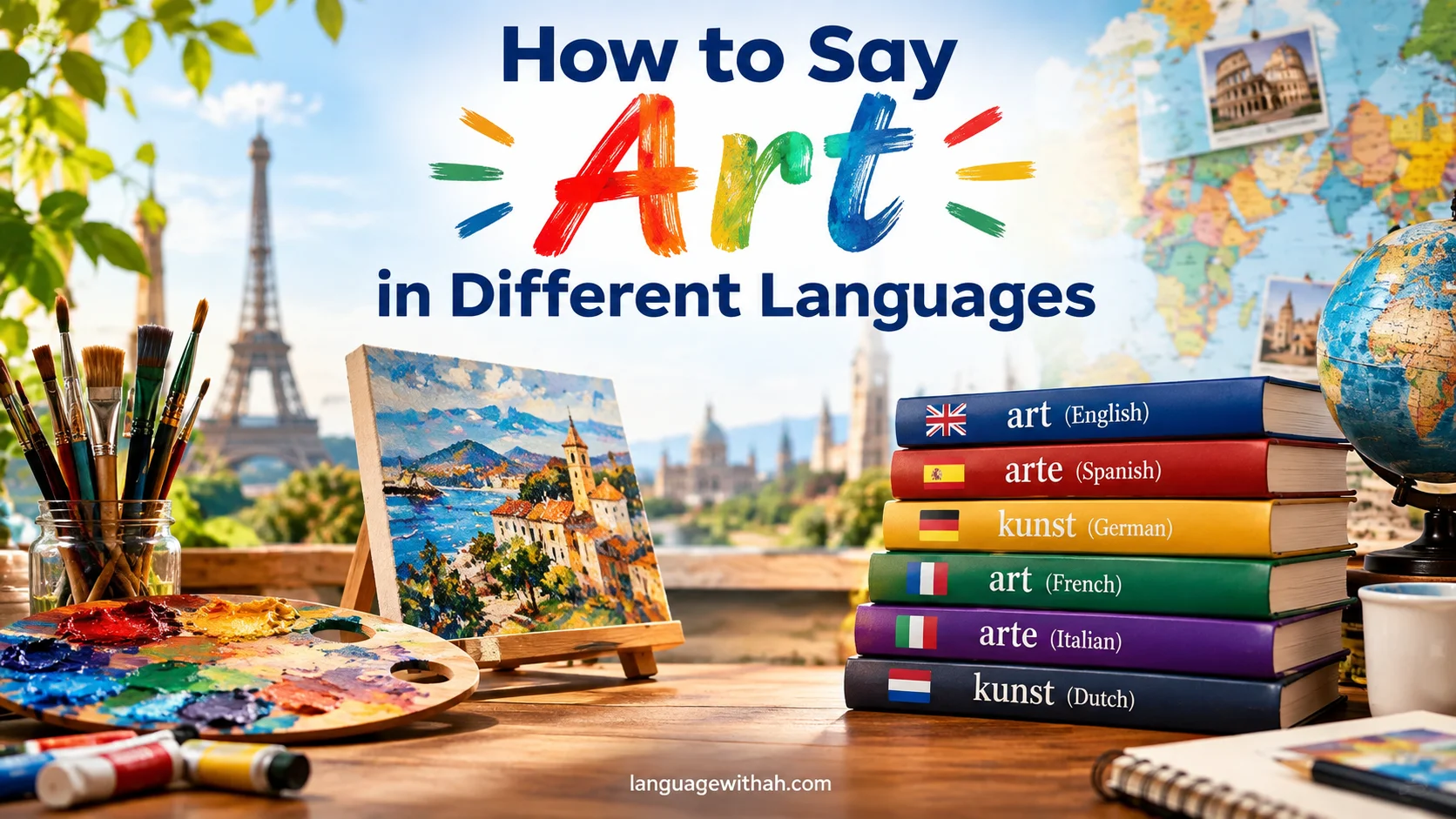
Art is a small English word with a remarkably broad meaning. It can describe painting, sculpture, drawing, music, creative expression, craftsmanship, or the wider human practice of making something meaningful and beautiful. When exploring Art in 70 Different Languages, you quickly discover that other languages do not always divide or describe the idea in exactly the same way.
People may want to learn how to say art in another language for travel, language learning, creative writing, school projects, tattoos, conversations, or simply because they enjoy discovering how different cultures express familiar ideas. A direct word-for-word translation is not always the most natural choice, because a target language may use a word associated with skill, craftsmanship, beauty, fine art, or creative expression.
This guide covers 80 languages and regional varieties, with translations, pronunciation help, example sentences, and cultural notes. Some languages use different words depending on whether you mean fine art, visual art, artistic skill, or creative work. The tables therefore focus on the most useful general term for the meaning of art as a creative or artistic practice. The forms below were cross-checked against multilingual lexical references, while pronunciation guides and example sentences are presented in reader-friendly form.
Interesting Facts About Art
- The English word art can refer to both a broad creative practice and a particular work or field of artistic activity.
- Many languages connect the idea of art with skill or craftsmanship, so their traditional vocabulary may cover more than the English word alone.
- In Chinese, 艺术 (yìshù) is the usual modern term for art, while Chinese writing distinguishes simplified and traditional forms.
- Japanese commonly uses 芸術 (geijutsu) for art in a broad sense, while 美術 (bijutsu) is especially associated with fine or visual art.
- Korean distinguishes between broad artistic concepts such as 예술 (yesul) and more specific uses such as 미술 (misul) for fine or visual art.
- Arabic فن (fann) has a wider semantic range than English art in some contexts and can also relate to a skill, technique, or branch of knowledge.
- Some languages use words that are closely related to craft, beauty, ability, or creative work, showing that the concept of art is shaped partly by each language’s vocabulary and cultural history.
What Does Art Mean?
Art generally means the creation or expression of something through imagination, skill, and creativity. It can include painting, drawing, sculpture, photography, architecture, music, literature, dance, theater, crafts, and many other forms of creative expression.
The word can also have a more personal meaning. Someone might describe a painting as art, but they might also say that cooking, storytelling, or another highly skilled activity is an art.
In everyday English, art can therefore refer to:
- A creative discipline, such as painting or sculpture.
- A particular artistic work.
- The broader world of creative expression.
- Skill or craftsmanship in a particular activity.
- Fine art or visual art in more specialized contexts.
- Art as a cultural or personal form of expression.
This distinction matters when translating the word. A dictionary may provide several possibilities, but the best choice depends on what art means in the sentence.
Why Can Art Have Different Translations?
There is no universal one-to-one relationship between words in different languages. The English word art can correspond to a word meaning art, creative work, craftsmanship, fine art, or artistic skill depending on the language and context.
Several factors can affect the translation:
- Context: “modern art” may require a different construction from “the art of cooking.”
- Formality: everyday speech and academic writing may favor different terms.
- Meaning: some languages distinguish fine art from craft or practical skill more clearly.
- Region: a language may have different common forms in different countries.
- Dialect: spoken varieties can use different vocabulary from the standard language.
- Writing system: Chinese, Japanese, Korean, Arabic, Hebrew, and other languages may require both native script and romanization.
- Grammatical structure: some languages require gender, case, number, or other changes when the word appears in a sentence.
For this reason, the tables below give the most useful general noun for art as a creative or artistic practice, rather than mechanically translating individual English letters or sounds.
European Languages
Europe contains several major language families, including Romance, Germanic, Slavic, Celtic, Uralic, and others. As a result, the word for art can range from forms closely related to English art to completely different words such as Kunst, taide, or sztuka. Some languages also connect art with skill, craft, or mastery.
English Varieties
English does not have separate translations of art in American, British, and Australian English. The standard noun is art in all three varieties. Differences may instead appear in pronunciation, spelling in related words, or preferred terminology in particular contexts.
| 🌍 Language | Country/Region | Translation | Pronunciation | Example Sentence |
| English | International | art | ahrt | Art can communicate ideas without words. — Art can communicate ideas without words. |
| American English 🇺🇸 | United States | art | ahrt | I enjoy contemporary art. — I enjoy contemporary art. |
| British English 🇬🇧 | United Kingdom | art | aht | The gallery features modern art. — The gallery features modern art. |
| Australian English 🇦🇺 | Australia | art | aht | Australian art has many different traditions. — Australian art has many different traditions. |
| Spanish | Spain, Latin America | arte | AR-teh | El arte puede contar una historia. — Art can tell a story. |
| French | France, Francophone regions | art | ahr | L’art peut exprimer des émotions. — Art can express emotions. |
| German | Germany, Austria, Switzerland | Kunst | koonst | Kunst kann Menschen verbinden. — Art can bring people together. |
| Italian | Italy, San Marino | arte | AR-teh | L’arte racconta molte storie. — Art tells many stories. |
| Portuguese | Portugal, Brazil, Lusophone regions | arte | AR-teh | A arte pode mudar a forma como vemos o mundo. — Art can change how we see the world. |
| Dutch | Netherlands, Belgium | kunst | koonst | Kunst kan emoties zichtbaar maken. — Art can make emotions visible. |
| Swedish | Sweden, Finland | konst | kohnst | Konst kan väcka starka känslor. — Art can evoke strong feelings. |
| Norwegian | Norway | kunst | koonst | Kunst kan berätta en historia. — Art can tell a story. |
| Danish | Denmark | kunst | koonst | Kunst kan inspirere mennesker. — Art can inspire people. |
| Finnish | Finland | taide | TAI-deh | Taide voi kertoa paljon ihmisistä. — Art can tell us a lot about people. |
| Icelandic | Iceland | list | list | List getur tjáð tilfinningar. — Art can express emotions. |
| Irish | Ireland | ealaín | AL-een | Is féidir leis an ealaín scéal a insint. — Art can tell a story. |
| Welsh | Wales | celf | kelv | Gall celf mothúcháin a chur in iúl. — Art can express emotions. |
| Polish | Poland | sztuka | SHTOO-ka | Sztuka może opowiadać historię. — Art can tell a story. |
| Czech | Czechia | umění | OO-myeh-nee | Umění může vyjádřit emoce. — Art can express emotions. |
| Slovak | Slovakia | umenie | OO-meh-nyeh | Umenie môže spájať ľudí. — Art can bring people together. |
| Ukrainian | Ukraine | мистецтво | my-stets-TVO | Мистецтво може змінювати наше сприйняття світу. — Art can change how we see the world. |
| Russian | Russia, other Russian-speaking regions | искусство | is-KOOS-stvo | Искусство может передавать эмоции. — Art can convey emotions. |
| Romanian | Romania, Moldova | artă | AR-tuh | Arta poate exprima emoții. — Art can express emotions. |
| Hungarian | Hungary | művészet | MOO-veh-sayt | A művészet sokféleképpen fejezheti ki az érzéseket. — Art can express feelings in many ways. |
| Greek | Greece, Cyprus | τέχνη | TECH-nee | Η τέχνη μπορεί να εμπνεύσει az embereket. — Art can inspire people. |
| Bulgarian | Bulgaria | изкуство | iz-KOOS-tvo | Изкуството може да разказва истории. — Art can tell stories. |
| Croatian | Croatia | umjetnost | oo-MYET-nost | Umjetnost može izraziti osjećaje. — Art can express feelings. |
| Serbian | Serbia, Serbian-speaking regions | уметност / umetnost | oo-MET-nost | Уметност може да povezuje људе. — Art can connect people. |
| Slovenian | Slovenia | umetnost | oo-meht-NOST | Umetnost lahko izraža čustva. — Art can express emotions. |
| Lithuanian | Lithuania | menas | MEH-nas | Menas gali išreikšti jausmus. — Art can express feelings. |
| Latvian | Latvia | māksla | MAHK-sla | Māksla var izteikt emocijas. — Art can express emotions. |
| Estonian | Estonia | kunst | koonst | Kunst võib väljendada tundeid. — Art can express feelings. |
| Albanian | Albania, Kosovo | art | art | Arti mund të shprehë emocione. — Art can express emotions. |
| Catalan | Catalonia, Valencia, Balearic Islands | art | art | L’art pot explicar una història. — Art can tell a story. |
| Basque | Basque Country | artea | ar-TEH-a | Artea emozioak adierazteko modu bat da. — Art is a way to express emotions. |
Cultural note: Several European languages have words whose history connects art with skill or craftsmanship. That does not mean the words are interchangeable with skill in every modern sentence; context still matters.
Read More: How to Say Apple in Different Languages
Asian Languages
Asia includes hundreds of languages and several major writing systems. The concept of art may be expressed through words for art itself, fine art, artistic skill, or creative work. In languages such as Chinese, Japanese, Korean, and Arabic-script languages, the written form is particularly useful for learners because pronunciation alone may not make the intended meaning clear.
| 🌍 Language | Country/Region | Translation | Pronunciation | Example Sentence |
| Mandarin Chinese 🇨🇳 | China, Taiwan, Singapore | 艺术 / 藝術 | yì-shù | 艺术可以表达复杂的情感。 — Art can express complex emotions. |
| Cantonese 🇭🇰 | Hong Kong, Guangdong | 藝術 | ngai6 seot6 | 藝術可以表達感情。 — Art can express feelings. |
| Japanese 🇯🇵 | Japan | 芸術 | gei-jutsu | 芸術は人の心を動かします。 — Art moves people’s hearts. |
| Korean 🇰🇷 | South Korea, North Korea | 예술 | ye-sul | 예술은 감정을 표현하는 방법입니다. — Art is a way of expressing emotions. |
| Hindi 🇮🇳 | India | कला | ka-lā | कला भावनाओं को व्यक्त कर सकती है। — Art can express emotions. |
| Urdu 🇵🇰 | Pakistan, India | فن | fann | فن جذبات کے اظہار کا ذریعہ ہے۔ — Art is a means of expressing emotions. |
| Bengali 🇧🇩 | Bangladesh, India | শিল্প | shil-po | শিল্প মানুষের অনুভূতি প্রকাশ করতে পারে। — Art can express human feelings. |
| Punjabi | Pakistan, India | ਕਲਾ | ka-lā | ਕਲਾ ਭਾਵਨਾਵਾਂ ਨੂੰ ਪ੍ਰਗਟ ਕਰ ਸਕਦੀ ਹੈ। — Art can express emotions. |
| Gujarati | India | કલા | ka-lā | કલા લાગણીઓ વ્યક્ત કરી શકે છે. — Art can express feelings. |
| Marathi | India | कला | ka-lā | कला भावना व्यक्त करू शकते. — Art can express emotions. |
| Tamil | India, Sri Lanka, Singapore | கலை | ka-lai | கலை உணர்வுகளை வெளிப்படுத்த முடியும். — Art can express emotions. |
| Telugu | India | కళ | ka-la | కళ భావాలను వ్యక్తపరచగలదు. — Art can express feelings. |
| Kannada | India | ಕಲೆ | ka-leh | ಕಲೆ ಭಾವನೆಗಳನ್ನು ವ್ಯಕ್ತಪಡಿಸಬಹುದು. — Art can express emotions. |
| Malayalam | India | കല | ka-la | കല വികാരങ്ങൾ പ്രകടിപ്പിക്കാൻ കഴിയും. — Art can express emotions. |
| Nepali | Nepal | कला | ka-lā | कला भावनाहरू व्यक्त गर्न सक्छ। — Art can express feelings. |
| Sinhala | Sri Lanka | කලාව | ka-lā-va | කලාව මිනිස් හැඟීම් ප්රකාශ කළ හැක. — Art can express human emotions. |
| Thai | Thailand | ศิลปะ | sǐn-la-pà | ศิลปะสามารถสื่อความรู้สึกได้ — Art can communicate feelings. |
| Vietnamese | Vietnam | nghệ thuật | nghee-thu-at | Nghệ thuật có thể truyền tải cảm xúc. — Art can convey emotions. |
| Indonesian | Indonesia | seni | seh-nee | Seni dapat menyampaikan perasaan. — Art can convey feelings. |
| Malay | Malaysia, Brunei, Singapore | seni | seh-nee | Seni boleh menyampaikan perasaan. — Art can convey feelings. |
| Filipino/Tagalog | Philippines | sining | SEE-ning | Ang sining ay maaaring magpahayag ng damdamin. — Art can express feelings. |
| Burmese | Myanmar | အနုပညာ | a-nu-pyin-ya | အနုပညာသည် ခံစားချက်များကို ဖော်ပြနိုင်သည်။ — Art can express feelings. |
| Khmer | Cambodia | សិល្បៈ | sə-lə-pa | សិល្បៈអាចបង្ហាញអារម្មណ៍បាន។ — Art can express emotions. |
| Lao | Laos | ສິນລະປະ | sin-la-pa | ສິນລະປະສາມາດສະແດງອາລົມໄດ້. — Art can express emotions. |
| Mongolian | Mongolia | урлаг | oor-lag | Урлаг сэтгэл хөдлөлийг илэрхийлж чадна. — Art can express emotions. |
| Kazakh | Kazakhstan | өнер | ö-ner | Өнер сезімді жеткізе алады. — Art can convey feelings. |
| Uzbek | Uzbekistan | san’at / санъат | san-at | San’at inson tuyg‘ularini ifodalashi mumkin. — Art can express human feelings. |
Language note: In Chinese, Japanese, and Korean, different terms can become appropriate depending on whether you mean art in general, fine art, visual art, or artistic practice. For example, Japanese 芸術 is broad, while 美術 is more closely associated with fine or visual art.
African Languages
Africa is home to an exceptionally diverse collection of language families and regional varieties. A word for art may emphasize creative expression, craftsmanship, beauty, or artistic skill. The examples below use general forms intended for ordinary discussions of art rather than highly specialized terminology.
| 🌍 Language | Country/Region | Translation | Pronunciation | Example Sentence |
| Swahili | East Africa, especially Tanzania and Kenya | sanaa | sa-NAH | Sanaa inaweza kueleza hisia bila maneno. — Art can express feelings without words. |
| Afrikaans | South Africa, Namibia | kuns | koons | Kuns kan mense inspireer. — Art can inspire people. |
| Zulu | South Africa | ubuciko | oo-boo-SEE-ko | Ubuciko bungaveza imizwa yabantu. — Art can express people’s feelings. |
| Xhosa | South Africa | ubugcisa | oo-boo-GEE-sa | Ubugcisa bunokudibanisa abantu. — Art can bring people together. |
| Amharic | Ethiopia | ስነ ጥበብ | se-ne t’i-beb | ስነ ጥበብ ስሜትን ሊገልጽ ይችላል። — Art can express emotion. |
| Yoruba | Nigeria, Benin | aworan | a-wo-ran | Aworan le sọ ìtàn láìsí ọ̀rọ̀. — Art can tell a story without words. |
| Igbo | Nigeria | nka | n-ka | Nka nwere ike igosipụta mmetụta. — Art can express feelings. |
| Hausa | Nigeria, Niger, West Africa | fasaha | fa-SA-ha | Fasaha tana bayyana tunanin mutum. — Art expresses human thought. |
| Somali | Somalia, Somaliland, Djibouti | fanka | FAN-ka | Fanka wuxuu muujin karaa dareen. — Art can show emotion. |
| Shona | Zimbabwe | unyanzvi | oo-nyan-zvee | Unyanzvi hunogona kuratidza manzwiro. — Art can express feelings. |
Cultural note: It is important not to describe one African language as representative of the continent. Swahili, Yoruba, Zulu, Amharic, Hausa, Somali, and Shona, for example, belong to different linguistic and cultural settings.
Middle Eastern Languages
The Middle East contains several distinct language families and writing traditions. Arabic alone has numerous regional varieties, so Modern Standard Arabic is different from everyday Egyptian, Levantine, Gulf, Moroccan, and other spoken forms. The entries below use broadly understandable standard forms unless otherwise noted.
| 🌍 Language | Country/Region | Translation | Pronunciation | Example Sentence |
| Arabic | Middle East, North Africa | فن | fann | الفن يمكن أن يعبّر عن المشاعر. — Art can express emotions. |
| Persian | Iran, Afghanistan, Tajikistan-related Persian varieties | هنر | ho-NAR | هنر میتواند احساسات را بیان کند. — Art can express emotions. |
| Hebrew | Israel | אומנות | o-ma-NOOT | אמנות יכולה לספר סיפור. — Art can tell a story. |
| Kurdish (Kurmanji) | Kurdistan regions | huner | hoo-NER | Huner dikare hestan nîşan bide. — Art can express feelings. |
| Turkish | Türkiye, Cyprus and wider Turkish-speaking communities | sanat | sa-NAT | Sanat insanları bir araya getirebilir. — Art can bring people together. |
| Armenian | Armenia, Armenian-speaking communities | արվեստ | ar-VEST | Արվեստը կարող է մարդկանց միավորել։ — Art can bring people together. |
Arabic note: فن (fann) is a broad term and can refer to art as well as a skill, technique, or branch of knowledge depending on context.
Other World Languages
Languages outside the main European, Asian, African, and Middle Eastern groups add another useful perspective. Indigenous languages in particular may describe art through concepts of creative work, beauty, making, design, or cultural expression, so a literal one-word equivalent is not always available.
| 🌍 Language | Country/Region | Translation | Pronunciation | Example Sentence |
| Māori | New Zealand | toi | toy | He mea nui te toi ki te ahurea Māori. — Art is important to Māori culture. |
| Samoan | Samoa, American Samoa | faatufugaga | faa-too-foo-go-a-ga | E mafai e le faatufugaga ona faamatala se tala. — Art can tell a story. |
| Hawaiian | Hawaiʻi | hana noʻeau | HA-na no-eh-ow | He mea nui ka hana noʻeau i ka moʻomeheu. — Creative art is important to the culture. |
| Quechua | Andes, especially Peru, Bolivia, Ecuador | sumaq ruway | SOO-mahk ROO-way | Sumaq ruwaymi runakunapa yuyayta rikuchin. — Art shows people’s ideas. |
| Haitian Creole | Haiti | atizay | a-ti-ZAY | Atizay ka ede moun eksprime emosyon yo. — Art can help people express their emotions. |
Quick Reference: Art in Different Languages
| Language | Translation |
| English | art |
| American English | art |
| British English | art |
| Australian English | art |
| Spanish | arte |
| French | art |
| German | Kunst |
| Italian | arte |
| Portuguese | arte |
| Dutch | kunst |
| Swedish | konst |
| Norwegian | kunst |
| Danish | kunst |
| Finnish | taide |
| Icelandic | list |
| Irish | ealaín |
| Welsh | celf |
| Polish | sztuka |
| Czech | umění |
| Slovak | umenie |
| Ukrainian | мистецтво |
| Russian | искусство |
| Romanian | artă |
| Hungarian | művészet |
| Greek | τέχνη |
| Bulgarian | изкуство |
| Croatian | umjetnost |
| Serbian | уметност |
| Slovenian | umetnost |
| Lithuanian | menas |
| Latvian | māksla |
| Estonian | kunst |
| Albanian | art |
| Catalan | art |
| Basque | artea |
| Mandarin Chinese | 艺术 / 藝術 |
| Cantonese | 藝術 |
| Japanese | 芸術 |
| Korean | 예술 |
| Hindi | कला |
| Urdu | فن |
| Bengali | শিল্প |
| Punjabi | ਕਲਾ |
| Gujarati | કલા |
| Marathi | कला |
| Tamil | கலை |
| Telugu | కళ |
| Kannada | ಕಲೆ |
| Malayalam | കല |
| Nepali | कला |
| Sinhala | කලාව |
| Thai | ศิลปะ |
| Vietnamese | nghệ thuật |
| Indonesian | seni |
| Malay | seni |
| Filipino/Tagalog | sining |
| Burmese | အနုပညာ |
| Khmer | សិល្បៈ |
| Lao | ສິນລະປະ |
| Mongolian | урлаг |
| Kazakh | өнер |
| Uzbek | san’at |
| Swahili | sanaa |
| Afrikaans | kuns |
| Zulu | ubuciko |
| Xhosa | ubugcisa |
| Amharic | ስነ ጥበብ |
| Yoruba | aworan |
| Igbo | nka |
| Hausa | fasaha |
| Somali | fanka |
| Shona | unyanzvi |
| Arabic | فن |
| Persian | هنر |
| Hebrew | אומנות |
| Kurdish (Kurmanji) | huner |
| Turkish | sanat |
| Armenian | արվեստ |
| Māori | toi |
| Samoan | faatufugaga |
| Hawaiian | hana noʻeau |
| Quechua | sumaq ruway |
| Haitian Creole | atizay |
How to Choose the Right Translation
The best translation of art depends on what you actually want to say.
If you are talking about a painting, sculpture, gallery, or creative discipline, use the language’s ordinary term for art or fine art. If you are talking about the art of cooking, art of storytelling, or another skilled activity, a word associated with skill or technique may be more natural in some languages.
Before using a translation, consider:
- Context: Are you talking about art generally, fine art, visual art, or a particular artwork?
- Audience: Are you speaking with friends, writing academically, or visiting a museum?
- Region: Does the language have different regional standards?
- Formality: Is the expression intended for conversation or formal writing?
- Grammar: Does the word need a particular ending, article, case, or agreement?
- Writing system: If you are learning the language, learn both the native spelling and pronunciation.
For a simple multilingual vocabulary list, the forms in the tables are useful starting points. For a professional translation, publication, artwork title, tattoo, or culturally sensitive text, context should always be checked separately.
Common Mistakes When Translating Art
1. Translating every word literally
A dictionary equivalent is not necessarily the best translation in every sentence. Art may refer to creativity, craftsmanship, fine art, or skill.
2. Confusing art with artist
Art is the creative practice or work, while an artist is the person who creates it. These are different grammatical concepts in every language.
3. Assuming one word covers every meaning
Japanese, Korean, Chinese, Arabic, and several other languages have terminology that can become more specific depending on the type of art being discussed.
4. Ignoring regional variation
A language spoken across several countries may have differences in vocabulary and everyday usage. A translation suitable for one community may sound less natural somewhere else.
5. Using pronunciation without checking the writing
For languages such as Chinese, Japanese, Korean, Arabic, Hebrew, Hindi, Urdu, and Bengali, seeing the native script can help prevent confusion between words that sound similar.
6. Treating dialects as separate languages
A regional variety should not automatically be presented as a completely separate language. The English varieties above demonstrate this clearly: American, British, and Australian English all use art.
7. Confusing fine art with artistic skill
Some languages use a word that can cover both art and skill. The correct interpretation depends on the surrounding sentence.
Why Learn Art in Different Languages?
Learning how to say art in different languages is more than memorizing a vocabulary list. It introduces learners to the way languages categorize creativity, craftsmanship, beauty, and expression.
For travelers, knowing a few culturally relevant words can make visits to museums, galleries, workshops, and cultural sites more meaningful. For students, multilingual vocabulary provides an accessible way to compare how different languages organize similar ideas.
It can also help language learners remember vocabulary through cultural associations. Instead of memorizing an isolated word, you can connect it with a painting, sculpture, song, museum, artist, or creative tradition.
Most importantly, learning words from other languages encourages curiosity. A translation is not simply a replacement for an English word; it can offer a small glimpse into how another linguistic community describes the world.
FAQs:
How do you say art in different languages?
The word for art changes considerably between languages. Examples include arte in Spanish and Italian, art in French, Kunst in German and Dutch, sztuka in Polish, 艺术 (yìshù) in Mandarin, 芸術 (geijutsu) in Japanese, sanaa in Swahili, and sanat in Turkish.
What is the most natural translation of art?
There is no single universal translation. The most natural word depends on the language and context. For general creative or artistic expression, the translations in the regional tables provide useful starting points.
Can the translation of art change by country?
Yes. Languages spoken in several countries can have regional vocabulary differences. Sometimes the standard word remains the same while pronunciation or more specialized terminology changes.
Why do some languages have multiple translations for art?
The English word art covers several ideas. Another language may distinguish fine art, visual art, craftsmanship, artistic skill, creative work, or a particular art form with different terms.
Does pronunciation change between regions?
It can. A word may be spelled the same but pronounced differently in different varieties. This is particularly noticeable in widely spoken languages such as English, Spanish, Arabic, Portuguese, and Chinese.
Conclusion:
Learning how to say art in different languages reveals how a familiar idea can take many linguistic forms. Spanish arte, German Kunst, Japanese 芸術, Mandarin 艺术, Arabic فن, Swahili sanaa, and Māori toi all point toward creative expression, yet each belongs to a different linguistic and cultural environment.
The most important lesson is that translation is not always a simple word-for-word exchange. Context, region, formality, artistic discipline, pronunciation, and cultural usage can all affect which term sounds natural. A word that works for fine art may not be the best choice for artistic skill or creative craftsmanship.



1 thought on “How to Say Art in Different Languages”