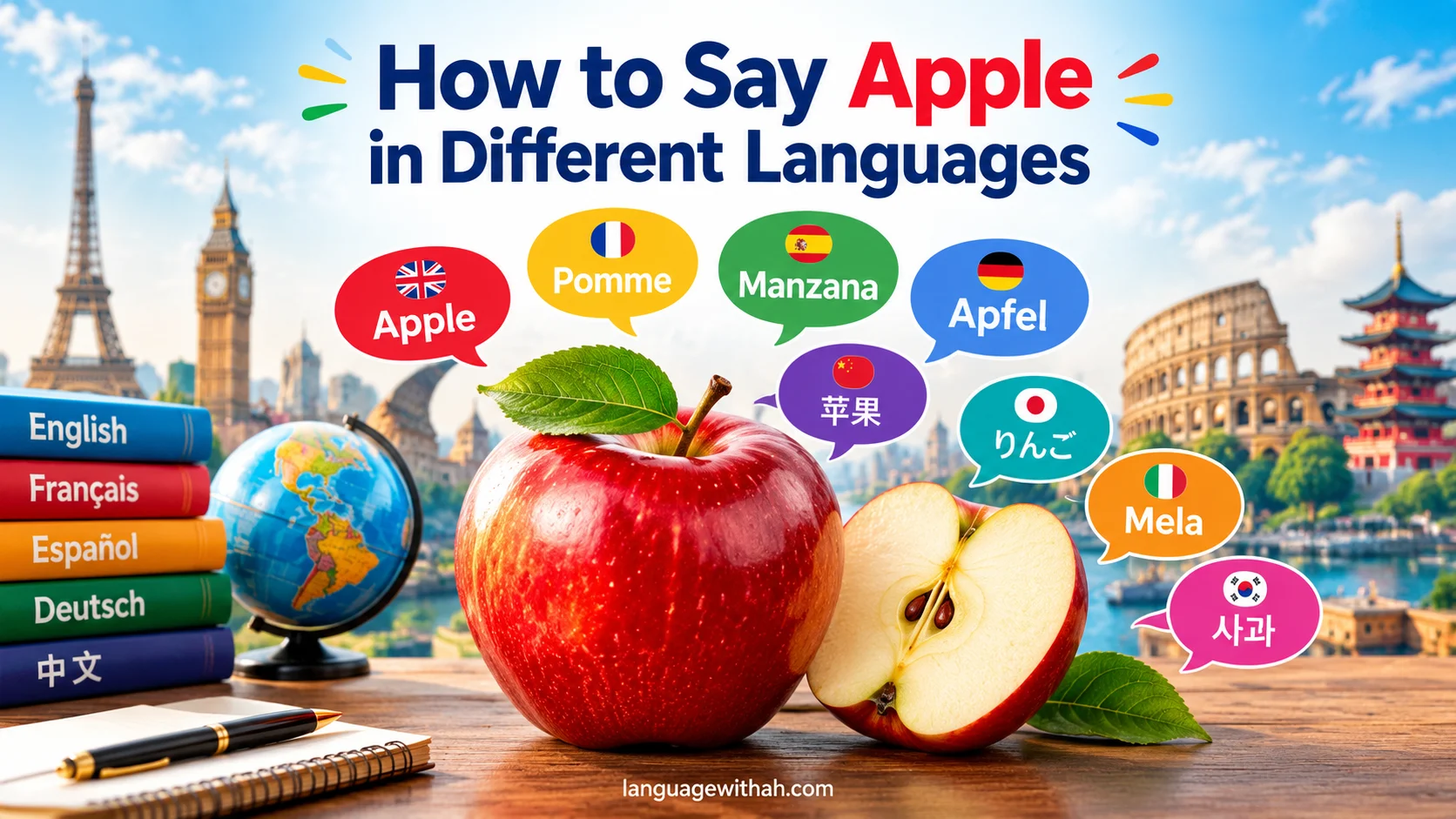
An apple is a familiar fruit, but its name changes considerably from one language to another. Learning how to say apple in different languages is a simple way to build vocabulary while discovering how languages describe everyday things. Whether you are studying a foreign language, traveling, preparing a multilingual lesson, or simply curious about world languages, this common word is a useful starting point.
In English, apple normally refers to the edible fruit of an apple tree. Other languages may use different grammatical forms depending on whether the word is singular or plural, definite or indefinite, or used in a particular sentence. Some languages also have regional vocabulary differences or grammatical features that do not exist in English.
Below, you will find 75 languages and language varieties, with translations, pronunciation guidance, regional information, and natural example sentences. The examples are designed to show how the word is actually used rather than simply repeating an isolated dictionary equivalent. Where useful, notes explain gender, script, regional variation, or pronunciation so that learners can use each translation more confidently.
Interesting Facts About Apple
- The English word apple refers to the fruit produced by species and cultivars of the genus Malus. In everyday speech, it normally means the familiar cultivated apple.
- The word for apple can look surprisingly different across language families. For example, German has Apfel, French has pomme, Spanish has manzana, and Russian has яблоко (yabloko).
- In many languages, nouns have grammatical gender. French pomme, Spanish manzana, and German Apfel therefore behave differently in sentences.
- Some languages use a writing system other than the Latin alphabet. Chinese, Japanese, Korean, Greek, Arabic, Hebrew, Hindi, Bengali, Tamil, and many others have their own scripts.
- A dictionary translation does not always tell you how a word behaves grammatically. In some languages, the form changes according to case, number, definiteness, or grammatical role.
- The pronunciation of the same language can vary between countries and regions. This is especially relevant for languages such as English, Arabic, Spanish, Portuguese, and Chinese varieties.
- In everyday conversation, the ordinary word for the fruit is generally more useful than a highly literal or botanical description.
What Does Apple Mean?
Apple is the common English name for a round or oval fruit that grows on an apple tree. Apples come in many varieties and can be sweet, tart, crisp, or soft.
The word normally refers to the fruit itself:
I ate an apple after lunch.
It can also appear in compound expressions, names, and cultural references. For example, English speakers may talk about apple juice, apple pie, apple trees, or apple slices.
There is also an important contextual distinction: Apple with a capital A can refer to the technology company. In this article, however, apple means the fruit, not the company.
Why Can Apple Have Different Translations?
There is usually a straightforward noun for the fruit in each language, but the way that noun appears in a sentence can vary.
Several factors can affect the translation:
- Grammatical gender: Some languages classify nouns as masculine, feminine, or neuter.
- Number: Singular and plural forms may differ.
- Case: Languages such as Russian, Polish, German, and Greek can change noun forms according to grammatical function.
- Articles: French, Spanish, Italian, and German may use articles that English does not use in exactly the same way.
- Regional vocabulary: Different countries may use different terms or pronunciation patterns.
- Writing system: The same concept may appear in Latin, Cyrillic, Arabic, Chinese, Japanese, Korean, or another script.
- Spoken vs. written language: Everyday speech can sometimes use forms that differ from a formal dictionary entry.
For a simple vocabulary question, the basic singular noun is normally the most useful translation.
European Languages
Europe contains several major language families, including Germanic, Romance, Slavic, Celtic, Baltic, Uralic, and Hellenic languages. As a result, the word for apple can vary substantially even between neighboring countries. The table below gives the ordinary singular noun for the fruit, with pronunciation guides designed for English-speaking learners.
European Apple Translations
| 🌍 Language | Country/Region | Translation | Pronunciation | Example Sentence |
| English | International | apple | AP-uhl | I ate an apple this morning. |
| American English 🇺🇸 | United States | apple | AP-uhl | This apple is very crisp. |
| British English 🇬🇧 | United Kingdom | apple | AP-uhl | I packed an apple for lunch. |
| Australian English 🇦🇺 | Australia | apple | AP-uhl | She bought a fresh apple. |
| Spanish | Spain and much of Latin America | manzana | mahn-SAH-nah | Me comí una manzana. — I ate an apple. |
| French | France and Francophone regions | pomme | pom | J’aime cette pomme. — I like this apple. |
| German | Germany, Austria, Switzerland | Apfel | AP-fel | Der Apfel ist rot. — The apple is red. |
| Italian | Italy and San Marino | mela | MEH-lah | Questa mela è dolce. — This apple is sweet. |
| Portuguese | Portugal, Brazil, other regions | maçã | mah-SAH̃ | Esta maçã é doce. — This apple is sweet. |
| Dutch | Netherlands and Belgium | appel | AH-puhl | Ik eet een appel. — I am eating an apple. |
| Swedish | Sweden | äpple | EP-pleh | Jag äter ett äpple. — I am eating an apple. |
| Norwegian | Norway | eple | EH-pleh | Jeg spiser et eple. — I am eating an apple. |
| Danish | Denmark | æble | EH-bleh | Jeg spiser et æble. — I am eating an apple. |
| Finnish | Finland | omena | OH-meh-nah | Syön omenan. — I am eating an apple. |
| Icelandic | Iceland | epli | EH-pli | Ég borða epli. — I am eating an apple. |
| Irish | Ireland | úll | ool | Tá úll agam. — I have an apple. |
| Welsh | Wales | afal | AH-val | Dw i’n bwyta afal. — I am eating an apple. |
| Polish | Poland | jabłko | YAHB-wkoh | Jem jabłko. — I am eating an apple. |
| Czech | Czech Republic | jablko | YAHB-lkoh | Jím jablko. — I am eating an apple. |
| Slovak | Slovakia | jablko | YAHB-lkoh | Jem jablko. — I am eating an apple. |
| Ukrainian | Ukraine | яблуко | YAB-loo-koh | Я їм яблуко. — I am eating an apple. |
| Russian | Russia and other Russian-speaking regions | яблоко | YAB-luh-kuh | Я ем яблоко. — I am eating an apple. |
| Bulgarian | Bulgaria | ябълка | YAH-buhl-kah | Ям ябълка. — I am eating an apple. |
| Croatian | Croatia | jabuka | yah-BOO-kah | Jedem jabuku. — I am eating an apple. |
| Serbian | Serbia and neighboring regions | јабука | yah-BOO-kah | Једем јабуку. — I am eating an apple. |
| Slovenian | Slovenia | jabolko | YAH-bol-koh | Jem jabolko. — I am eating an apple. |
| Romanian | Romania and Moldova | măr | muhr | Mănânc un măr. — I am eating an apple. |
| Hungarian | Hungary | alma | AHL-mah | Eszem az almát. — I am eating the apple. |
| Greek | Greece and Cyprus | μήλο | MEE-lo | Τρώω ένα μήλο. — I am eating an apple. |
| Lithuanian | Lithuania | obuolys | oh-boo-OH-lis | Aš valgau obuolį. — I am eating an apple. |
| Latvian | Latvia | ābols | AH-bols | Es ēdu ābolu. — I am eating an apple. |
| Estonian | Estonia | õun | urn, approximately | Ma söön õuna. — I am eating an apple. |
| Albanian | Albania and Kosovo | mollë | MOL-uh | Po ha një mollë. — I am eating an apple. |
| Bosnian | Bosnia and Herzegovina | jabuka | yah-BOO-kah | Jedem jabuku. — I am eating an apple. |
English Varieties: American, British, and Australian English
There is no separate vocabulary word for the fruit in standard American, British, or Australian English. All three varieties normally use apple.
The main differences are associated with accent, pronunciation, spelling conventions in surrounding vocabulary, and regional usage, rather than a different name for the fruit.
Cultural Notes on European Languages
The basic noun is usually enough when asking how to say apple, but the surrounding grammar can change.
For example, German uses Apfel as a masculine noun, while French pomme is feminine. Spanish manzana is also feminine. In Slavic languages, the noun can change form according to grammatical case.
This means that memorizing only the dictionary form is useful for vocabulary building, but learners should pay attention to the sentence form when they begin using the word naturally.
Read More: How to Say Autumn in Different Languages
Asian Languages
Asia contains an enormous range of languages and writing systems. A single table can therefore include alphabetic scripts, abugidas, syllabaries, logographic characters, and other writing traditions. Some languages also distinguish between formal and conversational forms or use grammatical systems that have no direct equivalent in English.
| 🌍 Language | Country/Region | Translation | Pronunciation | Example Sentence |
| Mandarin Chinese | China, Taiwan, Singapore and elsewhere | 苹果 | píngguǒ | 我吃了一个苹果。— I ate an apple. |
| Cantonese | Hong Kong, Macau, Guangdong | 蘋果 | ping4 gwo2 | 我食咗一個蘋果。— I ate an apple. |
| Japanese | Japan | りんご / 林檎 | ringo | りんごを食べます。— I eat an apple. |
| Korean | South Korea, North Korea | 사과 | sa-gwa | 저는 사과를 먹어요. — I eat an apple. |
| Hindi | India | सेब | seb | मैं सेब खाता हूँ। — I eat an apple. |
| Urdu | Pakistan, India | سیب | seb | میں سیب کھاتا ہوں۔ — I eat an apple. |
| Bengali | Bangladesh, India | আপেল | apel | আমি একটি আপেল খাই। — I eat an apple. |
| Punjabi | India and Pakistan | ਸੇਬ / سیب | seb | ਮੈਂ ਸੇਬ ਖਾਂਦਾ ਹਾਂ। — I eat an apple. |
| Gujarati | India | સફરજન | safarjan | હું સફરજન ખાઉં છું. — I eat an apple. |
| Marathi | India | सफरचंद | safarchand | मी सफरचंद खातो. — I eat an apple. |
| Tamil | India, Sri Lanka, Singapore | ஆப்பிள் | aappil | நான் ஆப்பிள் சாப்பிடுகிறேன். — I am eating an apple. |
| Telugu | India | ఆపిల్ | aapil | నేను ఆపిల్ తింటున్నాను. — I am eating an apple. |
| Kannada | India | ಸೇಬು | sebu | ನಾನು ಸೇಬು ತಿನ್ನುತ್ತೇನೆ. — I eat an apple. |
| Malayalam | India | ആപ്പിൾ | aappil | ഞാൻ ആപ്പിൾ കഴിക്കുന്നു. — I am eating an apple. |
| Nepali | Nepal and India | स्याउ | syāu | म स्याउ खान्छु। — I eat an apple. |
| Sinhala | Sri Lanka | ඇපල් | æpal | මම ඇපල් කනවා. — I eat an apple. |
| Thai | Thailand | แอปเปิล | aep-poen | ฉันกินแอปเปิล。— I eat an apple. |
| Vietnamese | Vietnam | quả táo | kwah tao | Tôi ăn một quả táo. — I eat an apple. |
| Indonesian | Indonesia | apel | AH-pel | Saya makan apel. — I eat an apple. |
| Malay | Malaysia, Brunei, Singapore | epal | EH-pal | Saya makan epal. — I eat an apple. |
| Filipino/Tagalog | Philippines | mansanas | man-SAH-nas | Kumakain ako ng mansanas. — I am eating an apple. |
| Burmese | Myanmar | ပန်းသီး | pan-thi | ကျွန်တော် ပန်းသီး စားတယ်။ — I eat an apple. |
| Khmer | Cambodia | ផ្លែប៉ោម | phlae paom | ខ្ញុំញ៉ាំ ផ្លែប៉ោម។ — I eat an apple. |
| Lao | Laos | ໝາກໂປມ | mak-pom | ຂ້ອຍກິນ ໝາກໂປມ. — I eat an apple. |
| Mongolian | Mongolia | алим | alim | Би алим идэж байна. — I am eating an apple. |
| Kazakh | Kazakhstan and Central Asia | алма | alma | Мен алма жеймін. — I eat an apple. |
| Uzbek | Uzbekistan and Central Asia | olma | OL-mah | Men olma yeyman. — I eat an apple. |
| Turkish | Turkey and Cyprus | elma | EL-mah | Ben elma yiyorum. — I am eating an apple. |
| Tajik | Tajikistan | себ | seb | Ман себ мехӯрам. — I eat an apple. |
Cultural and Linguistic Notes on Asia
The Asian entries demonstrate why native script plus pronunciation can be particularly helpful for learners.
In Mandarin, 苹果 (píngguǒ) is the ordinary word for apple. Mandarin uses tones, so píngguǒ is more informative than an approximate English spelling alone.
Japanese commonly uses りんご (ringo) in everyday writing. Korean uses 사과 (sagwa). In Hindi and Urdu, the commonly used forms are सेब and سیب, respectively.
Some South Asian languages also have vocabulary influenced by historical contact and borrowing. The important point for learners is to use the ordinary contemporary word appropriate to the language rather than assuming that related languages must share identical vocabulary.
African Languages
Africa is home to hundreds of languages belonging to several major language families. Swahili, Hausa, Yoruba, Igbo, Amharic, Zulu, Xhosa, Afrikaans, and many others have different grammatical structures and histories.
The following translations represent commonly used vocabulary for the fruit in the specified languages.
| 🌍 Language | Country/Region | Translation | Pronunciation | Example Sentence |
| Swahili | East Africa | tofaa | toh-FAH-ah | Ninakula tofaa. — I am eating an apple. |
| Afrikaans | South Africa, Namibia | appel | AH-puhl | Ek eet ‘n appel. — I am eating an apple. |
| Zulu | South Africa | i-apula | ee-AH-poo-lah | Ngidla i-apula. — I am eating an apple. |
| Xhosa | South Africa | iapile | ee-AH-pee-leh | Nditya iapile. — I am eating an apple. |
| Amharic | Ethiopia | ፖም | pom | አንድ ፖም እበላለሁ። — I eat an apple. |
| Yoruba | Nigeria and Benin | àpùlù | ah-poo-loo | Mo ń jẹ àpùlù. — I am eating an apple. |
| Igbo | Nigeria | apụl | ah-pool | Ana m eri apụl. — I am eating an apple. |
| Hausa | Nigeria, Niger and surrounding areas | tuffa | TOO-fah | Ina cin tuffa. — I am eating an apple. |
| Somali | Somalia and neighboring regions | tufaax | too-FAHSH | Waxaan cunayaa tufaax. — I am eating an apple. |
| Shona | Zimbabwe | apuro | ah-POO-roh | Ndiri kudya apuro. — I am eating an apple. |
| Sesotho | Lesotho, South Africa | apole | ah-POH-leh | Ke ja apole. — I am eating an apple. |
| Setswana | Botswana, South Africa | apole | ah-POH-leh | Ke ja apole. — I am eating an apple. |
| Kinyarwanda | Rwanda | pome | POH-meh | Ndarya pome. — I am eating an apple. |
| Malagasy | Madagascar | paoma | pah-OH-mah | Mihinana paoma aho. — I am eating an apple. |
Cultural Notes on African Languages
Africa’s linguistic diversity means that there is no single African word for apple. A word used in one language should not automatically be transferred to another language spoken in the same country.
For example, Swahili is widely used across East Africa, while Zulu and Xhosa are important languages in southern Africa. Their vocabulary and grammar are distinct.
Borrowing is also common. Some languages use forms that resemble European words, especially where the fruit itself entered local vocabulary through historical trade, agriculture, or language contact. Similar-looking words do not necessarily mean that the languages have identical grammar.
Middle Eastern Languages
The Middle East includes several different language families and literary traditions. Arabic, Persian, Hebrew, Kurdish, Turkish, and Armenian are not simply different dialects of one language. Even within Arabic, everyday vocabulary can vary between countries and dialect regions.
| 🌍 Language | Country/Region | Translation | Pronunciation | Example Sentence |
| Modern Standard Arabic | Arab world | تفاحة | tuffāḥah | أكلتُ تفاحة. — I ate an apple. |
| Persian | Iran, Afghanistan, Tajik-related contexts | سیب | sib | من یک سیب میخورم. — I am eating an apple. |
| Hebrew | Israel | תפוח | ta-POO-akh | אני אוכל תפוח. — I am eating an apple. |
| Kurdish (Kurmanji) | Kurdistan regions | sêv | sayv | Ez sêv dixwim. — I am eating an apple. |
| Turkish | Turkey and Cyprus | elma | EL-mah | Bir elma yiyorum. — I am eating an apple. |
| Armenian | Armenia and Armenian-speaking communities | խնձոր | khn-DZOR | Ես խնձոր եմ ուտում։ — I am eating an apple. |
Arabic: A Useful Distinction
In Modern Standard Arabic, تفاحة (tuffāḥah) means an apple in the feminine singular form. Arabic also has many regional dialects, and everyday pronunciation and vocabulary can differ from Modern Standard Arabic.
For a multilingual educational article, it is therefore more accurate to identify the form as Modern Standard Arabic rather than implying that one pronunciation represents every Arabic-speaking community.
Other World Languages
The world’s languages extend well beyond Europe, Asia, Africa, and the Middle East. The following examples add several languages from the Pacific and the Americas.
| 🌍 Language | Country/Region | Translation | Pronunciation | Example Sentence |
| Māori | New Zealand | āporo | AH-paw-raw | Kei te kai au i te āporo. — I am eating the apple. |
| Samoan | Samoa and American Samoa | apu | AH-poo | Ou te ‘ai i le apu. — I am eating the apple. |
| Tongan | Tonga | ʻapela | ah-PEH-lah | ʻOku ou kai ʻi he ʻapela. — I am eating an apple. |
| Hawaiian | Hawaii | ʻāpala | AH-pah-lah | Makemake au i ka ʻāpala. — I like the apple. |
| Quechua | Andes of South America | manzana | man-SAH-nah | Mikhuymi manzana. — I eat an apple. |
| Guarani | Paraguay and surrounding areas | manzana | man-SAH-nah | Akaru manzana. — I ate an apple. |
| Haitian Creole | Haiti and Haitian communities | pòm | pom | Mwen manje yon pòm. — I am eating an apple. |
| Esperanto | International constructed language | pomo | POH-moh | Mi manĝas pomon. — I am eating an apple. |
Note: Borrowed vocabulary can appear in several unrelated languages. That does not mean the languages themselves are closely related. For example, Romance-derived or internationally borrowed forms can occur in languages of the Americas and elsewhere.
Cultural Notes About Saying Apple in Different Languages
The word apple is relatively simple, but using it correctly provides several useful language-learning lessons.
Grammatical gender matters
In French, pomme is feminine, while German Apfel is masculine. Spanish manzana is also feminine. Learners should therefore memorize the noun together with its grammatical behavior where necessary.
Singular forms may change inside sentences
A dictionary may list the basic noun, but a sentence can require another grammatical form. This is particularly noticeable in languages with case systems, such as Polish, Russian, Ukrainian, and Lithuanian.
Script is part of vocabulary learning
Seeing 苹果, りんご, 사과, سیب, or תפוח alongside a pronunciation guide can help learners connect spoken language with its written form.
Regional differences should not be exaggerated
American, British, and Australian English all use apple for the fruit. There is no need to manufacture a different translation simply because the varieties are geographically distinct.
Pronunciation Guidelines for Apple in Different Languages
Pronunciation guides in this article are designed to give English-speaking learners a useful approximation, but they are not substitutes for hearing native speech.
A few examples show why pronunciation deserves attention:
- Mandarin píngguǒ contains tones, so the tone marks are meaningful.
- French pomme has a pronunciation that does not match the English spelling of pom perfectly.
- German Apfel has sounds that differ from English.
- Japanese ringo uses Japanese phonology rather than English pronunciation.
- Russian яблоко (yabloko) begins with a consonant sound represented through Cyrillic spelling.
- Arabic تفاحة (tuffāḥah) includes sounds that can be difficult to reproduce using ordinary English spelling.
For serious language learning, listen to native-speaker audio and practice the sound within a complete sentence rather than memorizing an English approximation alone.
How to Choose the Right Translation
The best translation depends on how you intend to use the word.
If you are simply learning vocabulary, start with the standard singular noun. If you are writing a sentence, check whether the noun needs a different form because of case, gender, number, article, or grammatical agreement.
Consider these questions:
- Which country or region is your audience from?
- Is the language formal or conversational in your situation?
- Do you need the singular or plural form?
- Does the noun have grammatical gender?
- Does the sentence change the noun’s form?
- Does the language use a special writing system?
- Do you need a regional or dialect form?
For most beginners, learning the basic word first and then studying it in a natural sentence is an effective approach.
Common Mistakes When Translating Apple
1. Translating word-for-word without checking grammar
Knowing the dictionary word does not automatically tell you how to use it in a sentence. Case and grammatical agreement can change the form.
2. Confusing the fruit with the company
English uses Apple with a capital letter for the technology company. The ordinary fruit is written apple.
3. Ignoring regional differences
A language can be spoken across several countries. The standard word may remain the same while pronunciation or everyday usage differs.
4. Treating dialects as separate languages
Different varieties of Arabic, Chinese, Kurdish, or other languages should not automatically be counted as completely separate languages.
5. Using an approximate pronunciation as though it were exact
English-style pronunciation guides are useful for beginners, but they cannot always represent sounds such as tones, vowel distinctions, or unfamiliar consonants.
6. Forgetting the article
Some languages require articles in situations where English does not, or use articles differently. Learning the noun together with a short example sentence can prevent this problem.
7. Assuming similar-looking words have identical meanings
Loanwords can look similar across languages while behaving differently grammatically. Always check how the word is actually used.
Why Learn Apple in Different Languages?
Learning the word apple in different languages may seem simple, but everyday vocabulary provides an accessible way to explore how languages work.
You can use the word to practice pronunciation, sentence structure, grammatical gender, articles, cases, writing systems, and vocabulary building. Food vocabulary is also useful when traveling because it appears in markets, restaurants, supermarkets, recipes, and conversations.
For students, comparing words such as apple, pomme, manzana, Apfel, mela, яблоко, 苹果, 사과, and سیب can make differences between language families easier to notice.
For travelers and multilingual families, knowing a familiar food word can also make basic communication more comfortable. Most importantly, learning vocabulary in its cultural and grammatical context encourages respectful, accurate communication rather than relying only on direct word-for-word translation.
Quick Reference: Apple in Different Languages
| Language | Translation |
| English | apple |
| American English | apple |
| British English | apple |
| Australian English | apple |
| Spanish | manzana |
| French | pomme |
| German | Apfel |
| Italian | mela |
| Portuguese | maçã |
| Dutch | appel |
| Swedish | äpple |
| Norwegian | eple |
| Danish | æble |
| Finnish | omena |
| Icelandic | epli |
| Irish | úll |
| Welsh | afal |
| Polish | jabłko |
| Czech | jablko |
| Slovak | jablko |
| Ukrainian | яблуко |
| Russian | яблоко |
| Bulgarian | ябълка |
| Croatian | jabuka |
| Serbian | јабука |
| Slovenian | jabolko |
| Romanian | măr |
| Hungarian | alma |
| Greek | μήλο |
| Lithuanian | obuolys |
| Latvian | ābols |
| Estonian | õun |
| Albanian | mollë |
| Bosnian | jabuka |
| Mandarin Chinese | 苹果 |
| Cantonese | 蘋果 |
| Japanese | りんご / 林檎 |
| Korean | 사과 |
| Hindi | सेब |
| Urdu | سیب |
| Bengali | আপেল |
| Punjabi | ਸੇਬ / سیب |
| Gujarati | સફરજન |
| Marathi | सफरचंद |
| Tamil | ஆப்பிள் |
| Telugu | ఆపిల్ |
| Kannada | ಸೇಬು |
| Malayalam | ആപ്പിൾ |
| Nepali | स्याउ |
| Sinhala | ඇපල් |
| Thai | แอปเปิล |
| Vietnamese | quả táo |
| Indonesian | apel |
| Malay | epal |
| Filipino/Tagalog | mansanas |
| Burmese | ပန်းသီး |
| Khmer | ផ្លែប៉ោម |
| Lao | ໝາກໂປມ |
| Mongolian | алим |
| Kazakh | алма |
| Uzbek | olma |
| Turkish | elma |
| Tajik | себ |
| Swahili | tofaa |
| Afrikaans | appel |
| Zulu | i-apula |
| Xhosa | iapile |
| Amharic | ፖም |
| Yoruba | àpùlù |
| Igbo | apụl |
| Hausa | tuffa |
| Somali | tufaax |
| Shona | apuro |
| Sesotho | apole |
| Setswana | apole |
| Kinyarwanda | pome |
| Malagasy | paoma |
| Modern Standard Arabic | تفاحة |
| Persian | سیب |
| Hebrew | תפוח |
| Kurdish (Kurmanji) | sêv |
| Armenian | խնձոր |
| Māori | āporo |
| Samoan | apu |
| Tongan | ʻapela |
| Hawaiian | ʻāpala |
| Quechua | manzana |
| Guarani | manzana |
| Haitian Creole | pòm |
| Esperanto | pomo |
FAQs:
How do you say apple in different languages?
The word for apple varies widely between languages. Examples include manzana in Spanish, pomme in French, Apfel in German, mela in Italian, яблоко (yabloko) in Russian, 苹果 (píngguǒ) in Mandarin, 사과 (sagwa) in Korean, and سیب (seb) in Urdu.
What is the most natural translation of apple?
The most natural translation is normally the ordinary word used for the fruit in the target language. The correct form can change when the word is placed into a sentence because of grammar.
Can the translation of apple change by country?
Yes. A language can have regional vocabulary, pronunciation, or usage differences. However, not every country using a language necessarily has a different word for apple.
Why do some languages have multiple translations?
Multiple forms can result from regional variation, grammatical forms, writing conventions, or differences between formal and informal language. Sometimes two words may also describe related but slightly different concepts.
Does pronunciation change between regions?
It can. Pronunciation often changes across regions even when the written word remains the same. English, Spanish, Portuguese, Arabic, and Chinese varieties, among others, can show regional pronunciation differences.
Conclusion:
Learning how to say apple in different languages is a small vocabulary exercise with plenty of opportunities to discover how languages work. A simple word can change considerably from pomme in French and manzana in Spanish to Apfel in German, яблоко in Russian, 苹果 in Mandarin, and 사과 in Korean.
The most important lesson is that translation is not always just about replacing one English word with another. Grammar, pronunciation, writing systems, regional usage, and sentence context all influence how a word is naturally used.














1 thought on “How to Say Apple in Different Languages”