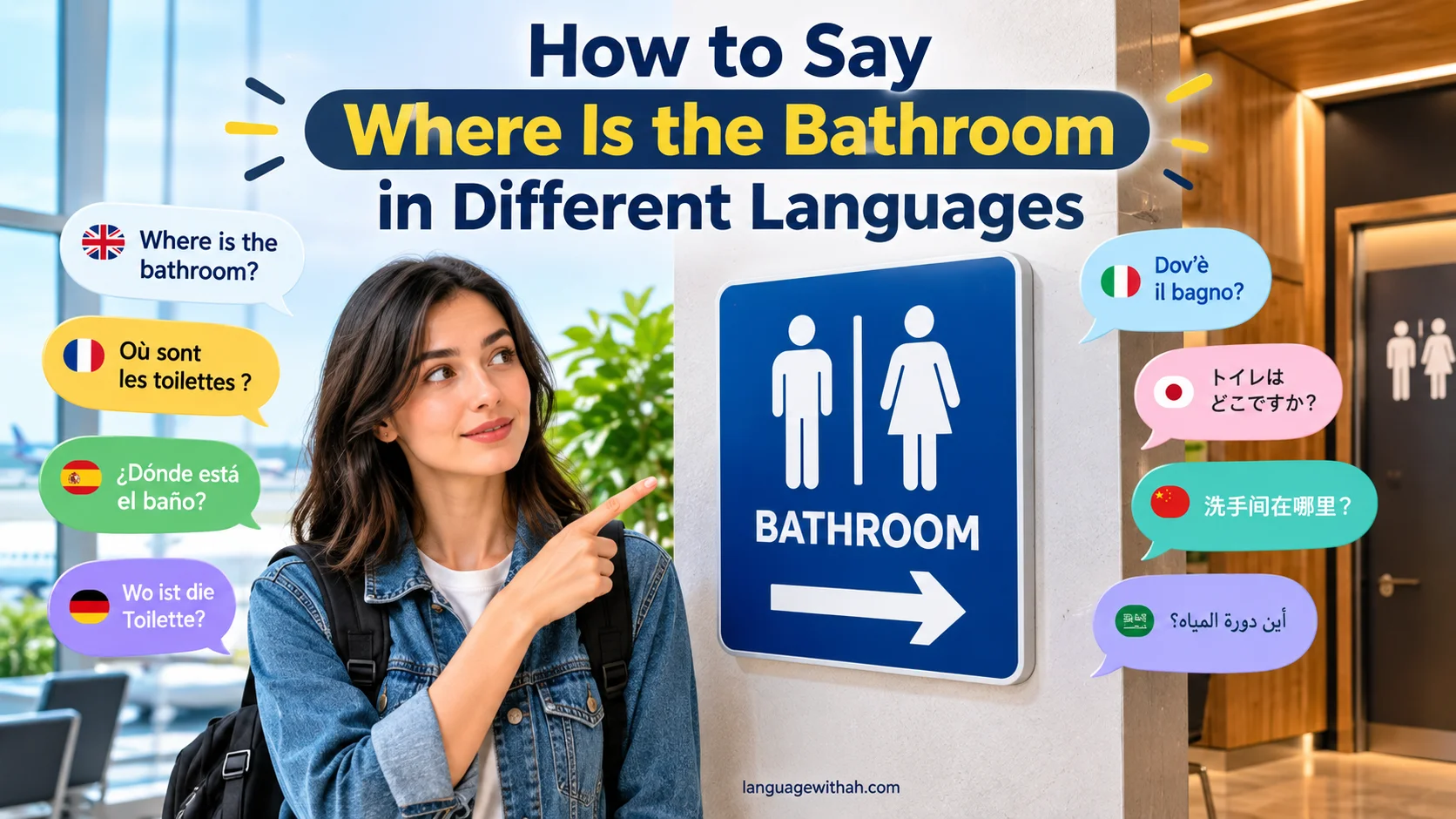
Knowing how to ask “Where is the bathroom?” is one of the most useful practical phrases for travelers, students, and anyone communicating in a foreign language. The English phrase asks for the location of a restroom, toilet, washroom, or bathroom, but other languages may naturally use a different word for the same place.
In many languages, the most natural translation is closer to “Where is the toilet?” or “Where is the restroom?” rather than a literal translation of “bathroom.” Multilingual phrase references show this difference clearly across languages and regions.
Learning Where is the Bathroom in 70 Different Languages can be especially useful at airports, hotels, restaurants, shopping centers, train stations, schools, and tourist attractions. It can also make everyday communication feel more respectful because you are making an effort to use someone else’s native language.
The wording can change according to formality, region, dialect, vocabulary, and local convention. This guide provides practical translations, pronunciation help, example sentences, and cultural notes so you can choose an expression that sounds natural rather than simply translating every English word individually.
Interesting Facts About Where Is the Bathroom
- In many languages, the natural expression uses a word meaning “toilet” or “restroom” rather than the literal equivalent of “bathroom.”
- English itself has several regional choices. Bathroom, restroom, toilet, and loo can all be understood, although their frequency and social tone vary by region.
- In French, the common everyday question is Où sont les toilettes ?, literally asking where the toilets are.
- In Japanese, トイレはどこですか? (toire wa doko desu ka?) is a practical way to ask where the toilet is. Japanese also has more polite vocabulary such as お手洗い (otearai).
- Mandarin Chinese commonly uses 洗手间 (xǐshǒujiān), meaning a washroom/restroom, although 厕所 (cèsuǒ) is also widely understood.
- Arabic varies significantly by dialect. أين الحمّام؟ (ayna al-ḥammām?) is broadly recognizable, while Egyptian, Lebanese, and other varieties use different everyday forms.
- Some languages change the expression depending on formality. Czech, Tamil, Amharic, and several other languages have forms or vocabulary that can differ according to social context.
What Does Where Is the Bathroom Mean?
“Where is the bathroom?” is a question asking someone to tell you the location of a place where you can use toilet or washing facilities.
In everyday English, bathroom can refer to a room containing a toilet, sink, and often a shower or bath. In public places, however, people may also say restroom, washroom, or toilet. The exact choice depends partly on regional English usage.
The phrase is normally a practical question, rather than an emotional or figurative expression. You might ask it in a hotel, café, airport, museum, restaurant, someone’s home, or another unfamiliar place.
Other languages do not necessarily divide these meanings in the same way. For example, French commonly uses toilettes, German uses Toilette, and Spanish commonly uses baño. These differences show why a natural translation is usually more useful than a word-for-word one.
Why Can Where Is the Bathroom Have Different Translations?
There is no single universal translation because languages organize everyday vocabulary differently.
Context is one major factor. A word meaning “bathroom” at home may not be the expression people normally use for a public restroom.
Formality can also matter. A short question may be perfectly acceptable with friends, while adding “excuse me” or a polite grammatical form can make the request more appropriate with strangers.
Regional variation is another important issue. Portuguese spoken in Portugal and Brazil has different everyday choices for this phrase. Arabic has particularly strong regional variation, while English uses different terms such as bathroom, restroom, and toilet depending on the variety.
Literal and natural translations are also different. A dictionary may give a direct equivalent for “bathroom,” but native speakers may normally ask for the toilet, WC, washroom, or another local term instead. Multilingual phrase references document many of these alternatives.
Gender and grammar can occasionally influence the wording as well. Some languages have grammatical agreement, while others use different politeness structures.
For this reason, the tables below prioritize the natural practical question a learner is likely to use when asking for a restroom.
European Languages
Europe contains several major language families, so the same practical question can look very different from one country to another. Romance languages often use words related to toilet, bathroom, or washroom, while Germanic and Slavic languages have their own common vocabulary. The forms below focus on everyday expressions that can be understood in practical situations.
| 🌍 Language | Country/Region | Translation | Pronunciation | Example Sentence |
| English | International | Where is the bathroom? | wair iz thuh BATH-room | Excuse me, where is the bathroom? — Where is the bathroom? |
| American English 🇺🇸 | United States | Where is the bathroom? | wair iz thuh BATH-room | Excuse me, where is the bathroom? — Where is the bathroom? |
| British English 🇬🇧 | United Kingdom | Where’s the toilet? / Where’s the loo? | wairz thuh TOY-let / wairz thuh loo | Excuse me, where’s the toilet? — Where is the toilet? |
| Australian English 🇦🇺 | Australia | Where’s the toilet? | wairz thuh TOY-let | Excuse me, where’s the toilet? — Where is the toilet? |
| Spanish 🇪🇸 | Spain and Latin America | ¿Dónde está el baño? | DON-deh es-TAH el BAN-yo | Perdón, ¿dónde está el baño? — Excuse me, where is the bathroom? |
| French 🇫🇷 | France and Francophone regions | Où sont les toilettes ? | oo son lay twa-LET | Excusez-moi, où sont les toilettes ? — Excuse me, where are the toilets? |
| German 🇩🇪 | Germany, Austria, Switzerland | Wo ist die Toilette? | vo ist dee toy-LET-tuh | Entschuldigung, wo ist die Toilette? — Excuse me, where is the toilet? |
| Italian 🇮🇹 | Italy | Dov’è il bagno? | doh-VEH eel BAN-yo | Scusi, dov’è il bagno? — Excuse me, where is the bathroom? |
| Portuguese 🇵🇹 | Portugal and other Portuguese-speaking regions | Onde fica a casa de banho? | ON-deh FEE-ka ah KAH-zah deh BAN-yoo | Com licença, onde fica a casa de banho? — Excuse me, where is the bathroom? |
| Dutch 🇳🇱 | Netherlands and Belgium | Waar is het toilet? | vaar is het toy-LET | Pardon, waar is het toilet? — Excuse me, where is the toilet? |
| Swedish 🇸🇪 | Sweden | Var är toaletten? | var air too-ah-LET-ten | Ursäkta, var är toaletten? — Excuse me, where is the toilet? |
| Norwegian 🇳🇴 | Norway | Hvor er toalettet? | voor air too-ah-LET-tet | Unnskyld, hvor er toalettet? — Excuse me, where is the toilet? |
| Danish 🇩🇰 | Denmark | Hvor er toilettet? | vor air toy-LET-et | Undskyld, hvor er toilettet? — Excuse me, where is the toilet? |
| Finnish 🇫🇮 | Finland | Missä on vessa? | MIS-sah on VES-sah | Anteeksi, missä on vessa? — Excuse me, where is the toilet? |
| Icelandic 🇮🇸 | Iceland | Hvar er klósettið? | kvar air KLOH-set-tith | Afsakið, hvar er klósettið? — Excuse me, where is the toilet? |
| Irish 🇮🇪 | Ireland | Cá bhfuil an leithreas? | kaw will un LEH-ras | Gabh mo leithscéal, cá bhfuil an leithreas? — Excuse me, where is the toilet? |
| Welsh 🏴 | Wales | Ble mae’r toiled? | ble myr TOY-led | Esgusodwch fi, ble mae’r toiled? — Excuse me, where is the toilet? |
| Polish 🇵🇱 | Poland | Gdzie jest toaleta? | gdyeh yest twa-LEH-ta | Przepraszam, gdzie jest toaleta? — Excuse me, where is the toilet? |
| Czech 🇨🇿 | Czech Republic | Kde je prosím záchod? | kdeh yeh PRO-seem ZAA-khod | Promiňte, kde je prosím záchod? — Excuse me, where is the toilet? |
| Slovak 🇸🇰 | Slovakia | Kde je záchod? | gdeh yeh ZAA-khod | Prosím, kde je záchod? — Please, where is the toilet? |
| Ukrainian 🇺🇦 | Ukraine | Де туалет? | deh too-ah-LET | Вибачте, де туалет? — Excuse me, where is the toilet? |
| Russian 🇷🇺 | Russia and other Russian-speaking regions | Где туалет? | gdyeh too-ah-LYET | Извините, где туалет? — Excuse me, where is the toilet? |
| Romanian 🇷🇴 | Romania and Moldova | Unde este toaleta? | OON-deh ES-teh twa-LE-ta | Scuzați-mă, unde este toaleta? — Excuse me, where is the toilet? |
| Hungarian 🇭🇺 | Hungary | Hol van a mosdó? | hol von uh MOSH-doh | Elnézést, hol van a mosdó? — Excuse me, where is the restroom? |
| Greek 🇬🇷 | Greece and Cyprus | Πού είναι η τουαλέτα; | poo EE-neh ee too-ah-LE-ta | Συγγνώμη, πού είναι η τουαλέτα; — Excuse me, where is the toilet? |
| Bulgarian 🇧🇬 | Bulgaria | Къде е тоалетната? | kuh-DEH eh toa-LET-na-ta | Извинете, къде е тоалетната? — Excuse me, where is the toilet? |
| Croatian 🇭🇷 | Croatia | Gdje je zahod? | gdyeh yeh ZA-hod | Oprostite, gdje je zahod? — Excuse me, where is the toilet? |
| Serbian 🇷🇸 | Serbia and surrounding regions | Где је тоалет? | gdeh yeh toa-LET | Извините, где је тоалет? — Excuse me, where is the toilet? |
| Slovenian 🇸🇮 | Slovenia | Kje imate stranišče? | kyeh EE-ma-teh stra-NEESH-cheh | Oprostite, kje imate stranišče? — Excuse me, where is the restroom? |
| Lithuanian 🇱🇹 | Lithuania | Kur yra tualetas? | koor EE-ra too-ah-LE-tas | Atsiprašau, kur yra tualetas? — Excuse me, where is the toilet? |
| Latvian 🇱🇻 | Latvia | Kur ir tualete? | koor eer too-ah-LEH-teh | Atvainojiet, kur ir tualete? — Excuse me, where is the toilet? |
| Estonian 🇪🇪 | Estonia | Kus on tualett? | koos on too-ah-LET | Vabandust, kus on tualett? — Excuse me, where is the toilet? |
| Albanian 🇦🇱 | Albania | Ku është tualeti? | koo UH-shtuh too-ah-LEH-tee | Më falni, ku është tualeti? — Excuse me, where is the toilet? |
| Bosnian 🇧🇦 | Bosnia and Herzegovina | Gdje je toalet? | gdyeh yeh toa-LET | Oprostite, gdje je toalet? — Excuse me, where is the toilet? |
| Belarusian 🇧🇾 | Belarus | Дзе туалет? | dzeh too-ah-LET | Прабачце, дзе туалет? — Excuse me, where is the toilet? |
| Catalan 🇪🇸 | Catalonia and other Catalan-speaking regions | On és el lavabo? | on es el la-VA-bo | Perdoni, on és el lavabo? — Excuse me, where is the washroom? |
European usage note: English, Portuguese, Spanish, Italian, French, Polish, and several other languages demonstrate why “bathroom” should not always be translated literally. French normally uses toilettes, while Spanish commonly uses baño and Italian uses bagno. Portuguese also differs between European and Brazilian usage.
English Varieties
The three English entries above should not be treated as three different languages. They are included because travelers may encounter different everyday vocabulary. American English commonly favors bathroom or restroom, British English frequently uses toilet or the informal loo, and Australian English commonly uses toilet. The basic question remains easily understandable across varieties.
Read More: How to Say What Is Your Name in Different Languages
Asian Languages
Asia includes many unrelated language families and several writing systems, including Chinese characters, Japanese kana, Korean Hangul, Arabic-derived scripts, Indic scripts, and Southeast Asian alphabets. The practical expression may use a word equivalent to bathroom, toilet, washroom, or restroom.
| 🌏 Language | Country/Region | Translation | Pronunciation | Example Sentence |
| Mandarin Chinese 🇨🇳 | China, Taiwan and Chinese-speaking communities | 洗手间在哪里? | xǐ-shǒu-jiān zài nǎ-lǐ | 请问,洗手间在哪里? — Excuse me, where is the restroom? |
| Cantonese 🇭🇰 | Hong Kong and Guangdong | 洗手間喺邊度呀? | sai-sau-gāan hai bīn-dou a | 唔該,洗手間喺邊度呀? — Excuse me, where is the restroom? |
| Japanese 🇯🇵 | Japan | トイレはどこですか? | TOY-reh wa DOH-koh dess ka | すみません、トイレはどこですか? — Excuse me, where is the toilet? |
| Korean 🇰🇷 | South Korea | 화장실이 어디예요? | hwa-jang-shi-ri eo-di-ye-yo | 실례합니다, 화장실이 어디예요? — Excuse me, where is the restroom? |
| Hindi 🇮🇳 | India | टॉयलेट कहाँ है? | TOY-let kah-HAAN hai | माफ़ कीजिए, टॉयलेट कहाँ है? — Excuse me, where is the toilet? |
| Urdu 🇵🇰 | Pakistan and Urdu-speaking communities | باتھ روم کہاں ہے؟ | bathroom kahaan hai | معاف کیجیے، باتھ روم کہاں ہے؟ — Excuse me, where is the bathroom? |
| Bengali 🇧🇩 | Bangladesh and eastern India | শৌচাগার কোথায়? | shou-cho-ga-ar KOTH-ay | মাফ করবেন, শৌচাগার কোথায়? — Excuse me, where is the restroom? |
| Punjabi 🇵🇰🇮🇳 | Pakistan and India | ਬਾਥਰੂਮ ਕਿੱਥੇ ਹੈ? | BAATH-room kit-theh hai | ਮਾਫ਼ ਕਰਨਾ, ਬਾਥਰੂਮ ਕਿੱਥੇ ਹੈ? — Excuse me, where is the bathroom? |
| Gujarati 🇮🇳 | Gujarat, India | શૌચાલય ક્યાં છે? | shau-cha-lay KYAA chhe | માફ કરશો, શૌચાલય ક્યાં છે? — Excuse me, where is the restroom? |
| Marathi 🇮🇳 | Maharashtra, India | शौचालय कुठे आहे? | shau-cha-LA-ya KOO-theh aa-he | माफ करा, शौचालय कुठे आहे? — Excuse me, where is the restroom? |
| Tamil 🇮🇳🇱🇰 | Tamil Nadu, Sri Lanka and Tamil-speaking communities | கழிவறை எங்கே? | ka-zhi-va-RYE EN-gay | மன்னிக்கவும், கழிவறை எங்கே? — Excuse me, where is the toilet? |
| Telugu 🇮🇳 | Andhra Pradesh and Telangana | బాత్రూమ్ ఎక్కడ ఉంది? | BATH-room ek-ka-da OON-di | క్షమించండి, బాత్రూమ్ ఎక్కడ ఉంది? — Excuse me, where is the bathroom? |
| Kannada 🇮🇳 | Karnataka, India | ಶೌಚಾಲಯ ಎಲ್ಲಿದೆ? | shau-cha-LA-ya EL-li-deh | ಕ್ಷಮಿಸಿ, ಶೌಚಾಲಯ ಎಲ್ಲಿದೆ? — Excuse me, where is the restroom? |
| Malayalam 🇮🇳 | Kerala, India | ബാത്ത്റൂം എവിടെയാണ്? | BATH-room e-vi-de-yaanu | ക്ഷമിക്കണം, ബാത്ത്റൂം എവിടെയാണ്? — Excuse me, where is the bathroom? |
| Nepali 🇳🇵 | Nepal | शौचालय कहाँ छ? | shau-cha-LA-ya ka-HAAN chha | माफ गर्नुहोस्, शौचालय कहाँ छ? — Excuse me, where is the restroom? |
| Sinhala 🇱🇰 | Sri Lanka | වැසිකිළිය කොහෙද? | wa-si-ki-li-ya ko-HE-da | සමාවෙන්න, වැසිකිළිය කොහෙද? — Excuse me, where is the toilet? |
| Thai 🇹🇭 | Thailand | ห้องน้ำอยู่ที่ไหน? | hong-NAAM yoo tee NAI | ขอโทษครับ ห้องน้ำอยู่ที่ไหน? — Excuse me, where is the bathroom? |
| Vietnamese 🇻🇳 | Vietnam | Nhà vệ sinh ở đâu? | nya veh sinh uh dow | Xin hỏi, nhà vệ sinh ở đâu? — Excuse me, where is the restroom? |
| Indonesian 🇮🇩 | Indonesia | Di mana kamar mandi? | dee MA-na KAH-mar MAN-dee | Permisi, di mana kamar mandi? — Excuse me, where is the bathroom? |
| Malay 🇲🇾 | Malaysia, Brunei and Singapore | Di mana tandas? | dee MA-na TAN-das | Maaf, di mana tandas? — Excuse me, where is the toilet? |
| Filipino/Tagalog 🇵🇭 | Philippines | Nasaan ang banyo? | na-SA-an ang BAN-yo | Excuse me, nasaan ang banyo? — Excuse me, where is the bathroom? |
| Khmer 🇰🇭 | Cambodia | បន្ទប់ទឹកនៅឯណា? | bon-top tuk nov ae-na | សូមទោស បន្ទប់ទឹកនៅឯណា? — Excuse me, where is the bathroom? |
| Lao 🇱🇦 | Laos | ຫ້ອງນ້ຳຢູ່ໃສ? | hong nam yoo sai | ຂໍໂທດ, ຫ້ອງນ້ຳຢູ່ໃສ? — Excuse me, where is the bathroom? |
| Mongolian 🇲🇳 | Mongolia | Ариун цэврийн өрөө хаана байна? | a-ri-un tsev-reen uruu kha-na bai-na | Уучлаарай, ариун цэврийн өрөө хаана байна? — Excuse me, where is the restroom? |
| Kazakh 🇰🇿 | Kazakhstan and Kazakh-speaking regions | Дәретхана қай жерде? | da-ret-kha-na kai ZHER-de | Кешіріңіз, дәретхана қай жерде? — Excuse me, where is the restroom? |
| Uzbek 🇺🇿 | Uzbekistan and Uzbek-speaking regions | Hojathona qayerda? | ho-ja-tho-na qa-YER-da | Kechirasiz, hojathona qayerda? — Excuse me, where is the restroom? |
| Turkish 🇹🇷 | Turkey and Turkish-speaking communities | Tuvalet nerede? | too-va-LET ne-re-DE | Affedersiniz, tuvalet nerede? — Excuse me, where is the toilet? |
Asian language notes
In Mandarin, both 厕所 (cèsuǒ) and 洗手间 (xǐshǒujiān) are used for restroom-related meanings; 洗手间 is especially useful as a polite public-place term.
In Japanese, トイレ (toire) is a common everyday term. お手洗い (otearai) is another polite expression, and Japanese normally uses the polite question ending ですか when making this request to a stranger.
In Korean, 화장실 (hwajangsil) is the standard word for a bathroom or restroom. A natural polite question is 화장실이 어디에 있어요?, meaning approximately “Where is the bathroom located?”
For Indian languages, everyday speech can alternate between traditional terms and English-derived words such as “bathroom” or “toilet.” The most appropriate choice can depend on region, setting, and level of formality.
African Languages
Africa contains enormous linguistic diversity, with languages belonging to several major families. A single English concept can therefore be expressed through very different grammatical structures. The following examples focus on practical restroom questions rather than attempting to make one African wording represent all regions.
| 🌍 Language | Country/Region | Translation | Pronunciation | Example Sentence |
| Swahili 🇰🇪🇹🇿 | East Africa | Choo kiko wapi? | choo KEE-ko WA-pee | Samahani, choo kiko wapi? — Excuse me, where is the toilet? |
| Afrikaans 🇿🇦 | South Africa and Namibia | Waar is die toilet? | vaar is dee toy-LET | Verskoon my, waar is die toilet? — Excuse me, where is the toilet? |
| Zulu 🇿🇦 | South Africa | Likuphi igumbi langasese? | lee-KOO-phee ee-GOOM-bee la-ngah-SEH-seh | Uxolo, likuphi igumbi langasese? — Excuse me, where is the bathroom? |
| Xhosa 🇿🇦 | South Africa | Liphi igumbi langasese? | LEE-pee ee-GOOM-bee la-ngah-SEH-seh | Uxolo, liphi igumbi langasese? — Excuse me, where is the bathroom? |
| Amharic 🇪🇹 | Ethiopia | መጸዳጃ ቤት የት ነው? | met-se-da-ja bet yet new | ይቅርታ፣ መጸዳጃ ቤት የት ነው? — Excuse me, where is the restroom? |
| Yoruba 🇳🇬 | Nigeria and neighboring areas | Nibo ni ile igbọnsẹ wa? | NEE-bo nee EE-leh eeg-BON-sheh wa | Ẹ jọ̀wọ́, nibo ni ile igbọnsẹ wa? — Please, where is the toilet? |
| Igbo 🇳🇬 | Nigeria | Ebee ka ụlọ mposi dị? | eh-BEH ka oo-LOH m-PO-see dee | Biko, ebee ka ụlọ mposi dị? — Please, where is the restroom? |
| Hausa 🇳🇬🇳🇪 | West Africa | Ina makewayi yake? | EE-na ma-ke-WAI-yee ya-keh | Don Allah, ina makewayi yake? — Please, where is the toilet? |
| Somali 🇸🇴 | Somalia and Somali-speaking regions | Musqusha aawey? | MOOS-qoo-sha AA-wey | Fadlan, musqusha aawey? — Please, where is the toilet? |
| Shona 🇿🇼 | Zimbabwe | Chimbuzi chiripi? | chim-BOO-zee chee-REE-pee | Ndapota, chimbuzi chiripi? — Please, where is the toilet? |
| Sesotho 🇱🇸🇿🇦 | Lesotho and South Africa | Ntloana e kae? | ntlo-A-na eh KAI | Ntšoarele, ntloana e kae? — Excuse me, where is the toilet? |
| Kinyarwanda 🇷🇼 | Rwanda | Aho kwituma ni he? | A-ho kwee-TOO-ma nee HEH | Mumbabarire, aho kwituma ni he? — Excuse me, where is the toilet? |
| Malagasy 🇲🇬 | Madagascar | Aiza ny toilety? | AI-za nee toy-LEH-tee | Azafady, aiza ny toilety? — Excuse me, where is the toilet? |
The Afrikaans form Waar is die toilet? is directly documented as a practical bathroom question, with badkamer also possible when referring specifically to a bathroom.
Middle Eastern Languages
The Middle East contains several distinct linguistic traditions. Arabic itself has many regional varieties, while Persian, Hebrew, Kurdish, Turkish, and Armenian belong to different language traditions. A useful traveler should therefore avoid treating one regional expression as universal.
| 🌍 Language | Country/Region | Translation | Pronunciation | Example Sentence |
| Modern Standard Arabic 🇸🇦 | Arabic-speaking countries | أين الحمّام؟ | AY-na al-ham-MAAM | عفواً، أين الحمّام؟ — Excuse me, where is the bathroom? |
| Egyptian Arabic 🇪🇬 | Egypt | الحمام فين؟ | el-ham-MAAM FEEN | لو سمحت، الحمام فين؟ — Please, where is the bathroom? |
| Persian/Farsi 🇮🇷 | Iran and Persian-speaking communities | دستشویی کجاست؟ | dast-shoo-EE-yee ko-JAST | ببخشید، دستشویی کجاست؟ — Excuse me, where is the bathroom? |
| Hebrew 🇮🇱 | Israel | איפה השירותים? | EY-fo ha-she-roo-TEEM | סליחה, איפה השירותים? — Excuse me, where is the restroom? |
| Kurdish (Kurmanji) | Kurdistan regions | Tuvalet li ku ye? | too-va-LET lee koo yeh | Bibore, tuvalet li ku ye? — Excuse me, where is the toilet? |
| Armenian 🇦🇲 | Armenia and Armenian-speaking communities | Որտե՞ղ է զուգարանը։ | vor-TEGH eh zoo-ga-RA-neh | Ներեցեք, որտե՞ղ է զուգարանը։ — Excuse me, where is the restroom? |
| Turkish 🇹🇷 | Turkey | Tuvalet nerede? | too-va-LET ne-re-DE | Affedersiniz, tuvalet nerede? — Excuse me, where is the toilet? |
| Pashto 🇦🇫 | Afghanistan and Pashto-speaking regions | تشناب چېرې دی؟ | tash-NAAB che-REH day | وبخښئ، تشناب چېرې دی؟ — Excuse me, where is the toilet? |
Arabic variation
Arabic deserves special attention because Modern Standard Arabic and regional dialects are not interchangeable in every everyday situation. أين الحمّام؟ (ayna al-ḥammām?) is broadly understandable, while Egyptian Arabic commonly uses الحمام فين؟ (el-ḥammām fein?). Lebanese, Kuwaiti, Moroccan, and other varieties have their own everyday forms.
Persian variation
Persian has more than one practical word for this place. دستشویی (dastshuyi) is a common everyday term, while توالت (tualet) is also understood. A polite request can begin with ببخشید (bebakhshid), meaning “excuse me.”
Other World Languages
The following languages extend the list beyond the major European, Asian, African, and Middle Eastern groups. They are included because they offer useful examples of how the same practical question can be structured in very different ways.
| 🌎 Language | Country/Region | Translation | Pronunciation | Example Sentence |
| Māori 🇳🇿 | New Zealand | Kei hea te wharepaku? | kay HEH-ah teh fa-reh-PA-koo | Tēnā koa, kei hea te wharepaku? — Please, where is the bathroom? |
| Samoan 🇼🇸 | Samoa | O fea le fale ta’ele? | oh FEH-ah leh fa-leh ta-EH-leh | Fa’amolemole, o fea le fale ta’ele? — Please, where is the bathroom? |
| Tongan 🇹🇴 | Tonga | Ko fē ʻa e falemālōlō? | koh FEH ah eh fa-le-ma-lo-lo | Kataki, ko fē ʻa e falemālōlō? — Please, where is the bathroom? |
| Haitian Creole 🇭🇹 | Haiti | Kote twalèt la? | KOH-teh twa-LET la | Tanpri, kote twalèt la? — Please, where is the toilet? |
| Quechua | Andes of Peru, Bolivia and surrounding regions | ¿Maypi bañu? | MAY-pee BA-nyoo | Ama hina, ¿maypi bañu? — Excuse me, where is the bathroom? |
| Guarani 🇵🇾 | Paraguay and surrounding regions | Moõpa oĩ tyehópe? | moh-O-pa oy tye-HO-pe | Ikatúpa ere chéve, moõpa oĩ tyehópe? — Can you tell me where the toilet is? |
| Esperanto | International constructed language | Kie estas la necesejo? | KEE-eh ES-tas la neh-tseh-SEH-yo | Pardonu, kie estas la necesejo? — Excuse me, where is the restroom? |
| Hawaiian 🇺🇸 | Hawaiʻi | Aia i hea i ka lua? | AI-a ee HEH-a ee ka LOO-a | E kala mai, aia i hea i ka lua? — Excuse me, where is the bathroom? |
The multilingual phrase reference also records Māori, Samoan, Haitian Creole, Quechua, Hawaiian, and Esperanto forms, illustrating how broad the vocabulary for this simple question can be.
Cultural Notes for Travelers
The safest approach is to learn the local practical expression, not simply translate the English word “bathroom.”
In a formal setting, adding a polite opener such as “Excuse me” or “Please” is often useful. The exact politeness strategy differs by language, so learners should avoid assuming that one English-style formula can be transferred directly.
In France, for example, toilettes is more natural for a public restroom than translating “bathroom” literally as salle de bains. In Portugal, casa de banho is a familiar term, while Brazil commonly uses banheiro.
In Japan, トイレ is practical and widely understood, while お手洗い can sound more polite. In Korea, 화장실 is the standard everyday word for a restroom.
In English-speaking countries, bathroom, restroom, toilet, washroom, and loo are not always interchangeable in tone or regional preference. The basic meaning remains clear, but the most natural choice depends on where you are.
Pronunciation Guidelines
Pronunciation guides in this article are learner-friendly approximations, not replacements for hearing a native speaker.
For languages with non-Latin writing systems, the native script is shown where practical, followed by romanization. Mandarin uses Pinyin, Korean uses a common romanization, and Japanese uses a common Latin-script representation.
Some languages have sounds that do not have exact English equivalents. For example, the ḥ in Arabic romanization represents a consonant that differs from an ordinary English “h.” Similarly, Japanese, Korean, Thai, Vietnamese, and Mandarin pronunciation cannot always be reproduced perfectly with English spelling.
For tonal languages such as Mandarin, Cantonese, Vietnamese, and Thai, an English-style pronunciation guide can only approximate the sound. When learning seriously, use audio from a reliable language-learning resource and imitate the native pronunciation rather than relying exclusively on the spelling.
Quick Reference: Where Is the Bathroom in Different Languages
| Language | Translation |
| English | Where is the bathroom? |
| American English | Where is the bathroom? |
| British English | Where’s the toilet? |
| Australian English | Where’s the toilet? |
| Spanish | ¿Dónde está el baño? |
| French | Où sont les toilettes ? |
| German | Wo ist die Toilette? |
| Italian | Dov’è il bagno? |
| Portuguese | Onde fica a casa de banho? |
| Dutch | Waar is het toilet? |
| Swedish | Var är toaletten? |
| Norwegian | Hvor er toalettet? |
| Danish | Hvor er toilettet? |
| Finnish | Missä on vessa? |
| Icelandic | Hvar er klósettið? |
| Irish | Cá bhfuil an leithreas? |
| Welsh | Ble mae’r toiled? |
| Polish | Gdzie jest toaleta? |
| Czech | Kde je prosím záchod? |
| Slovak | Kde je záchod? |
| Ukrainian | Де туалет? |
| Russian | Где туалет? |
| Romanian | Unde este toaleta? |
| Hungarian | Hol van a mosdó? |
| Greek | Πού είναι η τουαλέτα; |
| Bulgarian | Къде е тоалетната? |
| Croatian | Gdje je zahod? |
| Serbian | Где је тоалет? |
| Slovenian | Kje imate stranišče? |
| Lithuanian | Kur yra tualetas? |
| Latvian | Kur ir tualete? |
| Estonian | Kus on tualett? |
| Albanian | Ku është tualeti? |
| Bosnian | Gdje je toalet? |
| Belarusian | Дзе туалет? |
| Catalan | On és el lavabo? |
| Mandarin Chinese | 洗手间在哪里? |
| Cantonese | 洗手間喺邊度呀? |
| Japanese | トイレはどこですか? |
| Korean | 화장실이 어디예요? |
| Hindi | टॉयलेट कहाँ है? |
| Urdu | باتھ روم کہاں ہے؟ |
| Bengali | শৌচাগার কোথায়? |
| Punjabi | ਬਾਥਰੂਮ ਕਿੱਥੇ ਹੈ? |
| Gujarati | શૌચાલય ક્યાં છે? |
| Marathi | शौचालय कुठे आहे? |
| Tamil | கழிவறை எங்கே? |
| Telugu | బాత్రూమ్ ఎక్కడ ఉంది? |
| Kannada | ಶೌಚಾಲಯ ಎಲ್ಲಿದೆ? |
| Malayalam | ബാത്ത്റൂം എവിടെയാണ്? |
| Nepali | शौचालय कहाँ छ? |
| Sinhala | වැසිකිළිය කොහෙද? |
| Thai | ห้องน้ำอยู่ที่ไหน? |
| Vietnamese | Nhà vệ sinh ở đâu? |
| Indonesian | Di mana kamar mandi? |
| Malay | Di mana tandas? |
| Filipino | Nasaan ang banyo? |
| Khmer | បន្ទប់ទឹកនៅឯណា? |
| Lao | ຫ້ອງນ້ຳຢູ່ໃສ? |
| Mongolian | Ариун цэврийн өрөө хаана байна? |
| Kazakh | Дәретхана қай жерде? |
| Uzbek | Hojathona qayerda? |
| Turkish | Tuvalet nerede? |
| Arabic | أين الحمّام؟ |
| Egyptian Arabic | الحمام فين؟ |
| Persian | دستشویی کجاست؟ |
| Hebrew | איפה השירותים? |
| Kurdish | Tuvalet li ku ye? |
| Armenian | Որտե՞ղ է զուգարանը։ |
| Pashto | تشناب چېرې دی؟ |
| Swahili | Choo kiko wapi? |
| Afrikaans | Waar is die toilet? |
| Zulu | Likuphi igumbi langasese? |
| Xhosa | Liphi igumbi langasese? |
| Amharic | መጸዳጃ ቤት የት ነው? |
| Yoruba | Nibo ni ile igbọnsẹ wa? |
| Igbo | Ebee ka ụlọ mposi dị? |
| Hausa | Ina makewayi yake? |
| Somali | Musqusha aawey? |
| Shona | Chimbuzi chiripi? |
| Sesotho | Ntloana e kae? |
| Kinyarwanda | Aho kwituma ni he? |
| Malagasy | Aiza ny toilety? |
| Māori | Kei hea te wharepaku? |
| Samoan | O fea le fale ta’ele? |
| Tongan | Ko fē ʻa e falemālōlō? |
| Haitian Creole | Kote twalèt la? |
| Quechua | ¿Maypi bañu? |
| Guarani | Moõpa oĩ tyehópe? |
| Hawaiian | Aia i hea i ka lua? |
| Esperanto | Kie estas la necesejo? |
The core multilingual forms above are supported by established multilingual phrase references, with regional alternatives noted where the source material identifies them.
How to Choose the Right Translation
Choosing the right translation is easier when you think about where you are and who you are speaking to.
- Use the standard everyday form when asking a stranger for directions.
- Add a polite expression such as “excuse me” when appropriate.
- Check the region because the same language may use different everyday words in different countries.
- Prefer natural vocabulary over a literal dictionary translation.
- Listen to local pronunciation if the language is unfamiliar.
- Pay attention to formality when speaking to older people, customers, staff, or strangers.
- Use the local word for a public restroom when that is more common than the literal word for a private bathroom.
For example, a learner going to France will generally benefit more from learning Où sont les toilettes ? than from mechanically translating “bathroom.” Likewise, someone visiting Korea can use 화장실이 어디예요? as a practical everyday question.
Common Mistakes When Translating Where Is the Bathroom
1. Translating Every Word Literally
A literal translation can sound unnatural. Bathroom, toilet, restroom, and washroom may correspond to different everyday words in another language.
2. Ignoring Regional Vocabulary
Portuguese in Portugal and Brazil does not always use the same everyday expression. English also varies considerably between North America, Britain, Australia, and other English-speaking regions.
3. Forgetting Formality
A very short question may be acceptable among friends but less suitable with a stranger. When uncertain, a polite opening such as “Excuse me” is a useful choice.
4. Mixing Dialects
Arabic is a clear example. A learner should not assume that an Egyptian Arabic phrase is the standard everyday wording in Morocco or Lebanon.
5. Using Incorrect Pronunciation
A translation can be grammatically correct but difficult to understand if pronounced poorly. This is especially important for tonal languages and languages with unfamiliar sounds.
6. Confusing “Bathroom” With “Bath”
In some languages, the literal term for a bathing room may not be the usual term for a public toilet. Always learn the phrase used in the actual situation.
7. Assuming One Translation Works Everywhere
Even within the same language, speakers may prefer toilet, WC, restroom, bathroom, or washroom according to country and context.
Why Learn Where Is the Bathroom in Different Languages?
Learning a practical phrase such as “Where is the bathroom?” can have immediate value when traveling. It helps you navigate airports, hotels, restaurants, stations, public buildings, and unfamiliar neighborhoods.
For language learners, the phrase also teaches more than one vocabulary item. You encounter words for where, toilet, bathroom, restroom, and location, while also seeing how questions are grammatically structured.
It can also encourage cross-cultural communication. Even a short phrase in someone’s native language can make an interaction feel more personal and considerate.
The most valuable lesson is that languages do not simply replace one English word with another. They organize familiar ideas differently. Learning those differences helps you understand grammar, vocabulary, pronunciation, regional variation, and cultural expression at the same time.
FAQs:
How do you say Where Is the Bathroom in different languages?
There are many natural translations. For example, Spanish uses ¿Dónde está el baño?, French uses Où sont les toilettes ?, German uses Wo ist die Toilette?, Japanese uses トイレはどこですか?, and Korean uses 화장실이 어디예요?. The exact wording depends on the language and local usage.
What is the most natural translation of Where Is the Bathroom?
There is no single translation that is most natural for every language. In some languages, the natural phrase means “Where is the toilet?”, while others use a term closer to bathroom, washroom, or restroom.
Can the translation change by country?
Yes. Regional variation can affect vocabulary and phrasing. Portuguese is a good example because Brazilian and European Portuguese use different common terms for the bathroom. Arabic also has substantial regional variation.
Why do some languages have multiple translations?
Languages may have several words for the same general facility, such as toilet, bathroom, restroom, WC, or washroom. The choice may depend on formality, location, regional preference, or whether the facility is private or public.
Does pronunciation change between regions?
It can. Regional accents and dialects may change pronunciation even when the written phrase remains the same. This is especially noticeable in languages with multiple major regional varieties.
Conclusion:
Learning how to say “Where is the bathroom?” in different languages is a small but genuinely useful part of multilingual communication. The phrase can help travelers, students, families, and language learners manage ordinary situations in restaurants, hotels, airports, stations, schools, and public spaces.
The biggest lesson is that literal translation is not always natural translation. A language may use a word meaning toilet, washroom, WC, restroom, or bathroom, and the preferred term can change from one region to another. Arabic, Portuguese, English, and many other languages demonstrate how important regional variation and context can be.













1 thought on “How to Say Where Is the Bathroom in Different Languages”