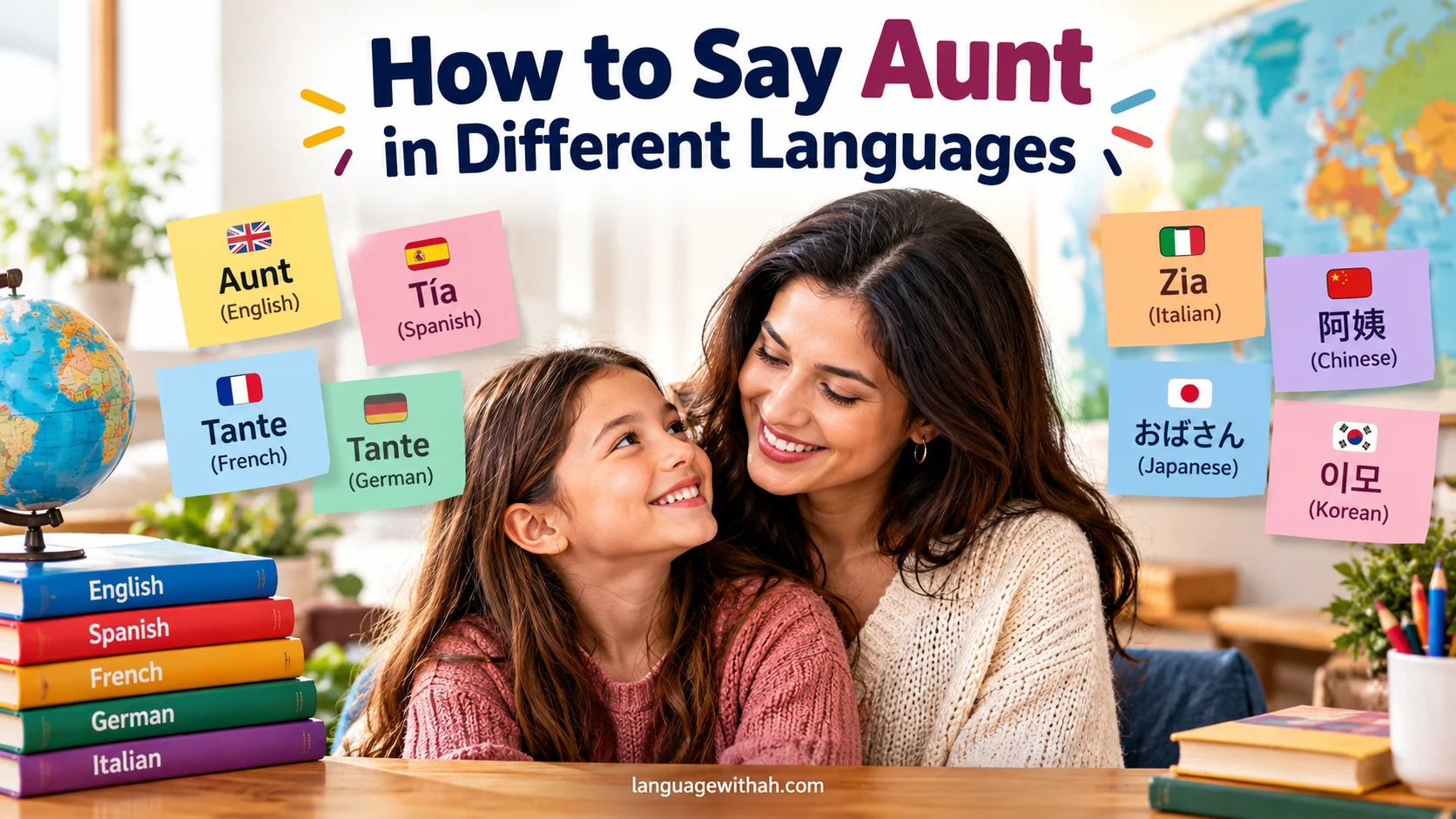
The word aunt describes an important family relationship, but languages around the world do not always divide that relationship in the same way. English normally uses one word for a parent’s sister and, in many contexts, a parent’s sister-in-law. In other languages, the exact term can tell you whether the woman is related through your mother or father, and sometimes whether she is older, younger, or related by marriage.
Learning Aunt in 70 Different Languages is therefore more than memorizing a list of vocabulary words. It can introduce you to the way different languages organize family relationships and show why a direct word-for-word translation is not always enough. For travelers, language learners, students, families, and anyone communicating internationally, knowing the appropriate family term can make a message sound more natural and respectful.
This guide covers 80 language and regional entries, including European, Asian, African, Middle Eastern, and other world languages. Each entry includes the natural term for aunt, an easy pronunciation guide, and an example sentence. Where a language has important regional or family-side distinctions, those are explained rather than hidden.
Interesting Facts About Aunt
- English uses one common everyday word, “aunt,” while several other languages have separate words for maternal and paternal aunts.
- Swedish distinguishes moster for a maternal aunt from faster for a paternal aunt.
- Arabic traditionally distinguishes khālah for a maternal aunt from ʿammah for a paternal aunt.
- Turkish uses teyze for a mother’s sister and hala for a father’s sister.
- Mandarin Chinese has several precise kinship terms, including 阿姨 (āyí) for a maternal aunt and 姑姑 (gūgu) for a father’s sister.
- Korean similarly uses different terms for a mother’s sister and a father’s sister: 이모 (imo) and 고모 (gomo).
- Some languages also distinguish aunts by marriage, older and younger relatives, or specific family positions, so the English word “aunt” can cover several different relationships.
What Does Aunt Mean?
An aunt is generally a woman who is the sister of someone’s mother or father. In English, the word can also refer to certain female relatives by marriage, especially an uncle’s wife.
The emotional meaning can be broader. An aunt may be a close family member, a trusted adult, a caregiver, or simply an older relative. In some communities, people also use an aunt-like term respectfully for an older woman who is not a biological relative.
The important point is that “aunt” is a broad English category. Another language may require you to identify exactly which relative you mean before choosing the appropriate word.
Why Can Aunt Have Different Translations?
There is no single universal translation of aunt because family relationships are organized differently across languages.
The correct term can depend on:
- Family side: maternal or paternal.
- Age: older or younger than a parent.
- Marriage: blood relative or relative by marriage.
- Formality: formal, neutral, affectionate, or colloquial.
- Region: the preferred term can differ between countries or dialects.
- Grammar: some languages require grammatical changes depending on the sentence.
- Context: a family relationship may use a different word from a respectful form of address.
- Written versus spoken language: some languages use different written characters to distinguish family relationships even when the spoken forms sound similar.
For example, English simply says “my aunt,” but Turkish can say teyzem for “my maternal aunt” and halam for “my paternal aunt.” Arabic, Persian, Chinese, Korean, and several South Asian languages make similar distinctions.
The tables below therefore give the most useful natural term for the stated context, rather than pretending every language has a perfect one-word equivalent.
Read More: How to Say Amen in Different Languages
European Languages
Europe contains several major language families, and family vocabulary varies considerably even among neighboring countries. Romance languages often use a broad word for aunt, while some Germanic, Slavic, and other European languages preserve more detailed distinctions. The examples below use ordinary family contexts rather than forcing literal translations.
English Varieties
American, British, and Australian English generally use the same basic word aunt. The main difference relevant here is pronunciation and, in some contexts, the affectionate forms auntie or aunty.
| 🌍 Language | Country/Region | Translation | Pronunciation | Example Sentence |
| 🇺🇸 American English | United States | Aunt | ant / awnt | My aunt lives nearby. |
| 🇬🇧 British English | United Kingdom | Aunt | ahnt / ant | My aunt is visiting today. |
| 🇦🇺 Australian English | Australia | Aunt / Aunty | ant / AHN-tee | My aunty made dinner. |
Note: These are varieties of English, not three separate languages. The vocabulary is essentially the same, although pronunciation and preferred affectionate forms can differ.
European Language Table
| 🌍 Language | Country/Region | Translation | Pronunciation | Example Sentence |
| 🇪🇸 Spanish | Spain, Latin America | tía | TEE-ah | Mi tía vive cerca. — My aunt lives nearby. |
| 🇫🇷 French | France, Belgium, Canada | tante | tahnt | Ma tante habite près d’ici. — My aunt lives nearby. |
| 🇩🇪 German | Germany, Austria, Switzerland | Tante | TAHN-tuh | Meine Tante wohnt in der Nähe. — My aunt lives nearby. |
| 🇮🇹 Italian | Italy, Switzerland | zia | TSEE-ah | Mia zia vive qui vicino. — My aunt lives nearby. |
| 🇵🇹 Portuguese | Portugal, Brazil | tia | TEE-ah | Minha tia mora perto. — My aunt lives nearby. |
| 🇳🇱 Dutch | Netherlands, Belgium | tante | TAHN-tuh | Mijn tante woont dichtbij. — My aunt lives nearby. |
| 🇸🇪 Swedish | Sweden, Finland | moster / faster | MOOS-ter / FAHS-ter | Min moster bor nära. — My maternal aunt lives nearby. |
| 🇳🇴 Norwegian | Norway | tante | TAHN-teh | Tanten min bor i nærheten. — My aunt lives nearby. |
| 🇩🇰 Danish | Denmark | tante | TAN-teh | Min tante bor i nærheden. — My aunt lives nearby. |
| 🇫🇮 Finnish | Finland | täti | TAE-tee | Täti asuu lähellä. — My aunt lives nearby. |
| 🇮🇸 Icelandic | Iceland | frænka | FRAIN-ka | Frænka mín býr hér. — My aunt lives here. |
| 🇮🇪 Irish | Ireland | aintín | AN-cheen | Tá m’aintín anseo. — My aunt is here. |
| 🏴 Welsh | Wales | modryb | MOD-rib | Mae fy modryb yma. — My aunt is here. |
| 🇵🇱 Polish | Poland | ciocia | CHO-cha | Moja ciocia mieszka blisko. — My aunt lives nearby. |
| 🇨🇿 Czech | Czech Republic | teta | TEH-ta | Moje teta bydlí blízko. — My aunt lives nearby. |
| 🇸🇰 Slovak | Slovakia | teta | TEH-ta | Moja teta býva blízko. — My aunt lives nearby. |
| 🇺🇦 Ukrainian | Ukraine | тітка | TEET-ka | Моя тітка живе тут. — My aunt lives here. |
| 🇷🇺 Russian | Russia | тётя | TYOH-tya | Моя тётя живёт рядом. — My aunt lives nearby. |
| 🇷🇴 Romanian | Romania, Moldova | mătușă | muh-TOO-shuh | Mătușa mea locuiește aproape. — My aunt lives nearby. |
| 🇭🇺 Hungarian | Hungary | nagynéni | NAHJ-nay-nee | A nagynéném itt lakik. — My aunt lives here. |
| 🇬🇷 Greek | Greece, Cyprus | θεία | thee-AH | Η θεία μου μένει κοντά. — My aunt lives nearby. |
| 🇧🇬 Bulgarian | Bulgaria | леля | LEH-lya | Леля ми живее наблизо. — My aunt lives nearby. |
| 🇭🇷 Croatian | Croatia | teta / tetka | TEH-ta / TET-ka | Moja teta živi blizu. — My aunt lives nearby. |
| 🇷🇸 Serbian | Serbia, Bosnia and Herzegovina | tetka | TET-ka | Moja tetka živi blizu. — My aunt lives nearby. |
| 🇸🇮 Slovenian | Slovenia | teta | TEH-ta | Moja teta živi blizu. — My aunt lives nearby. |
| 🇱🇹 Lithuanian | Lithuania | teta | TEH-ta | Mano teta gyvena čia. — My aunt lives here. |
| 🇱🇻 Latvian | Latvia | tante | TAHN-teh | Mana tante dzīvo šeit. — My aunt lives here. |
| 🇪🇪 Estonian | Estonia | tädi | TAE-dee | Mu tädi elab siin. — My aunt lives here. |
| 🇦🇱 Albanian | Albania, Kosovo | teze / hallë | TEH-zeh / HAH-luh | Halla ime po vjen sot. — My paternal aunt is coming today. |
| 🇪🇺 Basque | Basque Country | izeba | ee-SEH-ba | Nire izeba hemen dago. — My aunt is here. |
| 🇦🇩 Catalan | Catalonia, Valencia, Balearic Islands | tia | TEE-ah | La meva tia viu aquí. — My aunt lives here. |
| 🇪🇸 Galician | Galicia | tía | TEE-ah | A miña tía vive aquí. — My aunt lives here. |
| 🇲🇹 Maltese | Malta | zija | ZEE-ya | Iz-zija tiegħi tinsab hawn. — My aunt is here. |
European Cultural Notes
The Scandinavian languages illustrate how family vocabulary can be more precise than English. Swedish uses moster for a maternal aunt and faster for a paternal aunt. Norwegian and Danish also have traditional terms such as moster and faster, although tante is widely understood as a general word.
Albanian is another useful example: teze refers to a mother’s sister, while hallë refers to a father’s sister. This distinction reflects a broader pattern found in several languages of the region.
Catalan provides an interesting register distinction. tia is the standard kinship term, while tieta is an informal or diminutive form comparable to “auntie.”
Asian Languages
Asia contains an enormous range of language families and writing systems. Family terminology can be particularly detailed in South Asian, East Asian, and Southeast Asian languages. In several of these languages, the correct translation depends on which side of the family the aunt belongs to.
| 🌍 Language | Country/Region | Translation | Pronunciation | Example Sentence |
| 🇨🇳 Mandarin Chinese | China, Taiwan, Singapore | 阿姨 / 姑姑 | ā-yí / gū-gu | 我的阿姨住在这里。— My maternal aunt lives here. |
| 🇭🇰 Cantonese | Hong Kong, Guangdong | 姨媽 / 姑媽 | ji4 maa1 / gu1 maa1 | 我姨媽聽晚嚟食飯。— My maternal aunt is coming for dinner tomorrow. |
| 🇯🇵 Japanese | Japan | おば / おばさん | oh-bah / oh-bah-sahn | おばさんはここに住んでいます。— My aunt lives here. |
| 🇰🇷 Korean | South Korea, North Korea | 이모 / 고모 | EE-mo / GO-mo | 이모는 여기 살아요. — My maternal aunt lives here. |
| 🇮🇳 Hindi | India | मौसी / बुआ | MAU-see / BOO-aa | मेरी मौसी यहाँ रहती हैं।— My maternal aunt lives here. |
| 🇵🇰 Urdu | Pakistan, India | خالہ / پھوپھی | KHAH-la / PHOO-pee | میری خالہ یہاں رہتی ہیں۔— My maternal aunt lives here. |
| 🇧🇩 Bengali | Bangladesh, India | খালা / ফুফু | KHA-la / FOO-foo | আমার খালা এখানে থাকেন।— My maternal aunt lives here. |
| 🇮🇳 Punjabi | India, Pakistan | ਮਾਸੀ / ਭੂਆ | MAA-see / BOO-aa | ਮੇਰੀ ਮਾਸੀ ਇੱਥੇ ਰਹਿੰਦੀ ਹੈ।— My maternal aunt lives here. |
| 🇮🇳 Gujarati | India | માસી / ફઈબા / કાકી | MAA-see / FAI-ba / KAA-kee | મારી માસી અહીં રહે છે. — My maternal aunt lives here. |
| 🇮🇳 Marathi | India | मावशी / आत्या | MAA-vuh-shee / AAT-yaa | माझी मावशी इथे राहते. — My maternal aunt lives here. |
| 🇮🇳 Tamil | India, Sri Lanka, Singapore | அத்தை | AT-thai | என் அத்தை இங்கே வசிக்கிறார். — My aunt lives here. |
| 🇮🇳 Telugu | India | అత్త / పిన్ని | AT-ta / PIN-nee | నా అత్త ఇక్కడ ఉంది. — My aunt is here. |
| 🇮🇳 Kannada | India | ಅತ್ತೆ | AT-teh | ನನ್ನ ಅತ್ತೆ ಇಲ್ಲಿದ್ದಾರೆ. — My aunt is here. |
| 🇮🇳 Malayalam | India | അമ്മായി | am-MAA-yee | എന്റെ അമ്മായി ഇവിടെ താമസിക്കുന്നു. — My aunt lives here. |
| 🇳🇵 Nepali | Nepal | फुपू / काकी | FOO-poo / KAA-kee | मेरी फुपू यहाँ बस्नुहुन्छ।— My paternal aunt lives here. |
| 🇱🇰 Sinhala | Sri Lanka | නැන්දා | NAN-daa | මගේ නැන්දා මෙහි ඉන්නවා. — My aunt is here. |
| 🇹🇭 Thai | Thailand | ป้า / น้า / อา | bpâa / náa / aa | ป้าของฉันอยู่ที่นี่ — My aunt is here. |
| 🇻🇳 Vietnamese | Vietnam | dì / cô | zee / koh | Dì tôi sống ở đây. — My maternal aunt lives here. |
| 🇮🇩 Indonesian | Indonesia | bibi / tante | BEE-bee / TAHN-teh | Bibi saya tinggal di sini. — My aunt lives here. |
| 🇲🇾 Malay | Malaysia, Brunei, Singapore | mak cik / ibu saudara | mak-CHEEK / EE-boo sow-DA-ra | Mak cik saya tinggal di sini. — My aunt lives here. |
| 🇵🇭 Filipino/Tagalog | Philippines | tiyahin | tee-YAH-hin | Nandito ang tiyahin ko. — My aunt is here. |
| 🇲🇲 Burmese | Myanmar | ဒေါ်လေး | daw-LAY | ဒေါ်လေး ဒီမှာနေတယ်။— My aunt is staying here. |
| 🇰🇭 Khmer | Cambodia | មីង | ming | មីងខ្ញុំនៅទីនេះ។— My aunt is here. |
| 🇱🇦 Lao | Laos | ປ້າ | paa | ປ້າຂອງຂ້ອຍຢູ່ທີ່ນີ້. — My aunt is here. |
| 🇲🇳 Mongolian | Mongolia | авга эгч | AV-ga egch | Миний авга эгч энд байна. — My paternal aunt is here. |
| 🇰🇿 Kazakh | Kazakhstan | тәте / апа | TAE-teh / ah-PAH | Менің тәтем осында тұрады. — My aunt lives here. |
| 🇺🇿 Uzbek | Uzbekistan | xola / amma | kho-LA / AM-ma | Xolam shu yerda yashaydi. — My maternal aunt lives here. |
| 🇹🇷 Turkish | Turkey, Cyprus | teyze / hala | TAY-zeh / HAH-la | Teyzem burada yaşıyor. — My maternal aunt lives here. |
Asian Cultural Notes
Asian languages demonstrate especially clearly why context matters.
In Mandarin, 阿姨 (āyí) commonly refers to a maternal aunt, while 姑姑 (gūgu) refers to the father’s sister. Cantonese has additional distinctions such as 姨媽 for an elder maternal aunt and 姑媽 for a father’s elder sister.
Korean uses 이모 (imo) for a mother’s sister and 고모 (gomo) for a father’s sister. Japanese is different: the spoken form おば (oba) can cover aunts, while written kanji can distinguish whether the aunt is older or younger than the parent.
South Asian languages can be even more detailed. Hindi distinguishes मौसी (mausī), the mother’s sister, from बुआ (būā), the father’s sister. Urdu commonly uses خالہ (khāla) for a maternal aunt and پھوپھی (phūphī) for a paternal aunt.
Vietnamese and Thai also have several family terms whose correct use depends on family side and age. These distinctions should not be replaced with one supposedly universal translation.
African Languages
Africa is home to thousands of languages, so there is no single African equivalent of aunt. Family vocabulary differs across language families and communities. Some languages use broad terms, while others identify specific relatives or incorporate terms borrowed from neighboring languages.
| 🌍 Language | Country/Region | Translation | Pronunciation | Example Sentence |
| 🇰🇪 Swahili | Kenya, Tanzania, East Africa | shangazi | shan-GAH-zee | Shangazi yangu yuko hapa. — My aunt is here. |
| 🇿🇦 Afrikaans | South Africa, Namibia | tannie | TAN-nee | My tannie woon hier. — My aunt lives here. |
| 🇿🇦 Zulu | South Africa | u-anti | oo-AHN-tee | U-anti wami ulapha. — My aunt is here. |
| 🇿🇦 Xhosa | South Africa | u-anti | oo-AHN-tee | U-anti wam ulapha. — My aunt is here. |
| 🇪🇹 Amharic | Ethiopia | አክስት | ak-ist | አክስቴ እዚህ ትኖራለች። — My aunt lives here. |
| 🇸🇴 Somali | Somalia, Somaliland | eeddo / habaryar | AY-doh / ha-ba-RYAR | Eeddaday halkan ayay degan tahay. — My aunt lives here. |
| 🇳🇬 Hausa | Nigeria, Niger | goggo | GOG-go | Goggo ta zo. — Aunt came. |
| 🇳🇬 Yoruba | Nigeria, Benin | àǹtí | AHN-tee | Àǹtí mi wà níbí. — My aunt is here. |
African Cultural Notes
Swahili shangazi is a useful example of a kinship term with a specific traditional relationship, commonly associated with a paternal aunt. The broader Swahili family vocabulary contains additional terms for other relatives.
In South African languages such as Zulu and Xhosa, u-anti is a familiar form based on the English word “aunt,” adapted to local grammatical patterns.
Somali also has more than one term for aunt, so the exact relationship can matter. These examples demonstrate why a dictionary-style one-word list may hide useful information about family structure.
Middle Eastern and Related Languages
The Middle East contains several distinct language families and traditions. Terms for aunts often make a clear distinction between the mother’s side and father’s side, particularly in Arabic, Persian, Kurdish, and Armenian.
| 🌍 Language | Country/Region | Translation | Pronunciation | Example Sentence |
| 🇸🇦 Arabic | Middle East, North Africa | خالة / عمة | KHA-la / AM-ma | خالتي تعيش هنا. — My maternal aunt lives here. |
| 🇮🇷 Persian | Iran, Afghanistan, Tajikistan | خاله / عمه | KHA-leh / AM-meh | خالهام اینجا زندگی میکند. — My maternal aunt lives here. |
| 🇮🇱 Hebrew | Israel | דודה | doh-DAH | דודה שלי גרה כאן. — My aunt lives here. |
| 🇮🇶 Northern Kurdish | Kurdistan regions | xaltî / met | khal-TEE / met | Xaltîya min li vir dijî. — My maternal aunt lives here. |
| 🇦🇲 Armenian | Armenia, Armenian communities | մորաքույր / հորաքույր | mo-ra-KUYR / ho-ra-KUYR | Իմ մորաքույրը այստեղ է։ — My maternal aunt is here. |
| 🇬🇪 Georgian | Georgia | დეიდა / მამიდა | DEY-da / ma-MEE-da | ჩემი დეიდა აქ ცხოვრობს. — My maternal aunt lives here. |
Middle Eastern Cultural Notes
Arabic has a particularly clear distinction:
- خالة (khālah) = mother’s sister, or maternal aunt.
- عمة (ʿammah) = father’s sister, or paternal aunt.
Persian follows a similar pattern with خاله (khāleh) for a maternal aunt and عمه (ammeh) for a paternal aunt.
Armenian and Georgian also distinguish family sides. These terms are not interchangeable simply because both can be translated into English as “aunt.”
Other World Languages
Some useful expressions come from languages outside the main regional groupings above. These examples show how family vocabulary can also reflect local concepts of kinship and extended family.
| 🌍 Language | Country/Region | Translation | Pronunciation | Example Sentence |
| 🇭🇹 Haitian Creole | Haiti | matant | mah-TAHNT | Matant mwen rete isit la. — My aunt lives here. |
| 🇳🇿 Māori | New Zealand | whaea kēkē | FY-ah KAY-kay | Ko tōku whaea kēkē tēnā. — That is my aunt. |
In Māori, whaea kēkē specifically means aunt or aunty, while whaea itself can mean mother or aunt depending on context. Haitian Creole matant is related historically to the French expression ma tante.
A Quick Look at Maternal and Paternal Aunt Terms
Some of the most useful distinctions in this article can be summarized as follows:
| Language | Maternal Aunt | Paternal Aunt |
| Swedish | moster | faster |
| Turkish | teyze | hala |
| Arabic | خالة khālah | عمة ʿammah |
| Persian | خاله khāleh | عمه ammeh |
| Hindi | मौसी mausī | बुआ būā |
| Urdu | خالہ khāla | پھوپھی phūphī |
| Bengali | খালা khala | ফুফু phuphu |
| Korean | 이모 imo | 고모 gomo |
| Mandarin Chinese | 阿姨 āyí | 姑姑 gūgu |
| Georgian | დეიდა deida | მამიდა mamida |
| Armenian | մորաքույր morakuyr | հորաքույր horakuyr |
| Albanian | teze | hallë |
| Marathi | मावशी māvaśī | आत्या ātyā |
| Telugu | పిన్ని pinni | అత్త atta |
These distinctions are especially important when you are speaking directly to a family member or writing a personal message.
Quick Reference: Aunt in Different Languages
| Language | Translation |
| American English | Aunt |
| British English | Aunt |
| Australian English | Aunt / Aunty |
| Spanish | tía |
| French | tante |
| German | Tante |
| Italian | zia |
| Portuguese | tia |
| Dutch | tante |
| Swedish | moster / faster |
| Norwegian | tante |
| Danish | tante |
| Finnish | täti |
| Icelandic | frænka |
| Irish | aintín |
| Welsh | modryb |
| Polish | ciocia |
| Czech | teta |
| Slovak | teta |
| Ukrainian | тітка |
| Russian | тётя |
| Romanian | mătușă |
| Hungarian | nagynéni |
| Greek | θεία |
| Bulgarian | леля |
| Croatian | teta / tetka |
| Serbian | tetka |
| Slovenian | teta |
| Lithuanian | teta |
| Latvian | tante |
| Estonian | tädi |
| Albanian | teze / hallë |
| Basque | izeba |
| Catalan | tia |
| Galician | tía |
| Maltese | zija |
| Mandarin Chinese | 阿姨 / 姑姑 |
| Cantonese | 姨媽 / 姑媽 |
| Japanese | おば / おばさん |
| Korean | 이모 / 고모 |
| Hindi | मौसी / बुआ |
| Urdu | خالہ / پھوپھی |
| Bengali | খালা / ফুফু |
| Punjabi | ਮਾਸੀ / ਭੂਆ |
| Gujarati | માસી / ફઈબા / કાકી |
| Marathi | मावशी / आत्या |
| Tamil | அத்தை |
| Telugu | అత్త / పిన్ని |
| Kannada | ಅತ್ತೆ |
| Malayalam | അമ്മായി |
| Nepali | फुपू / काकी |
| Sinhala | නැන්දා |
| Thai | ป้า / น้า / อา |
| Vietnamese | dì / cô |
| Indonesian | bibi / tante |
| Malay | mak cik / ibu saudara |
| Filipino/Tagalog | tiyahin |
| Burmese | ဒေါ်လေး |
| Khmer | មីង |
| Lao | ປ້າ |
| Mongolian | авга эгч |
| Kazakh | тәте / апа |
| Uzbek | xola / amma |
| Turkish | teyze / hala |
| Swahili | shangazi |
| Afrikaans | tannie |
| Zulu | u-anti |
| Xhosa | u-anti |
| Amharic | አክስት |
| Somali | eeddo / habaryar |
| Hausa | goggo |
| Yoruba | àǹtí |
| Arabic | خالة / عمة |
| Persian | خاله / عمه |
| Hebrew | דודה |
| Northern Kurdish | xaltî / met |
| Armenian | մորաքույր / հորաքույր |
| Georgian | დეიდა / მამიდა |
| Haitian Creole | matant |
| Māori | whaea kēkē |
How to Choose the Right Translation
The best translation depends on what relationship you actually mean.
If you are talking about your mother’s sister, choose the maternal term when the language distinguishes it. If you mean your father’s sister, use the paternal term.
Also consider:
- Region: A word may be common in one country but less familiar elsewhere.
- Formality: Some languages have affectionate or respectful forms.
- Age: Certain languages distinguish older and younger relatives.
- Marriage: Your aunt may be a parent’s sister or a relative by marriage.
- Audience: A term used inside a family may differ from one used in formal writing.
- Spoken versus written language: Chinese and Japanese are especially useful examples of this distinction.
- Pronunciation: A correctly written word can still sound unnatural if pronounced incorrectly.
When you are unsure, it is usually safer to ask a native speaker which family relationship you mean rather than assuming that the English word “aunt” has one exact equivalent.
Common Mistakes When Translating Aunt
1. Translating Word for Word
The biggest mistake is assuming that every language has one word corresponding exactly to English aunt. Many languages divide the concept into several family relationships.
2. Ignoring the Family Side
In languages such as Arabic, Turkish, Hindi, Korean, and Chinese, saying whether the aunt is from the mother’s or father’s side can change the translation.
3. Confusing an Aunt With an Aunt by Marriage
A parent’s sister and the wife of a parent’s brother may have different terms in languages with detailed kinship vocabulary.
4. Using a Dialect as a Universal Standard
A term used in one regional variety should not automatically be presented as the standard form for an entire language.
5. Ignoring Age
Some Asian languages encode age or relative seniority into family terminology. A general dictionary translation may therefore be incomplete.
6. Forgetting Grammatical Changes
The basic noun may change when it becomes “my aunt,” “your aunt,” or “our aunt.” Possessive forms are especially important in languages with inflection.
7. Using an Unreliable Pronunciation
A pronunciation guide should be treated as a learning aid, not a replacement for hearing native speech. Romanization systems can also vary, especially for Asian languages.
Why Learn Aunt in Different Languages?
Learning aunt in different languages is a small vocabulary exercise with surprisingly useful cultural value.
Family words are among the first expressions language learners encounter because they help people describe the relationships around them. Learning these words can improve everyday communication, make travel conversations easier, and help learners understand how another language organizes family connections.
It can also make multilingual messages more personal. Writing tía, zia, khāla, imo, or another culturally appropriate family term can be more natural than simply inserting the English word “aunt.”
Most importantly, family vocabulary teaches an important lesson about language: languages do not all divide the world in exactly the same way. Learning those differences encourages curiosity and makes cross-cultural communication more thoughtful.
FAQs:
How do you say aunt in different languages?
The word varies by language. Common examples include tía in Spanish, tante in French and German, zia in Italian, ciocia in Polish, mătușă in Romanian, täti in Finnish, 阿姨 (āyí) in Mandarin, and matant in Haitian Creole.
What is the most natural translation of aunt?
There is no single translation that is most natural for every language. The correct term depends on the language, region, and family relationship. In some languages, you need to know whether the aunt is maternal or paternal.
Can the translation of aunt change by country?
Yes. Regional vocabulary can vary, and some languages have dialect differences. Even when the basic word remains the same, pronunciation, affectionate forms, or preferred family terminology can change.
Why do some languages have multiple words for aunt?
Some languages organize kinship more precisely than English. They may distinguish mother’s sister, father’s sister, an aunt by marriage, older relatives, younger relatives, or other specific family relationships.
How do you say maternal aunt in Arabic?
A maternal aunt is خالة (khālah) in Arabic. A paternal aunt is عمة (ʿammah). The distinction is important because these are different kinship terms.
Conclusion:
Learning how to say aunt in different languages reveals that even a familiar family word can carry surprisingly detailed cultural information. English usually groups several relationships under one word, while languages such as Arabic, Turkish, Chinese, Korean, Hindi, Swedish, and others may distinguish relatives according to family side, age, or relationship by marriage.
That is why a good translation is not always the shortest or most literal one. Context matters, and so do pronunciation, regional usage, grammar, and cultural conventions. If you are learning a language, start by identifying exactly which aunt you mean and then learn the term that native speakers would naturally use in that situation.














1 thought on “How to Say Aunt in Different Languages”