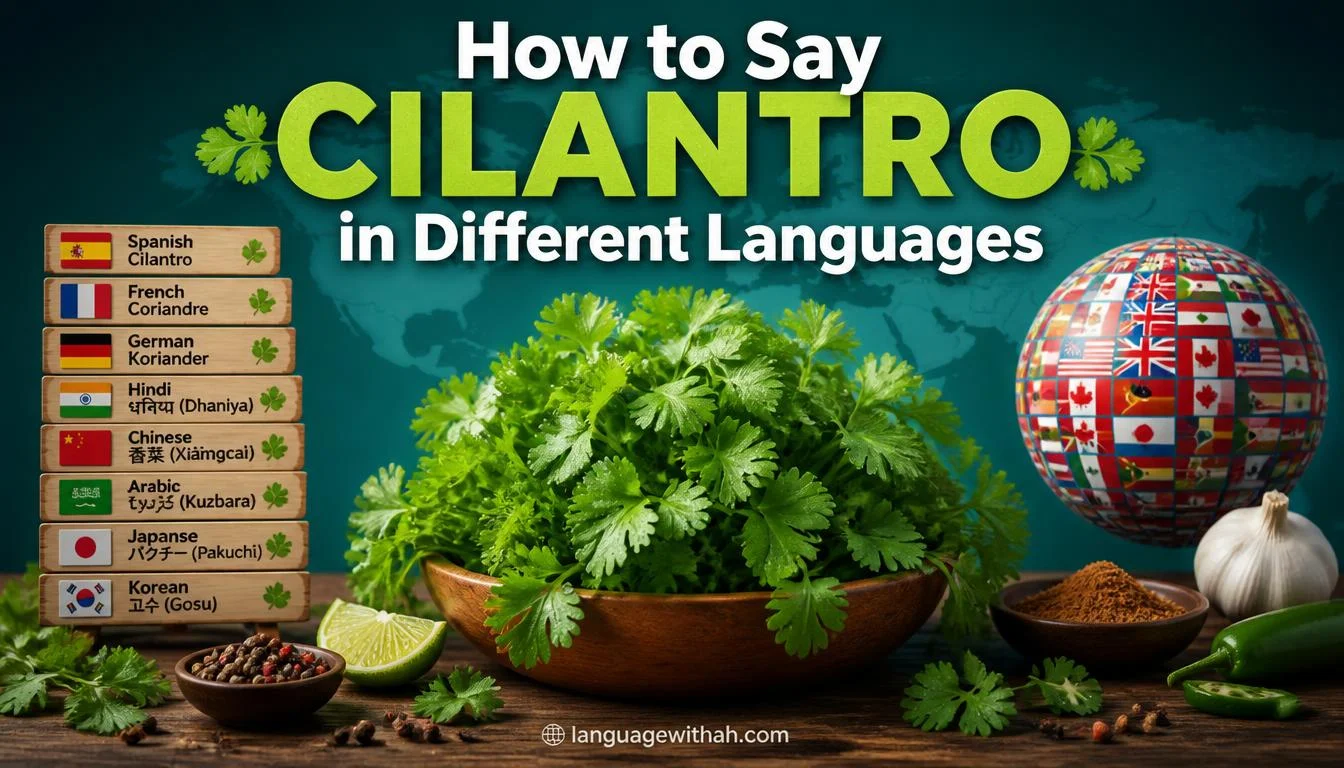
Cilantro is the fresh green leaf and stem of the coriander plant, widely used to add a bright, herbal flavor to food. In Cilantro in 70 Different Languages, you can see how this familiar culinary herb is named across Europe, Asia, Africa, the Middle East, and other parts of the world.
Although the plant is known internationally, the terminology is not always identical: in some varieties of English, coriander refers to both the fresh leaves and the dried seeds, while cilantro specifically identifies the fresh leafy part.
Learning the word in another language can be useful when shopping for ingredients, reading menus, following recipes, traveling, or talking with people from different cultures. It also reveals an interesting feature of multilingual vocabulary: a direct dictionary equivalent is not always the best way to understand a food term.
Interesting Facts About Cilantro
- Cilantro and coriander can mean different things in English. In American English, cilantro usually means the fresh leaves, while coriander commonly refers to the dried seeds. In British and Australian English, coriander can refer to the plant and its fresh leaves as well as the seeds.
- The botanical name of the plant is Coriandrum sativum. The leaves and seeds are used differently in cooking.
- The fresh leaves have a distinctive flavor that some people describe as fresh, citrusy, or herbal, while others experience an unpleasant soapy flavor.
- In Spanish, cilantro is the ordinary word for the fresh herb in many Spanish-speaking regions.
- Several European languages use forms related to the Latin coriandrum, including French coriandre, German Koriander, and Italian coriandolo.
- In South and East Asia, the herb has many local names that are separate from the European-derived forms, reflecting its long culinary history in different food traditions.
- Context matters when translating food vocabulary. A word for coriander may refer to the whole plant, fresh leaves, or seeds depending on the language and region.
What Does Cilantro Mean?
Cilantro means the fresh leaves and tender stems of the coriander plant, Coriandrum sativum. It is commonly used as a fresh herb in dishes such as salsa, chutneys, curries, soups, salads, sauces, and rice dishes.
The word can have a slightly different scope depending on the language. In American English, cilantro normally distinguishes the fresh leafy herb from coriander, which often means the dried seeds. In British English and Australian English, coriander is commonly used for the fresh leaves too.
This distinction is important when translating recipes. A translation that simply says coriander may be correct in one country but ambiguous in another.
Why Can Cilantro Have Different Translations?
Food vocabulary often depends on regional usage rather than literal word-for-word translation. One language may have a dedicated everyday word for the fresh leaves, while another may use a broader term covering the entire coriander plant.
Other factors can include:
- Region: Different countries may use different names for the same herb.
- Culinary context: A recipe may distinguish fresh leaves from dried seeds.
- Formality: Everyday cooking vocabulary is often more conversational than botanical terminology.
- Writing system: Chinese, Japanese, Korean, Arabic, Hindi, and other languages may require transliteration alongside their native scripts.
- Local varieties: A plant may have several traditional names in different regions.
- Translation direction: Translating cilantro into British English, for example, often gives coriander rather than cilantro.
For this reason, the tables use the most useful everyday culinary equivalent rather than forcing every language into an identical grammatical pattern.
European Languages
Europe contains several major language families, so the word for cilantro can look remarkably similar in some languages and completely different in others. Many Western European forms trace their vocabulary to older terms related to coriandrum, while languages farther north and east have developed their own forms. The important distinction is whether the local word naturally refers to the fresh herb, the coriander plant, or potentially the seeds as well.
| 🌍 Language | Country/Region | Translation | Pronunciation | Example Sentence |
| English (American) 🇺🇸 | United States | cilantro | sih-LAHN-troh | I added fresh cilantro to the salsa. |
| English (British) 🇬🇧 | United Kingdom | coriander | KOR-ee-an-der | I bought fresh coriander for the curry. |
| English (Australian) 🇦🇺 | Australia | coriander | KOR-ee-an-der | Add some fresh coriander before serving. |
| Spanish 🇪🇸 | Spain, Latin America | cilantro | see-LAHN-troh | Añadí cilantro fresco a la salsa. — I added fresh cilantro to the salsa. |
| French 🇫🇷 | France and Francophone regions | coriandre | koh-ree-AHN-druh | J’ajoute de la coriandre fraîche à la soupe. — I add fresh cilantro to the soup. |
| German 🇩🇪 | Germany, Austria, Switzerland | Koriander | koh-ree-AHN-der | Ich gebe frischen Koriander dazu. — I add fresh cilantro. |
| Italian 🇮🇹 | Italy | coriandolo | koh-ree-AHN-doh-loh | Aggiungo del coriandolo fresco. — I add fresh cilantro. |
| Portuguese 🇵🇹🇧🇷 | Portugal, Brazil | coentro | koh-EHN-troo | Adicione coentro fresco à sopa. — Add fresh cilantro to the soup. |
| Dutch 🇳🇱 | Netherlands, Belgium | koriander | koh-ree-AHN-der | Ik voeg verse koriander toe. — I add fresh cilantro. |
| Swedish 🇸🇪 | Sweden | koriander | koh-ree-AHN-der | Jag tillsätter färsk koriander. — I add fresh cilantro. |
| Norwegian 🇳🇴 | Norway | koriander | koh-ree-AHN-er | Jeg tilsetter frisk koriander. — I add fresh cilantro. |
| Danish 🇩🇰 | Denmark | koriander | koh-ree-AHN-er | Jeg tilsætter frisk koriander. — I add fresh cilantro. |
| Finnish 🇫🇮 | Finland | korianteri | koh-ree-AHN-teh-ree | Lisään tuoretta korianteria. — I add fresh cilantro. |
| Icelandic 🇮🇸 | Iceland | kóríander | KOH-ree-ahn-der | Ég bæti ferskum kóríander út í. — I add fresh cilantro. |
| Irish 🇮🇪 | Ireland | lus an choire | lus un KHIR-eh | Chuir mé lus an choire sa sailéad. — I put coriander in the salad. |
| Welsh 🏴 | Wales | coriander | kor-ee-AN-der | Rwy’n ychwanegu coriander ffres. — I add fresh coriander. |
| Polish 🇵🇱 | Poland | kolendra | koh-LEN-drah | Dodaję świeżą kolendrę do sałatki. — I add fresh coriander to the salad. |
| Czech 🇨🇿 | Czech Republic | koriandr | KOH-ree-ahn-dr | Přidám čerstvý koriandr. — I add fresh coriander. |
| Slovak 🇸🇰 | Slovakia | koriander | KOH-ree-ahn-der | Pridám čerstvý koriander. — I add fresh coriander. |
| Ukrainian 🇺🇦 | Ukraine | кінза | KEEN-zah | Я додаю свіжу кінзу. — I add fresh cilantro. |
| Russian 🇷🇺 | Russia | кинза | KEEN-zah | Я добавляю свежую кинзу. — I add fresh cilantro. |
| Romanian 🇷🇴 | Romania, Moldova | coriandru | koh-ree-AHN-droo | Adaug coriandru proaspăt. — I add fresh coriander. |
| Hungarian 🇭🇺 | Hungary | koriander | KOH-ree-ahn-der | Friss koriandert adok hozzá. — I add fresh coriander. |
| Greek 🇬🇷 | Greece, Cyprus | κόλιανδρος | KOH-lee-an-dros | Προσθέτω φρέσκο κόλιανδρο. — I add fresh coriander. |
| Bulgarian 🇧🇬 | Bulgaria | кориандър | koh-ree-AHN-duhr | Добавям пресен кориандър. — I add fresh coriander. |
| Croatian 🇭🇷 | Croatia | korijander | koh-ree-YAHN-der | Dodajem svježi korijander. — I add fresh coriander. |
| Serbian 🇷🇸 | Serbia, Balkans | korijander / koriјander | koh-ree-YAHN-der | Dodajem svež korijander. — I add fresh coriander. |
| Slovenian 🇸🇮 | Slovenia | koriander | koh-ree-AHN-der | Dodam svež koriander. — I add fresh coriander. |
| Lithuanian 🇱🇹 | Lithuania | kalendra | kah-LEN-drah | Įdedu šviežios kalendros. — I add fresh cilantro. |
| Latvian 🇱🇻 | Latvia | koriandrs | koh-ree-AHN-drs | Pievienoju svaigu koriandru. — I add fresh coriander. |
| Estonian 🇪🇪 | Estonia | koriander | koh-ree-AHN-der | Lisan värsket koriandrit. — I add fresh coriander. |
American English 🇺🇸
In American English, cilantro specifically and commonly identifies the fresh leaves and tender stems of Coriandrum sativum. For example, “Add chopped cilantro” clearly tells an American cook to use the fresh green herb.
British English 🇬🇧
In British English, the everyday culinary term is generally coriander for the fresh leaves. Coriander seeds specifies the dried seed when that is what a recipe requires.
Australian English 🇦🇺
Australian English commonly follows the broader coriander usage for the fresh herb. Therefore, an Australian recipe calling for fresh coriander generally means what an American recipe might call fresh cilantro.
European Cultural Note
The related forms coriandre, Koriander, coriandolo, koriander, koriander, and similar words show how vocabulary can preserve historical relationships between languages. However, similarity in spelling does not mean every language uses the word in exactly the same way.
Read More: How to Say Clouds in Different Languages
Asian Languages
Asia contains an enormous range of language families and writing systems. The everyday word for cilantro can therefore be completely different from European coriander forms. South Asian languages often have long-established culinary names for the herb, while East and Southeast Asian languages use their own traditional terms. In the following table, native scripts are included where they make the translation easier to recognize.
| 🌍 Language | Country/Region | Translation | Pronunciation | Example Sentence |
| Mandarin Chinese 🇨🇳 | China, Taiwan, Singapore | 香菜 | xiāngcài | 我在汤里加了香菜。 — I added cilantro to the soup. |
| Cantonese 🇭🇰 | Hong Kong, Guangdong | 芫荽 | jyun4 seoi1 | 我加咗啲芫荽。 — I added some cilantro. |
| Japanese 🇯🇵 | Japan | パクチー | pakuchī | スープにパクチーを入れます。 — I add cilantro to the soup. |
| Korean 🇰🇷 | South Korea | 고수 | gosu | 고수를 조금 넣어 주세요. — Please add a little cilantro. |
| Hindi 🇮🇳 | India | धनिया | dhaniyā | मैं सब्ज़ी में ताज़ा धनिया डालता हूँ। — I add fresh cilantro to the vegetable dish. |
| Urdu 🇵🇰 | Pakistan, India | دھنیا | dhaniyā | میں سالن میں تازہ دھنیا ڈالتا ہوں۔ — I add fresh cilantro to the curry. |
| Bengali 🇧🇩 | Bangladesh, India | ধনেপাতা | dhonepata | আমি তরকারিতে ধনেপাতা দিই। — I add cilantro to the curry. |
| Punjabi 🇵🇰🇮🇳 | Pakistan, India | ਧਨੀਆ | dhaniyā | ਮੈਂ ਸਬਜ਼ੀ ਵਿੱਚ ਤਾਜ਼ਾ ਧਨੀਆ ਪਾਂਦਾ ਹਾਂ। — I add fresh cilantro to the vegetable dish. |
| Gujarati 🇮🇳 | India | ધાણા | dhāṇā | હું શાકમાં તાજા ધાણા ઉમેરું છું. — I add fresh cilantro to the vegetable dish. |
| Marathi 🇮🇳 | India | कोथिंबीर | kōthimbīr | मी भाजीमध्ये कोथिंबीर घालतो. — I add cilantro to the vegetable dish. |
| Tamil 🇮🇳 | India, Sri Lanka | கொத்தமல்லி | kottamalli | நான் குழம்பில் கொத்தமல்லி சேர்க்கிறேன். — I add cilantro to the curry. |
| Telugu 🇮🇳 | India | కొత్తిమీర | kottimīra | నేను కూరలో కొత్తిమీర వేస్తాను. — I add cilantro to the curry. |
| Kannada 🇮🇳 | India | ಕೊತ್ತಂಬರಿ ಸೊಪ್ಪು | kottambari soppu | ನಾನು ಪಲ್ಯಕ್ಕೆ ಕೊತ್ತಂಬರಿ ಸೊಪ್ಪು ಹಾಕುತ್ತೇನೆ. — I add cilantro to the vegetable dish. |
| Malayalam 🇮🇳 | India | മല്ലിയില | malliyila | ഞാൻ കറിയിൽ മല്ലിയില ചേർക്കുന്നു. — I add cilantro to the curry. |
| Nepali 🇳🇵 | Nepal | धनियाँ | dhaniyā̃ | म तरकारीमा ताजा धनियाँ हाल्छु। — I add fresh cilantro to the vegetables. |
| Sinhala 🇱🇰 | Sri Lanka | කොත්තමල්ලි කොළ | kottamalli kola | මම කරියට කොත්තමල්ලි කොළ දමනවා. — I add cilantro leaves to the curry. |
| Thai 🇹🇭 | Thailand | ผักชี | phak-chī | ฉันใส่ผักชีในซุป — I put cilantro in the soup. |
| Vietnamese 🇻🇳 | Vietnam | rau mùi / ngò rí | zhow moo-ee / ngaw ree | Tôi thêm rau mùi vào món súp. — I add cilantro to the soup. |
| Indonesian 🇮🇩 | Indonesia | daun ketumbar | dah-oon kuh-toom-bar | Saya menambahkan daun ketumbar ke sup. — I add cilantro leaves to the soup. |
| Malay 🇲🇾 | Malaysia, Brunei, Singapore | daun ketumbar | dah-oon kuh-toom-bar | Saya menambah daun ketumbar ke dalam sup. — I add cilantro leaves to the soup. |
| Filipino/Tagalog 🇵🇭 | Philippines | kulantro | koo-LAHN-troh | Nagdagdag ako ng sariwang kulantro. — I added fresh cilantro. |
| Burmese 🇲🇲 | Myanmar | နံနံပင် | nan-nan-bin | ဟင်းထဲ နံနံပင် ထည့်တယ်။ — I add cilantro to the dish. |
| Khmer 🇰🇭 | Cambodia | ជីវ៉ាន់ស៊ុយ | chi-van-suy | ខ្ញុំដាក់ជីវ៉ាន់ស៊ុយក្នុងស៊ុប។ — I add cilantro to the soup. |
| Lao 🇱🇦 | Laos | ຜັກຫອມປ້ອມ | phak hawm pɔm | ຂ້ອຍໃສ່ຜັກຫອມປ້ອມໃນແກງ. — I add cilantro to the soup. |
| Mongolian 🇲🇳 | Mongolia | кинза | kinza | Би шөлөнд кинза хийдэг. — I add cilantro to soup. |
| Kazakh 🇰🇿 | Kazakhstan | кинза | kin-za | Мен сорпаға кинза қосамын. — I add cilantro to the soup. |
| Uzbek 🇺🇿 | Uzbekistan | kashnich | kash-neech | Men sho’rvaga kashnich qo’shaman. — I add cilantro to the soup. |
| Turkish 🇹🇷 | Turkey | kişniş | kish-NEESH | Çorbaya taze kişniş ekliyorum. — I add fresh cilantro to the soup. |
| Persian 🇮🇷 | Iran | گشنیز | gosh-niz | من گشنیز تازه به سوپ اضافه میکنم. — I add fresh cilantro to the soup. |
Asian Language Notes
A particularly useful distinction appears in South Asian languages. Hindi dhaniyā, Urdu dhania, Bengali dhonepata, Marathi kothimbir, Tamil kothamalli, and related terms all refer to the herb, but the vocabulary is not simply one shared word with identical pronunciation.
In Vietnamese, rau mùi is widely understood for the herb, while ngò rí is also used regionally, particularly in southern Vietnamese usage.
In Chinese, 香菜 (xiāngcài) is widely recognized for cilantro in Mandarin. Cantonese commonly uses 芫荽 (jyun4 seoi1), illustrating why regional Chinese varieties should not automatically be treated as having identical everyday vocabulary.
In Japanese, パクチー (pakuchī) is a common modern culinary term for cilantro, especially in contexts influenced by Southeast Asian cuisine. Another word, コリアンダー (koriandā), may also occur, particularly in product or international culinary contexts.
African Languages
Africa is home to hundreds of languages and numerous language families, so there is no single African term for cilantro. Some languages have established culinary vocabulary for the herb, while others commonly use a borrowed or descriptive term. The examples below focus on languages in which a useful everyday equivalent can be given without pretending that one word represents an entire country.
| 🌍 Language | Country/Region | Translation | Pronunciation | Example Sentence |
| Swahili 🇰🇪🇹🇿 | Kenya, Tanzania, East Africa | giligilani | gee-lee-gee-LAH-nee | Ninaongeza giligilani kwenye supu. — I add cilantro to the soup. |
| Afrikaans 🇿🇦 | South Africa, Namibia | koljander | koh-LYAHN-der | Ek voeg vars koljander by. — I add fresh cilantro. |
| Zulu 🇿🇦 | South Africa | ikoriyanda | ee-koh-ree-YAHN-dah | Ngifaka ikoriyanda entsha esobho. — I add fresh coriander to the soup. |
| Xhosa 🇿🇦 | South Africa | ikoriyanda | ee-koh-ree-YAHN-dah | Ndongeza ikoriyanda entsha kwisuphu. — I add fresh coriander to the soup. |
| Amharic 🇪🇹 | Ethiopia | ኮሪያንደር | koriyander | ትኩስ ኮሪያንደር ወደ ሾርባው እጨምራለሁ። — I add fresh cilantro to the soup. |
| Yoruba 🇳🇬 | Nigeria, Benin | ewé koriander | eh-weh koh-ree-AHN-der | Mo fi ewé koriander sí ọbẹ̀. — I add coriander leaves to the soup. |
| Igbo 🇳🇬 | Nigeria | akwukwo coriander | ah-kwoo-kwoh coriander | Ana m etinye akwukwo coriander na ofe. — I add coriander leaves to the soup. |
| Hausa 🇳🇬🇳🇪 | Nigeria, Niger and West Africa | ganyen korianda | gan-yen koh-ree-AHN-dah | Ina ƙara ganyen korianda a miya. — I add coriander leaves to the soup. |
| Somali 🇸🇴 | Somalia, Horn of Africa | koryander | koh-ryan-der | Waxaan maraqa ku daraa koryander. — I add cilantro to the soup. |
| Shona 🇿🇼 | Zimbabwe | korianda | koh-ree-AHN-dah | Ndinowedzera korianda mutsuro. — I add coriander to the soup. |
| Sesotho 🇱🇸🇿🇦 | Lesotho, South Africa | coriander | koh-ree-AN-der | Ke eketsa coriander sopong. — I add coriander to the soup. |
| Setswana 🇧🇼🇿🇦 | Botswana, South Africa | coriander | koh-ree-AN-der | Ke tsenya coriander mo sopong. — I put coriander in the soup. |
| Kinyarwanda 🇷🇼 | Rwanda | coriander | koh-ree-AN-der | Nshyiramo coriander nshya mu isupu. — I add fresh coriander to the soup. |
| Malagasy 🇲🇬 | Madagascar | kotomila | koh-too-MEE-lah | Manampy kotomila vaovao amin’ny lasopy aho. — I add fresh cilantro to the soup. |
African Cultural Note
In multilingual African settings, the same ingredient can be known by a local name, a borrowed culinary term, or a word inherited through contact with another language. It is therefore better to identify the language and region rather than assuming that a word used in one African country is universal across the continent.
Middle Eastern Languages
The Middle East contains several distinct linguistic traditions, including Semitic, Iranian, and other language families. Even when languages share culinary vocabulary through historical contact, their everyday words and pronunciation can differ. Arabic also requires special care, because Modern Standard Arabic and regional spoken varieties do not always use exactly the same everyday terminology.
| 🌍 Language | Country/Region | Translation | Pronunciation | Example Sentence |
| Modern Standard Arabic 🇸🇦 | Arab world | كزبرة خضراء | kuz-BAR-ah khad-RAH | أضيف الكزبرة الخضراء إلى السلطة. — I add fresh cilantro to the salad. |
| Egyptian Arabic 🇪🇬 | Egypt | كزبرة خضرا | koz-BAR-ah khod-RAH | بحط كزبرة خضرا على السلطة. — I put fresh cilantro on the salad. |
| Persian 🇮🇷 | Iran | گشنیز | gosh-niz | گشنیز تازه به سالاد اضافه میکنم. — I add fresh cilantro to the salad. |
| Hebrew 🇮🇱 | Israel | כוסברה | koos-BAH-rah | אני מוסיף כוסברה טרייה לסלט. — I add fresh cilantro to the salad. |
| Kurdish (Kurmanji) | Kurdish-speaking regions | kişnîz | kish-NEEZ | Ez kişnîzê taze li salatê zêde dikim. — I add fresh cilantro to the salad. |
| Armenian 🇦🇲 | Armenia | համեմ | hah-MEM | Ես թարմ համեմ եմ ավելացնում աղցանին։ — I add fresh cilantro to the salad. |
| Turkish 🇹🇷 | Turkey | kişniş | kish-NEESH | Salataya taze kişniş ekliyorum. — I add fresh cilantro to the salad. |
Arabic Note
كزبرة (kuzbara) is widely associated with coriander in Arabic. When the speaker wants to make clear that the fresh green herb is intended, كزبرة خضراء (kuzbara khaḍrāʾ, “green/fresh coriander”) can be used. Regional spoken Arabic may shorten or vary the expression.
This is a good example of why “cilantro” does not always have to be translated by a single isolated noun. The best choice can depend on whether the speaker needs to distinguish fresh leaves from coriander seeds.
Other World Languages
Some useful languages fall outside the four major regional categories above or have particularly distinctive culinary vocabulary. These examples broaden the list without treating geographically unrelated languages as though they belonged to one linguistic group.
| 🌍 Language | Country/Region | Translation | Pronunciation | Example Sentence |
| Māori 🇳🇿 | New Zealand | korianara | koh-ree-ah-NAH-rah | Ka tāpirihia te korianara hou. — Fresh coriander is added. |
| Samoan 🇼🇸 | Samoa | koriano | koh-ree-AH-noh | Ou te faaopoopo le koriano fou. — I add fresh coriander. |
| Tongan 🇹🇴 | Tonga | korianda | koh-ree-AHN-dah | ʻOku ou tānaki ʻa e korianda foʻou. — I add fresh coriander. |
| Hawaiian 🇺🇸 | Hawaiʻi | cilantro | see-LAHN-troh | Hoʻokomo au i ka cilantro hou. — I add fresh cilantro. |
| Quechua 🇵🇪🇧🇴 | Andes | culantro | koo-LAHN-troh | Culantrota yapayku. — I add cilantro. |
| Guarani 🇵🇾 | Paraguay | kuratu | koo-rah-TOO | Amoĩ kuratu tembi’úpe. — I add cilantro to the food. |
| Haitian Creole 🇭🇹 | Haiti | koryand | koh-ree-AHN | Mwen ajoute koryand fre nan soup la. — I add fresh cilantro to the soup. |
| Esperanto 🌍 | International | koriandro | koh-ree-AHN-droh | Mi aldonas freŝan koriandron. — I add fresh coriander. |
Note: Regional and traditional plant names can overlap. In particular, culantro in parts of Latin America can also refer to Eryngium foetidum, a different herb from Coriandrum sativum. When buying ingredients, checking the botanical or local culinary context can prevent confusion.
Cilantro vs. Coriander: An Important English Difference
One of the most useful things to remember is that English itself has regional variation.
In American English:
- cilantro = fresh leaves and tender stems
- coriander = commonly the dried seeds
In British and Australian English:
- coriander = commonly the fresh leaves, plant, or seeds depending on context
- coriander seeds = specifically the dried seeds
So an American recipe saying “2 tablespoons of chopped cilantro” and a British recipe saying “2 tablespoons of chopped coriander” can describe essentially the same fresh herb.
This is not simply a spelling difference. It is a useful example of how regional vocabulary changes the way a translation should be understood.
Cultural Notes About Using Cilantro
The herb appears in many culinary traditions, but its role varies considerably.
In Mexican and other Latin American cuisines, fresh cilantro is frequently used in salsas, tacos, soups, rice dishes, and other preparations. In South Asian cooking, fresh coriander leaves are commonly used as a garnish and flavoring ingredient, often alongside spices, chutneys, curries, and vegetable dishes.
In parts of Southeast Asia, cilantro can appear in soups, salads, noodle dishes, sauces, and fresh herb combinations. Its local name may be completely different from the English word.
It is better to describe these as common culinary uses rather than claiming that every person in a particular culture uses cilantro in the same way.
Pronunciation Guidelines
Pronouncing cilantro is relatively straightforward in English:
cilantro → sih-LAHN-troh
The pronunciation can change slightly with accent, but the middle syllable is generally prominent.
For languages using other writing systems, pronunciation guides in this article use practical romanization or transliteration rather than asking English-speaking readers to guess the pronunciation from unfamiliar scripts.
A few examples are especially useful:
- Mandarin 香菜 — xiāngcài
- Japanese パクチー — pakuchī
- Korean 고수 — gosu
- Hindi धनिया — dhaniyā
- Urdu دھنیا — dhaniyā
- Arabic كزبرة — kuzbara
- Hebrew כוסברה — koosbara
Romanization is a learning aid, not always a perfect representation of every sound in the original language.
Example Usage in Different Contexts
The word cilantro can appear naturally in several situations:
Shopping:
“I need fresh cilantro for the salsa.”
Cooking:
“Chop the cilantro and add it just before serving.”
Restaurant ordering:
“Does this dish contain cilantro?”
Discussing preferences:
“I like the fresh flavor of cilantro.”
Recipe writing:
“Garnish with chopped cilantro.”
These contexts are useful because a translator should consider not just the ingredient name but also how the word functions in the sentence.
Quick Reference: Cilantro in Different Languages
| Language | Translation |
| American English | cilantro |
| British English | coriander |
| Australian English | coriander |
| Spanish | cilantro |
| French | coriandre |
| German | Koriander |
| Italian | coriandolo |
| Portuguese | coentro |
| Dutch | koriander |
| Swedish | koriander |
| Norwegian | koriander |
| Danish | koriander |
| Finnish | korianteri |
| Icelandic | kóríander |
| Irish | lus an choire |
| Welsh | coriander |
| Polish | kolendra |
| Czech | koriandr |
| Slovak | koriander |
| Ukrainian | кінза |
| Russian | кинза |
| Romanian | coriandru |
| Hungarian | koriander |
| Greek | κόλιανδρος |
| Bulgarian | кориандър |
| Croatian | korijander |
| Serbian | korijander |
| Slovenian | koriander |
| Lithuanian | kalendra |
| Latvian | koriandrs |
| Estonian | koriander |
| Mandarin Chinese | 香菜 |
| Cantonese | 芫荽 |
| Japanese | パクチー |
| Korean | 고수 |
| Hindi | धनिया |
| Urdu | دھنیا |
| Bengali | ধনেপাতা |
| Punjabi | ਧਨੀਆ |
| Gujarati | ધાણા |
| Marathi | कोथिंबीर |
| Tamil | கொத்தமல்லி |
| Telugu | కొత్తిమీర |
| Kannada | ಕೊತ್ತಂಬರಿ ಸೊಪ್ಪು |
| Malayalam | മല്ലിയില |
| Nepali | धनियाँ |
| Sinhala | කොත්තමල්ලි කොළ |
| Thai | ผักชี |
| Vietnamese | rau mùi / ngò rí |
| Indonesian | daun ketumbar |
| Malay | daun ketumbar |
| Filipino/Tagalog | kulantro |
| Burmese | နံနံပင် |
| Khmer | ជីវ៉ាន់ស៊ុយ |
| Lao | ຜັກຫອມປ້ອມ |
| Mongolian | кинза |
| Kazakh | кинза |
| Uzbek | kashnich |
| Turkish | kişniş |
| Persian | گشنیز |
| Swahili | giligilani |
| Afrikaans | koljander |
| Zulu | ikoriyanda |
| Xhosa | ikoriyanda |
| Amharic | ኮሪያንደር |
| Yoruba | ewé koriander |
| Igbo | akwukwo coriander |
| Hausa | ganyen korianda |
| Somali | koryander |
| Shona | korianda |
| Sesotho | coriander |
| Setswana | coriander |
| Kinyarwanda | coriander |
| Malagasy | kotomila |
| Arabic | كزبرة خضراء |
| Hebrew | כוסברה |
| Kurdish (Kurmanji) | kişnîz |
| Armenian | համեմ |
| Māori | korianara |
| Samoan | koriano |
| Tongan | korianda |
| Hawaiian | cilantro |
| Quechua | culantro |
| Guarani | kuratu |
| Haitian Creole | koryand |
| Esperanto | koriandro |
How to Choose the Right Translation
The best translation of cilantro depends mainly on the country, culinary context, and intended audience.
When speaking with someone from the United States, cilantro is the clearest everyday term for the fresh herb. In the United Kingdom or Australia, coriander is usually more natural.
When translating a recipe, check whether the target language distinguishes between fresh coriander leaves and coriander seeds. If it does not, an added word such as fresh, green, or leaves may make the meaning clearer.
For menus and shopping, use the ordinary culinary term rather than a botanical description unless scientific precision is necessary.
When speaking or writing internationally, remember that a familiar English word may not map to exactly the same category in another language.
Common Mistakes When Translating Cilantro
Several mistakes can make an otherwise understandable translation confusing:
- Translating word-for-word: A dictionary equivalent may refer to coriander generally rather than specifically to fresh leaves.
- Ignoring regional English: Cilantro is common in American English, while coriander is commonly used for the fresh herb in British and Australian English.
- Confusing leaves and seeds: Fresh cilantro and dried coriander seeds are different culinary ingredients.
- Ignoring dialects: Chinese, Arabic, and other major languages can have meaningful regional differences.
- Using the wrong script: A romanized form can help learners, but it should not replace the native form when the native script is relevant.
- Inventing pronunciation: English-style spelling is not always a reliable way to represent sounds in another language.
- Assuming one word is universal: A term used in one country may be less familiar or mean something slightly different elsewhere.
- Confusing cilantro with culantro: These names can refer to different plants in some parts of the world.
The safest approach is to consider meaning + region + culinary context together.
Why Learn Cilantro in Different Languages?
Learning the word for cilantro in different languages is a small but practical way to expand vocabulary. Food words are especially useful because they appear in everyday conversations, recipes, restaurants, supermarkets, travel situations, and family kitchens.
Knowing the local term can make it easier to read menus, understand recipes, shop for ingredients, and communicate dietary preferences. It can also help language learners recognize that vocabulary does not always follow a simple one-word-to-one-word pattern.
For travelers, even learning one food word in the local language can make an interaction more comfortable. For students, comparing words such as cilantro, coriandre, coriandolo, coentro, and koriander offers a simple introduction to linguistic relationships and borrowing.
Most importantly, learning food vocabulary encourages people to approach another language with curiosity and cultural awareness rather than assuming that every language organizes concepts in exactly the same way.
FAQs:
How do you say cilantro in different languages?
The word varies widely. Examples include cilantro in Spanish, coriandre in French, coriandolo in Italian, coentro in Portuguese, 香菜 (xiāngcài) in Mandarin, 고수 (gosu) in Korean, and धनिया (dhaniyā) in Hindi.
What is the most natural translation of cilantro?
There is no single universal translation. The most natural term depends on the language and region. In American English, cilantro is standard for the fresh leaves, while British English commonly uses coriander.
Can the translation change by country?
Yes. Regional vocabulary can change even when people speak closely related varieties of the same language. English provides a particularly clear example with cilantro and coriander.
Why do some languages have multiple translations for cilantro?
A language may distinguish between fresh leaves, the whole coriander plant, and dried seeds. It may also have regional or colloquial names, so more than one term can be correct.
Does pronunciation change between regions?
Yes. Pronunciation can change according to accent, dialect, and local sound systems. Some languages also use sounds that do not have an exact equivalent in English.
Conclusion:
Learning how to say cilantro in different languages shows how even a simple food word can carry regional and cultural differences. From Spanish cilantro and French coriandre to Hindi धनिया, Mandarin 香菜, Korean 고수, and Swahili giligilani, the same familiar herb has many names around the world. The most important lesson is that translation is about meaning and usage, not just matching words.














1 thought on “How to Say Cilantro in Different Languages”