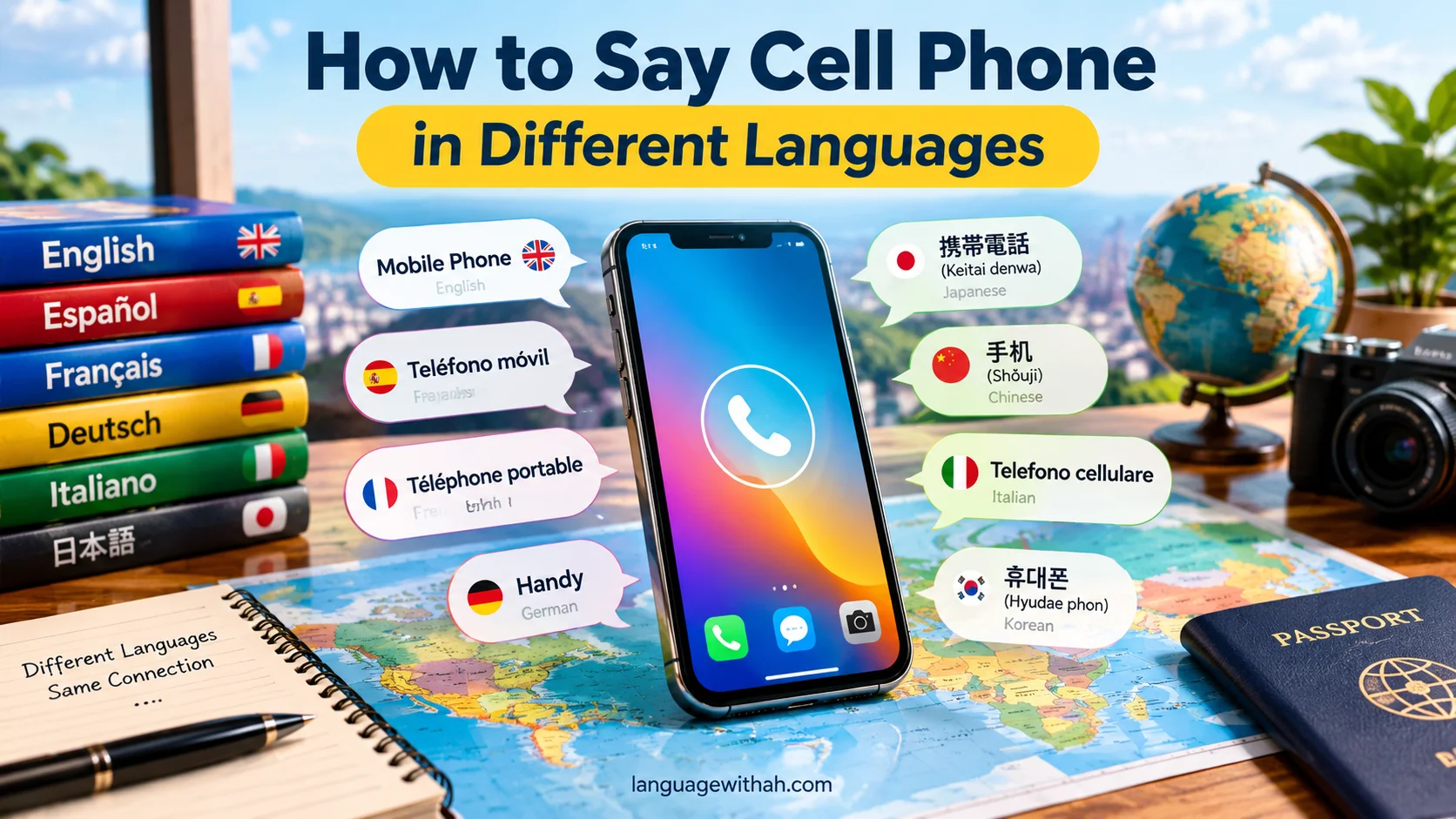
A cell phone is a portable electronic device used to make calls, send messages, browse the internet, take photographs, and communicate with people around the world. Learning how to say cell phone in different languages is useful when traveling abroad, shopping for electronics, asking for directions, or speaking with someone who uses a different language.
The name for this everyday device varies considerably across countries. American English commonly uses cell phone, while British English often uses mobile phone. Spanish speakers may say teléfono celular or móvil, and French speakers commonly use téléphone portable. These expressions refer to the same general device, but their wording reflects local vocabulary and everyday speech.
Understanding these differences can make conversations easier and help you recognize familiar technology terms in unfamiliar places. It can also expand your foreign-language vocabulary and help you communicate more naturally in shops, hotels, schools, and workplaces.
In this guide, you will discover how to express the idea of a cell phone across more than 70 languages, with translations, pronunciation guides, regional information, and example sentences. Because some languages distinguish between formal terminology and everyday speech, the most suitable expression may depend on the country, context, and local usage.
Interesting Facts About Cell Phone
- Different English names: Americans generally say cell phone, while speakers in the United Kingdom often say mobile phone. Australians also commonly use mobile.
- Spanish has regional variations: Teléfono celular, celular, and móvil are used in different Spanish-speaking communities.
- French emphasizes portability: The expression téléphone portable literally means a portable telephone.
- Chinese uses a distinctive compound: The Mandarin word 手机 (shǒujī) combines words associated with the hand and a machine.
- Japanese uses a short everyday term: 携帯電話 (keitai denwa) means mobile or portable telephone, while 携帯 (keitai) is a common shortened form.
- Some languages borrow international technology terms: Words derived from English mobile or cellular appear in everyday speech in various countries, sometimes alongside native-language expressions.
- A smartphone is not exactly the same term: A cell phone can refer to a basic mobile telephone or a smartphone, whereas smartphone specifically emphasizes advanced computing features.
What Does Cell Phone Mean?
A cell phone is a portable telephone that connects to a cellular network, allowing people to communicate without a fixed telephone line. Depending on its capabilities, it may also be called a mobile phone, cellular phone, or smartphone.
The expression can refer to different things in everyday conversation:
- Cell phone: A general term for a portable telephone that uses a cellular network.
- Mobile phone: A widely used alternative, especially in British English and many other varieties of English.
- Smartphone: A mobile phone with advanced features such as apps, internet access, and a touchscreen.
- Handset: A term sometimes used for the physical telephone device, especially in technical or telecommunications contexts.
For example, someone might ask, “Where is my cell phone?” when looking for a missing device. In another country, the same person might ask for a mobile, celular, or móvil.
Why Can Cell Phone Have Different Translations?
There is no single word for a cell phone that works across every language. Translators choose terms based on local vocabulary, the type of device, and how people normally speak.
Several factors explain these differences:
- Regional usage: Spanish speakers may use celular in Latin America and móvil in Spain.
- Formal versus informal language: A technical document may use a longer term, while a conversation may use a shortened word.
- Literal versus natural translation: A word-for-word translation of cell phone may sound unnatural in another language.
- Writing systems: Some languages write the term using their own scripts, while others commonly use borrowed words.
- Technology distinctions: Some expressions specifically mean mobile telephone, while others refer more broadly to a telephone or smart device.
The translations below focus on the device itself, rather than translating the entire English question “How to say cell phone?” This makes the vocabulary more useful for real conversations.
Cell Phone in Different Languages
The following tables cover more than 70 languages and regional varieties. Pronunciations are simplified guides for English-speaking learners; they are not substitutes for the full sound system of each language. Where a local expression differs significantly from a literal translation, the more natural everyday term is used when possible.
European Languages
European languages include several distinct language families, and technology vocabulary can vary even among neighboring countries. Some languages use native compounds, while others borrow or adapt international terminology. The English varieties are listed separately to highlight regional usage.
English Varieties
| 🌍 Language | Country/Region | Translation | Pronunciation | Example Sentence |
| English | International | Cell phone | sel fohn | “My cell phone is charging.” |
| American English 🇺🇸 | United States | Cell phone | sel fohn | “I left my cell phone at home.” |
| British English 🇬🇧 | United Kingdom | Mobile phone / mobile | MOH-byle fohn / MOH-byle | “My mobile is in my bag.” |
| Australian English 🇦🇺 | Australia | Mobile phone / mobile | MOH-byle fohn / MOH-byle | “I need to charge my mobile.” |
The device is the same in all three varieties. The main difference is regional vocabulary: cell phone is particularly associated with American English, while mobile is common in British and Australian English.
European Language Table
| 🌍 Language | Country/Region | Translation | Pronunciation | Example Sentence |
| Spanish | Spain, Latin America | Teléfono celular / móvil | teh-LEH-foh-noh seh-loo-LAR / MOH-beel | Mi teléfono celular está aquí. — My cell phone is here. |
| French | France, Belgium, Canada | Téléphone portable | tay-lay-FOHN por-TAHBL | Mon téléphone portable est neuf. — My cell phone is new. |
| German | Germany, Austria, Switzerland | Handy / Mobiltelefon | HEN-dee / moh-BEEL-tay-leh-fohn | Mein Handy ist neu. — My cell phone is new. |
| Italian | Italy, Switzerland | Cellulare / telefono cellulare | chel-loo-LAH-reh | Ho perso il cellulare. — I lost my cell phone. |
| Portuguese | Portugal, Brazil | Telemóvel / celular | teh-leh-MOH-vel / seh-loo-LAR | Meu celular está carregando. — My cell phone is charging. |
| Dutch | Netherlands, Belgium | Mobiele telefoon / mobiel | moh-BEE-luh tuh-LEH-fohn | Mijn mobiel ligt hier. — My mobile phone is here. |
| Swedish | Sweden, Finland | Mobiltelefon / mobil | moh-BEEL-teh-fohn | Min mobil är ny. — My mobile phone is new. |
| Norwegian | Norway | Mobiltelefon / mobil | moh-BEEL-teh-fohn | Mobilen min er ny. — My mobile phone is new. |
| Danish | Denmark | Mobiltelefon / mobil | moh-BEEL-teh-fohn | Min mobiltelefon er ny. — My mobile phone is new. |
| Finnish | Finland | Matkapuhelin / kännykkä | MAHT-kah-poo-heh-leen / KAN-nyk-kah | Minulla on uusi kännykkä. — I have a new cell phone. |
| Icelandic | Iceland | Farsími | FAR-see-mee | Farsíminn minn er nýr. — My cell phone is new. |
| Irish | Ireland | Fón póca | fohn POH-kah | Tá mo fhón póca anseo. — My cell phone is here. |
| Welsh | Wales | Ffôn symudol | fohn suh-MEE-dol | Mae fy ffôn symudol yma. — My mobile phone is here. |
| Polish | Poland | Telefon komórkowy / komórka | teh-LEH-fohn koh-moor-KOH-vih / koh-MOOR-kah | Zgubiłem telefon komórkowy. — I lost my cell phone. |
| Czech | Czechia | Mobilní telefon / mobil | MOB-eel-nee teh-leh-fohn | Můj mobil je nový. — My mobile phone is new. |
| Slovak | Slovakia | Mobilný telefón / mobil | MOB-eel-nee teh-leh-fohn | Môj mobil je nový. — My mobile phone is new. |
| Ukrainian | Ukraine | Мобільний телефон | moh-BEEL-nyy teh-leh-FOHN | Мій мобільний телефон новий. — My cell phone is new. |
| Russian | Russia and other Russian-speaking communities | Мобильный телефон / мобильник | moh-BEEL-nyy teh-leh-FOHN / moh-BEEL-neek | Мой мобильный телефон новый. — My cell phone is new. |
| Romanian | Romania, Moldova | Telefon mobil | teh-leh-FOHN moh-BEEL | Telefonul meu mobil este nou. — My cell phone is new. |
| Hungarian | Hungary | Mobiltelefon / mobil | MOH-beel-teh-leh-fohn | Az új mobilom itt van. — My new mobile phone is here. |
| Greek | Greece, Cyprus | Κινητό τηλέφωνο | kee-nee-TOH tee-LEH-foh-noh | Το κινητό μου είναι εδώ. — My cell phone is here. |
| Bulgarian | Bulgaria | Мобилен телефон | moh-BEE-len teh-leh-FOHN | Мобилният ми телефон е нов. — My cell phone is new. |
| Croatian | Croatia | Mobitel / mobilni telefon | MOH-bee-tel | Moj mobitel je nov. — My cell phone is new. |
| Serbian | Serbia and neighboring areas | Мобилни телефон / мобилni | moh-BEEL-nee teh-leh-FOHN | Мој мобилни телефон је нов. — My cell phone is new. |
| Slovenian | Slovenia | Mobilni telefon / mobitel | moh-BEEL-nee teh-leh-FOHN | Moj mobilni telefon je nov. — My cell phone is new. |
| Lithuanian | Lithuania | Mobilusis telefonas | moh-bee-LOO-sis teh-leh-FOH-nas | Mano mobilusis telefonas naujas. — My cell phone is new. |
| Latvian | Latvia | Mobilais tālrunis | moh-bee-LAIS TAHL-roo-nis | Mans mobilais tālrunis ir jauns. — My cell phone is new. |
| Estonian | Estonia | Mobiiltelefon / mobiil | MOH-beel-teh-fohn | Minu mobiiltelefon on uus. — My cell phone is new. |
Cultural and usage notes: In German, Handy is the everyday word for a mobile phone, even though it does not function as a standard English translation of handy. In Portuguese, celular is common in Brazil, while telemóvel is the usual term in Portugal. In Spanish, the preferred word depends on the region, so recognizing both celular and móvil is useful.
Read More: How to Say Cut in Different Languages
Asian Languages
Asia has a wide range of language families, scripts, and naming conventions for modern technology. Some languages use compound words meaning “mobile telephone,” while others favor shorter everyday terms or loanwords. The examples below include native writing and pronunciation guides wherever practical.
| 🌍 Language | Country/Region | Translation | Pronunciation | Example Sentence |
| Mandarin Chinese | China, Taiwan, Singapore | 手机 | shǒujī (show-jee, tones matter) | 我的手机在这里。— My cell phone is here. |
| Cantonese | Hong Kong, Guangdong | 手提電話 | sau2 tai4 din6 waa2 | 我部手提電話喺度。— My cell phone is here. |
| Japanese | Japan | 携帯電話 / 携帯 | keitai denwa / keitai | 私の携帯は新しいです。— My cell phone is new. |
| Korean | South Korea, North Korea | 휴대전화 / 휴대폰 | hyu-dae-jeon-hwa / hyu-dae-pon | 제 휴대폰은 새것이에요. — My cell phone is new. |
| Hindi | India | मोबाइल फ़ोन | moh-bाइल fohn (mobāil phon) | मेरा मोबाइल फ़ोन नया है। — My cell phone is new. |
| Urdu | Pakistan, India | موبائل فون | moh-bाइल fohn (mobāil fōn) | میرا موبائل فون نیا ہے۔ — My cell phone is new. |
| Bengali | Bangladesh, India | মোবাইল ফোন | moh-bाइल fohn | আমার মোবাইল ফোনটি নতুন। — My cell phone is new. |
| Punjabi | Pakistan, India | ਮੋਬਾਈਲ ਫ਼ੋਨ / موبائل فون | moh-bाइल fohn | ਮੇਰਾ ਮੋਬਾਈਲ ਫ਼ੋਨ ਨਵਾਂ ਹੈ। — My cell phone is new. |
| Gujarati | India | મોબાઇલ ફોન | moh-bाइल fohn | મારો મોબાઇલ ફોન નવો છે. — My cell phone is new. |
| Marathi | India | मोबाईल फोन | moh-bाइल fohn | माझा मोबाईल फोन नवीन आहे. — My cell phone is new. |
| Tamil | India, Sri Lanka, Singapore | கைப்பேசி | kai-pae-see | என் கைப்பேசி புதியது. — My cell phone is new. |
| Telugu | India | మొబైల్ ఫోన్ | moh-bайл fohn | నా మొబైల్ ఫోన్ కొత్తది. — My cell phone is new. |
| Kannada | India | ಮೊಬೈಲ್ ಫೋನ್ | moh-bайл fohn | ನನ್ನ ಮೊಬೈಲ್ ಫೋನ್ ಹೊಸದು. — My cell phone is new. |
| Malayalam | India | മൊബൈൽ ഫോൺ | moh-bайл fohn | എന്റെ മൊബൈൽ ഫോൺ പുതിയതാണ്. — My cell phone is new. |
| Nepali | Nepal, India | मोबाइल फोन | moh-bайл fohn | मेरो मोबाइल फोन नयाँ छ। — My cell phone is new. |
| Sinhala | Sri Lanka | ජංගම දුරකථනය | jang-gah-ma doo-ra-kah-tha-naya | මගේ ජංගම දුරකථනය අලුත්. — My cell phone is new. |
| Thai | Thailand | โทรศัพท์มือถือ | thoo-rah-sap meu-theu | โทรศัพท์มือถือของฉันใหม่ — My cell phone is new. |
| Vietnamese | Vietnam | Điện thoại di động | dee-en thwah-ee zee dong | Điện thoại di động của tôi còn mới. — My cell phone is still new. |
| Indonesian | Indonesia | Ponsel / telepon genggam | pon-sel / teh-leh-pon geng-gam | Ponsel saya masih baru. — My cell phone is still new. |
| Malay | Malaysia, Brunei, Singapore | Telefon bimbit | teh-leh-fohn bim-bit | Telefon bimbit saya baharu. — My cell phone is new. |
| Filipino/Tagalog | Philippines | Cellphone / telepon selular | sel-fohn / teh-leh-pon seh-loo-lar | Bago ang cellphone ko. — My cell phone is new. |
| Burmese | Myanmar | လက်ကိုင်ဖုန်း | let-kine-phone | ကျွန်တော့်ဖုန်းက အသစ်ပါ။ — My phone is new. |
| Khmer | Cambodia | ទូរស័ព្ទដៃ | too-rah-sap dai | ទូរស័ព្ទដៃរបស់ខ្ញុំថ្មី។ — My cell phone is new. |
| Lao | Laos | ໂທລະສັບມືຖື | tho-la-sap meu-theu | ໂທລະສັບມືຖືຂອງຂ້ອຍໃໝ່. — My cell phone is new. |
| Mongolian | Mongolia | Гар утас | gar oo-tas | Миний гар утас шинэ. — My cell phone is new. |
| Kazakh | Kazakhstan | Ұялы телефон | oo-yah-ly teh-leh-FOHN | Менің ұялы телефоным жаңа. — My cell phone is new. |
| Uzbek | Uzbekistan | Uyali telefon | oo-yah-lee teh-leh-fohn | Mening uyali telefonim yangi. — My cell phone is new. |
Cultural and usage notes: In Mandarin, 手机 (shǒujī) is the standard everyday term for a mobile phone. In Japanese, keitai is a common shortened form of keitai denwa. In Hindi and Urdu, mobile phone is widely understood, though pronunciation and writing differ between Devanagari and the Perso-Arabic script used for Urdu.
The table includes commonly used vocabulary rather than claiming that every region uses one exclusive expression. Loanwords such as mobile and cellphone are particularly common in conversations about modern devices.
African Languages
Africa is home to hundreds of languages with different grammatical systems and writing traditions. Terms for mobile phones may be borrowed, translated into local compounds, or shortened in everyday conversation. The entries below represent selected languages and regions, not the entire linguistic diversity of the continent.
| 🌍 Language | Country/Region | Translation | Pronunciation | Example Sentence |
| Swahili | Tanzania, Kenya, East Africa | Simu ya mkononi | SEE-moo yah m-koh-NOH-nee | Simu yangu ya mkononi ni mpya. — My cell phone is new. |
| Afrikaans | South Africa, Namibia | Selfoon | SEL-fohn | My selfoon is nuut. — My cell phone is new. |
| Zulu | South Africa | Umakhalekhukhwini | oo-mah-khah-leh-khoo-KHWIN-ee | Umakhalekhukhwini wami musha. — My cell phone is new. |
| Xhosa | South Africa | Iselula | ee-seh-LOO-lah | Iselula yam intsha. — My cell phone is new. |
| Amharic | Ethiopia | ሞባይል ስልክ | mobayl silik | ሞባይሌ አዲስ ነው። — My cell phone is new. |
| Yoruba | Nigeria, Benin | Fóònù alágbèéká | fohn ah-lah-gbeh-KAH | Fóònù alágbèéká mi tuntun ni. — My cell phone is new. |
| Igbo | Nigeria | Ekwentị mkpanaaka | eh-KWEN-tee m-kpah-nah-AH-kah | Ekwentị mkpanaaka m dị ọhụrụ. — My cell phone is new. |
| Hausa | Nigeria, Niger, West Africa | Wayar hannu | wah-yar HAN-noo | Wayar hannuna sabuwa ce. — My cell phone is new. |
| Somali | Somalia, Horn of Africa | Taleefanka gacanta | tah-lee-FAN-kah gah-CHAN-tah | Taleefankayga gacanta waa cusub yahay. — My cell phone is new. |
| Shona | Zimbabwe | Nharembozha | nhah-rem-BOH-zhah | Nharembozha yangu itsva. — My cell phone is new. |
| Sesotho | Lesotho, South Africa | Mohala oa letsoho | moh-HAH-lah oh-ah leh-TSAW-hoh | Mohala oa ka oa letsoho o mocha. — My cell phone is new. |
| Setswana | Botswana, South Africa | Mogala wa letheka / mogala wa selula | moh-GAH-lah wah leh-TEH-kah / seh-LOO-lah | Mogala wa me o mosha. — My phone is new. |
| Kinyarwanda | Rwanda | Telefoni igendanwa | teh-leh-FOH-nee ee-geh-dahn-wah | Telefoni yanjye igendanwa ni nshya. — My cell phone is new. |
| Malagasy | Madagascar | Finday | fin-DAI | Vaovao ny findaiko. — My cell phone is new. |
Cultural and usage notes: Some languages use a term that literally refers to a portable or handheld telephone, while others use a conventional borrowed word. Local spelling and pronunciation can vary, and informal speech may shorten the full term. For an important message, public sign, or formal publication, checking with a fluent speaker of the intended regional variety is sensible.
Middle Eastern Languages
The Middle East contains several distinct language traditions, including Arabic, Persian, Hebrew, Kurdish, and Armenian. Even when languages share a geographic region, they may use different scripts and completely different words for the same device.
| 🌍 Language | Country/Region | Translation | Pronunciation | Example Sentence |
| Modern Standard Arabic | Across the Arabic-speaking world | هاتف محمول | hātif maḥmūl | هاتفي المحمول جديد. — My mobile phone is new. |
| Egyptian Arabic | Egypt | موبايل | mobāyil | موبايلي جديد. — My cell phone is new. |
| Persian (Farsi) | Iran | تلفن همراه | telefon-e hamrāh | تلفن همراهم جدید است. — My mobile phone is new. |
| Hebrew | Israel | טלפון נייד | telefon nayad | הטלפון הנייד שלי חדש. — My cell phone is new. |
| Kurdish (Kurmanji) | Türkiye, Syria, Iraq, diaspora | Telefonê mobîl | teh-leh-foh-NEH moh-BEEL | Telefona min nû ye. — My phone is new. |
| Armenian | Armenia, Armenian-speaking communities | Բջջային հեռախոս | buj-jah-YEEN heh-rah-KHOS | Իմ բջջային հեռախոսը նոր է։ — My cell phone is new. |
| Turkish | Türkiye, Cyprus | Cep telefonu | jep teh-leh-foh-NOO | Cep telefonum yeni. — My cell phone is new. |
Cultural and usage notes: In Arabic, هاتف محمول (hātif maḥmūl) is a widely understood standard expression, while موبايل (mobāyil) is common in everyday speech in several countries. The pronunciation and preferred everyday vocabulary vary by dialect. Persian تلفن همراه and Turkish cep telefonu are established expressions for a mobile phone.
Other World Languages
The following languages broaden the list to include the Pacific, the Americas, and an international constructed language. Their vocabulary reflects different histories, local usage, and approaches to describing modern technology.
| 🌍 Language | Country/Region | Translation | Pronunciation | Example Sentence |
| Māori | New Zealand | Waea pūkoro | WAI-ah POO-koh-roh | Kei hea taku waea pūkoro? — Where is my cell phone? |
| Samoan | Samoa, American Samoa | Telefoni feaveaʻi | teh-leh-FOH-nee feh-ah-veh-EYE | O fea laʻu telefoni feaveaʻi? — Where is my cell phone? |
| Tongan | Tonga | Telefoni toʻotoʻo | teh-leh-FOH-nee toh-oh-TOH-oh | Ko e fē ʻeku telefoni? — Where is my phone? |
| Hawaiian | Hawaiʻi | Kelepona paʻa lima | keh-leh-POH-nah pah-AH LEE-mah | Aia kaʻu kelepona paʻa lima ma ʻaneʻi. — My cell phone is here. |
| Quechua | Andean regions of Peru, Bolivia, Ecuador | Celular / teléfono celular | seh-loo-LAR | Celularniyqa musuqmi. — My cell phone is new. |
| Guarani | Paraguay, neighboring regions | Pumbyry | poom-buh-RUH | Che pumbyry ipyahú. — My cell phone is new. |
| Haitian Creole | Haiti, Haitian communities abroad | Telefòn selilè | teh-leh-FOHN seh-lee-LEH | Telefòn selilè mwen an nouvo. — My cell phone is new. |
| Esperanto | International constructed language | Poŝtelefono | pohsh-teh-LEH-foh-noh | Mia poŝtelefono estas nova. — My cell phone is new. |
Cultural and usage notes: In Māori, waea pūkoro is a useful term for a mobile phone. Haitian Creole commonly uses telefòn selilè. In Paraguay, Guarani vocabulary may be used alongside Spanish, and expressions for technology can vary by speaker and context. Quechua includes several regional varieties, so terminology is not uniform across all Quechua-speaking communities.
Quick Reference: Cell Phone in Different Languages
Use this compact table to find the term you need. Some languages have multiple entries because the wording differs by region or dialect. The list includes the language varieties and regional entries covered above.
| Language or Variety | Translation |
| English | Cell phone |
| American English | Cell phone |
| British English | Mobile phone / mobile |
| Australian English | Mobile phone / mobile |
| Spanish | Teléfono celular / móvil |
| French | Téléphone portable |
| German | Handy / Mobiltelefon |
| Italian | Cellulare |
| Portuguese | Telemóvel / celular |
| Dutch | Mobiele telefoon |
| Swedish | Mobiltelefon |
| Norwegian | Mobiltelefon |
| Danish | Mobiltelefon |
| Finnish | Matkapuhelin / kännykkä |
| Icelandic | Farsími |
| Irish | Fón póca |
| Welsh | Ffôn symudol |
| Polish | Telefon komórkowy |
| Czech | Mobilní telefon |
| Slovak | Mobilný telefón |
| Ukrainian | Мобільний телефон |
| Russian | Мобильный телефон |
| Romanian | Telefon mobil |
| Hungarian | Mobiltelefon |
| Greek | Κινητό τηλέφωνο |
| Bulgarian | Мобилен телефон |
| Croatian | Mobitel |
| Serbian | Мобилни телефон |
| Slovenian | Mobilni telefon |
| Lithuanian | Mobilusis telefonas |
| Latvian | Mobilais tālrunis |
| Estonian | Mobiiltelefon |
| Mandarin Chinese | 手机 |
| Cantonese | 手提電話 |
| Japanese | 携帯電話 |
| Korean | 휴대전화 / 휴대폰 |
| Hindi | मोबाइल फ़ोन |
| Urdu | موبائل فون |
| Bengali | মোবাইল ফোন |
| Punjabi | ਮੋਬਾਈਲ ਫ਼ੋਨ |
| Gujarati | મોબાઇલ ફોન |
| Marathi | मोबाईल फोन |
| Tamil | கைப்பேசி |
| Telugu | మొబైల్ ఫోన్ |
| Kannada | ಮೊಬೈಲ್ ಫೋನ್ |
| Malayalam | മൊബൈൽ ഫോൺ |
| Nepali | मोबाइल फोन |
| Sinhala | ජංගම දුරකථනය |
| Thai | โทรศัพท์มือถือ |
| Vietnamese | Điện thoại di động |
| Indonesian | Ponsel |
| Malay | Telefon bimbit |
| Filipino/Tagalog | Cellphone |
| Burmese | လက်ကိုင်ဖုန်း |
| Khmer | ទូរស័ព្ទដៃ |
| Lao | ໂທລະສັບມືຖື |
| Mongolian | Гар утас |
| Kazakh | Ұялы телефон |
| Uzbek | Uyali telefon |
| Swahili | Simu ya mkononi |
| Afrikaans | Selfoon |
| Zulu | Umakhalekhukhwini |
| Xhosa | Iselula |
| Amharic | ሞባይል ስልክ |
| Yoruba | Fóònù alágbèéká |
| Igbo | Ekwentị mkpanaaka |
| Hausa | Wayar hannu |
| Somali | Taleefanka gacanta |
| Shona | Nharembozha |
| Sesotho | Mohala oa letsoho |
| Setswana | Mogala |
| Kinyarwanda | Telefoni igendanwa |
| Malagasy | Finday |
| Modern Standard Arabic | هاتف محمول |
| Egyptian Arabic | موبايل |
| Persian | تلفن همراه |
| Hebrew | טלפון נייד |
| Kurdish (Kurmanji) | Telefonê mobîl |
| Armenian | Բջջային հեռախոս |
| Turkish | Cep telefonu |
| Māori | Waea pūkoro |
| Samoan | Telefoni feaveaʻi |
| Tongan | Telefoni toʻotoʻo |
| Hawaiian | Kelepona paʻa lima |
| Quechua | Celular |
| Guarani | Pumbyry |
| Haitian Creole | Telefòn selilè |
| Esperanto | Poŝtelefono |
How to Choose the Right Translation
The best translation of cell phone depends on where you are, who you are speaking with, and whether the situation is casual or formal.
Use these tips to choose the appropriate expression:
- Check the region. If you are speaking Spanish in Spain, móvil is useful; in many Latin American countries, celular is common.
- Match the setting. In casual conversation, a shortened term may sound more natural than a formal technical expression.
- Consider the audience. Use a widely understood term when speaking with someone whose regional vocabulary you do not know.
- Learn the pronunciation. Correct pronunciation can make familiar words easier to recognize and understand.
- Distinguish the device. A cell phone, smartphone, and cordless landline telephone are not necessarily the same thing.
For a translation you intend to publish, print on a sign, or use in an important message, check the term with a reliable dictionary or a fluent speaker of the relevant language variety.
Common Mistakes When Translating Cell Phone
Even a simple technology word can cause confusion when translated without context. Avoid these common mistakes:
- Translating word for word: The phrase cell phone does not need to be translated as two separate words. Other languages often use a single word or a different compound.
- Ignoring regional vocabulary: Assuming that every Spanish-speaking country uses móvil or that every English speaker says cell phone can lead to misunderstandings.
- Confusing a phone with a smartphone: Some contexts require the broader term for a mobile telephone, while others specifically refer to a smartphone.
- Mixing languages and dialects: Combining a word from one regional variety with grammar from another can sound unnatural.
- Ignoring pronunciation: A correctly written term may still be difficult to understand if its sounds or tones are pronounced incorrectly.
- Assuming borrowed words are universal: A word borrowed from English may be familiar in one country but uncommon in another.
- Overlooking script differences: Hindi, Urdu, Arabic, Chinese, Japanese, and other languages use different writing systems. Romanization helps beginners, but it does not replace learning the native script.
Key tip: Learn the word people use in the particular place where you plan to communicate, rather than memorizing a single translation as universally correct.
Why Learn Cell Phone in Different Languages?
Learning how to say cell phone in different languages is a practical way to build vocabulary connected to everyday life. Mobile phones are used for navigation, travel arrangements, payments, work, education, and staying in touch with family and friends.
Knowing the local term can help you ask someone to call you, locate a misplaced device, find a phone shop, or understand instructions while traveling. It also makes it easier to recognize technology vocabulary in conversations, advertisements, and public signs.
For language learners, this word offers an opportunity to explore compound words, loanwords, pronunciation, and regional variation. Comparing expressions such as waea pūkoro, téléphone portable, and móvil reveals that languages can describe the same object in different ways.
Learning a word does not require mastering an entire language. Start with its meaning, practice saying it aloud, and use it in a short sentence. These small steps can strengthen vocabulary and encourage more thoughtful communication across languages and cultures.
FAQs:
How do you say cell phone in different languages?
The wording varies by language. Examples include teléfono celular in Spanish, téléphone portable in French, Handy in German, 手机 (shǒujī) in Mandarin Chinese, and موبائل فون (mobāil fōn) in Urdu.
What is the most natural translation of cell phone?
There is no single translation that is most natural everywhere. The appropriate term depends on the language and region. For example, celular is common in much of Latin America, while móvil is common in Spain.
Is cell phone the same as mobile phone?
Yes, in ordinary usage, both terms generally refer to a portable telephone that connects to a cellular network. Cell phone is especially common in American English, while mobile phone is common in British English and many other varieties.
Can the translation change by country?
Yes. People speaking the same language may prefer different words in different countries. Portuguese speakers in Brazil commonly say celular, while speakers in Portugal generally use telemóvel.
What is the difference between a cell phone and a smartphone?
A cell phone is a general term for a mobile telephone. A smartphone is a type of mobile phone with advanced computing features, such as apps, internet access, and a modern operating system.
Conclusion:
Learning how to say cell phone in different languages is a useful way to expand your vocabulary and become more comfortable communicating across cultures. From celular in many Spanish-speaking communities to téléphone portable in French and 手机 in Mandarin Chinese, each expression offers a different way to name the same everyday device.
The most useful translation is not always the one that follows English word for word. Regional vocabulary, pronunciation, formality, and context all influence how a term is understood. Recognizing these differences helps you choose expressions that fit the people and places with which you communicate.














1 thought on “How to Say Cell Phone in Different Languages”