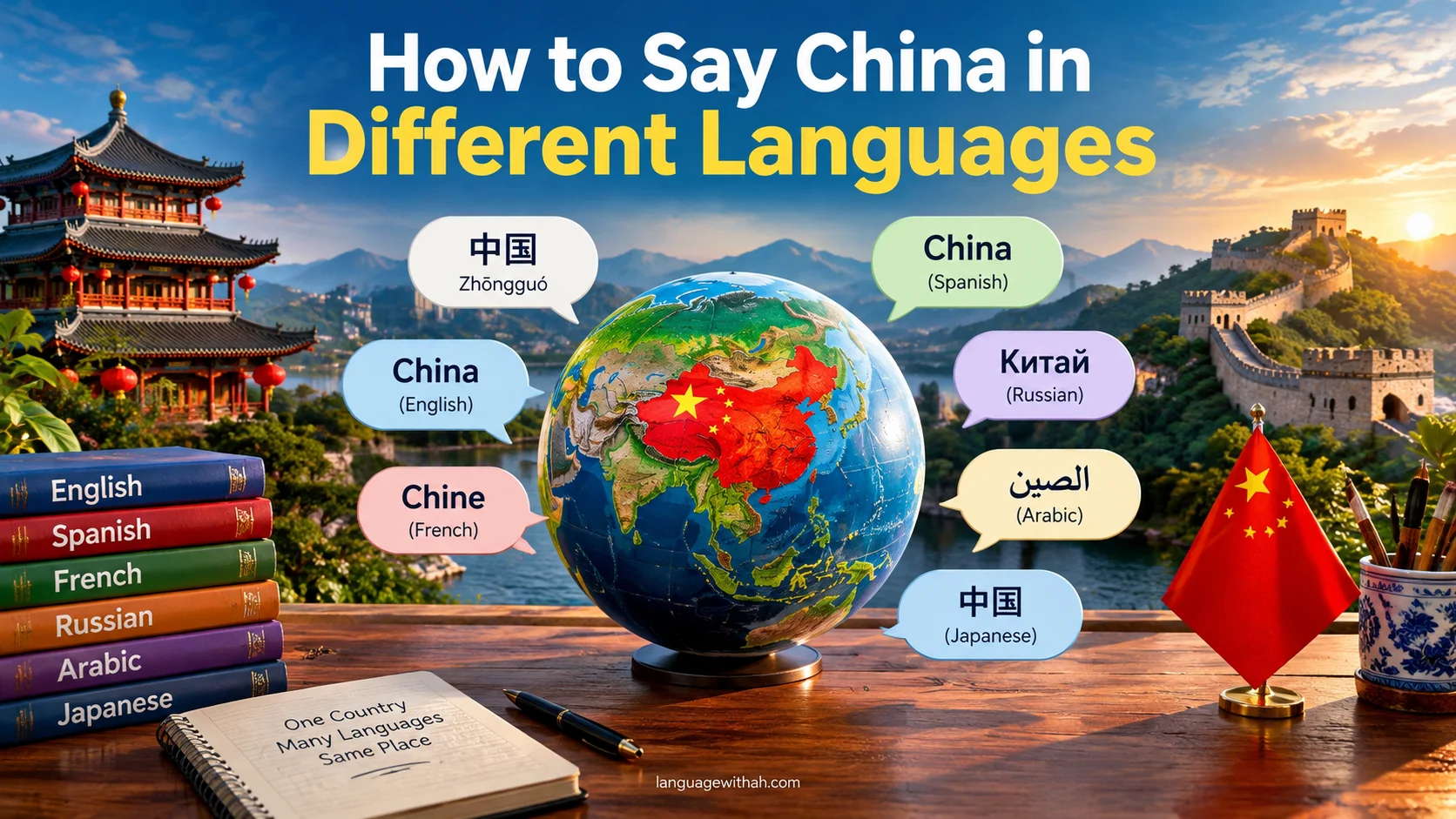
China is known around the world for its long history, distinctive writing system, regional cultures, and influence on art, food, philosophy, and technology. Learning how to say China in different languages is useful for travelers, students, language learners, writers, and anyone interested in how countries are named across cultures. Although the English word China is widely recognized, other languages use names such as 中国 in Mandarin Chinese, Chine in French, China in Spanish, and Cina in Italian.
Country names are especially interesting because they do not always come from the same linguistic roots. Some languages use names derived from historical terms, while others use native expressions that have developed through centuries of cultural contact. Pronunciation, spelling, and writing systems can also differ considerably.
In this guide, you will discover how to say China in 70 different languages, including European, Asian, African, and Middle Eastern languages. Each entry includes the language, a representative country or region, the translation, an approachable pronunciation guide, and an example sentence. You will also learn about regional variations, common translation mistakes, and the cultural context behind these international names.
Interesting Facts About China in Different Languages
- China has different names around the world. English uses China, French uses Chine, and German uses China, although their pronunciations differ.
- The Chinese name is 中国. In Simplified and Traditional Chinese, the characters are 中国 and 中國, respectively. The Mandarin pronunciation is Zhōngguó.
- Country names can have historical roots. The origins and pathways of international names for China are complex, and different languages adopted their forms through different historical contacts.
- Pronunciation changes across languages. The spelling China does not sound the same in English, German, Spanish, or other languages.
- Chinese uses more than one writing system convention. Simplified Chinese is commonly used in mainland China and Singapore, while Traditional Chinese is commonly used in Taiwan, Hong Kong, and Macau.
- The word for China is not always similar to the English name. Japanese uses 中国 (Chūgoku) and Korean uses 중국 (Jungguk), both written with characters historically connected to Chinese writing traditions.
- Country names may have different local and international forms. The name used by people in one language may differ from the name used by speakers of another language, even when they refer to the same country.
What Does China Mean?
China is the English name of the country officially called the People’s Republic of China. It is a country in East Asia with a long recorded history, diverse regional traditions, and one of the world’s largest populations.
The word China is a proper noun, meaning that it identifies a particular country rather than a general object or concept. In Mandarin Chinese, the country is called 中国 (Zhōngguó), a name commonly understood through the characters 中, meaning “middle” or “central,” and 国, meaning “country” or “state.”
The name’s historical interpretation requires context, however. Although Zhōngguó is often explained literally as “Middle Kingdom,” its historical uses and meanings have changed over time.
People use the name China when discussing geography, international relations, history, culture, business, travel, education, and Chinese communities worldwide.
When translating this country name, the goal is usually to find the standard name used in the target language, rather than translate the English spelling letter by letter.
Why Can China Have Different Translations?
China has different names in different languages because languages develop their own conventions for naming countries, peoples, and places. These names may reflect historical contact, pronunciation patterns, writing systems, or long-established traditions.
Here are the main factors to understand:
- Historical development: Languages adopted names for China at different times and through different cultural connections.
- Writing systems: Mandarin Chinese uses Chinese characters, Japanese uses kanji alongside hiragana and katakana, and Korean generally writes its country name in Hangul.
- Pronunciation: Even when two languages use the same spelling, their sounds may differ.
- Regional conventions: Speakers may use different scripts or spelling conventions depending on the region.
- Formal and informal usage: The short country name is generally appropriate in everyday conversation, while the full official name is used in formal political and administrative contexts.
- Literal versus established names: A country name is usually translated using the form already established in the target language, not by translating the meaning of each individual character.
For example, Mandarin 中国 (Zhōngguó) is the ordinary country name, while 中华人民共和国 (Zhōnghuá Rénmín Gònghéguó) is the formal name of the People’s Republic of China.
The distinction matters because the name of a country and the official name of its government are not interchangeable in every situation.
China in 70 Different Languages
The following tables cover 70 languages and language varieties. Pronunciations are practical guides rather than replacements for audio from a fluent speaker. Accents and regional pronunciation may vary.
European Languages
Europe contains several language families, including Romance, Germanic, Slavic, and Uralic languages. Country names often share historical connections, but their spelling and pronunciation may be quite different. The examples below use standard contemporary forms wherever possible.
| 🌍 Language | Country/Region | Translation | Pronunciation | Example Sentence |
| English | International | China | CHY-nuh | China is in East Asia. |
| American English 🇺🇸 | United States | China | CHY-nuh | I want to learn about China. |
| British English 🇬🇧 | United Kingdom | China | CHY-nuh | China has a long history. |
| Australian English 🇦🇺 | Australia | China | CHY-nuh | She hopes to visit China. |
| Spanish | Spain, Latin America | China | CHEE-nah | Quiero visitar China. — I want to visit China. |
| French | France, Belgium, parts of Canada | Chine | SHEEN | La Chine est en Asie. — China is in Asia. |
| German | Germany, Austria, Switzerland | China | KHEE-nah, with regional variation | China liegt in Asien. — China is in Asia. |
| Italian | Italy, Switzerland | Cina | CHEE-nah | La Cina è molto grande. — China is very large. |
| Portuguese | Portugal, Brazil | China | SHEE-nah in many varieties | Quero conhecer a China. — I want to discover China. |
| Dutch | Netherlands, Belgium | China | KHEE-nah | China ligt in Azië. — China is in Asia. |
| Swedish | Sweden, Finland | Kina | SHEE-nah | Kina ligger i Asien. — China is in Asia. |
| Norwegian | Norway | Kina | SHEE-nah | Kina er et stort land. — China is a large country. |
| Danish | Denmark | Kina | KEE-nah | Kina ligger i Asien. — China is in Asia. |
| Finnish | Finland | Kiina | KEE-nah | Kiina on Aasiassa. — China is in Asia. |
| Icelandic | Iceland | Kína | KEE-nah | Kína er í Asíu. — China is in Asia. |
| Irish | Ireland | An tSín | un T-sheen | Tá an tSín san Áise. — China is in Asia. |
| Welsh | Wales | Tsieina | chuh-AY-nah | Mae Tsieina yn Asia. — China is in Asia. |
| Polish | Poland | Chiny | KHIH-nih | Chiny leżą w Azji. — China is in Asia. |
| Czech | Czechia | Čína | CHEE-nah | Čína leží v Asii. — China is in Asia. |
| Slovak | Slovakia | Čína | CHEE-nah | Čína je v Ázii. — China is in Asia. |
| Ukrainian | Ukraine | Китай | kuh-TY | Китай розташований в Азії. — China is in Asia. |
| Russian | Russia | Китай | kee-TIE | Китай находится в Азии. — China is in Asia. |
| Romanian | Romania, Moldova | China | KEE-nah | China se află în Asia. — China is in Asia. |
| Hungarian | Hungary | Kína | KEE-nah | Kína Ázsiában van. — China is in Asia. |
| Greek | Greece, Cyprus | Κίνα | KEE-nah | Η Κίνα βρίσκεται στην Ασία. — China is in Asia. |
| Bulgarian | Bulgaria | Китай | kuh-TIE | Китай е в Азия. — China is in Asia. |
| Croatian | Croatia, Bosnia and Herzegovina | Kina | KEE-nah | Kina se nalazi u Aziji. — China is in Asia. |
| Serbian | Serbia, Bosnia and Herzegovina | Кина / Kina | KEE-nah | Кина се налази у Азији. — China is in Asia. |
| Slovenian | Slovenia | Kitajska | kee-TIE-skah | Kitajska je v Aziji. — China is in Asia. |
| Lithuanian | Lithuania | Kinija | kee-NEE-yah | Kinija yra Azijoje. — China is in Asia. |
| Latvian | Latvia | Ķīna | KEE-nah | Ķīna atrodas Āzijā. — China is in Asia. |
| Estonian | Estonia | Hiina | HEE-nah | Hiina asub Aasias. — China is in Asia. |
Cultural and linguistic notes
- English varieties: American, British, and Australian English all use China. There is no separate standard country name for each variety; the main differences are accent and local usage.
- Romance languages: Spanish China, French Chine, Italian Cina, and Portuguese China illustrate how related languages can have different established spellings and pronunciations.
- Slavic languages: Russian and Bulgarian use Китай, while Polish uses Chiny and Croatian uses Kina. These differences reflect each language’s own naming conventions.
- German pronunciation: The initial sound in China varies regionally. Both the more fronted pronunciation and the pronunciation with a sound similar to the ch in Scottish loch can be encountered.
Read More: How to Say Change in Different Languages
Asian Languages
Asia contains a wide range of language families and writing systems. Some languages use country names related to Chinese characters, while others have their own established names. The entries below distinguish standard forms from regional or script variations.
| 🌍 Language | Country/Region | Translation | Pronunciation | Example Sentence |
| Mandarin Chinese | Mainland China, Taiwan, Singapore | 中国 / 中國 | Zhōngguó | 中国在亚洲。— China is in Asia. |
| Cantonese | Hong Kong, Macau, Guangdong | 中國 | Zung¹ gwok³ | 中國喺亞洲。— China is in Asia. |
| Japanese | Japan | 中国 | Chūgoku | 中国はアジアにあります。— China is in Asia. |
| Korean | South Korea, North Korea | 중국 | Jungguk | 중국은 아시아에 있어요. — China is in Asia. |
| Hindi | India | चीन | Cheen | चीन एशिया में है। — China is in Asia. |
| Urdu | Pakistan, India | چین | Cheen | چین ایشیا میں ہے۔ — China is in Asia. |
| Bengali | Bangladesh, India | চীন | Chin | চীন এশিয়ায় অবস্থিত। — China is in Asia. |
| Punjabi | Punjab in Pakistan and India | ਚੀਨ / چین | Cheen | ਚੀਨ ਏਸ਼ੀਆ ਵਿੱਚ ਹੈ। — China is in Asia. |
| Gujarati | India | ચીન | Cheen | ચીન એશિયામાં આવેલું છે. — China is in Asia. |
| Marathi | India | चीन | Cheen | चीन आशियामध्ये आहे. — China is in Asia. |
| Tamil | India, Sri Lanka, Singapore | சீனா | See-naa | சீனா ஆசியாவில் உள்ளது. — China is in Asia. |
| Telugu | India | చైనా | Chai-naa | చైనా ఆసియాలో ఉంది. — China is in Asia. |
| Kannada | India | ಚೀನಾ | Chee-naa | ಚೀನಾ ಏಷ್ಯాలో ಇದೆ. — China is in Asia. |
| Malayalam | India | ചൈന | Chai-naa | ചൈന ഏഷ്യയിലാണ്. — China is in Asia. |
| Nepali | Nepal | चीन | Chin | चीन एसियामा छ। — China is in Asia. |
| Sinhala | Sri Lanka | චීනය | Chee-na-ya | චීනය ආසියාවේ පිහිටා ඇත. — China is in Asia. |
| Thai | Thailand | จีน | Jeen | จีนอยู่ในเอเชีย — China is in Asia. |
| Vietnamese | Vietnam | Trung Quốc | Choong kwok, approximate | Trung Quốc nằm ở châu Á. — China is in Asia. |
| Indonesian | Indonesia | Tiongkok / Cina | Tee-ong-kok / Chee-na | Tiongkok berada di Asia. — China is in Asia. |
| Malay | Malaysia, Brunei, Singapore | China | Chee-nah | China terletak di Asia. — China is in Asia. |
| Filipino/Tagalog | Philippines | Tsina | TSEE-nah | Nasa Asya ang Tsina. — China is in Asia. |
| Burmese | Myanmar | တရုတ် | Ta-yote, approximate | တရုတ်နိုင်ငံသည် အာရှတွင်ရှိသည်။ — China is in Asia. |
| Khmer | Cambodia | ចិន | Chen | ប្រទេសចិនស្ថិតនៅអាស៊ី។ — China is in Asia. |
| Lao | Laos | ຈີນ | Jeen | ຈີນຢູ່ໃນອາຊີ. — China is in Asia. |
| Mongolian | Mongolia | Хятад | Khyatad, approximate | Хятад улс Азид оршдог. — China is in Asia. |
| Kazakh | Kazakhstan | Қытай | Qytai, approximate | Қытай Азияда орналасқан. — China is in Asia. |
| Uzbek | Uzbekistan | Xitoy | Khi-toy, approximate | Xitoy Osiyoda joylashgan. — China is in Asia. |
| Turkish | Türkiye | Çin | Chin | Çin Asya’dadır. — China is in Asia. |
| Persian | Iran, Afghanistan, Tajikistan | چین | Chin | چین در آسیا قرار دارد. — China is in Asia. |
Cultural and linguistic notes
Mandarin and Cantonese: Mandarin uses Zhōngguó, while Cantonese commonly writes the country name as 中國 and pronounces it differently. The Cantonese pronunciation above uses Jyutping tone numbers: zung1 gwok3. In spoken Cantonese, sentence particles and word choices can vary by context.
Japanese: 中国 is pronounced Chūgoku when referring to China. The same characters can have other readings or meanings in different contexts, so context is important.
Korean: 중국 (Jungguk) is the standard Korean name for China. Korean pronunciation differs from Mandarin even though the names share a historical connection through Chinese characters.
Indonesian: Tiongkok is a widely used name for China, while Cina is also encountered. Choice of term can depend on context, style, and individual preference.
Persian: چین (Chin) is the established country name. Persian is spoken across several countries, with differences in accent and some vocabulary.
African Languages
Africa is home to hundreds of languages from several major language families. Country names may be borrowed, adapted to local sound systems, or represented using different scripts. These examples include languages used in East, West, Southern, and other parts of the continent.
| 🌍 Language | Country/Region | Translation | Pronunciation | Example Sentence |
| Swahili | Tanzania, Kenya, East Africa | China | CHEE-nah | China iko Asia. — China is in Asia. |
| Afrikaans | South Africa, Namibia | China | KHEE-nah, approximate | China is in Asië. — China is in Asia. |
| Zulu | South Africa | iShayina | ee-shy-EE-nah | IShayina lise-Asia. — China is in Asia. |
| Xhosa | South Africa | iTshayina | ee-tshy-EE-nah | ITshayina ise-Asiya. — China is in Asia. |
| Amharic | Ethiopia | ቻይና | Chay-na | ቻይና በእስያ ውስጥ ትገኛለች። — China is in Asia. |
| Yoruba | Nigeria, Benin | Ṣáínà | Shah-ee-nah, approximate | Ṣáínà wà ní Éṣíà. — China is in Asia. |
| Igbo | Nigeria | China | CHEE-nah | China dị na Eshia. — China is in Asia. |
| Hausa | Nigeria, Niger, West Africa | China | CHEE-nah | China tana cikin Asiya. — China is in Asia. |
| Somali | Somalia, Djibouti, Horn of Africa | Shiinaha | Shee-nah-ha | Shiinaha wuxuu ku yaal Aasiya. — China is in Asia. |
| Shona | Zimbabwe | China | CHEE-nah | China iri muAsia. — China is in Asia. |
| Sesotho | Lesotho, South Africa | China | CHEE-nah | China e Asia. — China is in Asia. |
| Setswana | Botswana, South Africa | China | CHEE-nah | China e kwa Asia. — China is in Asia. |
| Kinyarwanda | Rwanda | Ubushinwa | oo-boo-SHEEN-wah | Ubushinwa buri muri Aziya. — China is in Asia. |
| Malagasy | Madagascar | Sina | SEE-nah | Sina dia any Azia. — China is in Asia. |
Cultural and linguistic notes
- Swahili: China is the common country name, while Uchina can appear in certain constructions and expressions relating to China.
- Zulu and Xhosa: Their names for China reflect adaptation to the sound and noun-class systems of the languages. The initial forms iShayina and iTshayina are not pronounced like English China.
- Amharic: The name is written in the Geʽez-derived Ethiopic script, so romanization is an approximation rather than a substitute for the original writing.
- Regional usage: Africa’s linguistic diversity means that a country name can differ even between languages spoken in neighboring communities.
Middle Eastern Languages
The Middle East includes Arabic, Persian, Hebrew, Kurdish, Turkish, and Armenian language traditions, among others. Some languages use related historical forms, but they have distinct grammar, pronunciation, and writing systems. Arabic also has important differences between Modern Standard Arabic and regional dialects.
| 🌍 Language | Country/Region | Translation | Pronunciation | Example Sentence |
| Arabic (Modern Standard Arabic) | Middle East and North Africa | الصين | aṣ-Ṣīn | الصين تقع في آسيا. — China is in Asia. |
| Hebrew | Israel | סין | Seen | סין נמצאת באסיה. — China is in Asia. |
| Kurdish (Kurmanji) | Türkiye, Iraq, Syria, Iran | Çîn | Cheen | Çîn li Asyayê ye. — China is in Asia. |
| Armenian | Armenia and Armenian communities worldwide | Չինաստան | Chinasdan, approximate | Չինաստանը Ասիայում է։ — China is in Asia. |
Cultural and linguistic notes
Arabic: الصين (aṣ-Ṣīn) is the standard written form in Modern Standard Arabic. In everyday conversation, pronunciation and surrounding phrasing may vary by dialect, even when the written country name is the same.
Hebrew: סין (Seen) is the common name for China. Hebrew reads from right to left, so the written form may look unfamiliar to readers accustomed to Latin scripts.
Kurdish: This table uses Kurmanji, one major variety of Kurdish. Other Kurdish varieties, including Sorani, differ in writing conventions and some vocabulary.
Armenian: Չինաստան (Chinastan) is the standard country name. The suffix -stan appears in several country names in the region and beyond, but its use does not mean all such countries share the same language or cultural history.
Other World Languages
Some languages are used across oceans or in communities with histories of migration, colonization, and cultural exchange. Their names for China may reflect local pronunciation, established international forms, or different linguistic traditions.
| 🌍 Language | Country/Region | Translation | Pronunciation | Example Sentence |
| Māori | New Zealand | Haina | HY-nah | Kei Āhia a Haina. — China is in Asia. |
| Samoan | Samoa and Pacific communities | Saina | SAI-nah | O Saina e i Asia. — China is in Asia. |
| Tongan | Tonga | Siaina | see-eye-AH-nah | ʻOku ʻi ʻĒsia ʻa Siaina. — China is in Asia. |
| Hawaiian | Hawaiʻi | Kina | KEE-nah | Aia ʻo Kina ma ʻĀsia. — China is in Asia. |
| Quechua | Andean regions of South America | China | CHEE-nah, approximate | Chinaqa Asyapi kachkan. — China is in Asia. |
| Guarani | Paraguay and neighboring regions | China | CHEE-nah | China oĩ Asia-pe. — China is in Asia. |
| Haitian Creole | Haiti and Haitian communities | Lachin | lah-SHEEN | Lachin sitiye nan Azi. — China is in Asia. |
| Esperanto | International constructed language | Ĉinio | CHEE-nee-oh | Ĉinio troviĝas en Azio. — China is in Asia. |
Cultural and linguistic notes
- Māori: Haina is an established form for China, adapted to Māori pronunciation.
- Samoan and Tongan: Their forms resemble each other, but the spelling and pronunciation conventions of the two languages are distinct.
- Haitian Creole: Lachin is the common country name. Its spelling should not be confused with the French word Chine, even though the forms are historically related.
- Esperanto: Ĉinio follows Esperanto’s regular spelling and pronunciation conventions, making it relatively straightforward to pronounce once its alphabet is understood.
Quick Reference: China in Different Languages
Use this table to find the country name quickly. The English pronunciation guides above are approximate; consult the relevant regional table for writing-system notes and example sentences.
| Language | Translation |
| English | China |
| American English | China |
| British English | China |
| Australian English | China |
| Spanish | China |
| French | Chine |
| German | China |
| Italian | Cina |
| Portuguese | China |
| Dutch | China |
| Swedish | Kina |
| Norwegian | Kina |
| Danish | Kina |
| Finnish | Kiina |
| Icelandic | Kína |
| Irish | An tSín |
| Welsh | Tsieina |
| Polish | Chiny |
| Czech | Čína |
| Slovak | Čína |
| Ukrainian | Китай |
| Russian | Китай |
| Romanian | China |
| Hungarian | Kína |
| Greek | Κίνα |
| Bulgarian | Китай |
| Croatian | Kina |
| Serbian | Кина / Kina |
| Slovenian | Kitajska |
| Lithuanian | Kinija |
| Latvian | Ķīna |
| Estonian | Hiina |
| Mandarin Chinese | 中国 / 中國 |
| Cantonese | 中國 |
| Japanese | 中国 |
| Korean | 중국 |
| Hindi | चीन |
| Urdu | چین |
| Bengali | চীন |
| Punjabi | ਚੀਨ / چین |
| Gujarati | ચીન |
| Marathi | चीन |
| Tamil | சீனா |
| Telugu | చైనా |
| Kannada | ಚೀನಾ |
| Malayalam | ചൈന |
| Nepali | चीन |
| Sinhala | චීනය |
| Thai | จีน |
| Vietnamese | Trung Quốc |
| Indonesian | Tiongkok / Cina |
| Malay | China |
| Filipino/Tagalog | Tsina |
| Burmese | တရုတ် |
| Khmer | ចិន |
| Lao | ຈີນ |
| Mongolian | Хятад |
| Kazakh | Қытай |
| Uzbek | Xitoy |
| Turkish | Çin |
| Persian | چین |
| Swahili | China |
| Afrikaans | China |
| Zulu | iShayina |
| Xhosa | iTshayina |
| Amharic | ቻይና |
| Yoruba | Ṣáínà |
| Igbo | China |
| Hausa | China |
| Somali | Shiinaha |
| Shona | China |
| Sesotho | China |
| Setswana | China |
| Kinyarwanda | Ubushinwa |
| Malagasy | Sina |
| Arabic | الصين |
| Hebrew | סין |
| Kurdish (Kurmanji) | Çîn |
| Armenian | Չինաստան |
| Māori | Haina |
| Samoan | Saina |
| Tongan | Siaina |
| Hawaiian | Kina |
| Quechua | China |
| Guarani | China |
| Haitian Creole | Lachin |
| Esperanto | Ĉinio |
How to Choose the Right Translation
The right translation depends on where, why, and how you plan to use the name.
- Match the language to your audience. Use 中国 for Mandarin Chinese, 中國 for Traditional Chinese writing, and the relevant established country name for other languages.
- Consider the region. A name may be written differently depending on the standard used in a particular country or community.
- Use the correct script. When writing a message in another language, native script is usually more appropriate than English transliteration alone.
- Distinguish the country from its people. China is the country; Chinese usually refers to its people, language, or something associated with it. The exact equivalent depends on the target language.
- Check the context. A travel guide, school assignment, news report, and official document may require different levels of formality.
- Listen to pronunciation. Romanized spellings provide a useful starting point, but audio examples help you understand tones, stress, and sounds that English does not use.
Practical tip: If you are writing a multilingual greeting, travel caption, or educational post, use the country’s standard name in the intended language and double-check its script before publishing.
Common Mistakes When Translating China
Even a simple country name can lead to mistakes when its spelling, pronunciation, or context is misunderstood.
- Translating letters instead of using the established name. Country names are proper nouns, so their accepted forms should be used rather than invented phonetic spellings.
- Confusing China with Chinese. China names the country. Chinese can refer to the language, people, or cultural identity, depending on the sentence.
- Ignoring writing systems. 中国, 中国語, and other similar-looking forms do not necessarily mean the same thing. In Japanese, for example, 中国 refers to China, while 中国語 refers to the Chinese language.
- Assuming every Chinese language variety uses the same pronunciation. Mandarin and Cantonese differ in pronunciation, even when using the same Chinese characters.
- Using a pronunciation guide as an exact substitute for speech. English approximations cannot fully represent every tone or sound.
- Mixing regional standards. A word may be familiar in one language community but less common in another.
- Confusing the short and official names. China and the People’s Republic of China refer to different levels of naming: the country’s common name and its full official state name.
For accurate communication, choose the conventional name for the intended language, preserve the correct script, and consider the audience.
Why Learn China in Different Languages?
Learning how to say China in different languages offers more than a list of translations. It provides a small window into how languages develop, borrow words, and create their own ways of referring to the world.
- Improve communication: Country names are useful when asking for directions, discussing travel, or talking about international news.
- Build vocabulary: Learning names for countries introduces new sounds, spelling patterns, and writing systems.
- Understand linguistic relationships: Comparing forms such as Chine, China, Cina, and Kina reveals both similarities and differences between languages.
- Prepare for travel: Recognizing a country’s name in a local language can help you understand maps, signs, menus, and travel information.
- Create more thoughtful content: Writers, teachers, students, and social media creators can make their work more accessible to international audiences.
- Appreciate cultural diversity: A country’s name may reflect a language’s own history rather than the English form, reminding us that no single language determines how the world must be named.
Language learning becomes more rewarding when it combines vocabulary with context, pronunciation, and cultural awareness.
FAQs:
How do you say China in different languages?
China has different names across languages. Examples include 中国 (Zhōngguó) in Mandarin Chinese, Chine in French, Cina in Italian, Kina in Swedish, and Китай in Russian.
What is the Chinese name for China?
In Mandarin Chinese, China is called 中国 (Zhōngguó) in Simplified Chinese and 中國 (Zhōngguó) in Traditional Chinese. The pronunciation is approximately jong-gwo, with tones represented in the standard pinyin spelling.
Is China called Zhongguo by Chinese speakers?
Yes. Zhōngguó is the standard Mandarin name for China. The pronunciation and tone marks are important when learning to say it accurately.
Why do different languages have different names for China?
Languages develop country names through historical contact, borrowing, sound changes, and established naming traditions. Consequently, a country may have several names across the world’s languages.
Is China spelled the same in American, British, and Australian English?
Yes. The standard spelling is China in all three varieties. Pronunciation can vary slightly by accent, but the country name does not change.
Conclusion:
Learning how to say China in different languages shows how one country can be represented through many writing systems, pronunciation patterns, and linguistic traditions. From 中国 (Zhōngguó) in Mandarin Chinese to Chine in French, Cina in Italian, and Kina in Swedish, each name follows the conventions of its own language.
The most useful translation is not necessarily the one that looks or sounds closest to English. It is the form that speakers of the intended language recognize and use in the relevant context. Paying attention to pronunciation, spelling, regional variation, and writing systems helps you communicate more clearly and avoid common mistakes.














1 thought on “How to Say China in Different Languages”