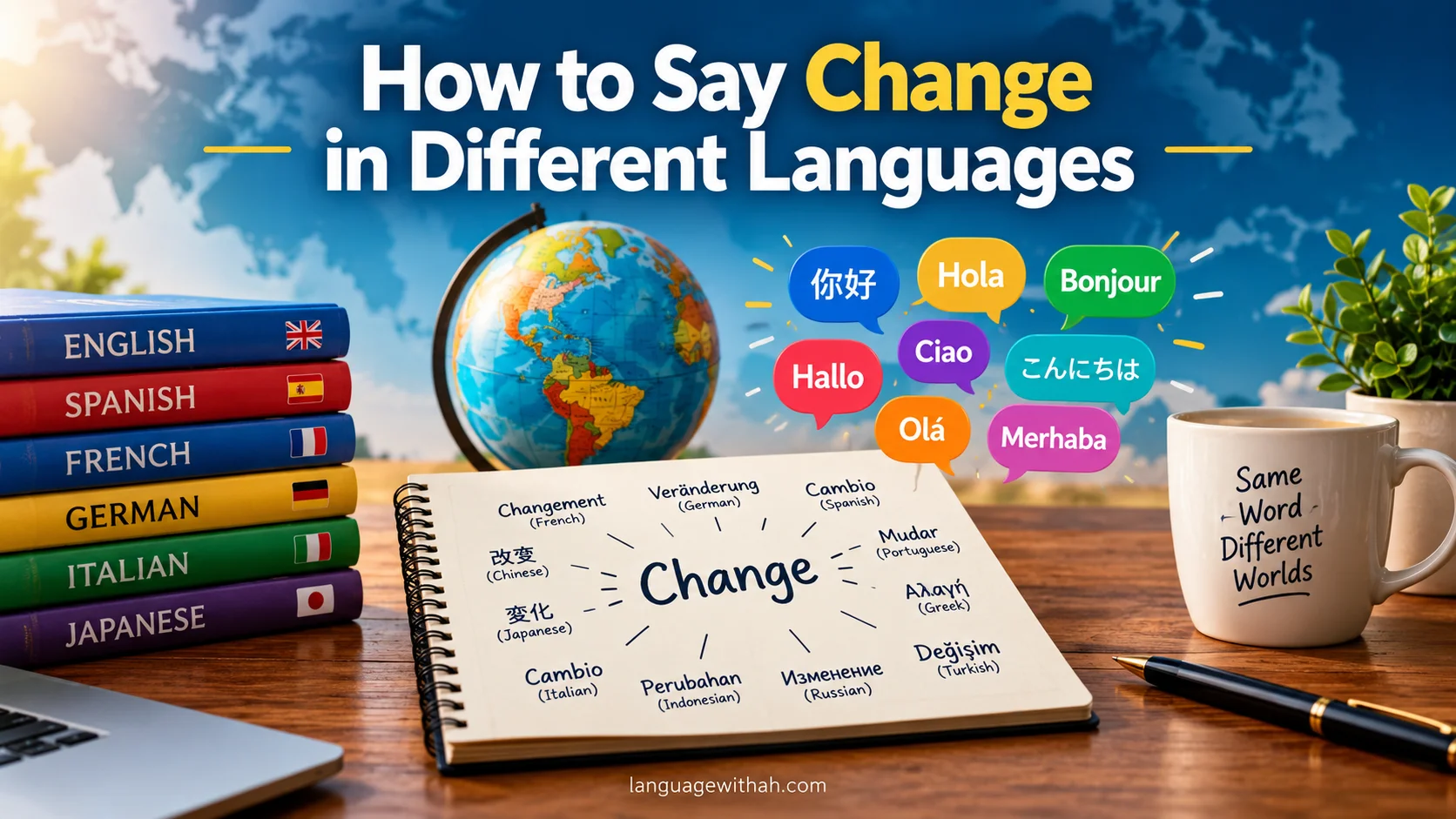
The word change can describe many things: making something different, adapting to a new situation, exchanging an item, or experiencing a personal transformation. Learning how to say change in different languages helps you understand how people express these ideas across cultures. Although English uses one word for several meanings, other languages often choose different words depending on the situation.
For language learners, travelers, students, and curious readers, exploring these translations is a useful way to build vocabulary and recognize subtle differences in everyday communication. A word used for changing a plan may not be the right choice for changing a person’s habits or exchanging money. Similarly, a translation that works in a formal document might sound less natural in casual conversation.
This guide explores translations of change across European, Asian, African, Middle Eastern, and other world languages. It includes native writing systems, pronunciation guides, example sentences, and helpful cultural and grammatical notes. Because change can function as both a noun and a verb, the most appropriate translation depends on its intended meaning, sentence structure, and context. Understanding those differences will help you choose a more natural expression rather than relying on a direct word-for-word translation.
Interesting Facts About Change
- Change can be a noun or a verb. In English, you can change your clothes, make a change to a plan, or talk about changes in society.
- Different meanings can require different words. Changing a schedule, transforming a building, and exchanging currency are related ideas, but they do not always use the same expression in another language.
- Grammar affects translation. Some languages express change through a verb, while others use a noun with an appropriate verb such as make, undergo, or bring about.
- Context helps determine the best word. A translation for personal growth may differ from one used for loose coins or a commercial exchange.
- Some languages distinguish gradual and sudden change. Depending on the language, different verbs may describe becoming different, replacing something, or changing something deliberately.
- Word forms matter. A dictionary entry for change may not be the form needed in a complete sentence. Verbs may need conjugation, and nouns may require grammatical endings.
- Pronunciation is part of learning. A familiar-looking word in another language may have a different sound, stress pattern, or pronunciation from its English equivalent.
What Does Change Mean?
Change means to make something different, become different, or replace one thing with another. It can refer to a small adjustment, a major transformation, or a new situation.
The word has several common meanings:
- As a verb: To make something different or become different. Example: “I want to change my routine.”
- As a noun: A difference, adjustment, or transformation. Example: “The change was helpful.”
- In personal life: A shift in habits, feelings, opinions, or circumstances.
- In business: An adjustment to a price, policy, plan, or process.
- In money and shopping: Coins or the money returned after a purchase.
- In everyday conversation: Replacing clothes, changing a meeting time, or choosing another option.
The emotional meaning of change can also vary. It may suggest growth, opportunity, uncertainty, or disruption, depending on the circumstances.
Why Can Change Have Different Translations?
There is no single translation of change that fits every situation in every language. Some languages use different words for making something different and becoming different. Others distinguish between changing an object, changing one’s mind, exchanging an item, and giving someone their money back.
The right translation may depend on:
- Context: Changing a plan is different from changing a person’s behavior.
- Grammar: The verb form may differ from the noun form.
- Formality: A conversational expression may not suit formal writing.
- Regional variation: Speakers may use different everyday expressions across countries.
- Sentence structure: Some languages require additional words to express the same idea naturally.
- Intended meaning: Transformation, replacement, exchange, and small adjustments are related but not identical.
In the tables below, the primary focus is the verb “to change” in the sense of making something different or becoming different. Where a language uses a different construction for these meanings, the examples help illustrate the distinction.
European Languages
European languages belong to several language families, including Romance, Germanic, Slavic, and Uralic. Although many have words that broadly correspond to change, their grammatical forms and everyday usage differ.
English also has regional varieties. American, British, and Australian English use the same basic word, although some expressions and pronunciations differ.
English varieties
| 🌍 Language | Country/Region | Translation | Pronunciation | Example Sentence |
| English | International | Change | chaynj | I want to change my routine. |
| American English 🇺🇸 | United States | Change | chaynj | I need to change my plans. |
| British English 🇬🇧 | United Kingdom | Change | chaynj | We may need to change the date. |
| Australian English 🇦🇺 | Australia | Change | chaynj | I decided to change my schedule. |
Regional note: The word change is the same in these varieties. Differences are more likely to occur in surrounding expressions, accent, and usage than in the word itself.
European translations
| 🌍 Language | Country/Region | Translation | Pronunciation | Example Sentence |
| Spanish | Spain, Latin America | Cambiar | kam-BYAR | Necesito cambiar mi horario. — I need to change my schedule. |
| French | France, Belgium, parts of Canada | Changer | shahn-ZHAY | Je veux changer mes plans. — I want to change my plans. |
| German | Germany, Austria, Switzerland | Ändern | EN-dern | Ich möchte meinen Plan ändern. — I want to change my plan. |
| Italian | Italy, Switzerland | Cambiare | kam-BYAH-reh | Voglio cambiare idea. — I want to change my mind. |
| Portuguese | Portugal, Brazil | Mudar | moo-DAR | Quero mudar meus planos. — I want to change my plans. |
| Dutch | Netherlands, Belgium | Veranderen | ver-AN-duh-ren | Ik wil mijn plannen veranderen. — I want to change my plans. |
| Swedish | Sweden, parts of Finland | Förändra | fur-EN-dra | Jag vill förändra min rutin. — I want to change my routine. |
| Norwegian | Norway | Endre | EN-druh | Jeg vil endre planen. — I want to change the plan. |
| Danish | Denmark | Ændre | EN-druh | Jeg vil ændre planen. — I want to change the plan. |
| Finnish | Finland | Muuttaa | MOO-tah | Haluan muuttaa suunnitelmaa. — I want to change the plan. |
| Icelandic | Iceland | Breyta | BRAY-ta | Ég vil breyta áætluninni. — I want to change the plan. |
| Irish | Ireland | Athraigh | AH-ree | Caithfidh mé mo phlean a athrú. — I have to change my plan. |
| Welsh | Wales | Newid | NEW-id | Dw i eisiau newid y cynllun. — I want to change the plan. |
| Polish | Poland | Zmieniać | ZMYEN-yach | Chcę zmienić plan. — I want to change the plan. |
| Czech | Czechia | Měnit | MYEH-nit | Chci změnit plán. — I want to change the plan. |
| Slovak | Slovakia | Meniť | MEH-nyeet | Chcem zmeniť plán. — I want to change the plan. |
| Ukrainian | Ukraine | Змінювати | zmin-YU-va-ty | Я хочу змінити план. — I want to change the plan. |
| Russian | Russia and other Russian-speaking communities | Менять | mye-NYAT | Я хочу изменить план. — I want to change the plan. |
| Romanian | Romania, Moldova | A schimba | ah skeem-BAH | Vreau să schimb planul. — I want to change the plan. |
| Hungarian | Hungary | Változtatni | VAAL-toz-tat-nee | Meg akarom változtatni a tervet. — I want to change the plan. |
| Greek | Greece, Cyprus | Αλλάζω | a-LA-zo | Θέλω να αλλάξω το σχέδιο. — I want to change the plan. |
| Bulgarian | Bulgaria | Променям | pro-meh-NYAM | Искам да променя плана. — I want to change the plan. |
| Croatian | Croatia | Mijenjati | MYEH-nya-tee | Želim promijeniti plan. — I want to change the plan. |
| Serbian | Serbia, neighboring communities | Мењати | ME-nya-tee | Желим да променим план. — I want to change the plan. |
| Slovenian | Slovenia | Spreminjati | spreh-mee-NYA-tee | Želim spremeniti načrt. — I want to change the plan. |
| Lithuanian | Lithuania | Keisti | KAY-stee | Noriu pakeisti planą. — I want to change the plan. |
| Latvian | Latvia | Mainīt | MAI-neet | Es vēlos mainīt plānu. — I want to change the plan. |
| Estonian | Estonia | Muutma | MOOT-mah | Ma tahan plaani muuta. — I want to change the plan. |
Cultural and grammatical notes
- In French, changer is the general verb for changing something, while expressions such as changer d’avis mean “change one’s mind.”
- In German, ändern usually means to alter something, while sich ändern means to change or become different oneself.
- In Spanish, cambiar covers many everyday situations, including changing plans and exchanging things. The surrounding words clarify the meaning.
- In Russian, менять and изменить are related alternatives; the choice depends on aspect, sentence structure, and intended meaning.
- In Irish, the form athrú is the verbal noun meaning “changing” or “change,” while athraigh appears in particular verb forms. The example sentence uses athrú after the relevant construction.
These examples show why learning a complete expression can be more useful than memorizing an isolated translation.
Read More: How to Say Caramel in Different Languages
Asian Languages
Asia contains hundreds of languages with distinct writing systems, grammatical structures, and pronunciation patterns. Some use alphabets, while others use characters or scripts with their own conventions. The translations below focus on the general idea of making something different, with examples that show how each expression works in context.
| 🌍 Language | Country/Region | Translation | Pronunciation | Example Sentence |
| Mandarin Chinese | China, Taiwan, Singapore | 改变 | gǎi biàn | 我想改变计划。— I want to change the plan. |
| Cantonese | Hong Kong, Guangdong | 改變 | goi2 bin3 | 我想改變計劃。— I want to change the plan. |
| Japanese | Japan | 変える | kaeru | 計画を変えたいです。— I want to change the plan. |
| Korean | South Korea, North Korea | 바꾸다 | ba-kk u-da | 계획을 바꾸고 싶어요. — I want to change the plan. |
| Hindi | India | बदलना | badalnā | मैं अपनी योजना बदलना चाहता हूँ। — I want to change my plan. |
| Urdu | Pakistan, India | بدلنا | badalnā | میں اپنا منصوبہ بدلنا چاہتا ہوں۔ — I want to change my plan. |
| Bengali | Bangladesh, India | পরিবর্তন করা | poriborton kôra | আমি পরিকল্পনাটি পরিবর্তন করতে চাই। — I want to change the plan. |
| Punjabi | India, Pakistan | ਬਦਲਣਾ / بدلنا | badalnā | ਮੈਂ ਆਪਣੀ ਯੋਜਨਾ ਬਦਲਣਾ ਚਾਹੁੰਦਾ ਹਾਂ। — I want to change my plan. |
| Gujarati | India | બદલવું | badalvu | મારે મારી યોજના બદલવી છે. — I want to change my plan. |
| Marathi | India | बदलणे | badalne | मला माझी योजना बदलायची आहे. — I want to change my plan. |
| Tamil | India, Sri Lanka, Singapore | மாற்று | māṟṟu | நான் திட்டத்தை மாற்ற விரும்புகிறேன். — I want to change the plan. |
| Telugu | India | మార్చడం | mārchaḍam | నేను ప్రణాళికను మార్చాలనుకుంటున్నాను. — I want to change the plan. |
| Kannada | India | ಬದಲಾಯಿಸು | badalāyisu | ನಾನು ಯೋಜನೆಯನ್ನು ಬದಲಾಯಿಸಲು ಬಯಸುತ್ತೇನೆ. — I want to change the plan. |
| Malayalam | India | മാറ്റുക | māṟṟuka | എനിക്ക് പദ്ധതി മാറ്റണം. — I want to change the plan. |
| Nepali | Nepal, India | परिवर्तन गर्नु | parivartan garnu | म योजना परिवर्तन गर्न चाहन्छु। — I want to change the plan. |
| Sinhala | Sri Lanka | වෙනස් කරනවා | venas karanawā | මට සැලැස්ම වෙනස් කරන්න ඕනෑ. — I want to change the plan. |
| Thai | Thailand | เปลี่ยน | plìan | ฉันอยากเปลี่ยนแผน — I want to change the plan. |
| Vietnamese | Vietnam | Thay đổi | thay doi | Tôi muốn thay đổi kế hoạch. — I want to change the plan. |
| Indonesian | Indonesia | Mengubah | muh-NGU-bah | Saya ingin mengubah rencana. — I want to change the plan. |
| Malay | Malaysia, Brunei, Singapore | Mengubah | muh-NGU-bah | Saya mahu mengubah rancangan. — I want to change the plan. |
| Filipino (Tagalog) | Philippines | Magbago | mag-BA-go | Gusto kong magbago ng plano. — I want to change the plan. |
| Burmese | Myanmar | ပြောင်းလဲသည် | pyaung: lè thī | အစီအစဉ်ကို ပြောင်းလဲချင်ပါတယ်။ — I want to change the plan. |
| Khmer | Cambodia | ផ្លាស់ប្តូរ | phlahs-bdao | ខ្ញុំចង់ផ្លាស់ប្តូរផែនការ។ — I want to change the plan. |
| Lao | Laos | ປ່ຽນ | pian | ຂ້ອຍຢາກປ່ຽນແຜນການ. — I want to change the plan. |
| Mongolian | Mongolia | Өөрчлөх | öörchlöh | Би төлөвлөгөөгөө өөрчлөхийг хүсэж байна. — I want to change my plan. |
| Kazakh | Kazakhstan | Өзгерту | özgertu | Мен жоспарымды өзгерткім келеді. — I want to change my plan. |
| Uzbek | Uzbekistan | O‘zgartirmoq | o’zgartirmoq | Men rejani o‘zgartirmoqchiman. — I want to change the plan. |
Cultural and grammatical notes
- Mandarin Chinese: 改变 (gǎibiàn) is a general term for change or transformation. Other verbs may be more suitable for changing clothes, switching items, or replacing something.
- Japanese: 変える (kaeru) means to change something. 変わる (kawaru) is used when something changes or becomes different. The distinction is similar to “change something” versus “change.”
- Korean: 바꾸다 (bakkuda) generally means to change or replace something. 바뀌다 (bakkwida) describes something being changed or becoming different.
- Hindi and Urdu: The examples use masculine speaker forms. A female speaker would generally use चाहती हूँ (chāhtī hū̃) in Hindi and چاہتی ہوں (chāhtī hū̃) in Urdu instead of the masculine forms.
- Indonesian and Malay: The words are similar, but usage and preferred sentence structures can differ. Do not assume that every expression is interchangeable between the two languages.
- Tamil and other South Asian languages: Verb endings and sentence structures depend on grammar and context. A dictionary form is not always the form used in a complete sentence.
African Languages
Africa is home to a remarkable range of languages, including Bantu, Semitic, Afroasiatic, and Niger-Congo languages. A single English word may correspond to a verb, a phrase, or several related expressions in these languages. The examples below use everyday contexts to show how the idea of changing a plan or making something different can be expressed.
| 🌍 Language | Country/Region | Translation | Pronunciation | Example Sentence |
| Swahili | Tanzania, Kenya, East Africa | Kubadilisha | koo-bah-dee-LEE-shah | Ninataka kubadilisha mpango. — I want to change the plan. |
| Afrikaans | South Africa, Namibia | Verander | fehr-AHN-der | Ek wil die plan verander. — I want to change the plan. |
| Zulu | South Africa | Ukushintsha | oo-koo-SHEEN-tsha | Ngifuna ukushintsha uhlelo. — I want to change the plan. |
| Xhosa | South Africa | Ukutshintsha | oo-koo-tshint-sha | Ndifuna ukutshintsha icebo. — I want to change the plan. |
| Amharic | Ethiopia | መቀየር | meqeyer | እቅዱን መቀየር እፈልጋለሁ። — I want to change the plan. |
| Yoruba | Nigeria, Benin | Yí padà | yee pah-dah | Mo fẹ́ yí ètò náà padà. — I want to change the plan. |
| Igbo | Nigeria | Ịgbanwe | ee-gbanwe | Achọrọ m ịgbanwe atụmatụ ahụ. — I want to change the plan. |
| Hausa | Nigeria, Niger, West Africa | Canza | chan-zah | Ina so in canza shirin. — I want to change the plan. |
| Somali | Somalia, Horn of Africa | Beddelid | bed-deh-lid | Waxaan rabaa inaan qorshaha beddelo. — I want to change the plan. |
| Shona | Zimbabwe | Kuchinja | koo-CHEEN-jah | Ndinoda kuchinja hurongwa. — I want to change the plan. |
| Sesotho | Lesotho, South Africa | Ho fetola | ho feh-TOH-lah | Ke batla ho fetola moralo. — I want to change the plan. |
| Setswana | Botswana, South Africa | Go fetola | go feh-TOH-lah | Ke batla go fetola leano. — I want to change the plan. |
| Kinyarwanda | Rwanda | Guhindura | goo-heen-DOO-rah | Ndashaka guhindura gahunda. — I want to change the plan. |
| Malagasy | Madagascar | Manova | mah-NOO-vah | Te hanova ny drafitra aho. — I want to change the plan. |
Cultural and grammatical notes
- In Swahili, kubadilisha commonly expresses changing or altering something. The exact form can depend on whether the sentence emphasizes changing something or undergoing a change.
- Afrikaans uses verander for changing or altering something. The word is also used for changes in circumstances.
- In Zulu and Xhosa, the words shown are infinitive forms. The form used in a sentence depends on the subject and grammatical construction.
- Yoruba uses yí padà for turning or changing, with the context determining the precise meaning.
- Hausa uses canza in many situations involving changing, replacing, or exchanging something.
These examples represent particular languages and contexts, not every local dialect or regional way of speaking.
Middle Eastern Languages
The Middle East includes several distinct language traditions, including Arabic, Persian, Hebrew, Kurdish, and Armenian. Expressions can differ by country, dialect, and formality. Arabic is especially diverse: Modern Standard Arabic is used in formal writing and many public settings, while everyday speech varies across regional dialects.
| 🌍 Language | Country/Region | Translation | Pronunciation | Example Sentence |
| Arabic (Modern Standard Arabic) | Middle East, North Africa | يُغَيِّر | yughayyir | أريد أن أغيّر الخطة. — I want to change the plan. |
| Persian (Farsi) | Iran, Afghanistan, Tajikistan in related varieties | تغییر دادن | taghyir dādan | میخواهم برنامه را تغییر دهم. — I want to change the plan. |
| Hebrew | Israel | לשנות | le-sha-NOT | אני רוצה לשנות את התוכנית. — I want to change the plan. |
| Kurdish (Kurmanji) | Türkiye, Iraq, Syria, Iran | Guhertin | gu-her-TIN | Ez dixwazim planê biguherînim. — I want to change the plan. |
| Turkish | Türkiye, Cyprus, diaspora communities | Değiştirmek | deh-eesh-TEER-mek | Planı değiştirmek istiyorum. — I want to change the plan. |
| Armenian | Armenia, diaspora communities | Փոխել | po-khel | Ես ուզում եմ փոխել ծրագիրը։ — I want to change the plan. |
Cultural and grammatical notes
- Arabic: The table gives a Modern Standard Arabic verb form. In everyday conversation, speakers may use different expressions depending on dialect. For example, Egyptian Arabic and Levantine Arabic have their own common spoken forms.
- Persian: Taghyir dādan literally conveys “to make a change.” It is a useful construction for changing a plan or arrangement.
- Hebrew: Leshanot is the infinitive “to change.” The form used in a sentence may change with tense and grammatical structure.
- Kurdish: Kurdish has several varieties. The entry uses Kurmanji and should not be assumed to represent every Kurdish dialect.
- Armenian: Փոխել is the verb “to change” or “to replace,” with the precise meaning depending on context.
Other World Languages
Languages outside the regions above offer further examples of how people express change. Some emphasize transformation, while others use a construction that describes making something different. The translations below are useful starting points, but local usage can vary.
| 🌍 Language | Country/Region | Translation | Pronunciation | Example Sentence |
| Māori | New Zealand | Huri | HOO-ree | E hiahia ana ahau ki te huri i te mahere. — I want to change the plan. |
| Samoan | Samoa, American Samoa | Suia | soo-EE-ah | Ou te manaʻo e sui le fuafuaga. — I want to change the plan. |
| Hawaiian | Hawaiʻi | Hoʻololi | hoh-oh-LOH-lee | Makemake au e hoʻololi i ka hoʻolālā. — I want to change the plan. |
| Quechua | Andes, especially Peru and Bolivia | Tikray | TEAK-rye | Regional varieties use different forms for changing or turning something. |
| Esperanto | International constructed language | Ŝanĝi | SHAN-jee | Mi volas ŝanĝi la planon. — I want to change the plan. |
| Haitian Creole | Haiti, Haitian communities abroad | Chanje | shahn-JEH | Mwen vle chanje plan an. — I want to change the plan. |
| Guarani | Paraguay, neighboring regions | Moambue | moh-ahm-boo-EH | Aipota amoambue che plan. — I want to change my plan. |
Note on regional accuracy: Māori, Hawaiian, Quechua, and Guarani have their own regional and grammatical variations. For formal publication, educational material, or an important personal message, confirm the wording with a reliable language-specific dictionary or fluent speaker familiar with the relevant variety.
Quick Reference: Change in Different Languages
This table provides a compact lookup of the translations covered above. For consistency, it lists the principal verb or expression used for to change, rather than attempting to list every possible meaning of the English noun and verb.
| Language | Translation |
| English | Change |
| American English | Change |
| British English | Change |
| Australian English | Change |
| Spanish | Cambiar |
| French | Changer |
| German | Ändern |
| Italian | Cambiare |
| Portuguese | Mudar |
| Dutch | Veranderen |
| Swedish | Förändra |
| Norwegian | Endre |
| Danish | Ændre |
| Finnish | Muuttaa |
| Icelandic | Breyta |
| Irish | Athrú |
| Welsh | Newid |
| Polish | Zmieniać |
| Czech | Měnit |
| Slovak | Meniť |
| Ukrainian | Змінювати |
| Russian | Менять |
| Romanian | A schimba |
| Hungarian | Változtatni |
| Greek | Αλλάζω |
| Bulgarian | Променям |
| Croatian | Mijenjati |
| Serbian | Мењати |
| Slovenian | Spreminjati |
| Lithuanian | Keisti |
| Latvian | Mainīt |
| Estonian | Muutma |
| Mandarin Chinese | 改变 |
| Cantonese | 改變 |
| Japanese | 変える |
| Korean | 바꾸다 |
| Hindi | बदलना |
| Urdu | بدلنا |
| Bengali | পরিবর্তন করা |
| Punjabi | ਬਦਲਣਾ / بدلنا |
| Gujarati | બદલવું |
| Marathi | बदलणे |
| Tamil | மாற்று |
| Telugu | మార్చడం |
| Kannada | ಬದಲಾಯಿಸು |
| Malayalam | മാറ്റുക |
| Nepali | परिवर्तन गर्नु |
| Sinhala | වෙනස් කරනවා |
| Thai | เปลี่ยน |
| Vietnamese | Thay đổi |
| Indonesian | Mengubah |
| Malay | Mengubah |
| Filipino (Tagalog) | Magbago |
| Burmese | ပြောင်းလဲသည် |
| Khmer | ផ្លាស់ប្តូរ |
| Lao | ປ່ຽນ |
| Mongolian | Өөрчлөх |
| Kazakh | Өзгерту |
| Uzbek | O‘zgartirmoq |
| Swahili | Kubadilisha |
| Afrikaans | Verander |
| Zulu | Ukushintsha |
| Xhosa | Ukutshintsha |
| Amharic | መቀየር |
| Yoruba | Yí padà |
| Igbo | Ịgbanwe |
| Hausa | Canza |
| Somali | Beddelid |
| Shona | Kuchinja |
| Sesotho | Ho fetola |
| Setswana | Go fetola |
| Kinyarwanda | Guhindura |
| Malagasy | Manova |
| Arabic | يُغَيِّر |
| Persian | تغییر دادن |
| Hebrew | לשנות |
| Kurdish (Kurmanji) | Guhertin |
| Turkish | Değiştirmek |
| Armenian | Փոխել |
| Māori | Huri |
| Samoan | Suia |
| Hawaiian | Hoʻololi |
| Quechua | Tikray* |
| Esperanto | Ŝanĝi |
| Haitian Creole | Chanje |
| Guarani | Moambue |
Quechua varies considerably by regional variety; verify the preferred form for the specific region before relying on it.
How to Choose the Right Translation
The best translation of change depends on what you want to communicate. Before using a word from the tables, consider these practical steps:
- Identify the meaning. Are you changing a plan, changing your mind, transforming something, or exchanging an item?
- Check the grammar. Make sure you have the right verb form for the sentence, rather than using a dictionary entry without adjustment.
- Consider the audience. A phrase suitable for a friend may not be appropriate for a formal letter or workplace conversation.
- Check regional usage. Ask whether the expression is appropriate for the country or dialect you are learning.
- Practice pronunciation. Pay attention to unfamiliar sounds, tones, syllable stress, and long vowels.
- Learn the complete sentence. Memorizing an expression in context often makes it easier to use naturally.
For example, if you want to say that your plans have changed, you need an expression that describes a change in circumstances. If you want to change someone else’s plan, you may need a verb form that explicitly expresses changing something.
Best tip: Learn the translation alongside a short example sentence. It gives you a clearer sense of how the word works in real communication.
Common Mistakes When Translating Change
Translating change can be tricky because the English word covers several related meanings. Avoid these common mistakes:
- Translating word for word: A literal translation may be grammatically incorrect or sound unnatural. Use a complete expression when possible.
- Confusing different meanings: Changing a plan, exchanging money, and receiving change after a purchase may require different words.
- Ignoring grammar: Some languages distinguish between changing something and something changing by itself.
- Overlooking formality: A casual expression may not suit professional writing or a formal conversation.
- Mixing regional varieties: A word or construction from one dialect may not be the most natural choice in another.
- Ignoring gender and agreement: In languages such as Hindi and Urdu, the form of a sentence may change according to the speaker or grammatical context.
- Relying on English-style pronunciation: Familiar letters do not always represent familiar sounds in another language.
- Assuming one translation works everywhere: Even within a single language, the best expression can change with the situation.
Avoiding these errors helps you move beyond memorizing vocabulary and toward using a language more confidently.
Why Learn Change in Different Languages?
Learning how to express change in different languages helps you build vocabulary and understand how people communicate adjustments, transitions, and new beginnings.
It can be especially useful when traveling, learning a foreign language, communicating with international colleagues, or talking with friends who speak another language. Knowing the appropriate expression can make it easier to discuss changing plans, adapting to new circumstances, or explaining a different point of view.
Comparing translations also reveals useful grammatical patterns. You may discover that one language uses a single verb where another uses a phrase, or that some languages distinguish between making a change and experiencing one.
There is also a cultural benefit. Words associated with change can carry different shades of meaning depending on the conversation, relationship, and situation. Learning these differences encourages thoughtful communication rather than relying on literal translations.
Start with one or two languages, practice their example sentences aloud, and gradually add more expressions to your vocabulary.
FAQs:
How do you say change in different languages?
The word change has different translations around the world. Examples include cambiar in Spanish, changer in French, ändern in German, 変える (kaeru) in Japanese, and بدلنا (badalna) in Urdu. The right choice depends on whether you mean changing something, becoming different, or exchanging an item.
What is the most natural translation of change?
There is no single best translation for every situation. For example, Spanish cambiar and French changer work in many everyday contexts, while other languages may require different verbs depending on the sentence. Choose a translation that matches your intended meaning.
Can the translation of change vary by country?
Yes. Regional vocabulary, dialects, and everyday expressions can differ between countries where the same language is spoken. Arabic, for example, has Modern Standard Arabic as well as numerous regional spoken varieties.
Why do some languages have multiple translations for change?
Because change can mean altering something, becoming different, exchanging something, or receiving money back. Other languages may use separate words or phrases to distinguish these meanings.
Does pronunciation change between regions?
Yes. Accents, stress patterns, and regional speech can affect pronunciation. However, the extent of the difference varies by language. Learning a pronunciation guide for a specific region can help you communicate more naturally.
Conclusion:
Learning how to say change in different languages is a useful way to expand your vocabulary and understand how people express adjustments, transformations, and new circumstances around the world. Although the English word change seems straightforward, its translation depends on the intended meaning, grammatical structure, and situation.
Words such as cambiar in Spanish, changer in French, and 変える (kaeru) in Japanese demonstrate how different languages express the general idea of making something different. However, no single translation works for every context. Changing a plan, changing your mind, and exchanging an item may require different expressions.














1 thought on “How to Say Change in Different Languages”