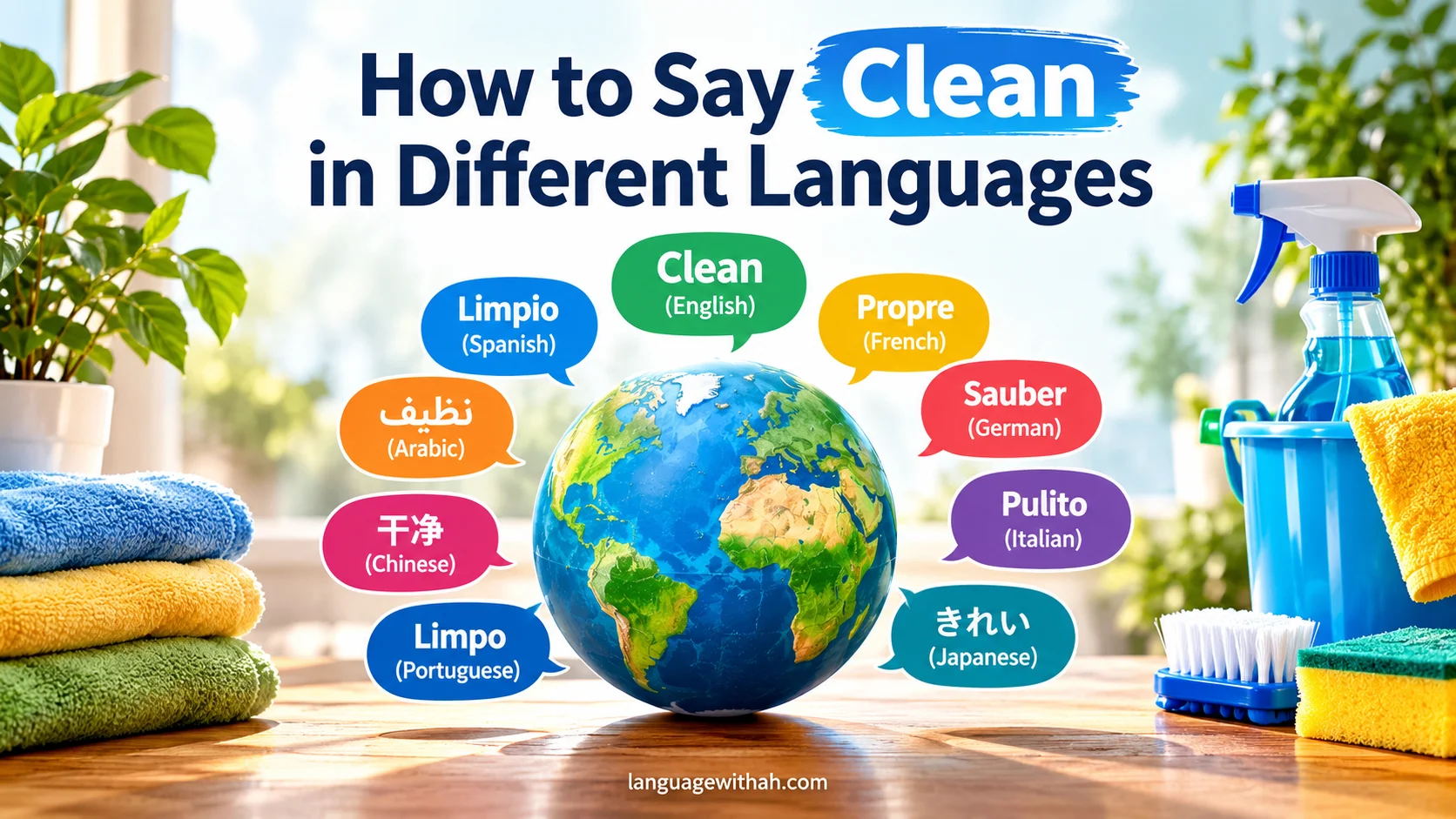
The word clean is simple in English, but its translation can change depending on whether you mean something that is not dirty, a person who is tidy, or the action of removing dirt. In another language, choosing the natural word often requires more than translating each English word directly. For example, some languages change the form of “clean” according to gender, number, or grammatical case, while others use different vocabulary for “clean” as an adjective and “to clean” as a verb.
Learning Clean in 70 Different Languages can be useful for travelers, language learners, families, students, and anyone who communicates across cultures. You might need the word when talking about a clean room, clean clothes, clean water, a tidy home, or a place that has just been cleaned.
This guide focuses mainly on clean as an adjective, meaning “free from dirt, marks, or unwanted material.” Where the verb “to clean” or an important regional distinction differs, the article points it out. You will find translations, pronunciation guides, natural examples, regional information, and practical cultural notes for more than 70 languages.
Interesting Facts About Clean
- Clean can describe both physical and figurative ideas. In English, it can refer to something free of dirt, but it can also describe language, behavior, records, or designs.
- Many languages change the adjective according to gender or grammatical agreement. Spanish, French, Italian, Portuguese, and several other languages are examples.
- The adjective and verb are not always related in the same obvious way. For example, the Spanish adjective is limpio, while the verb “to clean” is limpiar.
- Some languages have several everyday words for cleanliness depending on context. A word used for a clean object may not be the most natural choice for a clean person, surface, or environment.
- Clean water can have a culturally important meaning in everyday conversation, especially when discussing drinking water, hygiene, or public health.
- English-speaking regions generally use the same word clean, although pronunciation and some related expressions can vary between American, British, and Australian English.
- A literal translation is not always the best translation. A natural speaker may choose a different construction depending on whether “clean” means tidy, hygienic, pure, spotless, or recently washed.
What Does Clean Mean?
Clean usually means free from dirt, dust, stains, unwanted substances, or contamination. It can describe a room, shirt, table, car, floor, kitchen, street, or other physical object.
For example:
- “The kitchen is clean.”
- “Please use a clean towel.”
- “The water is clean.”
- “Her shoes are clean.”
The word can also have broader meanings. Clean language may mean language without offensive words, while a clean record can mean a record without criminal convictions or other negative entries. A clean design can mean simple and uncluttered.
For this article, the main translation focus is the everyday adjective clean = not dirty.
The verb is different in many languages. In English, clean can be both an adjective and a verb: “The room is clean” versus “I clean the room.” Other languages may use completely different forms.
Why Can Clean Have Different Translations?
There is no single universal translation of clean because context matters.
A translator may need to consider:
- Adjective vs. verb: “clean” and “to clean” may require different words.
- Gender: Some languages change adjectives for masculine and feminine nouns.
- Number: The form can change between singular and plural.
- Formality: Everyday speech and formal writing may use different expressions.
- Region: A standard language may have regional vocabulary.
- Meaning: “Clean,” “tidy,” “pure,” “hygienic,” and “spotless” are related but not identical.
- Grammar: The adjective may agree with the noun it describes.
- Context: “Clean water” may require a different natural expression from “clean clothes.”
The tables below therefore use the most useful everyday adjective for clean in the sense of “not dirty.”
European Languages
Europe contains several major language families, so the equivalent of clean can look and sound very different from one language to another. Some languages mark grammatical gender, while others use a single adjective more broadly. The forms below focus on ordinary descriptions of clean objects, places, or surroundings.
English Varieties
American, British, and Australian English all use clean as the normal adjective.
| 🌍 Language | Country/Region | Translation | Pronunciation | Example Sentence |
| English | International | clean | kleen | The room is clean. |
| American English 🇺🇸 | United States | clean | kleen | The kitchen is clean now. |
| British English 🇬🇧 | United Kingdom | clean | kleen | The bathroom is clean. |
| Australian English 🇦🇺 | Australia | clean | kleen | The house is clean and tidy. |
The spelling is the same in these English varieties. Pronunciation can vary slightly by accent, but the word itself does not need to be translated differently.
Read More: How to Say Angel in Different Languages
European Language Table
| 🌍 Language | Country/Region | Translation | Pronunciation | Example Sentence |
| Spanish | Spain, Latin America | limpio / limpia | LEEM-pyoh / LEEM-pyah | La habitación está limpia. — The room is clean. |
| French | France, Belgium, Canada | propre | pro-pr | La chambre est propre. — The room is clean. |
| German | Germany, Austria, Switzerland | sauber | ZOW-ber | Das Zimmer ist sauber. — The room is clean. |
| Italian | Italy, Switzerland | pulito / pulita | poo-LEE-toh / poo-LEE-tah | La casa è pulita. — The house is clean. |
| Portuguese | Portugal, Brazil | limpo / limpa | LEEM-poo / LEEM-pah | A cozinha está limpa. — The kitchen is clean. |
| Dutch | Netherlands, Belgium | schoon | skhohn | De kamer is schoon. — The room is clean. |
| Swedish | Sweden, Finland | ren | rehn | Rummet är rent. — The room is clean. |
| Norwegian | Norway | ren | rehn | Rommet er rent. — The room is clean. |
| Danish | Denmark | ren | rehn | Værelset er rent. — The room is clean. |
| Finnish | Finland | puhdas | POOH-das | Huone on puhdas. — The room is clean. |
| Icelandic | Iceland | hreinn / hreint | raytn / raynt | Herbergið er hreint. — The room is clean. |
| Irish | Ireland | glan | glahn | Tá an seomra glan. — The room is clean. |
| Welsh | Wales | glân | glahn | Mae’r ystafell yn lân. — The room is clean. |
| Polish | Poland | czysty / czysta | CHIS-tih / CHIS-tah | Pokój jest czysty. — The room is clean. |
| Czech | Czechia | čistý / čistá | CHIS-tee / CHIS-tah | Pokoj je čistý. — The room is clean. |
| Slovak | Slovakia | čistý / čistá | CHIS-tee / CHIS-tah | Izba je čistá. — The room is clean. |
| Ukrainian | Ukraine | чистий / чиста | CHYS-tiy / CHYS-tah | Кімната чиста. — The room is clean. |
| Russian | Russia and surrounding regions | чистый / чистая | CHEES-tiy / CHEES-tah | Комната чистая. — The room is clean. |
| Romanian | Romania, Moldova | curat / curată | koo-RAT / koo-RAH-tuh | Camera este curată. — The room is clean. |
| Hungarian | Hungary | tiszta | TEES-tah | A szoba tiszta. — The room is clean. |
| Greek | Greece, Cyprus | καθαρός / καθαρή / καθαρό | ka-tha-ROS / ka-tha-REE / ka-tha-RO | Το δωμάτιο είναι καθαρό. — The room is clean. |
| Bulgarian | Bulgaria | чист / чиста / чисто | chist / CHIS-tah / CHEES-toh | Стаята е чиста. — The room is clean. |
| Croatian | Croatia, Bosnia and Herzegovina | čist / čista | chist / CHIS-tah | Soba je čista. — The room is clean. |
| Serbian | Serbia, Bosnia and Herzegovina | чист / чиста | chist / CHIS-tah | Соба је чиста. — The room is clean. |
| Slovenian | Slovenia | čist / čista | chist / CHIS-tah | Soba je čista. — The room is clean. |
| Lithuanian | Lithuania | švarus / švari | SHVAH-roos / SHVAH-ree | Kambarys yra švarus. — The room is clean. |
| Latvian | Latvia | tīrs / tīra | teers / TEE-rah | Istaba ir tīra. — The room is clean. |
| Estonian | Estonia | puhas | POO-has | Tuba on puhas. — The room is clean. |
| Albanian | Albania, Kosovo | i pastër / e pastër | ee PAS-tuhr / eh PAS-tuhr | Dhoma është e pastër. — The room is clean. |
| Maltese | Malta | nadif / nadifa | NAH-dif / nah-DEE-fah | Il-kamra hija nadifa. — The room is clean. |
European Cultural Notes
In many European languages, clean is an adjective that agrees with the noun. Spanish uses limpio with masculine nouns and limpia with feminine nouns. Italian similarly uses pulito/pulita, while Romanian uses curat/curată.
French propre is especially useful because it normally remains the same in pronunciation across masculine and feminine singular forms. Dutch schoon is also an everyday word for clean, although context can give it additional meanings.
In Slavic languages such as Polish, Czech, Ukrainian, Russian, Croatian, Serbian, and Slovenian, adjective endings can change according to gender, case, and number.
Asian Languages
Asia contains hundreds of languages and many different writing systems. The word clean may be expressed with a single adjective in one language and with several grammatical forms in another. For languages using non-Latin scripts, a romanized pronunciation is included to make the entries easier for English speakers to use.
| 🌍 Language | Country/Region | Translation | Pronunciation | Example Sentence |
| Mandarin Chinese | China, Taiwan, Singapore | 干净 / 乾淨 | gān-jìng | 房间很干净。— The room is very clean. |
| Cantonese | Hong Kong, Guangdong | 乾淨 | gon-jing | 間房好乾淨。— The room is very clean. |
| Japanese | Japan | きれい | kee-reh-ee | 部屋はきれいです。— The room is clean. |
| Korean | South Korea, North Korea | 깨끗하다 | kkae-kkeut-ha-da | 방이 깨끗해요. — The room is clean. |
| Hindi | India | साफ़ | saaf | कमरा साफ़ है। — The room is clean. |
| Urdu | Pakistan, India | صاف | saaf | کمرہ صاف ہے۔ — The room is clean. |
| Bengali | Bangladesh, India | পরিষ্কার | po-ri-shkar | ঘরটি পরিষ্কার। — The room is clean. |
| Punjabi | India, Pakistan | ਸਾਫ਼ / صاف | saaf | ਕਮਰਾ ਸਾਫ਼ ਹੈ। — The room is clean. |
| Gujarati | India | સ્વચ્છ | swach-chh | ઓરડો સ્વચ્છ છે. — The room is clean. |
| Marathi | India | स्वच्छ | swach-chha | खोली स्वच्छ आहे. — The room is clean. |
| Tamil | India, Sri Lanka | சுத்தமான | sut-tha-maa-na | அறை சுத்தமாக இருக்கிறது. — The room is clean. |
| Telugu | India | శుభ్రమైన | shubh-ra-maina | గది శుభ్రంగా ఉంది. — The room is clean. |
| Kannada | India | ಸ್ವಚ್ಛ | swach-cha | ಕೊಠಡಿ ಸ್ವಚ್ಛವಾಗಿದೆ. — The room is clean. |
| Malayalam | India | വൃത്തിയുള്ള | vrith-thi-yul-la | മുറി വൃത്തിയുള്ളതാണ്. — The room is clean. |
| Nepali | Nepal | सफा | sa-fa | कोठा सफा छ। — The room is clean. |
| Sinhala | Sri Lanka | පිරිසිදු | pi-ri-si-du | කාමරය පිරිසිදුයි. — The room is clean. |
| Thai | Thailand | สะอาด | sa-aht | ห้องสะอาด |
| Vietnamese | Vietnam | sạch | sahk | Phòng rất sạch. — The room is very clean. |
| Indonesian | Indonesia | bersih | ber-sih | Kamarnya bersih. — The room is clean. |
| Malay | Malaysia, Brunei, Singapore | bersih | ber-sih | Bilik itu bersih. — The room is clean. |
| Filipino/Tagalog | Philippines | malinis | ma-lee-nees | Malinis ang kuwarto. — The room is clean. |
| Burmese | Myanmar | သန့်ရှင်း | than-shin | အခန်းက သန့်ရှင်းတယ်။ — The room is clean. |
| Khmer | Cambodia | ស្អាត | sa-at | បន្ទប់ស្អាត។ — The room is clean. |
| Lao | Laos | ສະອາດ | sa-aht | ຫ້ອງສະອາດ. — The room is clean. |
| Mongolian | Mongolia | цэвэр | tseh-ver | Өрөө цэвэрхэн байна. — The room is clean. |
| Kazakh | Kazakhstan | таза | ta-za | Бөлме таза. — The room is clean. |
| Uzbek | Uzbekistan | toza | toh-za | Xona toza. — The room is clean. |
Asian Cultural and Usage Notes
Hindi, Urdu, Nepali, Punjabi, Bengali, and several other South Asian languages commonly use words related to cleanliness or being free from dirt. Their exact grammatical behavior depends on the language and sentence.
Mandarin 干净 (gānjìng) is a common everyday adjective for clean. Japanese きれい (kirei) can mean clean, neat, beautiful, or pretty depending on context, so it should not automatically be understood as only “clean.”
Korean 깨끗하다 (kkaekkeuthada) is the dictionary form, while 깨끗해요 is a common polite conversational form. In actual conversation, the latter may be more useful for learners.
In Indonesian and Malay, bersih is a standard everyday word for clean. Filipino malinis is similarly common when describing a clean room, place, or object.
Middle Eastern Languages
The Middle East includes several unrelated language families and traditions. Arabic alone contains substantial regional variation, so Modern Standard Arabic and everyday dialects should not automatically be treated as identical. The following forms focus on broadly understandable everyday vocabulary.
| 🌍 Language | Country/Region | Translation | Pronunciation | Example Sentence |
| Arabic | Middle East and North Africa | نظيف / نظيفة | na-DEEF / na-DEE-fah | الغرفة نظيفة. — The room is clean. |
| Persian | Iran, Afghanistan, Tajikistan | تمیز | ta-MEEZ | اتاق تمیز است. — The room is clean. |
| Hebrew | Israel | נקי / נקייה | na-KEE / ne-kee-YAH | החדר נקי. — The room is clean. |
| Kurdish (Kurmanji) | Türkiye, Iraq, Syria, Iran | paqij | pa-KEEJ | Ode paqij e. — The room is clean. |
| Turkish | Türkiye, Cyprus | temiz | teh-MEEZ | Oda temiz. — The room is clean. |
| Armenian | Armenia and Armenian-speaking communities | մաքուր | ma-KOOR | Սենյակը մաքուր է։ — The room is clean. |
Middle Eastern Cultural Notes
In Arabic, نظيف (naẓīf) is masculine and نظيفة (naẓīfa) is feminine. The appropriate form depends on the noun. The example الغرفة نظيفة uses the feminine form because غرفة (“room”) is grammatically feminine.
Persian تمیز (tamiz) is widely useful for describing something clean and does not change for grammatical gender. Turkish temiz likewise functions broadly without the gender agreement found in Arabic.
Hebrew uses נקי (naki) for masculine singular and נקייה (nekiya) for feminine singular.
African Languages
Africa is home to extraordinary linguistic diversity, including Bantu, Semitic, Afroasiatic, and many other language families. A translation that works naturally in one African language should never automatically be assumed to work in another. The examples below use everyday words for clean in their respective languages.
| 🌍 Language | Country/Region | Translation | Pronunciation | Example Sentence |
| Swahili | Kenya, Tanzania, Uganda, East Africa | safi | SAH-fee | Chumba ni safi. — The room is clean. |
| Afrikaans | South Africa, Namibia | skoon | skohn | Die kamer is skoon. — The room is clean. |
| Zulu | South Africa | hlanzekile | hlan-zee-KEH-leh | Igumbi lihlanzekile. — The room is clean. |
| Xhosa | South Africa | icocekile | ee-cho-CHEH-kee-leh | Igumbi licocekile. — The room is clean. |
| Amharic | Ethiopia | ንጹህ | ni-tsuh | ክፍሉ ንጹህ ነው። — The room is clean. |
| Yoruba | Nigeria, Benin | mímọ́ | mee-MAW | Yàrá náà mọ́. — The room is clean. |
| Igbo | Nigeria | dị ọcha | dee aw-cha | Ụlọ ahụ dị ọcha. — The house is clean. |
| Hausa | Nigeria, Niger and West Africa | tsaf | tsahf | Dakin yana da tsabta. — The room is clean. |
| Somali | Somalia, Djibouti, Ethiopia | nadiif | na-DEEF | Qolku waa nadiif. — The room is clean. |
| Shona | Zimbabwe | kuchena | koo-CHEH-na | Imba yakachena. — The house is clean. |
| Malagasy | Madagascar | madio | ma-DEE-oo | Madio ny efitrano. — The room is clean. |
African Language Notes
Swahili safi is widely used for clean and can describe many things, including a room, place, or object. Somali nadiif and Amharic ንጹህ likewise express the basic idea of cleanliness.
In Zulu and Xhosa, the form of the word can be affected by grammatical structure. Yoruba also uses different grammatical constructions depending on what is being described, so a dictionary word should not always be inserted into an English sentence word-for-word.
Quick Reference: Clean in Different Languages
| Language | Translation |
| English | clean |
| Spanish | limpio / limpia |
| French | propre |
| German | sauber |
| Italian | pulito / pulita |
| Portuguese | limpo / limpa |
| Dutch | schoon |
| Swedish | ren |
| Norwegian | ren |
| Danish | ren |
| Finnish | puhdas |
| Icelandic | hreinn / hreint |
| Irish | glan |
| Welsh | glân |
| Polish | czysty / czysta |
| Czech | čistý / čistá |
| Slovak | čistý / čistá |
| Ukrainian | чистий / чиста |
| Russian | чистый / чистая |
| Romanian | curat / curată |
| Hungarian | tiszta |
| Greek | καθαρός / καθαρή / καθαρό |
| Bulgarian | чист / чиста / чисто |
| Croatian | čist / čista |
| Serbian | чист / чиста |
| Slovenian | čist / čista |
| Lithuanian | švarus / švari |
| Latvian | tīrs / tīra |
| Estonian | puhas |
| Albanian | i pastër / e pastër |
| Maltese | nadif / nadifa |
| Mandarin Chinese | 干净 / 乾淨 |
| Cantonese | 乾淨 |
| Japanese | きれい |
| Korean | 깨끗하다 |
| Hindi | साफ़ |
| Urdu | صاف |
| Bengali | পরিষ্কার |
| Punjabi | ਸਾਫ਼ / صاف |
| Gujarati | સ્વચ્છ |
| Marathi | स्वच्छ |
| Tamil | சுத்தமான |
| Telugu | శుభ్రమైన |
| Kannada | ಸ್ವಚ್ಛ |
| Malayalam | വൃത്തിയുള്ള |
| Nepali | सफा |
| Sinhala | පිරිසිදු |
| Thai | สะอาด |
| Vietnamese | sạch |
| Indonesian | bersih |
| Malay | bersih |
| Filipino/Tagalog | malinis |
| Burmese | သန့်ရှင်း |
| Khmer | ស្អាត |
| Lao | ສະອາດ |
| Mongolian | цэвэр |
| Kazakh | таза |
| Uzbek | toza |
| Arabic | نظيف / نظيفة |
| Persian | تمیز |
| Hebrew | נקי / נקייה |
| Kurdish | paqij |
| Turkish | temiz |
| Armenian | մաքուր |
| Swahili | safi |
| Afrikaans | skoon |
| Zulu | hlanzekile |
| Xhosa | icocekile |
| Amharic | ንጹህ |
| Yoruba | mímọ́ |
| Igbo | dị ọcha |
| Hausa | tsaf |
| Somali | nadiif |
| Shona | kuchena |
| Malagasy | madio |
This reference contains 75 distinct languages or language varieties, with American, British, and Australian English shown separately as requested regional varieties rather than being counted as separate languages.
How to Choose the Right Translation
The best translation of clean depends on what you are describing.
If you are describing a room, house, shirt, table, or surface, use the ordinary adjective for “clean” in that language. If you mean the action of cleaning, use the appropriate verb instead.
Pay attention to:
- Gender: Spanish, Italian, French-related grammatical distinctions, Arabic, Hebrew, and several other languages may require a different form.
- Region: A standard language can have regional alternatives.
- Formality: A dictionary form may differ from the form naturally used in conversation.
- Meaning: “Clean” is not always identical to “tidy,” “pure,” “sterile,” or “spotless.”
- Grammar: Some languages require the adjective to agree with the noun.
- Writing system: When speaking rather than writing, learn the pronunciation as well as the written form.
For a message or conversation, it is better to learn a complete natural sentence rather than memorizing an isolated word.
Common Mistakes When Translating Clean
1. Translating the adjective as a verb
English uses clean for both the adjective and the verb. Many languages do not. For example, Spanish uses limpio/limpia for the adjective but limpiar for “to clean.”
2. Ignoring grammatical gender
A learner might memorize limpio and use it with every Spanish noun. However, the feminine form limpia is required with feminine nouns.
3. Assuming one form works everywhere
Arabic, Hebrew, and many European languages can change adjective forms depending on the noun.
4. Confusing clean with tidy
A room can be clean without being tidy. Dirt and organization are not exactly the same concept.
5. Using literal translations
A word-for-word translation can sound unnatural. Japanese きれい, for example, can express cleanliness but also beauty, depending on context.
6. Ignoring pronunciation
Knowing the written form does not guarantee that another speaker will understand you. Pronunciation matters, particularly when using a word in conversation.
7. Mixing dialects
A regional expression can be perfectly correct without being the universal form of the language. This is especially important with Arabic and other widely distributed languages.
Why Learn Clean in Different Languages?
Learning the word clean in different languages gives learners a practical piece of everyday vocabulary. Cleanliness is a common topic when traveling, staying in hotels, describing homes, talking about food and water, or asking about facilities.
It also shows how languages organize meaning differently. Some languages change adjectives according to gender and number, while others use forms that remain much more stable. Comparing these structures can strengthen vocabulary and grammar awareness.
For travelers, knowing a simple word such as clean can make basic communication easier. For families and students, it provides an approachable way to practice descriptions. For anyone interested in languages, it is a reminder that translation involves context and culture, not just replacing one word with another.
FAQs:
How do you say clean in different languages?
The word clean has many translations. Examples include limpio in Spanish, propre in French, sauber in German, pulito in Italian, 干净 (gānjìng) in Mandarin, きれい (kirei) in Japanese, صاف (saaf) in Urdu, and bersih in Indonesian.
What is the most natural translation of clean?
There is no single best translation for every situation. The natural choice depends on whether clean describes a physical object, person, place, water, behavior, or another concept.
Can the translation change by country?
Yes. A language spoken across several countries can have regional vocabulary and pronunciation differences. However, regional variation does not necessarily mean that every country uses a completely different word.
Why do some languages have multiple translations for clean?
Languages may distinguish between clean, tidy, pure, hygienic, spotless, and washed. Grammar can also create different forms according to gender, number, or case.
Does pronunciation change between regions?
Yes. Pronunciation can vary between countries and dialects even when the spelling remains similar. English is a good example because American, British, and Australian speakers pronounce many words somewhat differently.
Conclusion:
Learning how to say clean in different languages is a small but useful step toward more confident multilingual communication. The basic idea may be simple, but the natural translation can change with grammar, gender, context, region, and meaning. A word describing a clean room may not be the same form used for the action of cleaning, and “clean” should not automatically be treated as identical to “tidy,” “pure,” or “spotless.”














1 thought on “How to Say Clean in Different Languages”