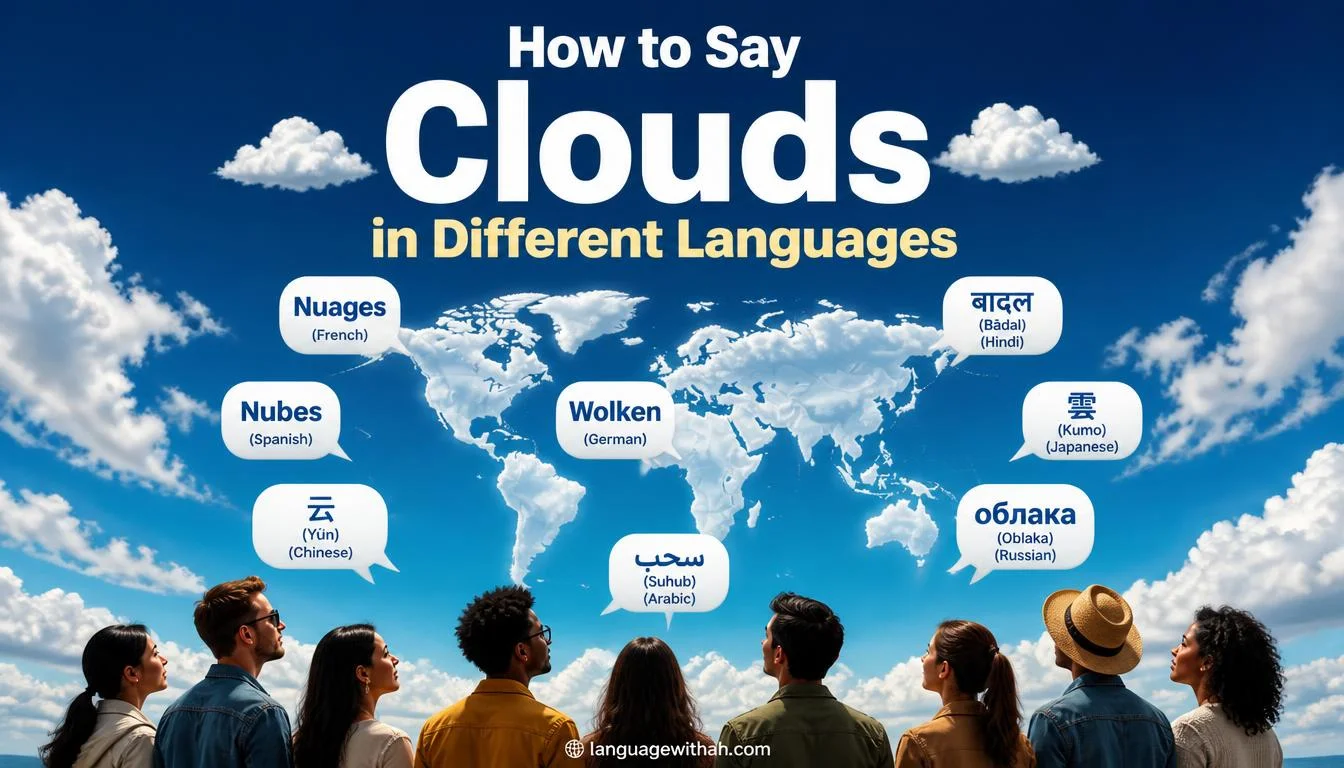
The word clouds describes the visible masses of water droplets or ice crystals floating in the sky. Although the basic meaning is simple, Clouds in 70 Different Languages reveals interesting differences in vocabulary, grammar, pronunciation, and even the way languages describe nature.
Learning this word can be useful for travelers, students, writers, photographers, weather enthusiasts, and anyone who enjoys building everyday vocabulary in another language. In some languages, the plural form is created by changing the word itself, while others use a grammatical plural ending or rely on context.
The word can also have related meanings, such as cloud cover, storm clouds, or figurative expressions about sadness and uncertainty. Regional usage may vary, too. A language spoken across several countries can have different everyday terms or pronunciations depending on location.
Interesting Facts About Clouds
- Cloud and clouds are not always formed by simply adding a plural ending. Languages use different grammatical systems to express number.
- In several languages, the same basic word can refer to both a cloud and the general idea of clouds, with context determining whether the meaning is singular or plural.
- Some languages distinguish grammatical forms that English does not, including gender, case, or definiteness.
- Weather vocabulary often has regional variations, particularly in languages spoken across multiple countries.
- In many cultures, clouds appear frequently in poetry, songs, literature, and everyday metaphors, where they can symbolize change, dreams, uncertainty, or sadness.
- Languages that use different writing systems may have completely different visual forms for the same natural object, while their pronunciation can sometimes be quite similar to related languages.
- The English word cloud also has modern technological meanings, such as cloud computing. In most everyday weather contexts, however, its meaning is clearly determined by the sky and weather.
What Does Clouds Mean?
Clouds are visible collections of tiny water droplets, ice crystals, or a mixture of both suspended in the atmosphere. They form when moist air rises, cools, and reaches conditions where water vapor condenses or freezes.
In everyday English, clouds normally refers to more than one cloud or to clouds generally:
- “Dark clouds are moving across the sky.”
- “The clouds disappeared after the rain.”
- “There are white clouds above the mountains.”
The word can also be used figuratively. For example, someone may describe a difficult situation as being “under a cloud,” although this is different from the literal weather meaning.
Why Can Clouds Have Different Translations?
There is not always a perfect one-to-one relationship between English and another language. The English plural clouds may correspond to a plural noun, a noun whose number is determined by context, or a different grammatical construction.
The best translation can depend on:
- Context — ordinary weather, poetry, science, or technology may require different wording.
- Grammar — some languages mark plural nouns differently from English.
- Formality — scientific and everyday weather vocabulary may differ.
- Region — speakers in different countries may use slightly different forms.
- Writing system — Chinese, Japanese, Korean, Arabic, Greek, Hebrew, and other languages use scripts other than the Latin alphabet.
- Literal versus natural translation — a dictionary equivalent may not always be the form a speaker would naturally choose in a sentence.
The translations below focus on the ordinary weather meaning of “clouds.”
European Languages
Europe contains several major language families, including Germanic, Romance, Slavic, Celtic, Baltic, Uralic, and Hellenic languages. As a result, the word for clouds can look and sound very different from one language to another. The tables below use everyday forms wherever possible.
English Varieties
American, British, and Australian English all use clouds for the ordinary plural weather meaning. There is no separate translation simply because the variety is different.
| 🌍 Language | Country/Region | Translation | Pronunciation | Example Sentence |
| American English 🇺🇸 | United States | clouds | KLOWDZ | The clouds are moving quickly. — The clouds are moving quickly. |
| British English 🇬🇧 | United Kingdom | clouds | KLOWDZ | Dark clouds covered the sky. — Dark clouds covered the sky. |
| Australian English 🇦🇺 | Australia | clouds | KLOWDZ | There are clouds over the coast. — There are clouds over the coast. |
Note: The spelling and basic pronunciation of clouds are the same in these three major English varieties, although individual accents naturally differ.
Western and Northern European Languages
| 🌍 Language | Country/Region | Translation | Pronunciation | Example Sentence |
| Spanish 🇪🇸 | Spain, Latin America | nubes | NOO-bes | Las nubes cubren el cielo. — The clouds cover the sky. |
| French 🇫🇷 | France, Belgium, Canada, other Francophone regions | nuages | nwee-AHZH | Les nuages couvrent le ciel. — The clouds cover the sky. |
| German 🇩🇪 | Germany, Austria, Switzerland | Wolken | VOL-ken | Die Wolken sind dunkel. — The clouds are dark. |
| Italian 🇮🇹 | Italy, Switzerland | nuvole | NOO-vo-leh | Le nuvole sono bianche. — The clouds are white. |
| Portuguese 🇵🇹 | Portugal, Brazil, other Lusophone regions | nuvens | NOO-vens | As nuvens cobrem o céu. — The clouds cover the sky. |
| Dutch 🇳🇱 | Netherlands, Belgium, Suriname | wolken | VOL-ken | De wolken worden donker. — The clouds are becoming dark. |
| Swedish 🇸🇪 | Sweden, Finland | moln | MOOLN | Molnen täcker himlen. — The clouds cover the sky. |
| Norwegian 🇳🇴 | Norway | skyer | SHOO-er | Skyene dekker himmelen. — The clouds cover the sky. |
| Danish 🇩🇰 | Denmark | skyer | SKOO-er | Skyerne dækker himlen. — The clouds cover the sky. |
| Finnish 🇫🇮 | Finland | pilvet | PEEL-vet | Pilvet peittävät taivaan. — The clouds cover the sky. |
| Icelandic 🇮🇸 | Iceland | ský | SKEE | Skýin eru dökk. — The clouds are dark. |
| Irish 🇮🇪 | Ireland | scamaill | SKAM-il | Tá na scamaill dorcha. — The clouds are dark. |
| Welsh 🏴 | Wales | cymylau | kuh-MUH-lie | Mae’r cymylau’n dywyll. — The clouds are dark. |
Central, Eastern, and Southern European Languages
| 🌍 Language | Country/Region | Translation | Pronunciation | Example Sentence |
| Polish 🇵🇱 | Poland | chmury | HMOO-rih | Chmury zasłaniają niebo. — The clouds cover the sky. |
| Czech 🇨🇿 | Czech Republic | mraky | MRAH-kee | Mraky zakrywají oblohu. — The clouds cover the sky. |
| Slovak 🇸🇰 | Slovakia | oblaky | OH-bla-kee | Oblaky zakrývajú oblohu. — The clouds cover the sky. |
| Ukrainian 🇺🇦 | Ukraine | хмари | KHMAR-y | Хмари закривають небо. — The clouds cover the sky. |
| Russian 🇷🇺 | Russia and other Russian-speaking regions | облака | ah-bla-KA | Облака закрывают небо. — The clouds cover the sky. |
| Romanian 🇷🇴 | Romania, Moldova | nori | NOR-ee | Norii acoperă cerul. — The clouds cover the sky. |
| Hungarian 🇭🇺 | Hungary | felhők | FEL-hurk | A felhők sötétek. — The clouds are dark. |
| Greek 🇬🇷 | Greece, Cyprus | σύννεφα | SEE-ne-fa | Τα σύννεφα καλύπτουν τον ουρανό. — The clouds cover the sky. |
| Bulgarian 🇧🇬 | Bulgaria | облаци | oh-BLAH-tsee | Облаците покриват небето. — The clouds cover the sky. |
| Croatian 🇭🇷 | Croatia | oblaci | oh-BLAHT-see | Oblaci prekrivaju nebo. — The clouds cover the sky. |
| Serbian 🇷🇸 | Serbia and neighboring Serbian-speaking areas | облаци / oblaci | OH-bla-tsee | Облаци прекривају небо. — The clouds cover the sky. |
| Slovenian 🇸🇮 | Slovenia | oblaki | oh-BLAH-kee | Oblaki pokrivajo nebo. — The clouds cover the sky. |
| Lithuanian 🇱🇹 | Lithuania | debesys | deh-BEH-sis | Debesys dengia dangų. — The clouds cover the sky. |
| Latvian 🇱🇻 | Latvia | mākoņi | MAH-koh-ny | Mākoņi klāj debesis. — The clouds cover the sky. |
| Estonian 🇪🇪 | Estonia | pilved | PEEL-ved | Pilved katavad taeva. — The clouds cover the sky. |
Regional note: Serbian can be written in both Cyrillic and Latin scripts, so облаци and oblaci represent the same word. Likewise, several Slavic languages have closely related forms, but their grammar and pronunciation are not identical.
Read More: How to Say Clean in Different Languages
Asian Languages
Asia contains an enormous range of languages and writing systems. The word for clouds may be written with Chinese characters, Japanese kanji, Korean Hangul, Indic scripts, Arabic-derived scripts, or Latin alphabets. Pronunciation guides below are simplified for English-speaking readers rather than substitutes for full phonetic transcription.
| 🌍 Language | Country/Region | Translation | Pronunciation | Example Sentence |
| Mandarin Chinese 🇨🇳 | China, Taiwan, Singapore | 云 / 雲 | yún | 天空中有很多云。 — There are many clouds in the sky. |
| Cantonese 🇭🇰 | Hong Kong, Guangdong | 雲 | wan4 | 天空有好多雲。 — There are many clouds in the sky. |
| Japanese 🇯🇵 | Japan | 雲 (くも) | KOO-mo | 空に雲が浮かんでいます。 — Clouds are floating in the sky. |
| Korean 🇰🇷 | South Korea, North Korea | 구름 | goo-reum | 하늘에 구름이 많아요. — There are many clouds in the sky. |
| Hindi 🇮🇳 | India | बादल | BAA-dal | आसमान में बादल हैं। — There are clouds in the sky. |
| Urdu 🇵🇰 | Pakistan, India | بادل | BAA-dal | آسمان پر بادل ہیں۔ — There are clouds in the sky. |
| Bengali 🇧🇩 | Bangladesh, India | মেঘ | megh | আকাশে মেঘ আছে। — There are clouds in the sky. |
| Punjabi 🇮🇳🇵🇰 | India, Pakistan | ਬੱਦਲ / بادل | BADD-al | ਅਸਮਾਨ ਵਿੱਚ ਬੱਦਲ ਹਨ۔ — There are clouds in the sky. |
| Gujarati 🇮🇳 | India | વાદળો | VAA-dah-lo | આકાશમાં વાદળો છે. — There are clouds in the sky. |
| Marathi 🇮🇳 | India | ढग | DHUG | आकाशात ढग आहेत. — There are clouds in the sky. |
| Tamil 🇮🇳🇱🇰 | India, Sri Lanka | மேகங்கள் | MAY-gang-gal | வானில் மேகங்கள் உள்ளன. — There are clouds in the sky. |
| Telugu 🇮🇳 | India | మేఘాలు | MAY-ghaa-loo | ఆకాశంలో మేఘాలు ఉన్నాయి. — There are clouds in the sky. |
| Kannada 🇮🇳 | India | ಮೋಡಗಳು | MO-da-ga-lu | ಆಕಾಶದಲ್ಲಿ ಮೋಡಗಳಿವೆ. — There are clouds in the sky. |
| Malayalam 🇮🇳 | India | മേഘങ്ങൾ | MEH-ghang-gal | ആകാശത്ത് മേഘങ്ങളുണ്ട്. — There are clouds in the sky. |
| Nepali 🇳🇵 | Nepal | बादलहरू | BAA-dal-ha-roo | आकाशमा बादलहरू छन्। — There are clouds in the sky. |
| Sinhala 🇱🇰 | Sri Lanka | වලාකුළු | wa-la-KOO-loo | අහසේ වලාකුළු තියෙනවා. — There are clouds in the sky. |
| Thai 🇹🇭 | Thailand | เมฆ | MÊEK | บนท้องฟ้ามีเมฆ — There are clouds in the sky. |
| Vietnamese 🇻🇳 | Vietnam | những đám mây | nyoong dahm may | Trên trời có những đám mây. — There are clouds in the sky. |
| Indonesian 🇮🇩 | Indonesia | awan | AH-wan | Ada banyak awan di langit. — There are many clouds in the sky. |
| Malay 🇲🇾🇧🇳 | Malaysia, Brunei, Singapore | awan | AH-wan | Ada banyak awan di langit. — There are many clouds in the sky. |
| Filipino/Tagalog 🇵🇭 | Philippines | mga ulap | muh-ngah OO-lap | May mga ulap sa langit. — There are clouds in the sky. |
| Burmese 🇲🇲 | Myanmar | တိမ်များ | TEIN-myar | ကောင်းကင်မှာ တိမ်တွေရှိတယ်။ — There are clouds in the sky. |
| Khmer 🇰🇭 | Cambodia | ពពក | po-POK | មានពពកនៅលើមេឃ។ — There are clouds in the sky. |
| Lao 🇱🇦 | Laos | ເມກ | MEK | ມີເມກຢູ່ເທິງຟ້າ. — There are clouds in the sky. |
| Mongolian 🇲🇳 | Mongolia | үүлс | OOL-s | Тэнгэрт үүлс байна. — There are clouds in the sky. |
| Kazakh 🇰🇿 | Kazakhstan | бұлттар | bool-TAR | Аспанда бұлттар бар. — There are clouds in the sky. |
| Uzbek 🇺🇿 | Uzbekistan | bulutlar | boo-LOOT-lar | Osmonda bulutlar bor. — There are clouds in the sky. |
| Turkish 🇹🇷 | Turkey | bulutlar | boo-LOOT-lar | Gökyüzünde bulutlar var. — There are clouds in the sky. |
| Persian 🇮🇷 | Iran, Afghanistan, Tajikistan | ابرها | abr-HAA | ابرها آسمان را پوشاندهاند. — The clouds have covered the sky. |
Pronunciation note: Romanization systems differ. For example, Mandarin yún is written with a tone mark in Pinyin. The tone is meaningful in Mandarin, so the simplified pronunciation guide should not be treated as a complete replacement for learning the original pronunciation.
Hindi and Urdu note: Hindi बादल (bādal) and Urdu بادل (bādal) are closely related everyday words. Their scripts differ, but the pronunciation and basic meaning are very similar in this context.
African Languages
Africa is home to thousands of languages and numerous language families. Weather vocabulary can therefore vary dramatically even between neighboring communities. The examples below represent widely spoken languages and provide a practical starting point for learners.
| 🌍 Language | Country/Region | Translation | Pronunciation | Example Sentence |
| Swahili 🇰🇪🇹🇿 | Kenya, Tanzania, East Africa | mawingu | mah-WEEN-goo | Mawingu yamefunika anga. — The clouds have covered the sky. |
| Afrikaans 🇿🇦 | South Africa, Namibia | wolke | VOL-kuh | Die wolke bedek die lug. — The clouds cover the sky. |
| Zulu 🇿🇦 | South Africa | amafu | ah-MAH-foo | Amafu agubungele isibhakabhaka. — The clouds cover the sky. |
| Xhosa 🇿🇦 | South Africa | amafu | ah-MAH-foo | Amafu agubungele isibhakabhaka. — The clouds cover the sky. |
| Amharic 🇪🇹 | Ethiopia | ደመናዎች | de-me-na-WOCH | ደመናዎች ሰማዩን ሸፍነዋል። — The clouds have covered the sky. |
| Yoruba 🇳🇬 | Nigeria, Benin | awọsanma | ah-WAW-shahn-mah | Awọsanma bo ọrun. — The clouds cover the sky. |
| Igbo 🇳🇬 | Nigeria | igwe ojii | ee-gweh oh-JEE | Igwe ojii kpuchiri elu. — The clouds cover the sky. |
| Hausa 🇳🇬🇳🇪 | Nigeria, Niger, West Africa | gajimare | gah-jee-MAH-reh | Gajimare ya rufe sararin sama. — The clouds have covered the sky. |
| Somali 🇸🇴 | Somalia, Horn of Africa | daruuro | dah-ROO-roh | Daruuro ayaa cirka daboolay. — The clouds covered the sky. |
| Shona 🇿🇼 | Zimbabwe | makore | mah-KOH-reh | Makore akafukidza denga. — The clouds covered the sky. |
| Sesotho 🇱🇸🇿🇦 | Lesotho, South Africa | maru | MAH-roo | Maru a koahetse leholimo. — The clouds cover the sky. |
| Setswana 🇧🇼🇿🇦 | Botswana, South Africa | maru | MAH-roo | Maru a apesitse loapi. — The clouds cover the sky. |
| Kinyarwanda 🇷🇼 | Rwanda | ibicu | ee-BEE-choo | Ibicu bitwikiriye ikirere. — The clouds cover the sky. |
| Malagasy 🇲🇬 | Madagascar | rahona | rah-HOO-nah | Ny rahona mandrakotra ny lanitra. — The clouds cover the sky. |
Cultural note: Africa should not be treated as a single linguistic region. Even where languages are geographically close, their vocabulary can belong to completely different language families. A translation that works in Swahili, for example, should not automatically be assumed to work in neighboring languages.
Middle Eastern Languages
The Middle East includes Arabic, Persian, Hebrew, Kurdish, Turkish, Armenian, and many other linguistic traditions. Arabic in particular has substantial dialectal variation, so Modern Standard Arabic and everyday regional Arabic should not automatically be treated as identical.
| 🌍 Language | Country/Region | Translation | Pronunciation | Example Sentence |
| Modern Standard Arabic 🇸🇦 | Arab world | السحب | as-SUHUB | السحب تغطي السماء. — The clouds cover the sky. |
| Egyptian Arabic 🇪🇬 | Egypt | السحب / السحاب | es-SOHOB / es-SA-HAB | السحب مغطية السما. — The clouds are covering the sky. |
| Hebrew 🇮🇱 | Israel | עננים | a-na-NEEM | העננים מכסים את השמיים. — The clouds cover the sky. |
| Kurdish (Kurmanji) 🟨 | Türkiye, Syria, Iraq, Iran | ewr | EWR | Ewr li ezmanê ne. — There are clouds in the sky. |
| Persian 🇮🇷 | Iran, Afghanistan, Tajikistan | ابرها | abr-HAA | ابرها آسمان را پوشاندهاند. — The clouds have covered the sky. |
| Turkish 🇹🇷 | Turkey and Cyprus | bulutlar | boo-LOOT-lar | Bulutlar gökyüzünü kaplıyor. — The clouds are covering the sky. |
| Armenian 🇦🇲 | Armenia and Armenian-speaking communities | ամպեր | am-PER | Ամպերը ծածկել են երկինքը։ — The clouds have covered the sky. |
Arabic note: Modern Standard Arabic commonly uses السحب (as-suḥub) for clouds. Everyday dialects may use related forms such as السحاب (as-saḥāb). The appropriate choice depends on the country and situation.
Other World Languages
Some languages do not fit neatly into the European, Asian, African, or Middle Eastern groupings. These examples broaden the list while showing how different writing systems and grammatical traditions express the same natural concept.
| 🌍 Language | Country/Region | Translation | Pronunciation | Example Sentence |
| Māori 🇳🇿 | New Zealand | kapua | kah-POO-ah | Kei te kapi te rangi i ngā kapua. — The sky is covered with clouds. |
| Samoan 🇼🇸 | Samoa | ao | AH-oh | Ua ufitia le lagi i ao. — The sky is covered with clouds. |
| Tongan 🇹🇴 | Tonga | ʻao | AH-oh | ʻOku ʻi ai ʻa e ʻao ʻi he langí. — There are clouds in the sky. |
| Hawaiian 🇺🇸 | Hawaiʻi | ao | AH-oh | Aia nā ao i ka lani. — The clouds are in the sky. |
| Quechua 🇵🇪🇧🇴 | Andes | phuyu | PHOO-yoo | Phuyukunaqa hanaqpachapi kachkan. — The clouds are in the sky. |
| Guarani 🇵🇾 | Paraguay and surrounding regions | arai | ah-RAH-ee | Araikuéra oĩ yvágape. — The clouds are in the sky. |
| Haitian Creole 🇭🇹 | Haiti | nyaj | NYAHZH | Gen nyaj nan syèl la. — There are clouds in the sky. |
| Esperanto 🌍 | International | nuboj | NOO-boy | La nuboj kovras la ĉielon. — The clouds cover the sky. |
How Many Languages Are Included?
This guide contains more than 70 language and regional varieties, including major European, Asian, African, Middle Eastern, and other world languages. Some entries represent regional varieties of a broader language rather than separate languages.
This distinction matters. For example, American English, British English, and Australian English are varieties of English, while Egyptian Arabic is a regional variety of Arabic. They are included separately only where regional usage provides useful information.
Quick Reference: Clouds in Different Languages
| Language | Translation |
| American English | clouds |
| British English | clouds |
| Australian English | clouds |
| Spanish | nubes |
| French | nuages |
| German | Wolken |
| Italian | nuvole |
| Portuguese | nuvens |
| Dutch | wolken |
| Swedish | moln |
| Norwegian | skyer |
| Danish | skyer |
| Finnish | pilvet |
| Icelandic | ský |
| Irish | scamaill |
| Welsh | cymylau |
| Polish | chmury |
| Czech | mraky |
| Slovak | oblaky |
| Ukrainian | хмари |
| Russian | облака |
| Romanian | nori |
| Hungarian | felhők |
| Greek | σύννεφα |
| Bulgarian | облаци |
| Croatian | oblaci |
| Serbian | облаци / oblaci |
| Slovenian | oblaki |
| Lithuanian | debesys |
| Latvian | mākoņi |
| Estonian | pilved |
| Mandarin Chinese | 云 / 雲 |
| Cantonese | 雲 |
| Japanese | 雲 |
| Korean | 구름 |
| Hindi | बादल |
| Urdu | بادل |
| Bengali | মেঘ |
| Punjabi | ਬੱਦਲ / بادل |
| Gujarati | વાદળો |
| Marathi | ढग |
| Tamil | மேகங்கள் |
| Telugu | మేఘాలు |
| Kannada | ಮೋಡಗಳು |
| Malayalam | മേഘങ്ങൾ |
| Nepali | बादलहरू |
| Sinhala | වලාකුළු |
| Thai | เมฆ |
| Vietnamese | những đám mây |
| Indonesian | awan |
| Malay | awan |
| Filipino/Tagalog | mga ulap |
| Burmese | တိမ်များ |
| Khmer | ពពក |
| Lao | ເມກ |
| Mongolian | үүлс |
| Kazakh | бұлттар |
| Uzbek | bulutlar |
| Turkish | bulutlar |
| Persian | ابرها |
| Swahili | mawingu |
| Afrikaans | wolke |
| Zulu | amafu |
| Xhosa | amafu |
| Amharic | ደመናዎች |
| Yoruba | awọsanma |
| Igbo | igwe ojii |
| Hausa | gajimare |
| Somali | daruuro |
| Shona | makore |
| Sesotho | maru |
| Setswana | maru |
| Kinyarwanda | ibicu |
| Malagasy | rahona |
| Arabic | السحب |
| Hebrew | עננים |
| Kurdish (Kurmanji) | ewr |
| Armenian | ամպեր |
| Māori | kapua |
| Samoan | ao |
| Tongan | ʻao |
| Hawaiian | ao |
| Quechua | phuyu |
| Guarani | arai |
| Haitian Creole | nyaj |
| Esperanto | nuboj |
How to Choose the Right Translation
The best translation of clouds depends mainly on the sentence in which you want to use it.
For ordinary conversation, use the common everyday word rather than a highly technical meteorological term. If you are writing a poem, travel caption, greeting, or personal message, a more descriptive expression may sound more natural.
Pay attention to regional usage when speaking with someone from a particular country. This is especially important with languages such as Arabic, Spanish, Portuguese, Chinese, and English, which have speakers across many regions.
For formal or scientific writing, check whether the language distinguishes between ordinary clouds and specific meteorological categories. For casual conversation, however, the everyday noun is usually sufficient.
If you are sending a message to someone who speaks another language, also consider formality and relationship. A simple weather sentence is generally safe, but poetic or figurative uses may require a different expression.
Common Mistakes When Translating Clouds
Several mistakes can make a translation of clouds sound unnatural:
- Translating word by word: English plural grammar does not work identically in every language.
- Ignoring context: A weather cloud and a computing “cloud” are not necessarily translated with the same terminology.
- Confusing singular and plural: Some languages change the noun substantially when expressing plural.
- Ignoring regional differences: A common term in one country may sound unusual elsewhere.
- Using an incorrect pronunciation: Native scripts do not always have pronunciation patterns that can be guessed from English.
- Mixing dialects: A regional Arabic expression, for example, should not automatically be labeled Modern Standard Arabic.
- Assuming related languages are interchangeable: Similar-looking Slavic or Romance words can still have different grammatical forms.
- Using a literal sentence: A grammatically possible translation may still sound unnatural to a native speaker.
Tip: When learning the word, learn it together with a short sentence. This makes it easier to remember how the noun behaves grammatically.
Why Learn Clouds in Different Languages?
Learning clouds in different languages is a small but useful way to expand everyday vocabulary. Weather is a common conversation topic, so words related to the sky can be useful when traveling, studying, meeting international friends, or describing a place.
It can also teach you more than a single vocabulary item. You may notice how languages form plural nouns, how they use different writing systems, and how sentence structure changes from one language to another.
For language learners, comparing words such as Spanish nubes, French nuages, German Wolken, and Italian nuvole can make vocabulary study more memorable. Learning the accompanying sentence also gives you a practical example instead of an isolated dictionary entry.
Most importantly, exploring everyday words encourages curiosity about other languages and cultures. Even a simple word such as clouds can reveal differences in grammar, pronunciation, writing, and expression.
FAQs:
How do you say clouds in different languages?
The word clouds has different forms in different languages. For example, it is nubes in Spanish, nuages in French, Wolken in German, 雲 in Japanese, 구름 in Korean, mawingu in Swahili, and облака in Russian.
What is the most natural translation of clouds?
There is no single universal translation. The natural form depends on the language and context. For ordinary weather descriptions, the everyday noun used by native speakers is generally the best choice.
Can the translation of clouds change by country?
Yes. A language spoken in several countries can have regional vocabulary differences. Arabic provides a particularly clear example because Modern Standard Arabic and regional varieties can use different everyday forms.
Why do some languages have different forms for cloud and clouds?
Languages have different grammatical systems. English usually forms the plural by changing cloud to clouds, while other languages may use a different ending, change the noun, or rely on grammatical context.
Does pronunciation change between regions?
It can. Even when the written word remains the same, accents and regional pronunciation can vary. English is an obvious example, with differences among American, British, and Australian pronunciation.
Conclusion:
Learning how to say clouds in different languages is a simple way to discover how differently languages organize familiar ideas. A word that seems straightforward in English can have different grammatical forms, scripts, pronunciations, and regional variations elsewhere. Spanish nubes, French nuages, German Wolken, Japanese 雲, Swahili mawingu, and Arabic السحب all express the same basic weather concept while belonging to very different linguistic systems.














1 thought on “How to Say Clouds in Different Languages”