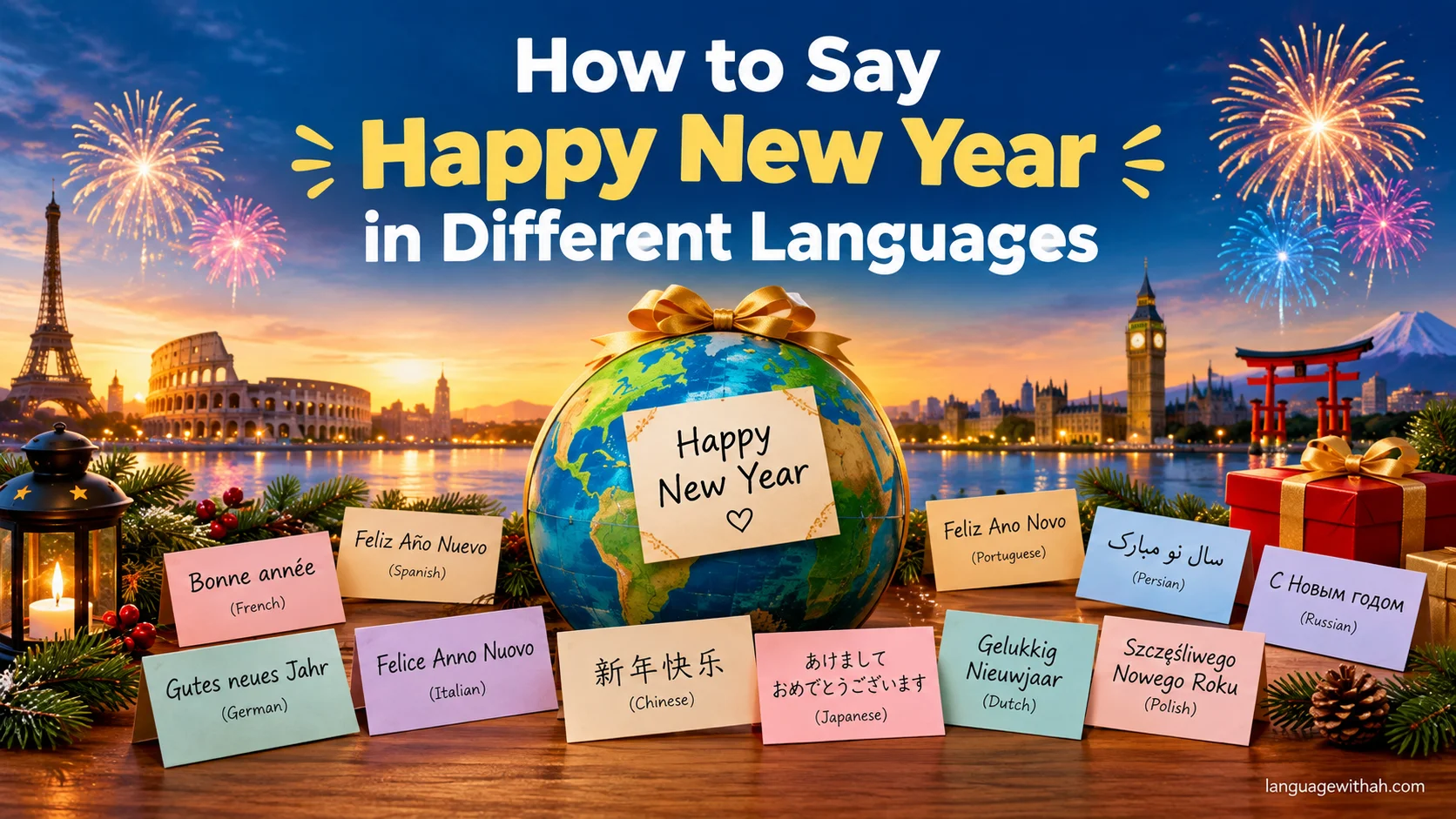
Happy New Year is a warm expression used to share good wishes, happiness, and hope at the beginning of a new calendar year. Learning to say Happy New Year in 70 different languages can make a greeting feel more personal, especially when speaking with friends, family members, travelers, classmates, or colleagues from different cultural backgrounds.
Although the basic idea is similar worldwide, languages do not always express New Year wishes in exactly the same way. Some use a direct equivalent of “Happy New Year,” while others have a phrase closer to “A happy new year to you” or use a traditional expression associated with the celebration. Formality, grammar, region, and everyday usage can also affect the wording.
This guide brings together translations from European, Asian, African, Middle Eastern, Pacific, and American languages. Each entry includes the language, representative region, natural translation, an easy pronunciation guide, and a practical example. Where an important regional or grammatical difference exists, it is explained rather than hidden.
Interesting Facts About Happy New Year
- “Happy New Year” is a greeting and a good wish, rather than simply the name of the holiday. It expresses hope that the coming year will be positive or joyful.
- Different languages may use a literal equivalent of “happy,” while others use words associated with goodness, prosperity, blessings, peace, or a successful year.
- New Year traditions differ greatly between cultures. The date, food, family customs, religious practices, and public celebrations are not identical everywhere.
- Some languages use different grammatical forms depending on the person being addressed, while others use the same greeting for friends, relatives, and strangers.
- A language may have several natural ways to greet someone at New Year. A formal written greeting can sound different from a short phrase used in a text message.
- Writing systems vary widely. The same basic New Year wish can appear in Latin, Cyrillic, Arabic, Greek, Hebrew, Devanagari, Chinese characters, Japanese kana, Korean Hangul, and many other scripts.
- Regional differences can matter. For example, Arabic has different everyday dialects across countries, while Chinese has different varieties such as Mandarin and Cantonese with their own spoken forms.
What Does Happy New Year Mean?
Happy New Year is a traditional greeting used around the beginning of a new year. Its basic meaning is a wish that someone will have a happy, successful, peaceful, or pleasant year ahead.
The expression can be used in many situations. You might say it to a family member at midnight, write it in a greeting card, send it in a message, or use it when meeting someone during the first days of the year.
The emotional meaning can go beyond the two words themselves. A New Year greeting can communicate friendship, affection, respect, celebration, and hope. In some languages, the most natural expression emphasizes happiness; in others, people commonly add wishes for health, prosperity, peace, or good fortune.
The English phrase is therefore best understood as a cultural greeting, not merely as two separate words that must always be translated literally.
Why Can Happy New Year Have Different Translations?
There is no single translation method that works perfectly for every language. Context and natural usage are important.
A literal translation of “happy” and “new year” may produce a grammatically possible phrase that native speakers would not normally use. Translators therefore consider how people actually express New Year wishes in ordinary communication.
Several factors can affect the wording:
- Context: A greeting card may use a longer expression than a casual text message.
- Formality: Some languages distinguish formal and informal ways of addressing people.
- Region: A language spoken in several countries may have different customary expressions.
- Grammar: Adjectives, nouns, gender, number, and word order can change the form.
- Relationship: A message to a close friend may be shorter or warmer than a business greeting.
- Culture: Some New Year expressions traditionally include wishes for health, prosperity, peace, or blessings.
- Written vs spoken language: The spelling may stay the same while pronunciation or everyday phrasing differs.
- Literal vs natural translation: The most accurate translation is often the expression that communicates the same idea naturally, rather than the one that copies every English word.
European Languages
Europe contains several major language families, including Germanic, Romance, Slavic, Celtic, Baltic, Uralic, and Hellenic languages. As a result, New Year greetings can look and sound very different even between neighboring countries. The entries below use common forms appropriate for ordinary New Year greetings.
| 🌍 Language | Country/Region | Translation | Pronunciation | Example Sentence |
| English | International | Happy New Year! | HAP-ee nyoo YEER | Happy New Year! I hope you have a wonderful year. |
| American English 🇺🇸 | United States | Happy New Year! | HAP-ee nyoo YEER | Happy New Year! Have a great year ahead. |
| British English 🇬🇧 | United Kingdom | Happy New Year! | HAP-ee nyoo YEER | Happy New Year! I hope the new year treats you well. |
| Australian English 🇦🇺 | Australia | Happy New Year! | HAP-ee nyoo YEER | Happy New Year! Have a brilliant year ahead. |
| Spanish | Spain, Latin America | ¡Feliz Año Nuevo! | feh-LEES AH-nyoh NWEH-boh | ¡Feliz Año Nuevo! Que tengas un año maravilloso. — Happy New Year! May you have a wonderful year. |
| French | France and Francophone regions | Bonne année ! | bun ah-NAY | Bonne année ! Je te souhaite beaucoup de bonheur. — Happy New Year! I wish you lots of happiness. |
| German | Germany, Austria, Switzerland | Frohes neues Jahr! | FROH-es NOY-es YAHR | Frohes neues Jahr! Ich wünsche dir alles Gute. — Happy New Year! I wish you all the best. |
| Italian | Italy | Buon anno! | bwohn AHN-noh | Buon anno! Ti auguro tanta felicità. — Happy New Year! I wish you much happiness. |
| Portuguese | Portugal, Brazil, Lusophone regions | Feliz Ano Novo! | feh-LEEZ AH-noh NOH-voh | Feliz Ano Novo! Desejo-lhe muita felicidade. — Happy New Year! I wish you much happiness. |
| Dutch | Netherlands, Belgium | Gelukkig nieuwjaar! | guh-LOO-kuh NEE-oo-yahr | Gelukkig nieuwjaar! Ik wens je een prachtig jaar. — Happy New Year! I wish you a wonderful year. |
| Swedish | Sweden, Finland | Gott nytt år! | got nyt ohr | Gott nytt år! Jag önskar dig ett fint år. — Happy New Year! I wish you a lovely year. |
| Norwegian | Norway | Godt nytt år! | goot nyt ohr | Godt nytt år! Jeg ønsker deg et godt år. — Happy New Year! I wish you a good year. |
| Danish | Denmark | Godt nytår! | goht NÜT-or | Godt nytår! Jeg ønsker dig et godt år. — Happy New Year! I wish you a good year. |
| Finnish | Finland | Hyvää uutta vuotta! | HÜ-vah OO-tah VOO-tah | Hyvää uutta vuotta! Toivotan sinulle kaikkea hyvää. — Happy New Year! I wish you all the best. |
| Icelandic | Iceland | Gleðilegt nýtt ár! | GLEH-theh-lekt neet ow | Gleðilegt nýtt ár! — Happy New Year! |
| Irish | Ireland | Athbhliain faoi mhaise duit! | AH-vleen fwee VAW-shuh dit | Athbhliain faoi mhaise duit! — Happy New Year to you! |
| Welsh | Wales | Blwyddyn Newydd Dda! | BLUHD-win NEH-with THA | Blwyddyn Newydd Dda! — Happy New Year! |
| Polish | Poland | Szczęśliwego Nowego Roku! | shchen-SHLEE-veh-goh noh-VEH-goh ROH-koo | Szczęśliwego Nowego Roku! Życzę ci wszystkiego dobrego. — Happy New Year! I wish you all the best. |
| Czech | Czech Republic | Šťastný nový rok! | SHTYAST-nee NOH-vee rok | Šťastný nový rok! — Happy New Year! |
| Slovak | Slovakia | Šťastný nový rok! | SHTYAST-nee NOH-vee rok | Šťastný nový rok! Prajem ti veľa šťastia. — Happy New Year! I wish you lots of happiness. |
| Ukrainian | Ukraine | Щасливого Нового року! | shchas-LY-vo-ho NO-vo-ho RO-koo | Щасливого Нового року! Бажаю щастя і здоров’я. — Happy New Year! I wish you happiness and health. |
| Russian | Russia and Russian-speaking regions | С Новым годом! | s NO-vym GO-dom | С Новым годом! Желаю счастья и здоровья. — Happy New Year! I wish you happiness and health. |
| Romanian | Romania, Moldova | La mulți ani! | la mulTSY ahn | La mulți ani! Să ai un an minunat. — Happy New Year! Have a wonderful year. |
| Hungarian | Hungary | Boldog új évet! | BOL-dog ooy AY-vet | Boldog új évet! Sok boldogságot kívánok. — Happy New Year! I wish you lots of happiness. |
| Greek | Greece, Cyprus | Καλή Χρονιά! | ka-LEE hro-NYA | Καλή Χρονιά! Σου εύχομαι υγεία και χαρά. — Happy New Year! I wish you health and joy. |
| Bulgarian | Bulgaria | Честита Нова година! | cheh-TEE-ta NO-va go-DEE-na | Честита Нова година! Пожелавам ти щастие. — Happy New Year! I wish you happiness. |
| Croatian | Croatia and Croatian-speaking communities | Sretna Nova godina! | SRET-na NO-va go-DEE-na | Sretna Nova godina! Želim ti puno sreće. — Happy New Year! I wish you lots of happiness. |
| Serbian | Serbia and Serbian-speaking communities | Срећна Нова година! | SRECH-na NO-va go-DEE-na | Срећна Нова година! Желим ти много среће. — Happy New Year! I wish you lots of happiness. |
| Slovenian | Slovenia | Srečno novo leto! | SRETCH-no NO-vo LEH-to | Srečno novo leto! Želim ti veliko sreče. — Happy New Year! I wish you lots of happiness. |
| Lithuanian | Lithuania | Laimingų Naujųjų metų! | lai-MING-oo now-YOO-yoo MEH-too | Laimingų Naujųjų metų! Linkiu daug laimės. — Happy New Year! I wish you lots of happiness. |
| Latvian | Latvia | Laimīgu Jauno gadu! | LAI-mee-goo YOW-no GA-doo | Laimīgu Jauno gadu! Novēlu tev laimi. — Happy New Year! I wish you happiness. |
| Estonian | Estonia | Head uut aastat! | head oot AH-stat | Head uut aastat! Soovin sulle õnne. — Happy New Year! I wish you happiness. |
English Varieties
American, British, and Australian English all commonly use “Happy New Year!”. The wording itself does not need to change simply because the speaker is from a different English-speaking country.
What can vary is accent, pronunciation, punctuation, surrounding wording, and conversational style. For example, “Have a great New Year” or “Wishing you a happy New Year” can appear in messages in all three varieties. It would be misleading to invent three different translations when the standard greeting is the same.
European Cultural Notes
In several European languages, the New Year greeting uses a structure that is not identical to English. Romanian La mulți ani!, for example, literally conveys a wish for “many years” and is also used on other celebratory occasions. Russian С Новым годом! uses a grammatical construction meaning roughly “With the New Year!”
These differences illustrate why a natural translation is more useful than mechanically replacing each English word.
Read More: How to Say Have a Good Day in Different Languages
Asian Languages
Asia includes an exceptionally broad range of language families, scripts, and cultural traditions. New Year greetings may be connected with the Gregorian New Year, local calendars, or particular cultural celebrations. The expressions below refer to the general idea of wishing someone a happy New Year.
| 🌏 Language | Country/Region | Translation | Pronunciation | Example Sentence |
| Mandarin Chinese | China, Taiwan, Singapore | 新年快乐! | Xīnnián kuàilè | 新年快乐! 祝你新的一年幸福快乐。 — Happy New Year! I wish you happiness in the new year. |
| Cantonese | Hong Kong, Macau, Guangdong | 新年快樂! | san-nin faai-lok | 新年快樂! 祝你新一年開開心心。 — Happy New Year! I wish you happiness in the new year. |
| Japanese | Japan | 明けましておめでとうございます! | akemashite omedetō gozaimasu | 明けましておめでとうございます! 今年もよろしくお願いします。 — Happy New Year! I look forward to your continued goodwill this year. |
| Korean | South Korea | 새해 복 많이 받으세요! | sae-hae bok ma-ni ba-deu-se-yo | 새해 복 많이 받으세요! 행복한 한 해 보내세요. — Happy New Year! Have a happy year. |
| Hindi | India | नया साल मुबारक हो! | na-ya saal mu-ba-rak ho | नया साल मुबारक हो! आपका नया साल खुशियों से भरा हो। — Happy New Year! May your new year be full of happiness. |
| Urdu | Pakistan, India | نیا سال مبارک ہو! | naya saal mubarak ho | نیا سال مبارک ہو! آپ کا نیا سال خوشیوں بھرا ہو۔ — Happy New Year! May your new year be full of happiness. |
| Bengali | Bangladesh, India | শুভ নববর্ষ! | shubho noboborsho | শুভ নববর্ষ! তোমার বছরটি আনন্দময় হোক। — Happy New Year! May your year be joyful. |
| Punjabi | India, Pakistan | ਨਵਾਂ ਸਾਲ ਮੁਬਾਰਕ! / نواں سال مبارک! | navā̃ sāl mubārak | ਨਵਾਂ ਸਾਲ ਮੁਬਾਰਕ! ਤੁਹਾਡਾ ਸਾਲ ਖੁਸ਼ੀਆਂ ਭਰਿਆ ਹੋਵੇ। — Happy New Year! May your year be full of happiness. |
| Gujarati | India | નવું વર્ષ મુબારક! | navu varsh mubārak | નવું વર્ષ મુબારક! તમારું વર્ષ આનંદમય રહે. — Happy New Year! May your year be joyful. |
| Marathi | India | नवीन वर्षाच्या हार्दिक शुभेच्छा! | naveen varshāchyā hārdik shubhechchhā | नवीन वर्षाच्या हार्दिक शुभेच्छा! तुम्हाला आनंदी वर्ष जावो. — Warm New Year wishes! May you have a happy year. |
| Tamil | India, Sri Lanka, Singapore | புத்தாண்டு வாழ்த்துக்கள்! | putthāṇḍu vāḻttukkaḷ | புத்தாண்டு வாழ்த்துக்கள்! உங்கள் ஆண்டு மகிழ்ச்சியாக அமையட்டும். — Happy New Year! May your year be happy. |
| Telugu | India | నూతన సంవత్సర శుభాకాంక్షలు! | nootana samvatsara shubhākān-kshalu | నూతన సంవత్సర శుభాకాంక్షలు! మీకు ఆనందమైన సంవత్సరం కావాలి. — Happy New Year! May you have a joyful year. |
| Kannada | India | ಹೊಸ ವರ್ಷದ ಶುಭಾಶಯಗಳು! | hosa varshada shubhāshayagaḷu | ಹೊಸ ವರ್ಷದ ಶುಭಾಶಯಗಳು! ನಿಮಗೆ ಸಂತೋಷದ ವರ್ಷವಾಗಲಿ. — Happy New Year! May you have a happy year. |
| Malayalam | India | പുതുവത്സരാശംസകൾ! | puthu-vatsarāshamsakaḷ | പുതുവത്സരാശംസകൾ! സന്തോഷം നിറഞ്ഞ ഒരു വർഷം ആശംസിക്കുന്നു. — Happy New Year! I wish you a year filled with happiness. |
| Nepali | Nepal | नयाँ वर्षको शुभकामना! | nayā̃ barṣako shubhakāmanā | नयाँ वर्षको शुभकामना! तपाईंको वर्ष सुखमय रहोस्। — Happy New Year! May your year be happy. |
| Sinhala | Sri Lanka | සුභ නව වසරක් වේවා! | subha nava vasarak wewa | සුභ නව වසරක් වේවා! ඔබට සතුටින් පිරි වසරක් වේවා. — Happy New Year! May you have a year filled with happiness. |
| Thai | Thailand | สวัสดีปีใหม่! | sa-wat-dee pee mai | สวัสดีปีใหม่! ขอให้ปีนี้มีความสุขมาก ๆ นะ — Happy New Year! May this year bring you much happiness. |
| Vietnamese | Vietnam | Chúc mừng năm mới! | chook moong nahm moy | Chúc mừng năm mới! Chúc bạn một năm hạnh phúc. — Happy New Year! I wish you a happy year. |
| Indonesian | Indonesia | Selamat Tahun Baru! | suh-LAH-maht TAH-hoon BAH-roo | Selamat Tahun Baru! Semoga tahun ini penuh kebahagiaan. — Happy New Year! May this year be full of happiness. |
| Malay | Malaysia, Brunei, Singapore | Selamat Tahun Baru! | suh-LAH-maht TAH-hoon BAH-roo | Selamat Tahun Baru! Semoga tahun baru membawa kebahagiaan. — Happy New Year! May the new year bring happiness. |
| Filipino/Tagalog | Philippines | Manigong Bagong Taon! | ma-nee-GONG ba-GONG ta-ON | Manigong Bagong Taon! Nawa’y maging masaya ang iyong taon. — Happy New Year! May your year be happy. |
| Burmese | Myanmar | နှစ်သစ်မင်္ဂလာပါ | hnit-thit min-ga-la-ba | နှစ်သစ်မင်္ဂလာပါ။ နှစ်သစ်မှာ ပျော်ရွှင်ပါစေ။ — Happy New Year! May you be happy in the new year. |
| Khmer | Cambodia | សួស្តីឆ្នាំថ្មី! | suŏs-dei chhnam thmei | សួស្តីឆ្នាំថ្មី! សូមឱ្យឆ្នាំថ្មីមានសុភមង្គល។ — Happy New Year! May the new year be happy and auspicious. |
| Lao | Laos | ສະບາຍດີປີໃໝ່! | sa-bai-dee pee mai | ສະບາຍດີປີໃໝ່! ຂໍໃຫ້ປີນີ້ມີຄວາມສຸກ. — Happy New Year! May this year bring happiness. |
| Mongolian | Mongolia | Шинэ жилийн мэнд хүргэе! | shi-ne yee-leen mend hoor-gee-ye | Шинэ жилийн мэнд хүргэе! — Happy New Year! |
| Kazakh | Kazakhstan and Central Asia | Жаңа жылыңызбен! | zha-NAH zhy-LY-ngyz-ben | Жаңа жылыңызбен! Сізге бақыт тілеймін. — Happy New Year! I wish you happiness. |
| Uzbek | Uzbekistan and Central Asia | Yangi yilingiz muborak! | YAN-gee yee-ling-GIZ moo-bo-RAK | Yangi yilingiz muborak! Sizga baxt tilayman. — Happy New Year! I wish you happiness. |
| Turkish | Türkiye and Turkish-speaking communities | Mutlu yıllar! | MOOT-loo YUHL-lar | Mutlu yıllar! Yeni yılınız kutlu olsun. — Happy New Year! May your new year be blessed/celebrated. |
Asian Cultural Notes
Some Asian languages have a particularly useful distinction between spoken and written greetings. Japanese commonly uses 明けましておめでとうございます after the New Year begins, while the accompanying 今年もよろしくお願いします is a culturally important expression of continued goodwill for the year.
Korean 새해 복 많이 받으세요 literally refers to receiving lots of good fortune or blessings in the new year. It is therefore not simply a word-for-word equivalent of the English phrase, but it serves the same broad New Year greeting function.
In Chinese, 新年快乐 means “Happy New Year” in a straightforward way. For Lunar New Year, additional traditional greetings such as wishes for prosperity are also widely used, but they should not automatically be treated as identical to the general Gregorian New Year greeting.
African Languages
Africa is home to an enormous range of language families and regional varieties. A single country may use several major languages, so the country listed below represents a common area of use rather than exclusive ownership of the language.
| 🌍 Language | Country/Region | Translation | Pronunciation | Example Sentence |
| Swahili | Kenya, Tanzania, East Africa | Heri ya Mwaka Mpya! | HEH-ree ya MWA-ka M-PYA | Heri ya Mwaka Mpya! Nakutakia mwaka wenye furaha. — Happy New Year! I wish you a happy year. |
| Afrikaans | South Africa, Namibia | Gelukkige Nuwe Jaar! | guh-LUK-uh-guh NOO-vuh YAHR | Gelukkige Nuwe Jaar! Ek wens jou ‘n voorspoedige jaar toe. — Happy New Year! I wish you a prosperous year. |
| Zulu | South Africa | Unyaka Omusha Omuhle! | oo-NYA-ka oh-MOO-sha oh-MOO-hleh | Unyaka Omusha Omuhle! — Happy New Year! |
| Xhosa | South Africa | Nyakhomtsha! | nya-khom-TSHA | Nyakhomtsha! Ndikunqwenelela unyaka omhle. — Happy New Year! I wish you a good year. |
| Amharic | Ethiopia | መልካም አዲስ ዓመት! | mel-kam a-dis a-met | መልካም አዲስ ዓመት! ደስታና ሰላም እመኝልዎታለሁ። — Happy New Year! I wish you joy and peace. |
| Yoruba | Nigeria, Benin | Ẹ kú ọdún tuntun! | eh koo oh-DOON toon-TOON | Ẹ kú ọdún tuntun! Mo fẹ́ kí ọdún tuntun yín dùn. — Happy New Year! I wish your new year to be joyful. |
| Igbo | Nigeria | Ezi afọ ọhụrụ! | EH-zee AH-foh OH-veh | Ezi afọ ọhụrụ! Ka afọ a bụrụ nke ọma nye gị. — Happy New Year! May this year be a good one for you. |
| Hausa | Nigeria, Niger and West Africa | Barka da Sabuwar Shekara! | BAR-ka da sa-boo-WAR sheh-KA-ra | Barka da Sabuwar Shekara! Ina muku fatan alheri. — Happy New Year! I wish you well. |
| Somali | Somalia, Somaliland, Djibouti | Sannad cusub oo wanaagsan! | san-ad koo-soob oo wa-naag-san | Sannad cusub oo wanaagsan! Waxaan kuu rajaynayaa farxad. — Happy New Year! I wish you happiness. |
| Shona | Zimbabwe | Goredzva Rakanaka! | go-reh-DZVA ra-ka-NA-ka | Goredzva Rakanaka! — Happy New Year! |
| Sesotho | Lesotho, South Africa | Mahlohonolo a Selemo se Secha! | ma-ho-lo-HO-no-lo a se-LE-mo se SE-cha | Mahlohonolo a Selemo se Secha! — Best wishes for the New Year! |
| Setswana | Botswana, South Africa | Ngwaga o mosha! | NGWA-ga oh MO-sha | Ngwaga o mosha! Ke go eleletsa ngwaga o o monate. — Happy New Year! I wish you a pleasant year. |
| Kinyarwanda | Rwanda | Umwaka Mushya Muhire! | oo-MWA-ka moo-SHYA moo-HEE-reh | Umwaka Mushya Muhire! Nkwifurije umwaka w’amahoro. — Happy New Year! I wish you a peaceful year. |
| Malagasy | Madagascar | Tratry ny taona! | TRAHT-ree nee TA-oo-na | Tratry ny taona! Mirary taona sambatra ho anao. — Happy New Year! I wish you a happy year. |
African Cultural Notes
African languages demonstrate why country and language should not be treated as interchangeable concepts. Swahili, for example, is spoken across several countries in East Africa, while South Africa has multiple widely used languages including Zulu, Xhosa, Sesotho, and Setswana.
New Year wording can also vary according to whether the speaker is using a formal standard variety or an everyday regional form. For that reason, a representative form is more useful than claiming that one expression is universal among all speakers.
Middle Eastern Languages
The Middle East contains several distinct linguistic traditions, including Arabic, Persian, Hebrew, Kurdish, Turkish, and Armenian. Arabic itself has many regional varieties, so Modern Standard Arabic and everyday dialects should not automatically be treated as identical.
| 🌍 Language | Country/Region | Translation | Pronunciation | Example Sentence |
| Modern Standard Arabic | Arab world | سنة جديدة سعيدة! | sanah jadeedah sa’eedah | سنة جديدة سعيدة! أتمنى لك عامًا مليئًا بالسعادة. — Happy New Year! I wish you a year full of happiness. |
| Egyptian Arabic | Egypt | سنة جديدة سعيدة! | sana gedida sa-eeda | سنة جديدة سعيدة! أتمنى لك سنة حلوة. — Happy New Year! I wish you a wonderful year. |
| Persian | Iran, Afghanistan, Tajikistan | سال نو مبارک! | sâl-e now mobârak | سال نو مبارک! سال خوبی داشته باشید. — Happy New Year! Have a good year. |
| Hebrew | Israel | שנה טובה! | shana tova | שנה טובה! שתהיה לך שנה נפלאה. — Happy New Year! May you have a wonderful year. |
| Kurdish (Kurmanji) | Türkiye, Syria, Iraq, diaspora | Sersala nû pîroz be! | ser-sa-LA noo pee-ROZ beh | Sersala nû pîroz be! — Happy New Year! |
| Turkish | Türkiye, Cyprus, Turkish-speaking communities | Mutlu yıllar! | MOOT-loo YUHL-lar | Mutlu yıllar! Yeni yılınız kutlu olsun. — Happy New Year! |
| Armenian | Armenia and Armenian communities | Շնորհավոր Ամանոր! | shnor-ha-VOR a-ma-NOR | Շնորհավոր Ամանոր! Մաղթում եմ երջանիկ տարի։ — Happy New Year! I wish you a happy year. |
Middle Eastern Cultural Notes
Arabic deserves particular care because Modern Standard Arabic is used in formal and written contexts, while everyday conversation usually takes place in regional dialects. The expression سنة جديدة سعيدة is understandable as a general New Year wish, but the surrounding wording may change in Egyptian, Levantine, Gulf, Iraqi, and other varieties.
Persian سال نو مبارک is a natural New Year greeting, while Nowruz is a separate and culturally significant New Year celebration associated with the Persian cultural sphere. A Gregorian New Year greeting and a Nowruz greeting should not automatically be treated as the same cultural occasion.
Other World Languages
Languages outside Europe, Asia, Africa, and the Middle East also provide interesting examples of how a simple New Year wish can be expressed naturally.
| 🌎 Language | Country/Region | Translation | Pronunciation | Example Sentence |
| Māori | New Zealand | Ngā mihi o te Tau Hou! | nga MEE-hee oh teh TOW HOH | Ngā mihi o te Tau Hou! — New Year greetings! |
| Samoan | Samoa, American Samoa | Manuia le Tausaga Fou! | ma-noo-EE-a leh tow-SA-ga FOH | Manuia le Tausaga Fou! — Happy New Year! |
| Tongan | Tonga | Fiefia ʻi he Taʻu Foʻou! | fee-eh-FEE-a ee he ta-oo fo-OO | Fiefia ʻi he Taʻu Foʻou! — Happy New Year! |
| Hawaiian | Hawaiʻi | Hauʻoli Makahiki Hou! | how-OH-lee ma-ka-HEE-kee hoh | Hauʻoli Makahiki Hou! — Happy New Year! |
| Quechua | Andes, especially Peru and Bolivia | Sumaq Musuq Wata! | SOO-mahk moo-SOOK wa-TA | Sumaq Musuq Wata! — Happy New Year! |
| Guarani | Paraguay and surrounding regions | Vy’apavẽ arý pyahúre! | vyah-pa-VEH a-RUH pya-HOO-reh | Vy’apavẽ arý pyahúre! — Happy New Year! |
| Haitian Creole | Haiti and Haitian communities | Bòn Ane! | bon AH-neh | Bòn Ane! Mwen swete w anpil kè kontan. — Happy New Year! I wish you much happiness. |
| Esperanto | International | Feliĉan Novjaron! | feh-lee-CHAN nov-YA-ron | Feliĉan Novjaron! Mi deziras al vi feliĉan jaron. — Happy New Year! I wish you a happy year. |
A Note About Calendars and New Year Celebrations
The phrase Happy New Year can refer to different celebrations depending on the cultural context. The Gregorian calendar begins on January 1, but many communities also observe other New Year celebrations.
For example, Lunar New Year, Nowruz, and regional calendar traditions have their own dates, customs, greetings, and cultural meanings. A translation may therefore be linguistically correct while still referring to a different celebration from the one a speaker has in mind.
When sending a New Year message internationally, it is useful to know which New Year celebration your recipient is observing.
Quick Reference: Happy New Year in Different Languages
| Language | Translation |
| English | Happy New Year! |
| American English | Happy New Year! |
| British English | Happy New Year! |
| Australian English | Happy New Year! |
| Spanish | ¡Feliz Año Nuevo! |
| French | Bonne année ! |
| German | Frohes neues Jahr! |
| Italian | Buon anno! |
| Portuguese | Feliz Ano Novo! |
| Dutch | Gelukkig nieuwjaar! |
| Swedish | Gott nytt år! |
| Norwegian | Godt nytt år! |
| Danish | Godt nytår! |
| Finnish | Hyvää uutta vuotta! |
| Icelandic | Gleðilegt nýtt ár! |
| Irish | Athbhliain faoi mhaise duit! |
| Welsh | Blwyddyn Newydd Dda! |
| Polish | Szczęśliwego Nowego Roku! |
| Czech | Šťastný nový rok! |
| Slovak | Šťastný nový rok! |
| Ukrainian | Щасливого Нового року! |
| Russian | С Новым годом! |
| Romanian | La mulți ani! |
| Hungarian | Boldog új évet! |
| Greek | Καλή Χρονιά! |
| Bulgarian | Честита Нова година! |
| Croatian | Sretna Nova godina! |
| Serbian | Срећна Нова година! |
| Slovenian | Srečno novo leto! |
| Lithuanian | Laimingų Naujųjų metų! |
| Latvian | Laimīgu Jauno gadu! |
| Estonian | Head uut aastat! |
| Mandarin Chinese | 新年快乐! |
| Cantonese | 新年快樂! |
| Japanese | 明けましておめでとうございます! |
| Korean | 새해 복 많이 받으세요! |
| Hindi | नया साल मुबारक हो! |
| Urdu | نیا سال مبارک ہو! |
| Bengali | শুভ নববর্ষ! |
| Punjabi | ਨਵਾਂ ਸਾਲ ਮੁਬਾਰਕ! / نواں سال مبارک! |
| Gujarati | નવું વર્ષ મુબારક! |
| Marathi | नवीन वर्षाच्या हार्दिक शुभेच्छा! |
| Tamil | புத்தாண்டு வாழ்த்துக்கள்! |
| Telugu | నూతన సంవత్సర శుభాకాంక్షలు! |
| Kannada | ಹೊಸ ವರ್ಷದ ಶುಭಾಶಯಗಳು! |
| Malayalam | പുതുവത്സരാശംസകൾ! |
| Nepali | नयाँ वर्षको शुभकामना! |
| Sinhala | සුභ නව වසරක් වේවා! |
| Thai | สวัสดีปีใหม่! |
| Vietnamese | Chúc mừng năm mới! |
| Indonesian | Selamat Tahun Baru! |
| Malay | Selamat Tahun Baru! |
| Filipino/Tagalog | Manigong Bagong Taon! |
| Burmese | နှစ်သစ်မင်္ဂလာပါ |
| Khmer | សួស្តីឆ្នាំថ្មី! |
| Lao | ສະບາຍດີປີໃໝ່! |
| Mongolian | Шинэ жилийн мэнд хүргэе! |
| Kazakh | Жаңа жылыңызбен! |
| Uzbek | Yangi yilingiz muborak! |
| Turkish | Mutlu yıllar! |
| Swahili | Heri ya Mwaka Mpya! |
| Afrikaans | Gelukkige Nuwe Jaar! |
| Zulu | Unyaka Omusha Omuhle! |
| Xhosa | Nyakhomtsha! |
| Amharic | መልካም አዲስ ዓመት! |
| Yoruba | Ẹ kú ọdún tuntun! |
| Igbo | Ezi afọ ọhụrụ! |
| Hausa | Barka da Sabuwar Shekara! |
| Somali | Sannad cusub oo wanaagsan! |
| Shona | Goredzva Rakanaka! |
| Sesotho | Mahlohonolo a Selemo se Secha! |
| Setswana | Ngwaga o mosha! |
| Kinyarwanda | Umwaka Mushya Muhire! |
| Malagasy | Tratry ny taona! |
| Arabic | سنة جديدة سعيدة! |
| Persian | سال نو مبارک! |
| Hebrew | שנה טובה! |
| Kurdish | Sersala nû pîroz be! |
| Armenian | Շնորհավոր Ամանոր! |
| Māori | Ngā mihi o te Tau Hou! |
| Samoan | Manuia le Tausaga Fou! |
| Tongan | Fiefia ʻi he Taʻu Foʻou! |
| Hawaiian | Hauʻoli Makahiki Hou! |
| Quechua | Sumaq Musuq Wata! |
| Guarani | Vy’apavẽ arý pyahúre! |
| Haitian Creole | Bòn Ane! |
| Esperanto | Feliĉan Novjaron! |
How to Choose the Right Translation
The best Happy New Year translation depends on who you are speaking to and which variety of the language they use.
For a friend, a short everyday greeting is usually enough. For a business contact, teacher, older relative, or someone you do not know well, a polite or formal form may be more suitable.
You should also consider the country or region. A language spoken across several countries can have different everyday expressions. If your recipient has a strong regional identity, using their local variety can make the greeting feel more natural.
For written messages, check the native script and spelling carefully. If you are unsure about pronunciation, using the written greeting together with a reliable romanization is safer than guessing from English spelling.
Most importantly, choose a phrase that expresses the same social meaning, not simply the same individual words.
Common Mistakes When Translating Happy New Year
1. Translating Every Word Literally
A word-for-word translation may be grammatically possible but unnatural. Expressions such as Romanian La mulți ani! demonstrate that the natural greeting does not always mirror English structure.
2. Ignoring Regional Variation
A language can have different common forms in different countries. Arabic, Chinese, Spanish, Portuguese, and English, among others, have significant regional variation.
3. Mixing Formal and Informal Language
Some languages change wording depending on the relationship between speakers. A greeting suitable for a close friend may not be the best choice for a formal professional message.
4. Assuming One Greeting Covers Every New Year
Gregorian New Year, Lunar New Year, Nowruz, and other New Year celebrations have different cultural contexts. Check which celebration your recipient means.
5. Guessing Pronunciation
English-style spelling is not a reliable way to reproduce every foreign sound. For languages using another writing system, a recognized romanization system can be much more helpful.
6. Treating Dialects as Separate Languages
Regional forms can be important, but a dialect or national variety should not automatically be counted as a separate language.
7. Copying a Translation Into the Wrong Context
A phrase used naturally in a greeting card may sound unusual in conversation. Always consider whether the message is spoken, written, formal, casual, personal, or professional.
Why Learn Happy New Year in Different Languages?
Learning Happy New Year in different languages is a small language-learning activity with practical value. It introduces learners to vocabulary, pronunciation, grammar, scripts, and cultural conventions in a memorable context.
For travelers, knowing a local New Year greeting can make a simple interaction more personal. For families and couples, using another language can add a thoughtful touch to a holiday message. Students can use the expressions to compare sentence structure and vocabulary across languages.
The exercise also shows that translation is not simply a matter of replacing English words. Languages organize ideas differently, and cultural traditions influence how people express good wishes, happiness, prosperity, peace, and celebration.
Even learning one greeting correctly can encourage further interest in a foreign language and its speakers.
FAQs:
How do you say Happy New Year in different languages?
You can express Happy New Year in many languages using the natural local greeting rather than a literal word-for-word translation. Examples include Spanish ¡Feliz Año Nuevo!, French Bonne année !, German Frohes neues Jahr!, Japanese 明けましておめでとうございます!, and Arabic سنة جديدة سعيدة!.
What is the most natural translation of Happy New Year?
There is no single translation that is natural in every language. The appropriate expression depends on language, region, context, and cultural convention. In some languages, the natural phrase directly means “Happy New Year,” while others use a different grammatical construction or traditional wish.
Can the translation change by country?
Yes. A language spoken in several countries can have regional vocabulary, pronunciation, or customary greetings. The differences may be small, or they may become more noticeable in spoken language and informal communication.
Why do some languages have multiple translations?
Languages can have multiple expressions because speakers use different forms according to formality, relationship, region, celebration, and style. A greeting card, business email, family conversation, and text message may not use exactly the same wording.
Does pronunciation change between regions?
It can. Even when the written phrase is identical, accent and pronunciation may vary between countries and communities. Some languages also have regional vocabulary differences that affect the spoken form.
Conclusion:
Learning how to say Happy New Year in different languages is a simple way to explore how people around the world express celebration, goodwill, and hope. The basic message may be similar, but each language brings its own vocabulary, grammar, pronunciation, writing system, and cultural conventions.
A natural translation is not always a literal translation. Expressions such as Romanian La mulți ani!, Korean 새해 복 많이 받으세요!, Japanese 明けましておめでとうございます!, and many others show how languages can communicate the same warm intention through different structures.













1 thought on “How to Say Happy New Year in Different Languages”