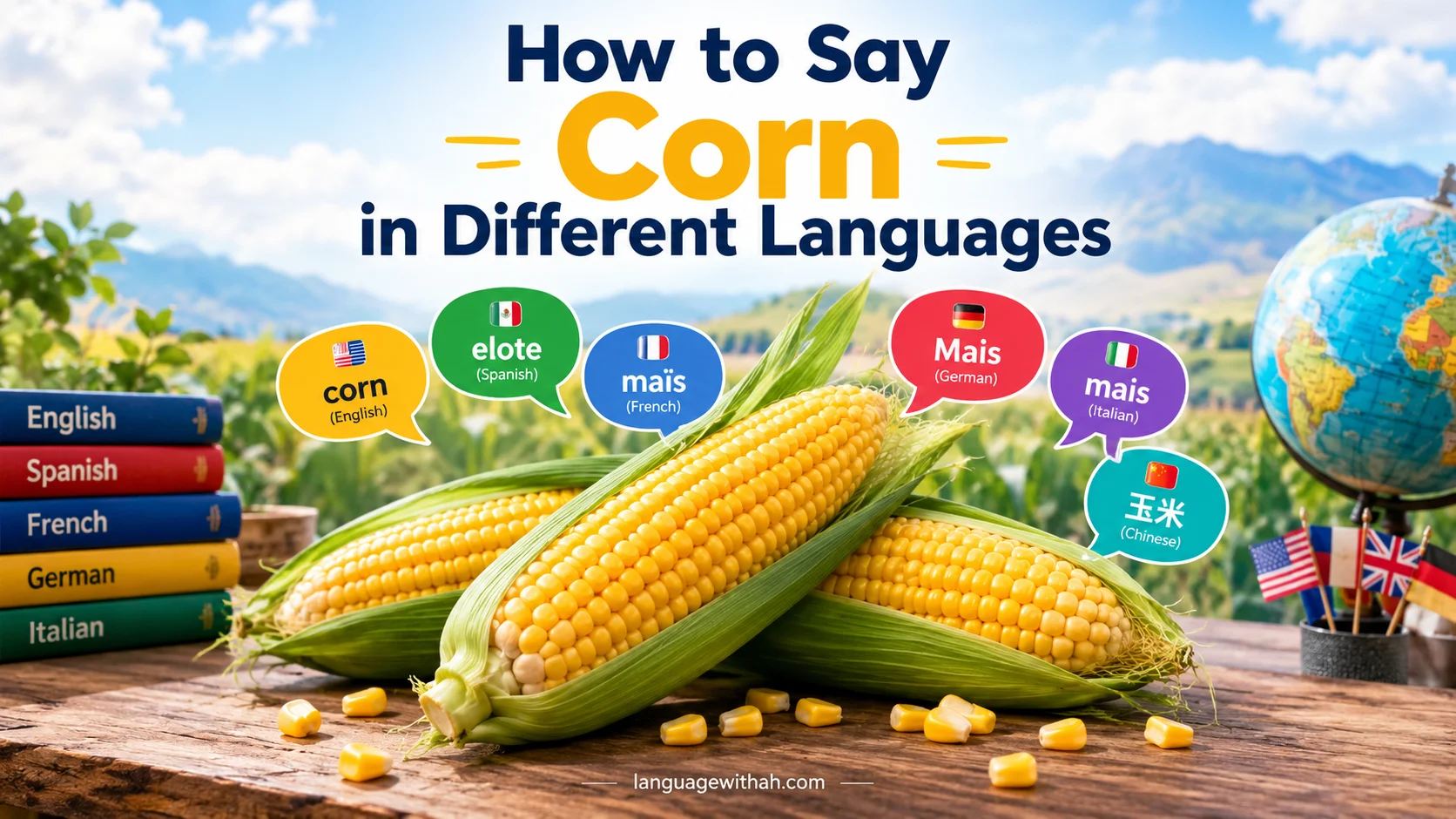
Corn is a familiar food in many parts of the world, appearing in everything from tortillas and porridge to popcorn, bread, soups, and grilled street food. Learning how to say corn in 70 different languages is a practical way to expand your vocabulary while discovering how different communities describe an important crop.
The English word corn has an interesting regional difference. In American English, it usually means maize, the tall cereal plant that produces yellow, white, or multicolored kernels. In British English, corn can also refer more broadly to cereal grains, although sweetcorn commonly identifies the familiar vegetable eaten from a cob. This distinction matters when translating food names, shopping lists, recipes, or agricultural information.
Across languages, corn may have different names depending on the variety, preparation, or local tradition. Some languages distinguish fresh sweet corn from dried maize, while others use one general word for the crop and its kernels. Pronunciation and spelling also vary, particularly in languages with different writing systems.
Interesting Facts About Corn in Different Languages
- Corn and maize are not always interchangeable. In the United States, corn generally refers to maize, while British English sometimes uses corn as a broader word for grain.
- Corn has several culinary forms. Fresh sweet corn, dried maize, cornmeal, and popcorn may have different names in the same language.
- The word varies across language families. Spanish uses maíz, French uses maïs, and German uses Mais for maize.
- Writing systems affect pronunciation guides. Chinese, Japanese, Korean, Arabic, and other languages use writing systems that may require romanization to help English speakers pronounce the word.
- Food vocabulary reflects local diets. In places where maize is a staple, corn-related vocabulary may include words for flour, porridge, flatbreads, or other traditional preparations.
- One language can have regional variations. Spanish speakers, for example, may use different terms for maize or sweet corn depending on the country and culinary context.
- Context helps prevent misunderstandings. When discussing a recipe, specifying sweet corn, maize flour, or popcorn may be more precise than using a general word for corn.
What Does Corn Mean?
Corn is a cereal crop that produces edible kernels on a cob. It is also called maize in many English-speaking contexts, particularly when discussing farming, nutrition, or the plant itself.
People use corn in a wide variety of foods. Fresh kernels can be boiled, steamed, or grilled; dried kernels can be ground into flour or meal; and specially prepared kernels can become popcorn. Corn is also used in animal feed and various industrial products.
The word can have slightly different meanings depending on where English is spoken. In the United States, corn normally means maize. In the United Kingdom, corn can refer more generally to grain, while sweetcorn usually means the familiar edible kernels.
When translating this word, it is useful to identify the intended meaning:
- Corn or maize: the crop or its kernels.
- Sweet corn: the sweet variety commonly eaten as a vegetable.
- Cornmeal: dried corn ground into a coarse meal.
- Corn flour: a term whose meaning varies between countries and may refer to finely ground maize or, in some places, cornstarch.
The tables below focus primarily on corn as maize, with regional distinctions noted where they are useful.
Why Can Corn Have Different Translations?
The word corn does not have one universal translation because languages divide food vocabulary differently. A word may refer to the whole maize plant, its kernels, or the edible vegetable sold fresh.
Several factors influence the right translation:
- Context: A farming discussion may use the general word for maize, while a recipe may call for sweet corn.
- Regional usage: Spanish, Arabic, and other widely spoken languages have regional vocabulary differences.
- Formality: Everyday conversations and technical agricultural writing may use different terms.
- Food preparation: Corn on the cob, cornmeal, and popcorn often have their own names.
- Writing system: Some languages write the word using non-Latin scripts, so romanization helps readers understand pronunciation.
- Local varieties: A familiar name for maize in one region may not describe every variety or preparation elsewhere.
For example, the Spanish word maíz generally refers to maize, whereas elote is widely used in Mexico for fresh corn on the cob. In many English-language recipes, sweet corn is more specific than simply corn.
Translation tip: If you are ordering food, translating a recipe, or buying ingredients abroad, identify whether you mean the crop, fresh kernels, cornmeal, or popcorn.
European Languages
European languages belong to several language families, including Germanic, Romance, Slavic, and Uralic. Although many use related words for maize, spelling and pronunciation differ. The examples below use the ordinary word for corn or maize rather than a word for cornmeal or popcorn.
English varieties
American, British, and Australian English share the word corn, but its meaning can vary by context. American English generally uses corn for maize, while British English often uses sweetcorn for the vegetable. Australian English commonly uses corn or sweet corn, depending on context.
| 🌍 Language | Country/Region | Translation | Pronunciation | Example Sentence |
| American English 🇺🇸 | United States | Corn | korn | We bought fresh corn. — We bought fresh corn. |
| British English 🇬🇧 | United Kingdom | Sweetcorn (for the vegetable) | SWEET-korn | I added sweetcorn to the salad. — I added sweetcorn to the salad. |
| Australian English 🇦🇺 | Australia | Corn / sweet corn | korn / sweet korn | We grilled corn for dinner. — We grilled corn for dinner. |
| Spanish | Spain and Latin America | Maíz | mah-EES | El maíz crece en el campo. — Corn grows in the field. |
| French | France, Belgium, Canada | Maïs | mah-EES | Le maïs pousse dans ce champ. — Corn grows in this field. |
| German | Germany, Austria, Switzerland | Mais | mice (rhymes approximately with “ice”) | Der Mais wächst auf dem Feld. — The corn grows in the field. |
| Italian | Italy, Switzerland | Mais | mah-EES | Il mais cresce bene qui. — Corn grows well here. |
| Portuguese | Portugal, Brazil | Milho | MEEL-yoo | O milho está fresco. — The corn is fresh. |
| Dutch | Netherlands, Belgium | Maïs | mah-ISS | De maïs groeit op het land. — The corn grows in the field. |
| Swedish | Sweden, Finland | Majs | myce (approximately “mाइस”) | Majsen växer på åkern. — The corn grows in the field. |
| Norwegian | Norway | Mais | mice | Maisen vokser på jordet. — The corn grows in the field. |
| Danish | Denmark | Majs | mice | Majsen vokser på marken. — The corn grows in the field. |
| Finnish | Finland | Maissi | MYE-see | Maissi kasvaa pellolla. — Corn grows in the field. |
| Icelandic | Iceland | Maís | myce | Maísinn vex á akrinum. — The corn grows in the field. |
| Irish | Ireland | Arbhar Indiach | AR-wer IN-dee-akh | Tá arbhar Indiach sa réimse. — There is maize in the field. |
| Welsh | Wales | Indrawn | in-DRAWN | Mae indrawn yn tyfu yn y cae. — Corn grows in the field. |
| Polish | Poland | Kukurydza | koo-koo-RIH-dzah | Kukurydza rośnie na polu. — Corn grows in the field. |
| Czech | Czechia | Kukuřice | koo-koo-RZHEE-tseh | Kukuřice roste na poli. — Corn grows in the field. |
| Slovak | Slovakia | Kukurica | koo-koo-REE-tsah | Kukurica rastie na poli. — Corn grows in the field. |
| Ukrainian | Ukraine | Кукурудза (kukurudza) | koo-koo-ROOD-zah | Кукурудза росте на полі. — Corn grows in the field. |
| Russian | Russia and other Russian-speaking regions | Кукуруза (kukuruza) | koo-koo-ROO-zah | Кукуруза растёт в поле. — Corn grows in the field. |
| Romanian | Romania, Moldova | Porumb | poh-ROOMB | Porumbul crește pe câmp. — Corn grows in the field. |
| Hungarian | Hungary | Kukorica | KOO-koh-ree-tsah | A kukorica a mezőn nő. — Corn grows in the field. |
| Greek | Greece, Cyprus | Καλαμπόκι (kalampóki) | kah-lahm-BOH-kee | Το καλαμπόκι μεγαλώνει στο χωράφι. — Corn grows in the field. |
| Bulgarian | Bulgaria | Царевица (tsarevitsa) | tsah-reh-VEE-tsah | Царевицата расте на полето. — Corn grows in the field. |
| Croatian | Croatia | Kukuruz | koo-koo-ROOZ | Kukuruz raste na polju. — Corn grows in the field. |
| Serbian | Serbia and neighboring regions | Кукуруз (kukuruz) | koo-koo-ROOZ | Кукуруз расте на пољу. — Corn grows in the field. |
| Slovenian | Slovenia | Koruza | koh-ROO-zah | Koruza raste na polju. — Corn grows in the field. |
| Lithuanian | Lithuania | Kukurūzai | koo-koo-ROO-zai | Kukurūzai auga lauke. — Corn grows in the field. |
| Latvian | Latvia | Kukurūza | koo-koo-ROO-zah | Kukurūza aug laukā. — Corn grows in the field. |
| Estonian | Estonia | Mais | myce | Mais kasvab põllul. — Corn grows in the field. |
Regional note: The Irish term arbhar can mean grain or cereal more broadly, so arbhar Indiach is a more specific expression for maize. In everyday conversation, the precise choice in any language may depend on whether the speaker means fresh sweet corn or maize as a crop.
Read More: How to Say Come Here in Different Languages
Asian Languages
Asia includes languages with very different writing systems and grammatical structures. Some use alphabets, others use syllabic scripts or characters, and several languages have important tone distinctions. The following translations refer to maize or corn in its general food or crop sense.
| 🌍 Language | Country/Region | Translation | Pronunciation | Example Sentence |
| Mandarin Chinese | China, Taiwan, Singapore | 玉米 (yùmǐ) | yoo-MEE (fourth tone on yù) | 田里的玉米长得很好。— The corn in the field is growing well. |
| Cantonese | Hong Kong, Guangdong | 玉米 (juk6 mai5) | yook-moy, with Cantonese tones | 我哋買咗玉米。— We bought corn. |
| Japanese | Japan | とうもろこし (tōmorokoshi) | toh-moh-roh-koh-shee | とうもろこしを焼きます。— I grill corn. |
| Korean | South Korea, North Korea | 옥수수 (oksusu) | ok-soo-soo | 옥수수를 샀어요. — I bought corn. |
| Hindi | India | मक्का (makkā) | muk-KAA | खेत में मक्का उगता है। — Corn grows in the field. |
| Urdu | Pakistan, India | مکئی (makai) | muh-KAI | کھیت میں مکئی اگتی ہے۔ — Corn grows in the field. |
| Bengali | Bangladesh, India | ভুট্টা (bhuṭṭā) | BHOOT-tah | মাঠে ভুট্টা জন্মায়। — Corn grows in the field. |
| Punjabi | Punjab, India and Pakistan | ਮੱਕੀ / مکئی (makkī / makai) | muh-KEE / muh-KAI | ਖੇਤ ਵਿੱਚ ਮੱਕੀ ਉੱਗਦੀ ਹੈ। — Corn grows in the field. |
| Gujarati | Gujarat, India | મકાઈ (makāī) | muh-KAI | ખેતરમાં મકાઈ ઊગે છે. — Corn grows in the field. |
| Marathi | Maharashtra, India | मका (makā) | muh-KAA | शेतात मका उगवतो. — Corn grows in the field. |
| Tamil | Tamil Nadu, Sri Lanka | மக்காச்சோளம் (makkāccōḷam) | muk-kaa-CHOH-lum | வயலில் மக்காச்சோளம் வளர்கிறது. — Corn grows in the field. |
| Telugu | Andhra Pradesh, Telangana, India | మొక్కజొన్న (mokkajonna) | mok-kuh-JON-nuh | పొలంలో మొక్కజొన్న పెరుగుతోంది. — Corn is growing in the field. |
| Kannada | Karnataka, India | ಮೆಕ್ಕೆಜೋಳ (mekkejōḷa) | mek-keh-JOH-luh | ಹೊಲದಲ್ಲಿ ಮೆಕ್ಕೆಜೋಳ ಬೆಳೆಯುತ್ತದೆ. — Corn grows in the field. |
| Malayalam | Kerala, India | ചോളം (chōḷam) | CHOH-lum | വയലിൽ ചോളം വളരുന്നു. — Corn grows in the field. |
| Nepali | Nepal | मकै (makai) | muh-KAI | खेतमा मकै फल्छ। — Corn grows in the field. |
| Sinhala | Sri Lanka | බඩඉරිඟු (baḍa iriṅgu) | buh-duh ee-RING-goo | බඩඉරිඟු කෙතේ වැවේ. — Corn grows in the field. |
| Thai | Thailand | ข้าวโพด (khâao-phôot) | khao-phot, with tones | ข้าวโพดกำลังโตในไร่ — Corn is growing in the field. |
| Vietnamese | Vietnam | Ngô / bắp | ngoh / buhp | Ngô đang mọc trên đồng. — Corn is growing in the field. |
| Indonesian | Indonesia | Jagung | jah-goong | Jagung tumbuh di ladang. — Corn grows in the field. |
| Malay | Malaysia, Brunei, Singapore | Jagung | jah-goong | Jagung itu masih segar. — The corn is still fresh. |
| Filipino/Tagalog | Philippines | Mais | myce | Bumili kami ng mais. — We bought corn. |
| Burmese | Myanmar | ပြောင်းဖူး (pyaung-bu) | pyaung-boo | ပြောင်းဖူး ဝယ်ခဲ့တယ်။ — I bought corn. |
| Khmer | Cambodia | ពោត (poat) | poat | ពោតដុះនៅក្នុងស្រែ។ — Corn grows in the field. |
| Lao | Laos | ສາລີ (sali) | sah-lee | ສາລີກຳລັງໃຫຍ່. — The corn is growing. |
| Mongolian | Mongolia | Эрдэнэ шиш (erdene shish) | er-deh-neh sheesh | Эрдэнэ шиш талбайд ургаж байна. — Corn is growing in the field. |
| Kazakh | Kazakhstan | Жүгері (jügeri) | zhü-geh-REE | Жүгері алқапта өсіп жатыр. — Corn is growing in the field. |
| Uzbek | Uzbekistan | Makkajoʻxori | mahk-kah-joh-KHOH-ree | Makkajoʻxori dalada o‘sadi. — Corn grows in the field. |
Regional note: In Vietnamese, ngô is common in northern usage, while bắp is common in southern usage. In India, the most natural word can vary with region and with the type of corn being discussed. For example, some languages distinguish a maize crop from other cereal grains more explicitly than English does.
African Languages
Africa is home to hundreds of languages from several major language families. Corn vocabulary varies according to local food traditions, regional varieties, and the distinction between maize and prepared corn products. These examples represent particular languages and communities rather than the whole continent.
| 🌍 Language | Country/Region | Translation | Pronunciation | Example Sentence |
| Swahili | Tanzania, Kenya, East Africa | Mahindi | mah-HIN-dee | Mahindi yanakua shambani. — Corn is growing on the farm. |
| Afrikaans | South Africa, Namibia | Mielies | MEE-lees | Die mielies groei op die land. — The corn is growing in the field. |
| Zulu | South Africa | Ummbila | oom-BEE-lah | Umbila uyakhula ensimini. — The corn is growing in the field. |
| Xhosa | South Africa | Umbona | oom-BOH-nah | Umbona uyakhula entsimini. — The corn is growing in the field. |
| Amharic | Ethiopia | በቆሎ (bek’olo) | beh-KOH-loh | በቆሎ በእርሻው ላይ ያድጋል። — Corn grows on the farm. |
| Yoruba | Nigeria, Benin | Agbado | ahg-BAH-doh | Agbado ń dàgbà ní oko. — Corn is growing on the farm. |
| Igbo | Nigeria | Ọka | aw-KAH | Ọka na-eto n’ubi. — Corn grows in the farm. |
| Hausa | Nigeria, Niger, West Africa | Masara | mah-SAH-rah | Masara tana girma a gona. — Corn is growing on the farm. |
| Somali | Somalia, Horn of Africa | Galley | GAL-ley | Galleydu waxay ka baxaysaa beerta. — Corn is growing in the field. |
| Shona | Zimbabwe | Chibage | chee-BAH-geh | Chibage chiri kukura mumunda. — Corn is growing in the field. |
| Sesotho | Lesotho, South Africa | Poone | poh-OH-neh | Poone e mela masimong. — Corn grows in the fields. |
| Setswana | Botswana, South Africa | Mabele | mah-BEH-leh | Mabele a gola mo masimong. — The maize is growing in the fields. |
| Kinyarwanda | Rwanda | Ibigori | ee-bee-GOH-ree | Ibigori birakura mu murima. — Corn is growing in the field. |
| Malagasy | Madagascar | Katsaka | kah-TSAH-kah | Mitombo eny an-tsaha ny katsaka. — Corn grows in the field. |
Cultural note: In many African communities, maize is an important food crop, but it is not the only staple. The words used for maize flour, cooked porridge, or a local dish may differ from the general word for the crop. When talking about a particular meal, naming the preparation can make your meaning clearer.
Middle Eastern Languages
The Middle East includes Arabic-speaking communities, Persian-speaking regions, Hebrew-speaking communities, Kurdish-speaking populations, and others. Some languages have several regional varieties, so a general translation may not be the only natural option.
| 🌍 Language | Country/Region | Translation | Pronunciation | Example Sentence |
| Arabic (Modern Standard Arabic) | Middle East, North Africa | ذرة (dhurra) | THUR-rah, with the Arabic dh sound | تنمو الذرة في الحقل. — Corn grows in the field. |
| Persian (Farsi) | Iran and Persian-speaking communities | ذرت (zorrat) | zor-RAT | ذرت در مزرعه رشد میکند. — Corn grows on the farm. |
| Hebrew | Israel | תירס (tirás) | tee-RAHS | התירס גדל בשדה. — The corn grows in the field. |
| Kurdish (Kurmanji) | Türkiye, Syria, Iraq, diaspora | Gêzer / corn terminology varies regionally; genim can mean wheat, not maize | Varies by dialect | The precise term should be checked for the local Kurdish variety and context. |
| Turkish | Türkiye, Cyprus | Mısır | muh-SUHR | Mısır tarlada yetişiyor. — Corn is growing in the field. |
| Armenian | Armenia and Armenian-speaking communities | Եգիպտացորեն (yeghiptsatsoren) | yeh-ghip-tsah-tsoh-REN | Եգիպտացորենը աճում է դաշտում։ — Corn grows in the field. |
Important regional distinction: In Arabic, dhurra (ذرة) is a common term for maize, but local usage and the wording used for sweet corn may vary. In Turkish, mısır means maize and also means Egypt, with context making the intended meaning clear. Kurdish vocabulary differs by dialect, so it is better to verify a local term than to present one uncertain word as universal.
Other World Languages
Maize is also named in Indigenous languages, Pacific languages, and constructed languages. These examples expand the geographical range of the list while showing how vocabulary reflects each language’s own structure and history.
| 🌍 Language | Country/Region | Translation | Pronunciation | Example Sentence |
| Māori | New Zealand | Kānga | KAA-ngah | Kei te tipu te kānga i te māra. — Corn is growing in the garden. |
| Samoan | Samoa and Pacific communities | Saga | SAH-ngah | Ua ola le saga i le fanua. — The corn is growing in the field. |
| Tongan | Tonga | Koane | koh-AH-neh | ʻOku tupu ʻa e koane ʻi he ngoue. — Corn is growing in the garden. |
| Hawaiian | Hawaiʻi | Kānana (corn terminology may vary; verify with a Hawaiian-language source before publication) | KAA-nah-nah | Use a locally verified example before publishing. |
| Quechua | Andes, including Peru and Bolivia | Sara | SAH-rah | Saraqa chakra-pi wiñan. — The corn grows in the field. |
| Guarani | Paraguay and neighboring regions | Avati | ah-vah-TEE | Avati okakuaa kokue-pe. — Corn grows in the field. |
| Haitian Creole | Haiti and Haitian communities | Mayi | mah-YEE | Mayi a ap grandi nan jaden an. — The corn is growing in the field. |
| Esperanto | International constructed language | Maizo | mah-EE-zoh | Maizo kreskas en la kampo. — Corn grows in the field. |
Editorial note: Hawaiian and some Indigenous-language vocabulary should be confirmed with reliable community or language resources before publication. Local terminology may differ, and a word for a related plant or food should not be substituted merely to complete a language count.
Quick Reference: Corn in Different Languages
Use this table to look up the general word for corn or maize quickly. Where a language distinguishes fresh sweet corn from maize as a crop, the context notes above are important.
| Language | Translation |
| American English | Corn |
| British English | Sweetcorn |
| Australian English | Corn / sweet corn |
| Spanish | Maíz |
| French | Maïs |
| German | Mais |
| Italian | Mais |
| Portuguese | Milho |
| Dutch | Maïs |
| Swedish | Majs |
| Norwegian | Mais |
| Danish | Majs |
| Finnish | Maissi |
| Icelandic | Maís |
| Irish | Arbhar Indiach |
| Welsh | Indrawn |
| Polish | Kukurydza |
| Czech | Kukuřice |
| Slovak | Kukurica |
| Ukrainian | Кукурудза |
| Russian | Кукуруза |
| Romanian | Porumb |
| Hungarian | Kukorica |
| Greek | Καλαμπόκι |
| Bulgarian | Царевица |
| Croatian | Kukuruz |
| Serbian | Кукуруз |
| Slovenian | Koruza |
| Lithuanian | Kukurūzai |
| Latvian | Kukurūza |
| Estonian | Mais |
| Mandarin Chinese | 玉米 |
| Cantonese | 玉米 |
| Japanese | とうもろこし |
| Korean | 옥수수 |
| Hindi | मक्का |
| Urdu | مکئی |
| Bengali | ভুট্টা |
| Punjabi | ਮੱਕੀ / مکئی |
| Gujarati | મકાઈ |
| Marathi | मका |
| Tamil | மக்காச்சோளம் |
| Telugu | మొక్కజొన్న |
| Kannada | ಮೆಕ್ಕೆಜೋಳ |
| Malayalam | ചോളം |
| Nepali | मकै |
| Sinhala | බඩඉරිඟු |
| Thai | ข้าวโพด |
| Vietnamese | Ngô / bắp |
| Indonesian | Jagung |
| Malay | Jagung |
| Filipino/Tagalog | Mais |
| Burmese | ပြောင်းဖူး |
| Khmer | ពោត |
| Lao | ສາລີ |
| Mongolian | Эрдэнэ шиш |
| Kazakh | Жүгері |
| Uzbek | Makkajoʻxori |
| Swahili | Mahindi |
| Afrikaans | Mielies |
| Zulu | Umbila |
| Xhosa | Umbona |
| Amharic | በቆሎ |
| Yoruba | Agbado |
| Igbo | Ọka |
| Hausa | Masara |
| Somali | Galley |
| Shona | Chibage |
| Sesotho | Poone |
| Setswana | Mabele |
| Kinyarwanda | Ibigori |
| Malagasy | Katsaka |
| Arabic | ذرة |
| Persian | ذرت |
| Hebrew | תירס |
| Turkish | Mısır |
| Armenian | Եգիպտացորեն |
| Māori | Kānga |
| Samoan | Saga |
| Tongan | Koane |
| Quechua | Sara |
| Guarani | Avati |
| Haitian Creole | Mayi |
| Esperanto | Maizo |
How to Choose the Right Translation
The best translation depends on what kind of corn you mean, where you are speaking, and who will read or hear your words.
- For everyday conversation: Use the ordinary word for maize in the target language.
- For recipes: Specify sweet corn, cornmeal, or popcorn when the distinction matters.
- For travel: Learn the local word and how to pronounce it. If ordering food, pointing to a picture can help clarify the variety.
- For formal writing: Use the appropriate agricultural or culinary term rather than relying on a broad everyday word.
- For regional audiences: Check whether the word changes between countries or dialects.
- For language learning: Learn the word in a complete sentence so you can see how it works grammatically.
A helpful strategy is to check a reliable bilingual dictionary and then compare the term with real examples of its use in recipes, food labels, or local-language publications.
Remember: A translation can be correct but still too broad for the situation. Precision matters most when a misunderstanding could affect a recipe, food purchase, or agricultural discussion.
Common Mistakes When Translating Corn
Translating food vocabulary seems straightforward, but several mistakes can lead to confusion.
1. Assuming every English variety uses “corn” the same way. In American English, corn generally means maize. In British English, the word can also mean grain more broadly.
2. Confusing maize with sweet corn. Maize is the crop, while sweet corn refers to varieties commonly eaten as a vegetable. Some languages use different expressions for these meanings.
3. Translating word for word. A dictionary may provide a broad equivalent without explaining whether it fits a recipe, farming conversation, or food label.
4. Ignoring regional vocabulary. Spanish maíz, for instance, is widely understood, but words such as elote and choclo are used for particular forms of corn in different regions.
5. Overlooking pronunciation. A correctly spelled word may be difficult to recognize when spoken if its vowels, tones, or consonants are pronounced incorrectly.
6. Mixing regional varieties. Using vocabulary from one dialect alongside grammar from another may sound unnatural.
7. Confusing related products. Corn, corn flour, cornmeal, and cornstarch are not interchangeable ingredients. Check the precise term when translating a recipe.
8. Treating uncertain vocabulary as established fact. Some Indigenous and regional languages have local terms that require additional verification. It is better to acknowledge uncertainty than to publish an unverified translation.
Why Learn Corn in Different Languages?
Learning the word for corn in other languages builds practical vocabulary and offers a small window into food traditions around the world.
- Communicate more easily: Recognizing food names can help when shopping, reading menus, or asking questions while traveling.
- Understand recipes: Knowing the difference between maize, sweet corn, and cornmeal can make international cooking more accurate.
- Expand vocabulary: A familiar food provides an easy starting point for learning related words, such as farm, harvest, flour, and grain.
- Explore cultures: Food vocabulary often reflects the ingredients and preparations that are important in a particular region.
- Personalize conversations: Using the correct word can make discussions with language partners and friends more natural.
- Improve pronunciation: Practicing short food words helps learners become more comfortable with unfamiliar sounds and writing systems.
The goal is not simply to memorize a long list. It is to understand which word fits which situation and how to use it naturally.
FAQs:
1. How do you say corn in different languages?
Corn is maíz in Spanish, maïs in French, mais in German, milho in Portuguese, jagung in Indonesian, and 玉米 (yùmǐ) in Mandarin Chinese. The exact word depends on the language and sometimes on whether you mean fresh sweet corn or maize as a crop.
2. What is the most natural translation of corn?
There is no single translation that works in every language. The most natural choice is the everyday word used for maize in the target language and region. If you mean sweet corn, cornmeal, or popcorn, a more specific term may be necessary.
3. Is corn called maize in every English-speaking country?
No. American English generally uses corn for maize. British English can use corn to mean grain more broadly, while sweetcorn commonly refers to the vegetable. Australian English also uses corn and sweet corn, depending on context.
4. What is corn called in Spanish?
The general Spanish word for maize is maíz. In Mexico, elote commonly refers to fresh corn on the cob, while choclo is used in several South American countries. Usage varies by region and preparation.
5. How do you say corn in French?
Corn or maize is maïs in French. It is pronounced approximately mah-EES. The word is used in France and other French-speaking regions, although the terms for specific corn products may differ.
Conclusion:
Learning how to say corn in 70 different languages reveals how a familiar food can have different names, pronunciations, and meanings around the world. From maíz in Spanish and milho in Portuguese to 玉米 in Mandarin and mahindi in Swahili, each translation offers another way to explore everyday communication.
The most useful translation depends on context. A word for maize as a crop may not be the best choice when ordering sweet corn, reading a recipe, or buying cornmeal. Regional vocabulary, pronunciation, and local usage can all influence how naturally a word fits a conversation.














1 thought on “How to Say Corn in Different Languages”