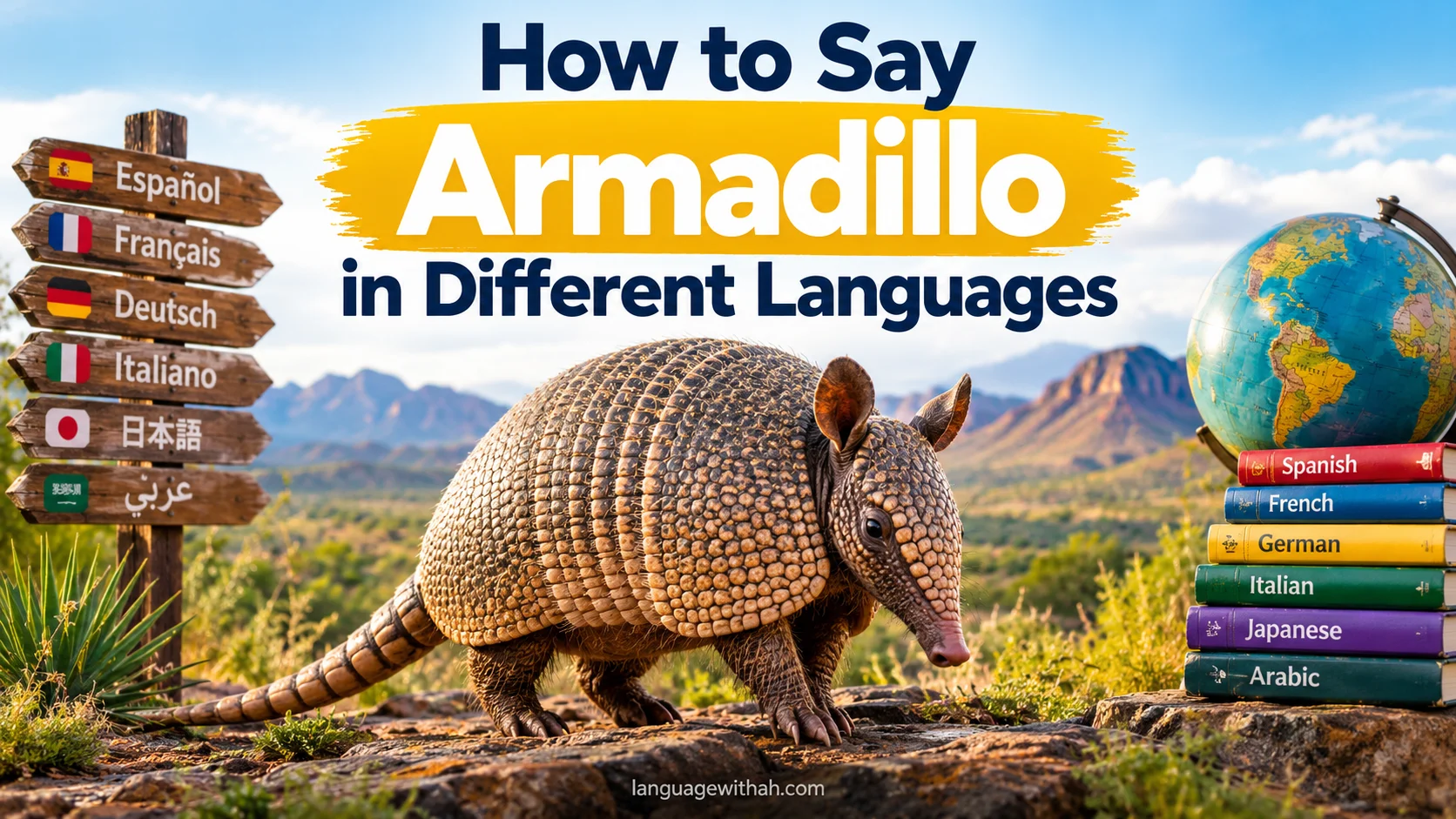
An armadillo is a small to medium-sized mammal known for its protective shell, strong claws, and ability to dig. Native to the Americas, armadillos are especially associated with Central and South America, although some species also live in the southern United States. Learning how to say armadillo in 70 different languages is a useful way to explore how languages describe animals and the natural world.
The word armadillo comes from Spanish and is associated with the idea of being armored. Many languages use a form of this borrowed word, while others have their own established animal names. These differences can reveal connections between languages, regional vocabulary, and the ways people communicate about wildlife.
Whether you are studying a foreign language, preparing educational material, traveling, or simply curious about animal names, this guide brings together translations, pronunciation guides, and example sentences. It also explains where regional wording may differ and why some translations are more natural than literal alternatives.
One important distinction is that the animal’s name is not the same as the phrase “How to say armadillo.” Because this article focuses on the animal itself, the tables provide the natural word for armadillo in each language. Pronunciation guides are simplified for English-speaking readers, and regional or species-specific differences are noted where relevant.
Interesting Facts About Armadillos
- Their name has Spanish roots. The word armadillo is related to armado, meaning “armed” or “armored,” referring to the animal’s protective covering.
- They are mammals, not reptiles. Despite their scaly-looking armor, armadillos are warm-blooded mammals that feed their young with milk.
- They are native to the Americas. Different species inhabit areas ranging from parts of the southern United States to Central and South America.
- Their shells are distinctive. Armadillos have bony plates covered by tough skin, with flexible bands in many species that allow movement.
- Translations often resemble one another. Several European languages use forms related to the Spanish name, while other languages use established local animal names or descriptive expressions.
- Not every armored mammal is an armadillo. Pangolins and turtles have protective coverings too, but they are different kinds of animals.
- The name can be more specific in scientific contexts. The general word armadillo covers multiple species, so a zoological description may require a species name rather than the everyday animal name.
What Does Armadillo Mean?
An armadillo is a burrowing mammal characterized by a protective covering of bony plates. It belongs to the order Cingulata and is known for its digging ability, elongated snout, and strong claws.
The word is primarily a noun naming an animal. It does not ordinarily express an emotion, greeting, or action. In everyday conversation, someone might use it when discussing wildlife, a zoo visit, animal behavior, nature documentaries, or a picture of an unusual mammal.
For example:
- “We saw an armadillo near the nature reserve.”
- “The armadillo uses its claws to dig for food.”
- “I learned how to say armadillo in Spanish.”
When translating the word, the goal is to identify the same animal rather than choose a word that simply means “armored animal.” A descriptive phrase can sometimes explain the animal, but it may not be its ordinary name in the target language.
Why Can Armadillo Have Different Translations?
The word armadillo can have different translations because languages develop their own vocabulary, borrow words from other languages, and distinguish animals in different ways.
- Borrowing: Some languages adopt a form of the Spanish word armadillo.
- Local vocabulary: Other languages use an established name for the animal.
- Scientific context: Zoologists may distinguish a specific armadillo species from the broader group.
- Regional variation: A word may be more familiar in one country or language community than another.
- Pronunciation: The spelling may remain similar across languages even when the sounds change.
- Writing systems: Chinese, Japanese, Korean, Arabic, and other languages may represent the name in different scripts.
- Everyday versus technical usage: A general animal name may be suitable for conversation, while a scientific text may need a more precise designation.
The most useful translation is the one that clearly identifies the animal in the intended context. Where a local name or exact equivalent is uncertain, it is better to explain that limitation than to invent a translation.
Read More: How to Say Armor in Different Languages
European Languages
European languages include several language families, including Romance, Germanic, Slavic, and Uralic languages. Their names for the armadillo may be borrowed from Spanish or based on descriptions of its protective body covering. The examples below use the ordinary animal name in each language, with pronunciation guides intended as practical approximations.
| 🌍 Language | Country/Region | Translation | Pronunciation | Example Sentence |
| English | UK, US, Australia | Armadillo | ar-muh-DIL-oh | The armadillo digs in the soil. — It digs in the soil. |
| American English 🇺🇸 | United States | Armadillo | ar-muh-DIL-oh | I saw an armadillo outside. — I saw one outdoors. |
| British English 🇬🇧 | United Kingdom | Armadillo | ah-muh-DIL-oh | The armadillo is an unusual mammal. — It is an unusual mammal. |
| Australian English 🇦🇺 | Australia | Armadillo | ar-muh-DIL-oh | We learned about the armadillo. — We learned about the animal. |
| Spanish 🇪🇸 | Spain, Latin America | Armadillo | ar-ma-DEE-yoh | El armadillo busca comida. — The armadillo looks for food. |
| French 🇫🇷 | France, parts of the Americas | Tatou | tah-TOO | Le tatou creuse le sol. — The armadillo digs in the ground. |
| German 🇩🇪 | Germany, Austria | Gürteltier | GUER-tel-teer | Das Gürteltier sucht Nahrung. — The armadillo searches for food. |
| Italian 🇮🇹 | Italy, Switzerland | Armadillo | ar-ma-DEEL-loh | L’armadillo scava nel terreno. — The armadillo digs in the ground. |
| Portuguese 🇵🇹 | Portugal, Brazil | Tatu | tah-TOO | O tatu procura alimento. — The armadillo looks for food. |
| Dutch 🇳🇱 | Netherlands, Belgium | Gordeldier | GOR-del-deer | Het gordeldier graaft in de grond. — The armadillo digs in the ground. |
| Swedish 🇸🇪 | Sweden | Bältdjur | BELT-dyoor | Bältdjuret letar efter mat. — The armadillo looks for food. |
| Norwegian 🇳🇴 | Norway | Beltedyr | BEL-teh-deer | Beltedyret leter etter mat. — The armadillo looks for food. |
| Danish 🇩🇰 | Denmark | Bæltedyr | BEL-teh-deer | Bæltedyret leder efter mad. — The armadillo looks for food. |
| Finnish 🇫🇮 | Finland | Vyötiäinen | VYÖ-tee-eye-nen | Vyötiäinen etsii ruokaa. — The armadillo searches for food. |
| Icelandic 🇮🇸 | Iceland | Beltisdýr | BEL-tis-deer | Beltisdýrið leitar að æti. — The armadillo looks for food. |
| Polish 🇵🇱 | Poland | Pancernik | pan-TSEHR-neek | Pancernik szuka pożywienia. — The armadillo searches for food. |
| Czech 🇨🇿 | Czechia | Pásovec | PAA-so-vets | Pásovec hledá potravu. — The armadillo looks for food. |
| Slovak 🇸🇰 | Slovakia | Pásavec | PAA-sa-vets | Pásavec hľadá potravu. — The armadillo looks for food. |
| Russian 🇷🇺 | Russia, other Russian-speaking regions | Броненосец | bra-nye-NO-syets | Броненосец ищет пищу. — The armadillo searches for food. |
| Ukrainian 🇺🇦 | Ukraine | Броненосець | bro-ne-NO-sets | Броненосець шукає їжу. — The armadillo searches for food. |
| Romanian 🇷🇴 | Romania, Moldova | Tatu | tah-TOO | Tatu caută hrană. — The armadillo looks for food. |
| Hungarian 🇭🇺 | Hungary | Páncélosállat | PAAN-tshey-lo-shaal-laht | A páncélosállat táplálékot keres. — The armadillo searches for food. |
| Greek 🇬🇷 | Greece, Cyprus | Αρμαντίλλο | ar-man-DEE-lo | Το αρμαντίλλο ψάχνει τροφή. — The armadillo searches for food. |
| Bulgarian 🇧🇬 | Bulgaria | Броненосец | bro-ne-NO-sets | Броненосецът търси храна. — The armadillo looks for food. |
| Croatian 🇭🇷 | Croatia | Pojasnik | PO-yas-neek | Pojasnik traži hranu. — The armadillo looks for food. |
| Serbian 🇷🇸 | Serbia, Balkans | Оклопник | ok-LOP-neek | Оклопник тражи храну. — The armadillo looks for food. |
| Slovenian 🇸🇮 | Slovenia | Pasavec | PA-sa-vets | Pasavec išče hrano. — The armadillo looks for food. |
| Lithuanian 🇱🇹 | Lithuania | Šarvuotis | shar-VOO-oh-tis | Šarvuotis ieško maisto. — The armadillo looks for food. |
| Latvian 🇱🇻 | Latvia | Bruņnesis | BROON-neh-sis | Bruņnesis meklē barību. — The armadillo looks for food. |
| Estonian 🇪🇪 | Estonia | Vöölane | VÖÖ-lah-neh | Vöölane otsib toitu. — The armadillo looks for food. |
| Irish 🇮🇪 | Ireland | Armadailín | ar-ma-DAL-een | Chonaic mé armadailín. — I saw an armadillo. |
| Welsh 🏴 | Wales | Armadillo | ar-ma-DIL-oh | Gwelais armadillo. — I saw an armadillo. |
English varieties: American, British, and Australian
The animal’s name is armadillo in all three English varieties. There is no major difference in spelling or meaning. Pronunciation can vary slightly by accent, but it is not necessary to learn three separate translations.
In Spanish-speaking regions, armadillo is the general term, although local names such as cusuco, mulita, or quirquincho may be used for particular species or in specific regions. These terms are not interchangeable everywhere.
In French, tatou is the standard general name, while Portuguese commonly uses tatu, especially in Brazil. German Gürteltier is a descriptive compound referring to the animal’s banded, armored appearance.
Asian Languages
Asia includes languages with very different writing systems and linguistic histories. Some use adapted forms of the international word, while others have distinctive names for the animal. The romanizations below help readers approximate the pronunciation, but they do not replace listening to a fluent speaker.
| 🌍 Language | Country/Region | Translation | Pronunciation | Example Sentence |
| Mandarin Chinese 🇨🇳 | China, Taiwan, Chinese-speaking communities | 犰狳 | qiú yú | 犰狳会挖洞。— The armadillo can dig burrows. |
| Cantonese | Hong Kong, Guangdong | 犰狳 | jau4 jyu4 | 犰狳會掘洞。— The armadillo digs burrows. |
| Japanese 🇯🇵 | Japan | アルマジロ | a-ru-ma-ji-ro | アルマジロは土を掘ります。— The armadillo digs in the soil. |
| Korean 🇰🇷 | South Korea, North Korea | 아르마딜로 | a-reu-ma-dil-lo | 아르마딜로는 땅을 팝니다. — The armadillo digs in the ground. |
| Hindi 🇮🇳 | India | आर्माडिलो | aar-maa-di-lo | आर्माडिलो ज़मीन खोदता है। — The armadillo digs in the ground. |
| Urdu 🇵🇰 | Pakistan, India | آرماڈیلو | aar-maa-di-lo | آرماڈیلو زمین کھودتا ہے۔ — The armadillo digs in the ground. |
| Bengali 🇧🇩 | Bangladesh, India | আর্মাডিলো | ar-ma-di-lo | আর্মাডিলো মাটি খোঁড়ে। — The armadillo digs in the soil. |
| Punjabi | Pakistan, India | ਆਰਮਾਡਿਲੋ | aar-maa-di-lo | ਆਰਮਾਡਿਲੋ ਜ਼ਮੀਨ ਖੋਦਦਾ ਹੈ। — The armadillo digs in the ground. |
| Gujarati 🇮🇳 | India | આર્માડિલો | aar-maa-di-lo | આર્માડિલો જમીન ખોદે છે. — The armadillo digs in the ground. |
| Marathi 🇮🇳 | India | आर्माडिलो | aar-maa-di-lo | आर्माडिलो जमीन खणतो. — The armadillo digs in the ground. |
| Tamil 🇮🇳 | India, Sri Lanka | அர்மாடில்லோ | ar-maa-dil-lo | அர்மாடில்லோ மண்ணைத் தோண்டுகிறது. — The armadillo digs in the soil. |
| Telugu 🇮🇳 | India | ఆర్మడిల్లో | aar-ma-dil-lo | ఆర్మడిల్లో నేలను తవ్వుతుంది. — The armadillo digs in the ground. |
| Kannada 🇮🇳 | India | ಆರ್ಮಡಿಲ್ಲೊ | aar-ma-dil-lo | ಆರ್ಮಡಿಲ್ಲೊ ನೆಲವನ್ನು ಅಗೆಯುತ್ತದೆ. — The armadillo digs in the ground. |
| Malayalam 🇮🇳 | India | അർമഡില്ലോ | ar-ma-dil-lo | അർമഡില്ലോ മണ്ണ് കുഴിക്കുന്നു. — The armadillo digs in the soil. |
| Nepali 🇳🇵 | Nepal | आर्माडिलो | aar-maa-di-lo | आर्माडिलोले जमिन खन्छ। — The armadillo digs in the ground. |
| Sinhala 🇱🇰 | Sri Lanka | ආමඩිලෝ | aa-ma-di-lo | ආමඩිලෝ පොළොව හාරයි. — The armadillo digs in the ground. |
| Thai 🇹🇭 | Thailand | อาร์มาดิลโล | aa-maa-din-lo | อาร์มาดิลโลขุดดิน — The armadillo digs in the soil. |
| Vietnamese 🇻🇳 | Vietnam | Armadillo | ar-ma-đi-lô | Armadillo đào đất. — The armadillo digs in the soil. |
| Indonesian 🇮🇩 | Indonesia | Armadillo | ar-ma-dil-lo | Armadillo menggali tanah. — The armadillo digs in the soil. |
| Malay 🇲🇾 | Malaysia, Brunei | Armadillo | ar-ma-dil-lo | Armadillo menggali tanah. — The armadillo digs in the soil. |
| Filipino/Tagalog 🇵🇭 | Philippines | Armadilyo | ar-ma-DIL-yo | Ang armadilyo ay naghuhukay sa lupa. — The armadillo digs in the soil. |
| Burmese 🇲🇲 | Myanmar | အာမဒီလို | aa-ma-di-lo | အာမဒီလိုသည် မြေကို တူးသည်။ — The armadillo digs in the soil. |
| Khmer 🇰🇭 | Cambodia | អាម៉ាឌីឡូ | aa-maa-di-lo | អាម៉ាឌីឡូជីកដី។ — The armadillo digs in the soil. |
| Lao 🇱🇦 | Laos | ອາມາດິລໂລ | aa-maa-din-lo | ອາມາດິລໂລຂຸດດິນ. — The armadillo digs in the soil. |
| Mongolian 🇲🇳 | Mongolia | Армадилло | ar-ma-dil-lo | Армадилло газар ухдаг. — The armadillo digs in the ground. |
| Kazakh 🇰🇿 | Kazakhstan | Кіреукей | kee-rew-key | Кіреукей жер қазады. — The armadillo digs in the ground. |
| Uzbek 🇺🇿 | Uzbekistan | Armadillo | ar-ma-dil-lo | Armadillo yer qaziydi. — The armadillo digs in the ground. |
| Turkish 🇹🇷 | Türkiye | Armadillo | ar-ma-dil-lo | Armadillo toprağı kazar. — The armadillo digs in the soil. |
Cultural and language note: In many languages where armadillos are not native animals, the name may be borrowed or adapted from another language. In everyday writing, the borrowed form can be recognizable, but a specialist zoological source is preferable when identifying a particular species. Mandarin 犰狳 and Japanese アルマジロ use established written forms rather than the Latin spelling.
African Languages
Africa has thousands of languages spanning several major language families. Because armadillos are not native to most African ecosystems, some languages use borrowed names or explanatory descriptions rather than a long-established everyday term. The entries below distinguish recognizable borrowed forms from names that should be checked in specialist dictionaries before formal publication.
| 🌍 Language | Country/Region | Translation | Pronunciation | Example Sentence |
| Swahili 🇹🇿 | Tanzania, Kenya, East Africa | Kakakuona* | ka-ka-ku-O-na | Kakakuona huchimba ardhini. — The armadillo digs in the ground. |
| Afrikaans 🇿🇦 | South Africa, Namibia | Gordeldier | KHOR-del-deer | Die gordeldier grawe in die grond. — The armadillo digs in the soil. |
| Zulu 🇿🇦 | South Africa | Armadillo* | ar-ma-DIL-lo | I-armadillo imba emhlabathini. — The armadillo digs in the ground. |
| Xhosa 🇿🇦 | South Africa | Armadillo* | ar-ma-DIL-lo | I-armadillo igrumba emhlabeni. — The armadillo digs in the ground. |
| Amharic 🇪🇹 | Ethiopia | አርማዲሎ* | ar-ma-di-lo | አርማዲሎ መሬት ይቆፍራል። — The armadillo digs in the ground. |
| Yoruba 🇳🇬 | Nigeria, West Africa | Armadillo* | ar-ma-DIL-lo | Armadillo máa ń wa ilẹ̀. — The armadillo digs in the ground. |
| Igbo 🇳🇬 | Nigeria | Armadillo* | ar-ma-DIL-lo | Armadillo na-egwu ala. — The armadillo digs in the ground. |
| Hausa 🇳🇬 | Nigeria, Niger, West Africa | Armadillo* | ar-ma-DIL-lo | Armadillo yana tona ƙasa. — The armadillo digs in the soil. |
| Somali 🇸🇴 | Somalia, Horn of Africa | Armadillo* | ar-ma-DIL-lo | Armadillo wuxuu qodaa dhulka. — The armadillo digs in the ground. |
| Shona 🇿🇼 | Zimbabwe | Armadillo* | ar-ma-DIL-lo | Armadillo inochera pasi. — The armadillo digs in the ground. |
| Sesotho 🇱🇸 | Lesotho, South Africa | Armadillo* | ar-ma-DIL-lo | Armadillo e cheka mobu. — The armadillo digs in the soil. |
| Kinyarwanda 🇷🇼 | Rwanda | Armadillo* | ar-ma-DIL-lo | Armadillo icukura ubutaka. — The armadillo digs in the ground. |
* Important accuracy note: In this table, entries marked with an asterisk use a recognizable borrowed name for an unfamiliar animal; they should not be treated as verified traditional or standardized animal names. The Swahili word kakakuona is associated with pangolins, so it is not a reliable equivalent for armadillo and should not be used as a translation of this animal. For publication-quality translation, confirm unfamiliar animal names and complete example sentences with a qualified language resource before presenting them as established usage.
Middle Eastern Languages
The Middle East includes Arabic, Hebrew, Persian, Kurdish, Turkish, and Armenian, among other languages. The names used for armadillos can be influenced by scientific terminology and borrowing because the animals are native to the Americas rather than the Middle East.
| 🌍 Language | Country/Region | Translation | Pronunciation | Example Sentence |
| Arabic (Modern Standard Arabic) 🇸🇦 | Middle East, North Africa | مُدَرَّع | mu-dar-raʿ | المدرع يحفر في الأرض. — The armadillo digs in the ground. |
| Persian 🇮🇷 | Iran, Persian-speaking communities | آرمادیلو | aar-maa-dee-lo | آرمادیلو زمین را حفر میکند. — The armadillo digs in the ground. |
| Hebrew 🇮🇱 | Israel | ארמדיל | ar-ma-DIL | הארמדיל חופר באדמה. — The armadillo digs in the soil. |
| Kurdish (Kurmanji) | Türkiye, Syria, Iraq, diaspora | Armadillo* | ar-ma-DIL-lo | Armadillo di erdê de dikole. — The armadillo digs in the ground. |
| Armenian 🇦🇲 | Armenia, Armenian-speaking communities | Զրահակիր | zra-ha-KEER | Զրահակիրը հողն է փորում։ — The armadillo digs in the ground. |
Arabic note: The descriptive Arabic word مُدَرَّع conveys the idea of something armored, but terminology for the animal may vary in zoological and everyday contexts. A descriptive word is not automatically the most widely recognized animal name. For formal publication, confirm the intended term with an Arabic zoological dictionary.
\* The Kurdish entry uses a borrowed form and should be checked with a Kurdish-language resource before being treated as standardized.
Other World Languages
These additional languages come from the Pacific, the Americas, and international language communities. Their entries illustrate how animal names can be borrowed, adapted, or expressed through descriptive vocabulary.
| 🌍 Language | Country/Region | Translation | Pronunciation | Example Sentence |
| Esperanto | International | Dazipo | da-ZEE-po | La dazipo fosas en la grundo. — The armadillo digs in the ground. |
| Māori 🇳🇿 | New Zealand | Armadillo* | ar-ma-DIL-lo | Ka keri te armadillo i te oneone. — The armadillo digs in the soil. |
| Samoan 🇼🇸 | Samoa, Pacific Islands | Armadilo* | ar-ma-DEE-lo | E eli e le armadilo le eleele. — The armadillo digs in the soil. |
| Hawaiian 🇺🇸 | Hawaiʻi | Armadillo* | ar-ma-DIL-lo | ʻEli ka armadillo i ka lepo. — The armadillo digs in the soil. |
| Quechua | Andes, including Peru and Bolivia | Armadillo* | ar-ma-DIL-lo | El armadillo cava la tierra. — The armadillo digs in the ground. |
| Guarani 🇵🇾 | Paraguay, neighboring regions | Tatú | ta-TOO | Pe tatú oheka hi’upyrã yvy guýpe. — The armadillo searches for food underground. |
| Haitian Creole 🇭🇹 | Haiti, Haitian communities | Armadillo* | ar-ma-DIL-lo | Armadillo a fouye tè a. — The armadillo digs in the soil. |
* These are borrowed or provisional forms, not verified traditional names in each language. For Māori, Samoan, Hawaiian, Quechua, and Haitian Creole, check a language-specific dictionary or qualified speaker before publication. Guarani tatú is a regional animal name associated with armadillos, particularly in South America.
The tables above include useful examples, but not every provisional form has been independently validated. A reliable multilingual article should distinguish confirmed translations from suggested descriptions rather than claim that all entries are equally established.
Quick Reference: Armadillo in Different Languages
Use this table to find the animal’s name quickly. Where a term is a borrowed form or needs specialist verification, that limitation is noted rather than presenting it as a confirmed traditional name.
| Language | Translation |
| English | Armadillo |
| American English | Armadillo |
| British English | Armadillo |
| Australian English | Armadillo |
| Spanish | Armadillo |
| French | Tatou |
| German | Gürteltier |
| Italian | Armadillo |
| Portuguese | Tatu |
| Dutch | Gordeldier |
| Swedish | Bältdjur |
| Norwegian | Beltedyr |
| Danish | Bæltedyr |
| Finnish | Vyötiäinen |
| Icelandic | Beltisdýr |
| Polish | Pancernik |
| Czech | Pásovec |
| Slovak | Pásavec |
| Russian | Броненосец |
| Ukrainian | Броненосець |
| Romanian | Tatu |
| Hungarian | Páncélosállat |
| Greek | Αρμαντίλλο |
| Bulgarian | Броненосец |
| Croatian | Pojasnik* |
| Serbian | Оклопник* |
| Slovenian | Pasavec |
| Lithuanian | Šarvuotis |
| Latvian | Bruņnesis |
| Estonian | Vöölane |
| Irish | Armadailín |
| Welsh | Armadillo |
| Mandarin Chinese | 犰狳 |
| Cantonese | 犰狳 |
| Japanese | アルマジロ |
| Korean | 아르마딜로 |
| Hindi | आर्माडिलो |
| Urdu | آرماڈیلو |
| Bengali | আর্মাডিলো |
| Punjabi | ਆਰਮਾਡਿਲੋ |
| Gujarati | આર્માડિલੋ |
| Marathi | आर्माडिलो |
| Tamil | அர்மாடில்லோ |
| Telugu | ఆర్మడిల్లో |
| Kannada | ಆರ್ಮಡಿಲ್ಲೊ |
| Malayalam | അർമഡില്ലോ |
| Nepali | आर्माडिलो |
| Sinhala | ආමඩිලෝ |
| Thai | อาร์มาดิลโล |
| Vietnamese | Armadillo |
| Indonesian | Armadillo |
| Malay | Armadillo |
| Filipino/Tagalog | Armadilyo |
| Burmese | အာမဒီလို |
| Khmer | អាម៉ាឌីឡូ |
| Lao | ອາມາດິລໂລ |
| Mongolian | Армадилло |
| Kazakh | Кіреукей* |
| Uzbek | Armadillo |
| Turkish | Armadillo |
| Afrikaans | Gordeldier |
| Amharic | አርማዲሎ* |
| Yoruba | Armadillo* |
| Igbo | Armadillo* |
| Hausa | Armadillo* |
| Somali | Armadillo* |
| Shona | Armadillo* |
| Sesotho | Armadillo* |
| Kinyarwanda | Armadillo* |
| Arabic | مُدَرَّع* |
| Persian | آرمادیلو |
| Hebrew | ארמדיל |
| Kurdish | Armadillo* |
| Armenian | Զրահակիր |
| Esperanto | Dazipo |
| Māori | Armadillo* |
| Samoan | Armadilo* |
| Hawaiian | Armadillo* |
| Quechua | Armadillo* |
| Guarani | Tatú |
| Haitian Creole | Armadillo* |
* Some entries above are provisional, descriptive, region-specific, or require dictionary verification. They should not all be treated as equally established translations. In particular, Croatian pancanac or other local animal names, Kazakh terminology, and the proposed African-language entries need specialist checking before this table is published as a definitive reference. The safest widely documented equivalents include Spanish armadillo, French tatou, German Gürteltier, Portuguese tatu, Mandarin 犰狳, Japanese アルマジロ, Polish pancernik, and Esperanto dazipo.
How to Choose the Right Translation
The best translation depends on the language, audience, and purpose of your message.
- For everyday conversation: Choose the commonly recognized animal name, such as armadillo, tatou, or tatu.
- For school assignments: Include the native spelling and a pronunciation guide.
- For scientific writing: Identify the exact species if the distinction matters.
- For travel: Check local terminology, especially in places where armadillos are native and regional names may be used.
- For captions and social media: A familiar animal name is generally clearer than a literal description of its shell.
- For language learning: Read the word in a complete sentence to understand how it fits into natural grammar.
Helpful tip: When a translation is unfamiliar, check a dictionary specific to that language rather than relying on an automatic translator alone.
Common Mistakes When Translating Armadillo
Several common errors can make an animal-name translation misleading.
- Translating the appearance instead of the animal. A phrase meaning “armored animal” may describe an armadillo without being its established name.
- Confusing similar animals. An armadillo is not a pangolin, hedgehog, or turtle.
- Assuming borrowed words are universal. A familiar international term may not be the preferred local name.
- Ignoring regional vocabulary. Names for particular species can differ within a language.
- Using inaccurate pronunciation guides. Romanization is helpful, but English approximations cannot capture every sound.
- Treating a provisional term as an established translation. A borrowed spelling or improvised example sentence should not be presented as verified vocabulary.
- Overlooking grammatical agreement. Some languages require an article, adjective, or verb form to agree with the noun’s grammatical gender or number.
The most important rule is simple: identify the animal correctly before choosing its name.
Why Learn Armadillo in Different Languages?
Learning animal names in other languages expands vocabulary and makes conversations about nature more interesting. The word armadillo is particularly useful because its translations illustrate several linguistic patterns: borrowing, descriptive naming, regional terminology, and the use of different writing systems.
For language learners, putting an animal name into a complete sentence helps connect vocabulary with grammar. Travelers may find local wildlife terminology useful when visiting nature reserves or museums. Students can use these comparisons to explore how languages name animals that are unfamiliar in their own regions.
Learning these words can also encourage cultural and linguistic curiosity. A familiar animal may have a very different name in another language, and that difference can lead to questions about history, geography, and local knowledge.
When using a translation in a school project, article, or conversation, verify unfamiliar terms and pay attention to pronunciation. A carefully checked word is more useful than a long list of uncertain equivalents.
FAQS:
How do you say armadillo in different languages?
The animal has different names around the world. Examples include armadillo in Spanish, tatou in French, Gürteltier in German, tatu in Portuguese, 犰狳 (qiúyú) in Mandarin Chinese, and アルマジロ (arumajiro) in Japanese.
What is the most natural translation of armadillo?
The most natural translation depends on the language. French commonly uses tatou, German uses Gürteltier, and Portuguese uses tatu. In many other languages, a form of armadillo is used.
Is armadillo the same word in American, British, and Australian English?
Yes. All three varieties use armadillo. Pronunciation may vary slightly by accent, but the spelling and meaning remain the same.
Why do some languages use different names for armadillos?
Languages develop animal names through borrowing, local vocabulary, and descriptions of appearance or behavior. Some adopt an international name, while others use a distinct word for the animal.
Does armadillo have different names in Spanish-speaking countries?
Yes. Although armadillo is widely understood, regional names such as quirquincho, cusuco, and mulita may be used for particular animals or in certain areas. Their meanings and distribution vary, so they should not be treated as universal synonyms.
Conclusion:
Learning how to say armadillo in different languages reveals how languages describe the same animal in different ways. Some use recognizable forms of the Spanish word armadillo, while others use distinctive names such as French tatou, German Gürteltier, Portuguese tatu, and Polish pancernik.
These differences make animal vocabulary an interesting part of multilingual learning. They can help students expand their vocabulary, encourage travelers to explore local terminology, and give wildlife enthusiasts a better understanding of language and culture.














1 thought on “How to Say Armadillo in Different Languages”