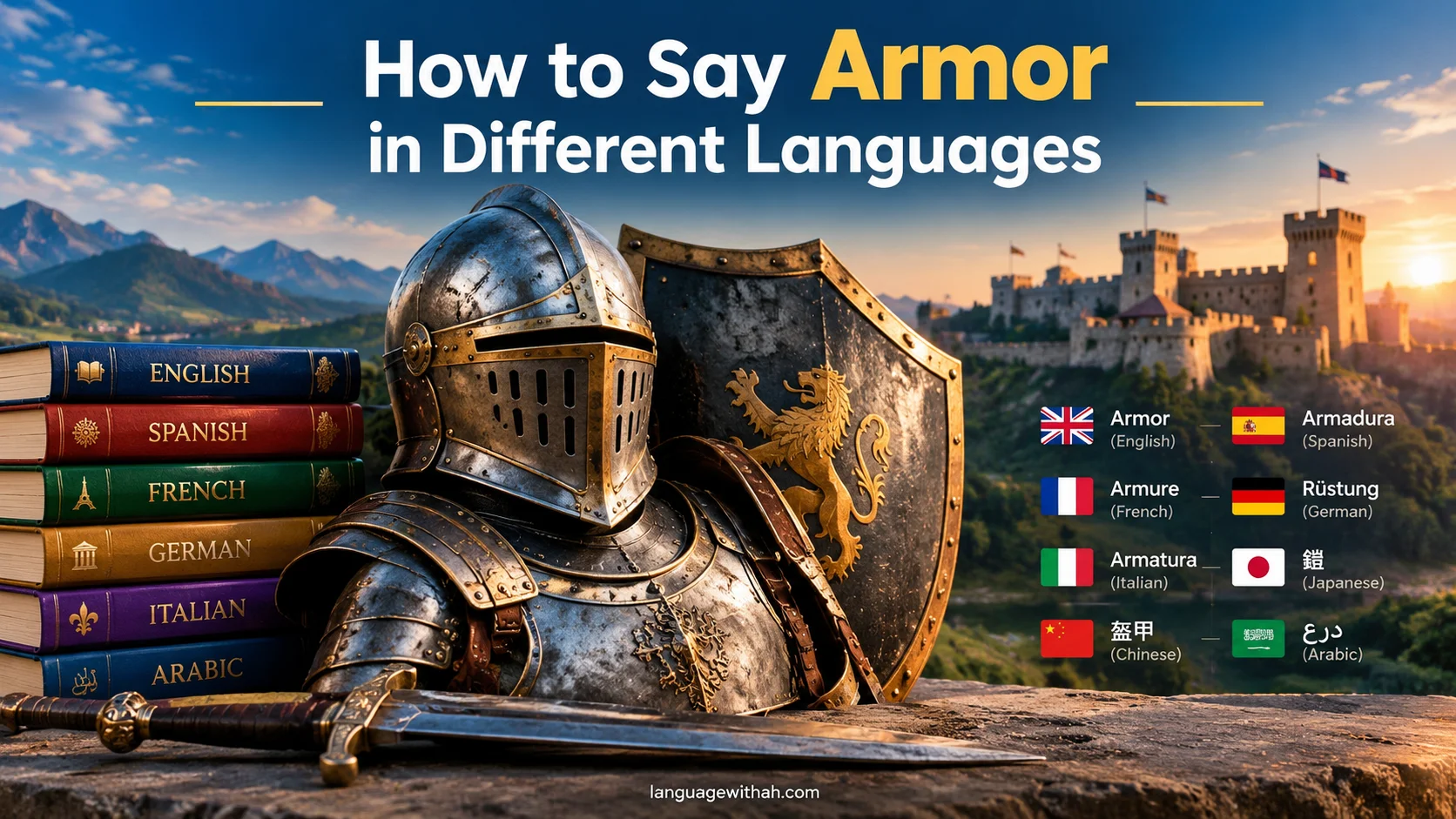
Armor is protective equipment designed to shield the body, vehicles, or other objects from injury and damage. The word armor in different languages can refer to ancient metal suits worn by knights, modern military protection, protective clothing, or figurative defenses against emotional harm. Although many languages have a direct equivalent for armor, the most natural word can depend on the material, historical period, and intended use.
Learning how to say armor in another language is useful for travelers visiting museums, students studying history, readers exploring mythology, gamers discussing equipment, and writers describing battles or protective gear. It can also help language learners understand how different cultures describe safety, defense, and resilience.
Some languages distinguish between a complete suit of armor and individual protective pieces, while others use different expressions for military body armor and medieval equipment. Context matters: a term appropriate for a historical knight may not be the best choice for a modern soldier’s protective vest. This guide explores translations, pronunciations, example sentences, and regional variations across languages worldwide so you can choose an expression that fits your intended meaning.
Interesting Facts About Armor
- Armor has several meanings. It can describe physical protection, such as a steel breastplate, or figurative protection against criticism and emotional pain.
- Historical armor differs from modern armor. Medieval armor often consisted of metal plates or linked rings, whereas modern protective equipment may use specialized fabrics, ceramics, composites, and other materials.
- Some languages distinguish armor by function. A word for a knight’s full suit may differ from one for a bullet-resistant vest or a protective shield.
- Spelling varies across English varieties. American English generally uses armor, while British and Australian English commonly use armour.
- Armor appears in mythology and literature. It often symbolizes courage, authority, preparedness, or protection, although its meaning depends on the story.
- Grammar affects translation. The word may have grammatical gender in some languages, and related adjectives or articles may change accordingly.
- Figurative armor is common in expressive writing. Phrases about emotional armor describe the ways people protect themselves from vulnerability, rejection, or disappointment.
What Does Armor Mean?
Armor means protective equipment that helps defend a person, animal, vehicle, or object against physical harm. Traditionally, the word is associated with helmets, breastplates, chain mail, and other equipment used by warriors.
The meaning depends on the situation:
- Historical armor: Metal or linked-ring equipment worn by knights and soldiers.
- Modern body armor: Protective equipment, such as a bullet-resistant vest, designed to reduce injury from particular threats.
- Vehicle armor: Protective plating or other materials used on military vehicles.
- Animal armor: Natural protective coverings, such as the hard plates or shells found on certain animals.
- Figurative armor: Emotional or psychological defenses that help someone feel less exposed or vulnerable.
In translation, the distinction between a complete suit, a single protective item, and a metaphorical defense is important. A general dictionary equivalent may work in one context but sound imprecise in another.
Why Can Armor Have Different Translations?
The word armor does not have one universally interchangeable translation in every language. Several factors influence the best choice.
- Context: A medieval knight’s armor and a modern bullet-resistant vest are different objects.
- Formality: Technical writing may use a specialized military or engineering term, while everyday conversation may use a broader word.
- Gender and grammar: Some languages assign nouns a grammatical gender or require changes to accompanying words.
- Regional variation: Speakers in different countries may prefer different technical terms or loanwords.
- Cultural history: Words associated with traditional weapons and protective clothing may reflect a region’s own historical equipment.
- Literal versus figurative meaning: Emotional armor may require a descriptive expression rather than the ordinary word for protective gear.
- Written versus spoken language: A formal term may be suitable for a museum label but less natural in casual conversation.
The translations below generally refer to physical armor or protective equipment, with contextual notes where a language distinguishes historical armor from modern body protection. The English example meanings clarify how each expression is being used.
European Languages
European languages belong to several language families, including Romance, Germanic, Slavic, and Uralic. Their words for armor reflect different linguistic histories and military traditions. The translations below use the general meaning of protective equipment, particularly armor worn by a person.
English varieties
| 🌍 Language | Country/Region | Translation | Pronunciation | Example Sentence |
| English | International | Armor | AR-mer | The knight wore armor. |
| American English 🇺🇸 | United States | Armor | AR-mer | The soldier wore armor. |
| British English 🇬🇧 | United Kingdom | Armour | AR-mer | The knight wore armour. |
| Australian English 🇦🇺 | Australia | Armour | AR-mer | The museum displays medieval armour. |
Usage note: American English uses armor, while British and Australian English generally use armour. The meaning and pronunciation are essentially the same.
European translations
| 🌍 Language | Country/Region | Translation | Pronunciation | Example Sentence |
| Spanish | Spain, Mexico, Latin America | Armadura | ar-ma-DOO-ra | El caballero llevaba una armadura. — The knight wore armor. |
| French | France, Belgium, Switzerland | Armure | ar-MOOR | Le chevalier portait une armure. — The knight wore armor. |
| German | Germany, Austria, Switzerland | Rüstung | RÜS-toong | Der Ritter trug eine Rüstung. — The knight wore armor. |
| Italian | Italy, Switzerland | Armatura | ar-ma-TOO-ra | Il cavaliere indossava un’armatura. — The knight wore armor. |
| Portuguese | Portugal, Brazil | Armadura | ar-ma-DOO-ra | O cavaleiro usava uma armadura. — The knight wore armor. |
| Dutch | Netherlands, Belgium | Harnas | HAR-nas | De ridder droeg een harnas. — The knight wore armor. |
| Swedish | Sweden, Finland | Rustning | ROOST-ning | Riddaren bar en rustning. — The knight wore armor. |
| Norwegian | Norway | Rustning | ROOST-ning | Ridderen bar rustning. — The knight wore armor. |
| Danish | Denmark | Rustning | ROOST-ning | Ridderen bar rustning. — The knight wore armor. |
| Finnish | Finland | Haarniska | HAAR-nis-ka | Ritari käytti haarniskaa. — The knight wore armor. |
| Icelandic | Iceland | Brynja | BRIN-ya | Riddarinn klæddist brynju. — The knight wore armor. |
| Irish | Ireland | Armúr | ar-MOOR | Chaith an ridire armúr. — The knight wore armor. |
| Welsh | Wales | Arfwisg | ar-VOOSG | Roedd y marchog yn gwisgo arfwisg. — The knight wore armor. |
| Polish | Poland | Zbroja | ZBROY-a | Rycerz nosił zbroję. — The knight wore armor. |
| Czech | Czechia | Brnění | BRN-yeh-nee | Rytíř měl brnění. — The knight wore armor. |
| Slovak | Slovakia | Brnenie | BR-neh-nyeh | Rytier mal brnenie. — The knight wore armor. |
| Ukrainian | Ukraine | Броня | bro-NYA | Лицар носив броню. — The knight wore armor. |
| Russian | Russia and other Russian-speaking regions | Броня | bra-NYA | Рыцарь носил доспехи. — The knight wore armor. |
| Romanian | Romania, Moldova | Armură | ar-MOO-ruh | Cavalerul purta armură. — The knight wore armor. |
| Hungarian | Hungary | Páncél | PAAN-tsayl | A lovag páncélt viselt. — The knight wore armor. |
| Greek | Greece, Cyprus | Πανοπλία | pa-no-PLEE-a | Ο ιππότης φορούσε πανοπλία. — The knight wore armor. |
| Bulgarian | Bulgaria | Броня | bro-NYA | Рицарят носеше броня. — The knight wore armor. |
| Croatian | Croatia | Oklop | OK-lop | Vitez je nosio oklop. — The knight wore armor. |
| Serbian | Serbia and neighboring regions | Оклоп / Oklop | OK-lop | Витез је носио оклоп. — The knight wore armor. |
| Slovenian | Slovenia | Oklep | OK-lep | Vitez je nosil oklep. — The knight wore armor. |
| Lithuanian | Lithuania | Šarvai | SHAR-vai | Riteris dėvėjo šarvus. — The knight wore armor. |
| Latvian | Latvia | Bruņas | BROO-nyas | Bruņinieks valkāja bruņas. — The knight wore armor. |
| Estonian | Estonia | Soomusrüü | SOO-mus-rüü | Rüütel kandis soomusrüüd. — The knight wore armor. |
Cultural and vocabulary notes
- In Spanish, armadura is a broad term for armor, particularly a suit of protective equipment.
- In French, armure commonly refers to armor worn by a person; specialized military contexts may use other terms.
- In German, Rüstung can refer to armor and, in other contexts, equipment or protective gear.
- In Russian, доспехи (dospekhi) is particularly relevant to a suit of historical armor, while броня (bronya) has broader uses involving armor or protective plating.
- In Finnish, haarniska specifically evokes a suit of armor, making it especially appropriate for a medieval knight.
Read More: How to Say Creative in Different Languages
Asian Languages
Asia contains numerous language families, scripts, and regional traditions. A word for historical armor may differ from the term used for modern military protection. The examples below focus primarily on protective equipment worn by a person, with the English meanings helping distinguish the intended context.
| 🌍 Language | Country/Region | Translation | Pronunciation | Example Sentence |
| Mandarin Chinese | China, Taiwan, Singapore | 盔甲 | kuī jiǎ | 骑士穿着盔甲。— The knight wore armor. |
| Cantonese | Hong Kong, Guangdong | 盔甲 | fui¹ gaap³ | 騎士穿著盔甲。— The knight wore armor. |
| Japanese | Japan | 鎧(よろい) | yoroi | 騎士は鎧を着ていた。— The knight wore armor. |
| Korean | South Korea, North Korea | 갑옷 | ga-bot | 기사는 갑옷을 입었다. — The knight wore armor. |
| Hindi | India | कवच | ka-vach | योद्धा ने कवच पहना। — The warrior wore armor. |
| Urdu | Pakistan, India | زرہ | zi-rah | جنگجو نے زرہ پہنی۔ — The warrior wore armor. |
| Bengali | Bangladesh, India | বর্ম | bôrmo | যোদ্ধাটি বর্ম পরেছিল। — The warrior wore armor. |
| Punjabi | India, Pakistan | ਜ਼ਿਰਹ / زرہ | zi-rah | ਯੋਧੇ ਨੇ ਜ਼ਿਰਹ ਪਹਿਨੀ। — The warrior wore armor. |
| Gujarati | India | બખ્તર | bakh-tar | યોદ્ધાએ બખ્તર પહેર્યું. — The warrior wore armor. |
| Marathi | India | चिलखत | chil-khat | योद्ध्याने चिलखत घातले. — The warrior wore armor. |
| Tamil | India, Sri Lanka, Singapore | கவசம் | ka-va-sam | வீரன் கவசம் அணிந்தான். — The warrior wore armor. |
| Telugu | India | కవచం | ka-va-cham | యోధుడు కవచం ధరించాడు. — The warrior wore armor. |
| Kannada | India | ಕವಚ | ka-va-cha | ಯೋಧನು ಕವಚ ಧರಿಸಿದನು. — The warrior wore armor. |
| Malayalam | India | കവചം | ka-va-cham | യോദ്ധാവ് കവചം ധരിച്ചു. — The warrior wore armor. |
| Nepali | Nepal, India | कवच | ka-vach | योद्धाले कवच लगायो। — The warrior wore armor. |
| Sinhala | Sri Lanka | සන්නාහය | san-naa-ha-ya | සටන්කරුවා සන්නාහය පැළඳ සිටියේය. — The warrior wore armor. |
| Thai | Thailand | เกราะ | grɔ̀ | นักรบสวมเกราะ — The warrior wears armor. |
| Vietnamese | Vietnam | Áo giáp | ao zap | Chiến binh mặc áo giáp. — The warrior wore armor. |
| Indonesian | Indonesia | Baju zirah | ba-joo zee-rah | Kesatria itu mengenakan baju zirah. — The knight wore armor. |
| Malay | Malaysia, Brunei, Singapore | Baju zirah | ba-ju zee-rah | Kesatria itu memakai baju zirah. — The knight wore armor. |
| Filipino / Tagalog | Philippines | Baluti | ba-loo-tee | Nakasuot ng baluti ang mandirigma. — The warrior wore armor. |
| Burmese | Myanmar | သံချပ်ကာ | than-chat-ka | စစ်သည်သည် သံချပ်ကာကို ဝတ်ဆင်ထားသည်။ — The soldier wears armor. |
| Khmer | Cambodia | គ្រឿងសឹក | krueang-seuk | អ្នកចម្បាំងពាក់គ្រឿងសឹក។ — The warrior wears armor. |
| Lao | Laos | ເກາະ | kaw | ນັກຮົບໃສ່ເກາະ. — The warrior wears armor. |
| Mongolian | Mongolia | Хуяг дуулга | khu-yag duul-ga | Дайчин хуяг дуулга өмссөн. — The warrior wore armor. |
| Kazakh | Kazakhstan | Сауыт | sa-uht | Жауынгер сауыт киді. — The warrior wore armor. |
| Uzbek | Uzbekistan | Sovut | so-vut | Jangchi sovut kiydi. — The warrior wore armor. |
Cultural and vocabulary notes
- Mandarin 盔甲 (kuī jiǎ) is a general term for armor. Modern protective equipment may have more specialized names.
- Japanese 鎧 (yoroi) is strongly associated with traditional armor. It is a better fit for historical armor than for every kind of modern protective vest.
- Hindi कवच (kavach) can mean armor or protective covering and may also appear in literary or religious contexts.
- Urdu زرہ (zirah) is associated with armor, particularly traditional protective equipment.
- Filipino baluti is a general word for armor; the most suitable term can vary with the kind of equipment being described.
African Languages
Africa is home to a remarkable range of languages, including Bantu, Afroasiatic, and Niger-Congo languages. Words for armor can refer to traditional protective equipment, military gear, or protective coverings. The following examples use a warrior or soldier as the context.
| 🌍 Language | Country/Region | Translation | Pronunciation | Example Sentence |
| Swahili | Tanzania, Kenya, East Africa | Silaha za kujikinga | see-LA-ha za ku-jee-KING-a | Shujaa alivaa vazi la kujikinga. — The hero wore protective clothing. |
| Afrikaans | South Africa, Namibia | Harnas | HAR-nas | Die ridder het ‘n harnas gedra. — The knight wore armor. |
| Zulu | South Africa | Izikhali zokuzivikela | ee-zee-KHA-lee zo-ku-zee-vee-KE-la | Umlwi wayegqoke izikhali zokuzivikela. — The warrior wore protective equipment. |
| Xhosa | South Africa | Isikrweqe | ee-see-KRWE-ke | Igorha lalinxibe isikrweqe. — The hero wore armor. |
| Amharic | Ethiopia | ጋሻ ልብስ | ga-sha libs | ተዋጊው ጋሻ ልብስ ለበሰ። — The warrior wore protective armor. |
| Yoruba | Nigeria, Benin | Ìhámọ́ra | ee-ha-MAW-rah | Akíkanjú náà wọ ìhámọ́ra. — The hero wore armor. |
| Igbo | Nigeria | Ihe agha nchebe | ee-he a-gha nche-be | Dike ahụ yikwara ihe agha nchebe. — The warrior wore protective armor. |
| Hausa | Nigeria, Niger, West Africa | Kayan sulke | ka-yan SOOL-ke | Jarumin ya sa kayan sulke. — The hero wore armor. |
| Somali | Somalia, Horn of Africa | Hub difaac | hoob dee-FAACH | Dagaalyahanku wuxuu xirnaa hub difaac. — The warrior wore protective gear. |
| Shona | Zimbabwe | Nhumbi dzokuzvidzivirira | n-HOOM-bee dzo-ku-zvee-dzee-dzee-vee-ree-ra | Murwi akapfeka nhumbi dzokuzvidzivirira. — The warrior wore protective equipment. |
| Sesotho | Lesotho, South Africa | Lihlomo | lee-HLO-mo | Mohlabani o ne a apere lihlomo. — The warrior wore armor. |
| Setswana | Botswana, South Africa | Dihlomo | dee-HLO-mo | Motsenyi o ne a apere dihlomo. — The warrior wore armor. |
| Kinyarwanda | Rwanda | Intwaro zo kwirinda | in-TWA-ro zo kwee-RIN-da | Umurwanyi yari yambaye ibikoresho byo kwirinda. — The warrior wore protective equipment. |
| Malagasy | Madagascar | Fiadian-tena | fee-a-dee-an-TE-na | Nitafy fiarovan-tena ilay mpiady. — The warrior wore protective gear. |
Cultural note: Some African languages use descriptive expressions meaning protective equipment rather than a single word corresponding exactly to English armor. These expressions can be more useful when the type of protection is not specified. Traditional equipment and modern military body armor may require different terminology.
Middle Eastern Languages
The Middle East contains several distinct language traditions, including Arabic, Persian, Hebrew, Kurdish, Turkish, and Armenian. Historical armor, modern protective equipment, and metaphorical protection may be described differently in each language. Arabic also has regional dialects, so the examples below identify the variety where relevant.
| 🌍 Language | Country/Region | Translation | Pronunciation | Example Sentence |
| Arabic (Modern Standard Arabic) | Middle East, North Africa | دِرْع | dirʿ | ارتدى المحارب درعًا. — The warrior wore armor. |
| Persian (Farsi) | Iran, Afghanistan, Tajikistan | زره | ze-reh | جنگجو زره پوشید. — The warrior wore armor. |
| Hebrew | Israel | שריון | shir-YON | הלוחם לבש שריון. — The warrior wore armor. |
| Kurdish (Kurmanji) | Türkiye, Iraq, Syria, Iran | Zirx | zeer-kh | Şervan zirx li xwe kir. — The warrior put on armor. |
| Turkish | Türkiye, Cyprus | Zırh | zuh-ruh | Savaşçı zırh giydi. — The warrior wore armor. |
| Armenian | Armenia, Armenian-speaking communities | Զրահ | zra-H | Ռազմիկը զրահ հագավ։ — The warrior wore armor. |
Cultural and vocabulary notes
- In Modern Standard Arabic, dirʿ refers to armor or a protective covering. Everyday dialects and modern military terminology may use other expressions.
- Persian زره (zereh) is used for armor, particularly traditional protective equipment.
- Hebrew שריון (shiryon) can refer to armor or armored protection; its precise meaning depends on context.
- Turkish zırh is appropriate for armor or protective plating. More specific terms are used for particular forms of body protection.
- Kurdish has regional and dialectal variation. The example uses Kurmanji rather than implying that one expression is universal across all Kurdish varieties.
Other World Languages
Languages from the Pacific, the Americas, and international language communities add further perspectives to the vocabulary of protection. Some use a traditional term, while others use a descriptive expression that communicates the idea of armor.
| 🌍 Language | Country/Region | Translation | Pronunciation | Example Sentence |
| Māori | New Zealand | Haumaru ā-tinana | how-MA-roo aa tee-NA-na | I mau te toa i ngā taputapu whakamarumaru. — The warrior wore protective equipment. |
| Samoan | Samoa, Pacific Islands | Ofutau | o-foo-tow | Sa ofuina e le toa le ofutau. — The warrior wore armor. |
| Hawaiian | Hawaiʻi | Pale kaua | PA-leh KOW-a | Ua komo ke koa i ka pale kaua. — The warrior wore armor. |
| Quechua | Andes, especially Peru and Bolivia | Arma hark’ay p’acha | AR-ma har-kay PA-cha | The expression is a descriptive rendering of protective clothing; regional terminology varies. |
| Esperanto | International | Kiraso | kee-RA-so | La kavaliro portis kirason. — The knight wore armor. |
| Haitian Creole | Haiti, Haitian diaspora | Zam | zam | Gèrye a te mete zam pwoteksyon. — The warrior wore protective equipment. |
| Guarani | Paraguay, neighboring regions | Ñemo’ã ao | nye-mo-AH ow | This is a descriptive expression for protective clothing; wording can vary by dialect and context. |
Note on regional terms: Descriptive expressions in Māori, Quechua, Guarani, and Haitian Creole should not automatically be treated as the only standard translation for armor. For technical, historical, or published work, verify the wording with a specialist familiar with the relevant regional variety.
Quick Reference: Armor in Different Languages
Use this table to find a translation quickly. Where a language has different terms for historical armor and modern protective equipment, the entry gives the general or context-specific form discussed above.
| Language | Translation |
| English | Armor |
| American English | Armor |
| British English | Armour |
| Australian English | Armour |
| Spanish | Armadura |
| French | Armure |
| German | Rüstung |
| Italian | Armatura |
| Portuguese | Armadura |
| Dutch | Harnas |
| Swedish | Rustning |
| Norwegian | Rustning |
| Danish | Rustning |
| Finnish | Haarniska |
| Icelandic | Brynja |
| Irish | Armúr |
| Welsh | Arfwisg |
| Polish | Zbroja |
| Czech | Brnění |
| Slovak | Brnenie |
| Ukrainian | Броня |
| Russian | Доспехи |
| Romanian | Armură |
| Hungarian | Páncél |
| Greek | Πανοπλία |
| Bulgarian | Броня |
| Croatian | Oklop |
| Serbian | Оклоп |
| Slovenian | Oklep |
| Lithuanian | Šarvai |
| Latvian | Bruņas |
| Estonian | Soomusrüü |
| Mandarin Chinese | 盔甲 |
| Cantonese | 盔甲 |
| Japanese | 鎧 |
| Korean | 갑옷 |
| Hindi | कवच |
| Urdu | زرہ |
| Bengali | বর্ম |
| Punjabi | ਜ਼ਿਰਹ / زرہ |
| Gujarati | બખ્તર |
| Marathi | चिलखत |
| Tamil | கவசம் |
| Telugu | కవచం |
| Kannada | ಕವಚ |
| Malayalam | കവചം |
| Nepali | कवच |
| Sinhala | සන්නාහය |
| Thai | เกราะ |
| Vietnamese | Áo giáp |
| Indonesian | Baju zirah |
| Malay | Baju zirah |
| Filipino / Tagalog | Baluti |
| Burmese | သံချပ်ကာ |
| Khmer | គ្រឿងសឹក |
| Lao | ເກາະ |
| Mongolian | Хуяг дуулга |
| Kazakh | Сауыт |
| Uzbek | Sovut |
| Swahili | Silaha za kujikinga |
| Afrikaans | Harnas |
| Zulu | Izikhali zokuzivikela |
| Xhosa | Isikrweqe |
| Amharic | ጋሻ ልብስ |
| Yoruba | Ìhámọ́ra |
| Igbo | Ihe agha nchebe |
| Hausa | Kayan sulke |
| Somali | Hub difaac |
| Shona | Nhumbi dzokuzvidzivirira |
| Sesotho | Lihlomo |
| Setswana | Dihlomo |
| Kinyarwanda | Intwaro zo kwirinda |
| Malagasy | Fiadian-tena |
| Arabic | دِرْع |
| Persian | زره |
| Hebrew | שריון |
| Kurdish (Kurmanji) | Zirx |
| Turkish | Zırh |
| Armenian | Զրահ |
| Māori | Haumaru ā-tinana |
| Samoan | Ofutau |
| Hawaiian | Pale kaua |
| Quechua | Descriptive expression; regional wording varies |
| Esperanto | Kiraso |
| Haitian Creole | Zam |
| Guarani | Descriptive expression; regional wording varies |
How to Choose the Right Translation
The best translation depends on what you want to describe and who will read or hear it.
- Identify the type of armor. For medieval clothing, choose a term associated with historical armor. For modern protective vests or vehicle plating, use the relevant technical term.
- Consider your audience. A general word is usually suitable for everyday conversation, while a museum description or military document may require more precise terminology.
- Check the region. Spanish, Arabic, Chinese, and Kurdish all have regional variation. Confirm that the selected expression suits the intended audience.
- Pay attention to grammar. Articles, adjectives, and verb forms may change according to the noun’s grammatical gender, number, or role in a sentence.
- Listen to pronunciation. Romanization helps you get started, but it cannot always capture sounds or tones accurately.
- Distinguish literal and figurative meanings. If you mean emotional armor rather than physical protection, a natural descriptive expression may work better than the ordinary noun.
Practical tip: If you are translating a tattoo, book title, product description, or historical inscription, have the complete phrase reviewed by a qualified speaker familiar with the intended context. A single translated word may not convey the same associations in every language.
Common Mistakes When Translating Armor
- Translating word for word: Some languages use a descriptive phrase instead of one noun.
- Confusing historical and modern equipment: A term for a knight’s suit may not describe a modern bullet-resistant vest accurately.
- Ignoring regional variation: A word that works in one dialect may not be the best choice elsewhere.
- Assuming similar words have identical meanings: Related words can differ in scope, usage, and connotation.
- Overlooking grammatical agreement: The surrounding words may need to change to match the translated noun.
- Relying entirely on English-style pronunciation: Romanized spellings are approximations, especially for tones and unfamiliar consonants.
- Using an unverified technical term: Military, engineering, and historical terminology may be more specific than everyday vocabulary.
- Confusing physical and figurative armor: Emotional protection may need a phrase that describes psychological defense rather than physical equipment.
The safest approach is to translate the intended object or idea, then check the expression in a complete sentence.
Why Learn Armor in Different Languages?
Learning the word for armor in several languages can be useful for more than vocabulary practice.
- Travel and museums: You can recognize relevant terms in historical exhibitions, captions, and guided tours.
- History and literature: The vocabulary helps when reading about knights, warriors, ancient civilizations, and military traditions.
- Gaming and entertainment: Knowing the relevant terms can make discussions of equipment, fantasy worlds, and historical games more precise.
- Language learning: Comparing related words helps you notice differences in spelling, grammar, and word formation.
- Writing and translation: A context-appropriate word makes descriptions more accurate and natural.
- Cultural understanding: Learning how languages describe protection can introduce you to different historical traditions without assuming that all cultures use the same concepts.
Vocabulary becomes more useful when you learn it in context. Instead of memorizing armor as an isolated word, practice it in a sentence about a knight, a soldier, a museum exhibit, or a protective vest. This helps you understand when a general term is enough and when a more specific expression is necessary.
FAQs:
How do you say armor in different languages?
The word armor has different translations around the world. Examples include armadura in Spanish, armure in French, Rüstung in German, 鎧 (yoroi) in Japanese, and زره (zirah) in Urdu. The best choice depends on whether you mean historical armor or modern protective equipment.
What is the most natural translation of armor?
The most natural translation depends on the language and context. For example, Spanish armadura is suitable for a suit of armor, while Japanese 鎧 (yoroi) is particularly associated with traditional armor. Technical descriptions may require more specialized vocabulary.
Does armor have different meanings in different countries?
Yes. The basic concept of physical protection remains recognizable, but the equipment being described and the terminology used can vary. Regional military terminology, historical traditions, and everyday usage all influence the best translation.
What is the difference between armor and armour?
Armor is the standard American English spelling. Armour is the usual spelling in British and Australian English, as well as several other varieties of English. Both words have the same basic meaning and pronunciation.
How do you say medieval armor in Spanish?
The usual word is armadura. For example, El caballero llevaba una armadura means “The knight wore armor.” The word is suitable for describing protective equipment worn by a historical knight.
Conclusion:
Learning how to say armor in different languages reveals how a familiar concept can be expressed through different words, writing systems, and cultural traditions. From Spanish armadura and French armure to Japanese yoroi and Arabic dirʿ, each translation provides a useful starting point for understanding protective equipment in another language.
However, the most accurate translation depends on context. A medieval knight’s suit, a modern protective vest, and the metaphorical idea of emotional armor may require different expressions. Literal translation is not always enough; grammar, regional usage, pronunciation, and the intended audience also matter.














1 thought on “How to Say Armor in Different Languages”