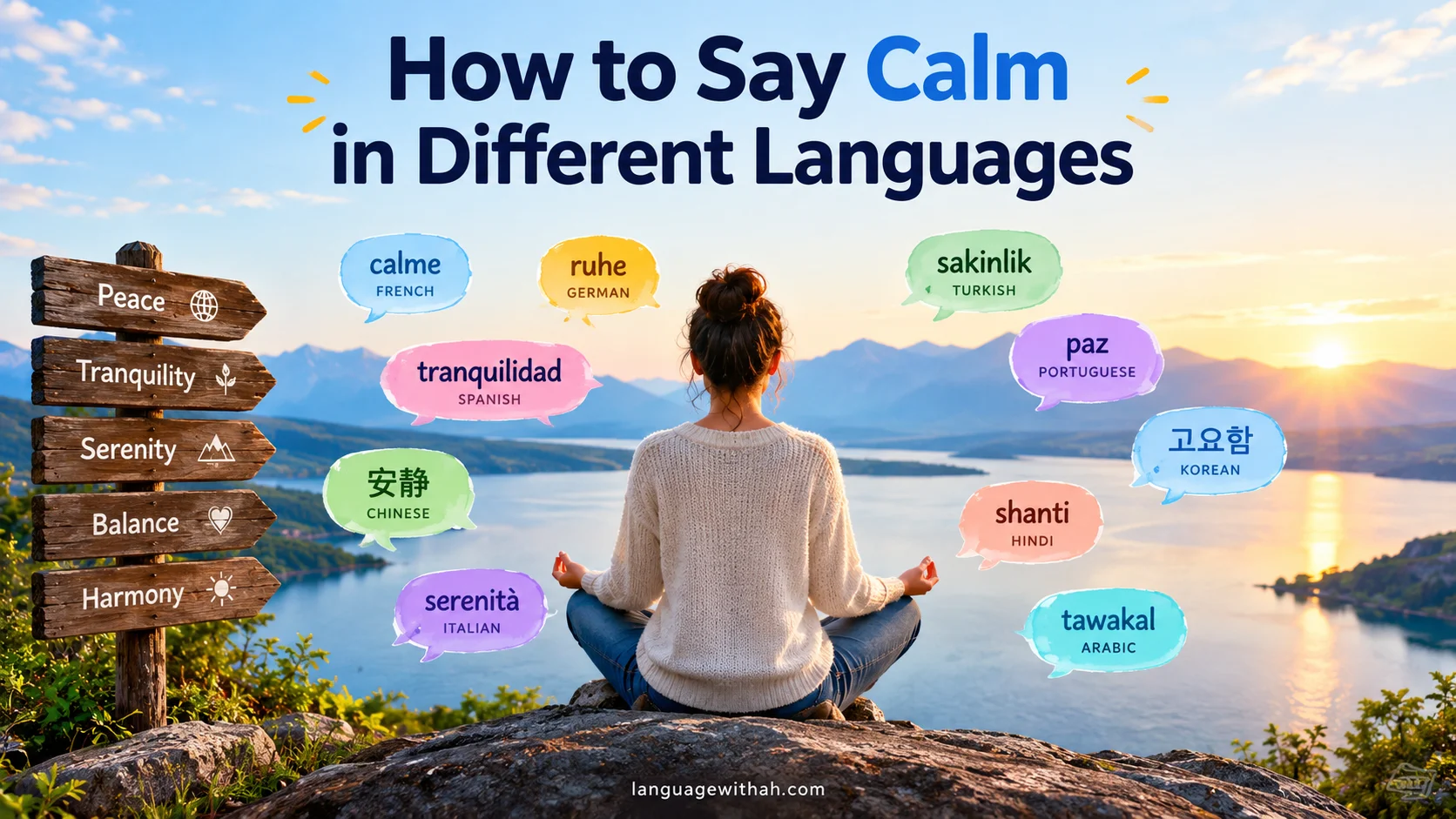
The word calm describes a state of peace, quietness, and emotional balance. It can refer to a relaxed person, a peaceful environment, a gentle voice, or the ability to remain composed during a difficult situation. Learning how to say calm in different languages helps you express these ideas more naturally when traveling, communicating with international friends, writing meaningful messages, or studying another language.
Although English uses one word for several situations, other languages may choose different expressions depending on the intended meaning. For example, describing a calm person is not always the same as asking someone to calm down or describing a peaceful sea. Some languages also change adjectives according to gender, number, or grammatical structure.
In this guide, you will discover translations of calm across European, Asian, African, and Middle Eastern languages, along with pronunciation guides and practical example sentences. You will also learn about regional variations, differences between literal and natural translations, and common mistakes to avoid. Whether you are learning vocabulary for everyday conversations or searching for a word that captures a peaceful feeling, understanding the context will help you choose an expression that communicates your meaning clearly and respectfully.
Interesting Facts About Calm
- Calm can describe emotions and surroundings. A person can feel calm, a room can be peaceful, and the sea can be still.
- Adjectives may change form. In languages such as Spanish, French, and Italian, an adjective describing a person may change according to grammatical gender or number.
- Calm down is a different expression. A word meaning calm does not automatically work as a command to someone who is upset.
- Peaceful and calm overlap but are not identical. Peaceful often emphasizes the absence of conflict or disturbance, while calm can emphasize composure or a lack of agitation.
- Context affects translation. The best word for a calm voice may differ from the expression used for a calm mind or quiet weather.
- Pronunciation can change meaning. In tonal languages such as Mandarin Chinese, tones are essential to distinguishing words.
- Politeness matters. An expression intended to reassure someone may sound different from a direct instruction to remain calm, especially in a formal conversation.
What Does Calm Mean?
Calm means peaceful, relaxed, or free from strong agitation. It can describe both an internal emotional state and an external situation.
Common meanings include:
- Emotionally calm: Feeling relaxed rather than worried, angry, or excited.
- A calm person: Someone who remains composed, even when facing pressure.
- A calm environment: A place with little noise, activity, or disturbance.
- Calm weather or water: Conditions with little wind, movement, or turbulence.
- Calm down: To become less upset, anxious, angry, or excited.
For this article, the main translation is the adjective calm, particularly when describing a person who is composed or a situation that is peaceful. Where a language uses a different expression for a peaceful environment, that distinction is noted where useful.
Why Can Calm Have Different Translations?
The word calm does not have one universal translation because languages organize emotions and descriptions differently. The best choice depends on what you are describing and how you intend to use it.
- Context: A calm person, a calm voice, and calm water may require different words.
- Formality: A reassuring expression used with a friend may not suit a professional or formal conversation.
- Gender and number: Some languages change adjective endings to agree with the person or thing being described.
- Regional dialects: Speakers in different regions may prefer different everyday expressions.
- Literal versus natural translation: A dictionary equivalent may be correct but sound awkward in a complete sentence.
- Written versus spoken language: A literary word for serenity may be less common in casual conversation.
- Cultural conventions: The way reassurance is phrased can depend on the relationship between speakers.
Translation tip: First decide whether you mean emotionally composed, quiet, peaceful, or becoming less upset. Then choose the word that matches that meaning.
European Languages
European languages belong to several language families, including Romance, Germanic, Slavic, and Uralic. Their translations of calm may overlap in meaning while differing in grammar, tone, and everyday usage. The examples below primarily describe a calm person or a peaceful situation.
English varieties
| 🌍 Language | Country/Region | Translation | Pronunciation | Example Sentence |
| English | International | Calm | kahm | Stay calm. — Remain composed. |
| American English 🇺🇸 | United States | Calm | kahm | She stayed calm during the storm. — She remained composed. |
| British English 🇬🇧 | United Kingdom | Calm | kahm | He remained calm throughout. — He stayed composed. |
| Australian English 🇦🇺 | Australia | Calm | kahm | Try to stay calm. — Try to remain composed. |
These English varieties use the same standard spelling and meaning. Accent and intonation differ, but the word itself does not require a separate translation.
European translation table
| 🌍 Language | Country/Region | Translation | Pronunciation | Example Sentence |
| Spanish | Spain, Latin America | Tranquilo / tranquila | trahn-KEE-loh / trahn-KEE-lah | Estoy tranquilo. — I am calm. |
| French | France, Belgium, Canada | Calme | kahm | Elle est calme. — She is calm. |
| German | Germany, Austria, Switzerland | Ruhig | ROO-ikh | Bleib ruhig. — Stay calm. |
| Italian | Italy, Switzerland | Calmo / calma | KAHL-moh / KAHL-mah | Sono calmo. — I am calm. |
| Portuguese | Portugal, Brazil | Calmo / calma | KAHL-moo / KAHL-mah | Estou calmo. — I am calm. |
| Dutch | Netherlands, Belgium | Kalm | kahlm | Blijf kalm. — Stay calm. |
| Swedish | Sweden, Finland | Lugn | loongn | Jag är lugn. — I am calm. |
| Norwegian | Norway | Rolig | ROO-lee | Vær rolig. — Be calm. |
| Danish | Denmark | Rolig | ROH-lee | Hold dig rolig. — Stay calm. |
| Finnish | Finland | Rauhallinen | ROW-hahl-lee-nen | Olen rauhallinen. — I am calm. |
| Icelandic | Iceland | Rólegur / róleg | ROH-leh-gur / ROH-leh | Hún er róleg. — She is calm. |
| Irish | Ireland | Socair | SUH-kir | Tá sí socair. — She is calm. |
| Welsh | Wales | Tawel | TOW-el | Mae hi’n dawel. — She is calm. |
| Polish | Poland | Spokojny / spokojna | spoh-KOY-nih / spoh-KOY-nah | Jestem spokojny. — I am calm. |
| Czech | Czechia | Klidný / klidná | KLEED-nee / KLEED-nah | Jsem klidný. — I am calm. |
| Slovak | Slovakia | Pokojný / pokojná | poh-KOY-nee / poh-KOY-nah | Som pokojný. — I am calm. |
| Ukrainian | Ukraine | Спокійний / спокійна | spoh-KEE-yee / spoh-KEE-nah | Я спокійний. — I am calm. |
| Russian | Russia and other Russian-speaking communities | Спокойный / спокойная | spuh-KOY-nyy / spuh-KOY-nuh-yuh | Я спокоен. — I am calm. |
| Romanian | Romania, Moldova | Calm / calmă | kahm / KAHL-muh | Sunt calm. — I am calm. |
| Hungarian | Hungary | Nyugodt | NYOO-got | Nyugodt vagyok. — I am calm. |
| Greek | Greece, Cyprus | Ήρεμος / ήρεμη | EE-reh-mos / EE-reh-mee | Είμαι ήρεμος. — I am calm. |
| Bulgarian | Bulgaria | Спокоен / спокойна | spoh-KOH-en / spoh-KOY-nah | Аз съм спокоен. — I am calm. |
| Croatian | Croatia | Smiren / smirena | Smee-ren / smee-reh-nah | Ostajem smiren. — I remain calm. |
| Serbian | Serbia and neighboring regions | Смирен / смирена | smee-ren / smee-reh-nah | Остајем смирен. — I remain calm. |
| Slovenian | Slovenia | Miren / mirna | MEE-ren / MEER-nah | Ostajam miren. — I remain calm. |
| Lithuanian | Lithuania | Ramus / rami | RAH-moos / RAH-mee | Esu ramus. — I am calm. |
| Latvian | Latvia | Mierīgs / mierīga | MYEH-reegs / MYEH-ree-gah | Es esmu mierīgs. — I am calm. |
| Estonian | Estonia | Rahulik | RAH-hoo-lik | Ma olen rahulik. — I am calm. |
Cultural and grammar note: Several European languages use different adjective forms for masculine and feminine subjects. The appropriate form may also change with grammatical number or sentence structure. In Spanish, for example, tranquilo and tranquila describe masculine and feminine subjects, respectively.
In Norwegian and Danish, rolig can mean calm or quiet depending on context. In Swedish, lugn is the usual adjective for being calm, whereas rolig generally means fun or amusing. Similar-looking words do not always carry the same meaning across languages.
Read More: How to Say Cupcake in Different Languages
Asian Languages
Asia has a wide range of language families, scripts, and pronunciation systems. A translation for calm may describe emotional composure, a quiet atmosphere, or peacefulness, so context remains important. The table uses common expressions and includes romanization for languages that do not use the Latin alphabet.
| 🌍 Language | Country/Region | Translation | Pronunciation | Example Sentence |
| Mandarin Chinese | China, Taiwan, Singapore | 平静的 (píngjìng de) | peeng-jing duh | 我现在很平静。— I am calm now. |
| Cantonese | Hong Kong, Guangdong | 冷静 (ling5 zing6) | ling-jing | 你要保持冷靜。— You should stay calm. |
| Japanese | Japan | 落ち着いた (ochitsuita) | oh-chee-tsoo-ee-tah | 彼女は落ち着いています。— She is calm. |
| Korean | South Korea, North Korea | 차분한 (chabunhan) | cha-boon-han | 그는 차분해요. — He is calm. |
| Hindi | India | शांत (shaant) | shaant | मैं शांत हूँ। — I am calm. |
| Urdu | Pakistan, India | پُرسکون (pursukoon) | pur-suh-koon | میں پُرسکون ہوں۔ — I am calm. |
| Bengali | Bangladesh, India | শান্ত (shanto) | SHAAN-toh | আমি শান্ত আছি। — I am calm. |
| Punjabi | Pakistan, India | ਸ਼ਾਂਤ / ਸ਼ਾਂਤ (shaant) | shaant | ਮੈਂ ਸ਼ਾਂਤ ਹਾਂ। — I am calm. |
| Gujarati | India | શાંત (shaant) | shaant | હું શાંત છું. — I am calm. |
| Marathi | India | शांत (shaant) | shaant | मी शांत आहे. — I am calm. |
| Tamil | India, Sri Lanka, Singapore | அமைதியான (amaithiyaana) | uh-my-thee-YAA-nah | நான் அமைதியாக இருக்கிறேன். — I am calm. |
| Telugu | India | ప్రశాంతమైన (prashantamaina) | pruh-SHAAN-tuh-my-nah | నేను ప్రశాంతంగా ఉన్నాను. — I am calm. |
| Kannada | India | ಶಾಂತ (shaanta) | SHAAN-tah | ನಾನು ಶಾಂತವಾಗಿದ್ದೇನೆ. — I am calm. |
| Malayalam | India | ശാന്തമായ (shaantamaaya) | SHAAN-tuh-maa-yah | ഞാൻ ശാന്തനാണ്. — I am calm. |
| Nepali | Nepal, India | शान्त (shaanta) | SHAAN-tah | म शान्त छु। — I am calm. |
| Sinhala | Sri Lanka | සන්සුන් (sansun) | san-soon | මම සන්සුන්ව සිටිමි. — I am calm. |
| Thai | Thailand | สงบ (sa-ngop) | sa-ngop | ฉันรู้สึกสงบ — I feel calm. |
| Vietnamese | Vietnam | Bình tĩnh | bing ting | Tôi vẫn bình tĩnh. — I remain calm. |
| Indonesian | Indonesia | Tenang | tuh-nang | Saya tetap tenang. — I remain calm. |
| Malay | Malaysia, Brunei, Singapore | Tenang | tuh-nang | Saya berasa tenang. — I feel calm. |
| Filipino/Tagalog | Philippines | Kalmado / kalma | kahl-MAH-doh / KAHL-mah | Kalmado siya. — He or she is calm. |
| Burmese | Myanmar | တည်ငြိမ်သော (ti-nyi-n) | tee-nyee-n | သူက တည်ငြိမ်တယ်။ — He or she is calm. |
| Khmer | Cambodia | ស្ងប់ស្ងាត់ (sngop sngat) | sngop sngaat | ខ្ញុំមានអារម្មណ៍ស្ងប់ស្ងាត់។ — I feel calm. |
| Lao | Laos | ສະຫງົບ (sa-ngop) | sah-ngop | ຂ້ອຍຮູ້ສຶກສະຫງົບ. — I feel calm. |
| Mongolian | Mongolia | Тайван (taivan) | TIE-vahn | Би тайван байна. — I am calm. |
| Kazakh | Kazakhstan | Сабырлы (sabyrly) | sah-buhr-LUH | Мен сабырлымын. — I am calm. |
| Uzbek | Uzbekistan | Xotirjam | khoh-teer-JAHM | Men xotirjamman. — I am calm. |
Important Asian language notes
- Mandarin: 平静 (píngjìng) describes calmness or tranquility. The example uses the complete expression 很平静 (hěn píngjìng), meaning calm or peaceful.
- Cantonese: 冷靜 (ling5 zing6) often emphasizes staying composed. The numbers in Jyutping romanization represent tones.
- Japanese: 落ち着いた describes someone or something composed, settled, or calm. 落ち着いて is commonly used when asking someone to calm down.
- Korean: 차분하다 conveys being composed or calm. The form used in the table is a polite conversational sentence.
- Hindi and Urdu: The words शांत and پُرسکون overlap in meaning, but the best choice depends on whether you mean quietness, inner peace, or composure.
- Indonesian and Malay: Both use tenang. The surrounding sentence and local usage establish whether it refers to a calm person, mind, or situation.
- Tagalog: Kalmado is commonly used for a composed person, while kalma also appears in casual speech and expressions such as calming down.
African Languages
Africa is home to extensive linguistic diversity, including Bantu, Afroasiatic, and Niger-Congo languages, among many others. Words associated with calm may express peace, quietness, patience, or emotional control. These examples illustrate individual languages and should not be treated as interchangeable across the continent.
| 🌍 Language | Country/Region | Translation | Pronunciation | Example Sentence |
| Swahili | Tanzania, Kenya, East Africa | Tulivu | too-LEE-voo | Niko mtulivu. — I am calm. |
| Afrikaans | South Africa, Namibia | Kalm | kahm | Ek is kalm. — I am calm. |
| Zulu | South Africa | Zolile | zoh-LEE-leh | Ngizolile. — I am calm. |
| Xhosa | South Africa | Zolile | zoh-LEE-leh | Ndizolile. — I am calm. |
| Amharic | Ethiopia | शांत (calm: ረጋ ያለ) | reh-gah yah-leh | እርሱ ረጋ ያለ ነው። — He is calm. |
| Yoruba | Nigeria, Benin | Tútù | too-too | Mo wà ní ìdákẹ́jẹ́. — I am at peace. |
| Igbo | Nigeria | Dị jụụ | dee joo | Obi ya dị jụụ. — His or her mind is calm. |
| Hausa | Nigeria, Niger, West Africa | Natsuwa | nah-tsoo-wah | Ina cikin natsuwa. — I am calm. |
| Somali | Somalia, Somaliland, Horn of Africa | Deggan | DEH-gan | Waan degganahay. — I am calm. |
| Shona | Zimbabwe | Dzikama | dzee-KAH-mah | Ndakadzikama. — I am calm. |
| Sesotho | Lesotho, South Africa | Khobile | khoh-BEE-leh | Ke khobile. — I am calm. |
| Setswana | Botswana, South Africa | Didimetse | dee-dee-MET-seh | Ke didimetse. — I am calm. |
| Kinyarwanda | Rwanda | Tuze | TOO-zeh | Ndatuje. — I have calmed down. |
| Malagasy | Madagascar | Tony | TOO-nee | Tony aho. — I am calm. |
Cultural and usage notes
- In Swahili, tulivu describes calmness or quietness; mtulivu is a form used for a calm person.
- In Yoruba, tútù can describe coolness or calmness, while ìdákẹ́jẹ́ emphasizes quietness or peace. The appropriate word depends on the sentence.
- In Hausa, natsuwa conveys composure or tranquility.
- In Kinyarwanda, tuze can describe being calm or composed, while Ndatuje can express that someone has calmed down.
- In Shona, dzikama is closely associated with calming down or becoming composed.
These distinctions are useful because a direct adjective translation does not always work in a complete sentence.
Middle Eastern Languages
The Middle East includes Arabic-speaking communities, Persian-speaking communities, Hebrew speakers, Kurdish-speaking communities, and other linguistic traditions. Even within one language, expressions for calm can vary between formal writing and everyday conversation. The following examples distinguish standard forms from important regional considerations.
| 🌍 Language | Country/Region | Translation | Pronunciation | Example Sentence |
| Arabic (Modern Standard Arabic) | Middle East, North Africa | هادئ / هادئة | HAA-di’ / HAA-di-ah | أنا هادئ. — I am calm. |
| Persian (Farsi) | Iran, Afghanistan, Tajikistan (related varieties) | آرام | aa-RAAM | من آرام هستم. — I am calm. |
| Hebrew | Israel | רגוע / רגועה | rah-GOO-ah / reh-goo-AH | אני רגוע. — I am calm. |
| Kurdish (Kurmanji) | Türkiye, Iraq, Syria, Iran | Aram | ah-RAHM | Ez aram im. — I am calm. |
| Turkish | Türkiye, Cyprus | Sakin | sah-KEEN | Sakinim. — I am calm. |
| Armenian | Armenia and Armenian-speaking communities | Հանգիստ (hangist) | hahn-GEEST | Ես հանգիստ եմ։ — I am calm. |
Important Middle Eastern language notes
- Arabic: هادئ is the masculine form and هادئة the feminine form of an adjective meaning calm or quiet. Regional dialects use other expressions, including forms related to hādi and rāyeq, depending on the dialect and situation.
- Persian: آرام can describe calmness, peace, or a gentle quality. It is also used in expressions relating to doing something calmly.
- Hebrew: רגוע is masculine and רגועה feminine. The adjective changes according to the person being described.
- Kurdish: Kurdish has several varieties, and vocabulary may differ between Kurmanji and Sorani. The table uses Kurmanji.
- Turkish: Sakin can mean calm, quiet, or composed. In an instruction, Sakin ol means “Calm down” or “Be calm,” depending on context.
- Armenian: Հանգիստ can mean calm, quiet, or at ease, depending on how it is used.
Other World Languages
Some languages outside the regions above offer especially useful ways to express peacefulness and composure. Their vocabulary may distinguish a peaceful feeling from the act of becoming calm.
| 🌍 Language | Country/Region | Translation | Pronunciation | Example Sentence |
| Māori | New Zealand | Marino | mah-REE-noh | Kei te tau taku ngākau. — My heart is at peace. |
| Samoan | Samoa, Pacific Islands | Filemu | fee-LEH-moo | Ou te filemu. — I am peaceful. |
| Hawaiian | Hawaiʻi, United States | Mālie | maa-LEE-eh | He mālie ka moana. — The ocean is calm. |
| Quechua | Andes, especially Peru and Bolivia | Thaklla / samay (context-dependent) | varies by variety | The wording depends on the Quechua variety and whether calmness or rest is intended. |
| Haitian Creole | Haiti and Haitian communities worldwide | Kalm | kahm | Mwen rete kalm. — I remain calm. |
| Esperanto | International constructed language | Trankvila | trahnk-VEE-lah | Mi estas trankvila. — I am calm. |
Note: Quechua has multiple regional varieties, and the words used for calmness, rest, or peacefulness are not fully interchangeable. The row is included as a contextual example, not as a single universal Quechua translation.
Quick Reference: Calm in Different Languages
Use this compact table to find a translation quickly. The words generally refer to a calm or composed person, unless a different nuance is noted.
| Language | Translation |
| English | Calm |
| American English | Calm |
| British English | Calm |
| Australian English | Calm |
| Spanish | Tranquilo / tranquila |
| French | Calme |
| German | Ruhig |
| Italian | Calmo / calma |
| Portuguese | Calmo / calma |
| Dutch | Kalm |
| Swedish | Lugn |
| Norwegian | Rolig |
| Danish | Rolig |
| Finnish | Rauhallinen |
| Icelandic | Rólegur / róleg |
| Irish | Socair |
| Welsh | Tawel |
| Polish | Spokojny / spokojna |
| Czech | Klidný / klidná |
| Slovak | Pokojný / pokojná |
| Ukrainian | Спокійний / спокійна |
| Russian | Спокойный / спокойная |
| Romanian | Calm / calmă |
| Hungarian | Nyugodt |
| Greek | Ήρεμος / ήρεμη |
| Bulgarian | Спокоен / спокойна |
| Croatian | Smiren / smirena |
| Serbian | Смирен / смирена |
| Slovenian | Miren / mirna |
| Lithuanian | Ramus / rami |
| Latvian | Mierīgs / mierīga |
| Estonian | Rahulik |
| Mandarin Chinese | 平静的 |
| Cantonese | 冷靜 |
| Japanese | 落ち着いた |
| Korean | 차분한 |
| Hindi | शांत |
| Urdu | پُرسکون |
| Bengali | শান্ত |
| Punjabi | ਸ਼ਾਂਤ |
| Gujarati | શાંત |
| Marathi | शांत |
| Tamil | அமைதியான |
| Telugu | ప్రశాంతమైన |
| Kannada | ಶಾಂತ |
| Malayalam | ശാന്തമായ |
| Nepali | शान्त |
| Sinhala | සන්සුන් |
| Thai | สงบ |
| Vietnamese | Bình tĩnh |
| Indonesian | Tenang |
| Malay | Tenang |
| Filipino/Tagalog | Kalmado / kalma |
| Burmese | တည်ငြိမ်သော |
| Khmer | ស្ងប់ស្ងាត់ |
| Lao | ສະຫງົບ |
| Mongolian | Тайван |
| Kazakh | Сабырлы |
| Uzbek | Xotirjam |
| Swahili | Tulivu |
| Afrikaans | Kalm |
| Zulu | Zolile |
| Xhosa | Zolile |
| Amharic | ረጋ ያለ |
| Yoruba | Tútù |
| Igbo | Dị jụụ |
| Hausa | Natsuwa |
| Somali | Deggan |
| Shona | Dzikama |
| Sesotho | Khobile |
| Setswana | Didimetse |
| Kinyarwanda | Tuze |
| Malagasy | Tony |
| Arabic | هادئ / هادئة |
| Persian | آرام |
| Hebrew | רגוע / רגועה |
| Kurdish (Kurmanji) | Aram |
| Turkish | Sakin |
| Armenian | Հանգիստ |
| Māori | Marino |
| Samoan | Filemu |
| Hawaiian | Mālie |
| Quechua | Context-dependent |
| Haitian Creole | Kalm |
| Esperanto | Trankvila |
How to Choose the Right Translation
The best translation depends on what you want to describe and who will read or hear it.
- For a calm person: Choose an adjective that describes emotional composure, such as Spanish tranquilo or German ruhig.
- For a peaceful atmosphere: Choose a word that naturally describes quiet surroundings or tranquility.
- For a supportive message: Use a complete, polite expression rather than inserting the adjective by itself.
- For a formal setting: Check whether the language has formal and informal ways to address another person.
- For a tattoo or permanent inscription: Verify the wording, grammar, and intended nuance with a qualified speaker of the specific language variety.
- For regional communication: Confirm whether the word is familiar in the country or community where you intend to use it.
Remember that the translation for “I am calm” may differ from “Stay calm.” A descriptive adjective and an instruction do different grammatical jobs.
Common Mistakes When Translating Calm
Several common errors can make a translation sound unnatural or change its meaning.
- Translating word for word: A dictionary equivalent may not fit every sentence. Choose a complete expression appropriate to the context.
- Ignoring grammatical gender: Spanish, French, Italian, Arabic, and Hebrew may require different forms depending on the subject.
- Confusing calm with quiet: Someone can speak quietly without feeling emotionally calm.
- Mixing dialects: A formal expression and a regional everyday expression may not sound equally natural to the intended audience.
- Using an adjective as a command: Saying that someone is calm is different from telling them to calm down.
- Ignoring pronunciation: In tonal languages, such as Mandarin and Cantonese, tone can affect meaning.
- Assuming similar words mean the same thing: Swedish lugn and Norwegian or Danish rolig illustrate why related languages still need separate checks.
- Overlooking the situation: A word suitable for describing calm weather may not be the best choice for reassuring an anxious friend.
Best practice: Learn the word alongside a natural sentence, not as an isolated vocabulary item.
Why Learn Calm in Different Languages?
Learning how to express calm in different languages expands your vocabulary and helps you communicate more thoughtfully. It can be useful when reassuring a friend, describing your feelings, traveling, writing a personal message, or learning how another language expresses emotional states.
Comparing translations also reveals how languages distinguish between composure, quietness, relaxation, and peace. This helps learners recognize that a single English word can correspond to several expressions in another language.
For travelers, even a small amount of local vocabulary can make everyday interactions easier. For students, comparing adjective forms and sentence structures can strengthen grammar skills. For anyone communicating across cultures, understanding context helps prevent a well-intended message from sounding too blunt or unnatural.
The goal is not simply to memorize a long list of words. It is to understand when and how each expression works. Pairing a translation with its pronunciation, grammatical form, and example sentence is a practical way to build that understanding.
FAQs:
How do you say calm in different languages?
The word calm has different translations around the world. Examples include tranquilo in Spanish, calme in French, ruhig in German, tenang in Indonesian and Malay, and 平静 (píngjìng) in Mandarin Chinese. The most suitable form depends on the sentence and intended meaning.
What is the most natural translation of calm?
There is no single best translation for every situation. Spanish tranquilo, French calme, and Japanese 落ち着いた (ochitsuita) can all describe calmness, but they differ in grammar and usage. Choose the word that best expresses whether you mean composure, quietness, or peacefulness.
Can the translation of calm change by country?
Yes. Speakers of the same language may use different regional vocabulary or expressions. Arabic, Spanish, Portuguese, and Chinese, for example, have regional varieties with differences in everyday speech. The core meaning may remain similar even when the wording changes.
What is the difference between calm and peaceful?
Calm often describes a person who is composed or a situation with little agitation. Peaceful more strongly emphasizes tranquility or the absence of disturbance or conflict. The meanings overlap, but they are not always interchangeable.
Does pronunciation change between regions?
Yes. Accents and pronunciation can vary across regions, even when the spelling is identical. Mandarin and Cantonese also use tones that are important to meaning. For unfamiliar words, listen to recordings from speakers of the intended language variety whenever possible.
Conclusion:
Learning how to say calm in different languages offers more than a way to memorize foreign vocabulary. It helps you understand how different languages express emotional balance, quietness, and peacefulness. Words such as Spanish tranquilo, French calme, German ruhig, and Japanese 落ち着いた illustrate how languages can communicate similar ideas through different grammatical structures and expressions.













1 thought on “How to Say Calm in Different Languages”