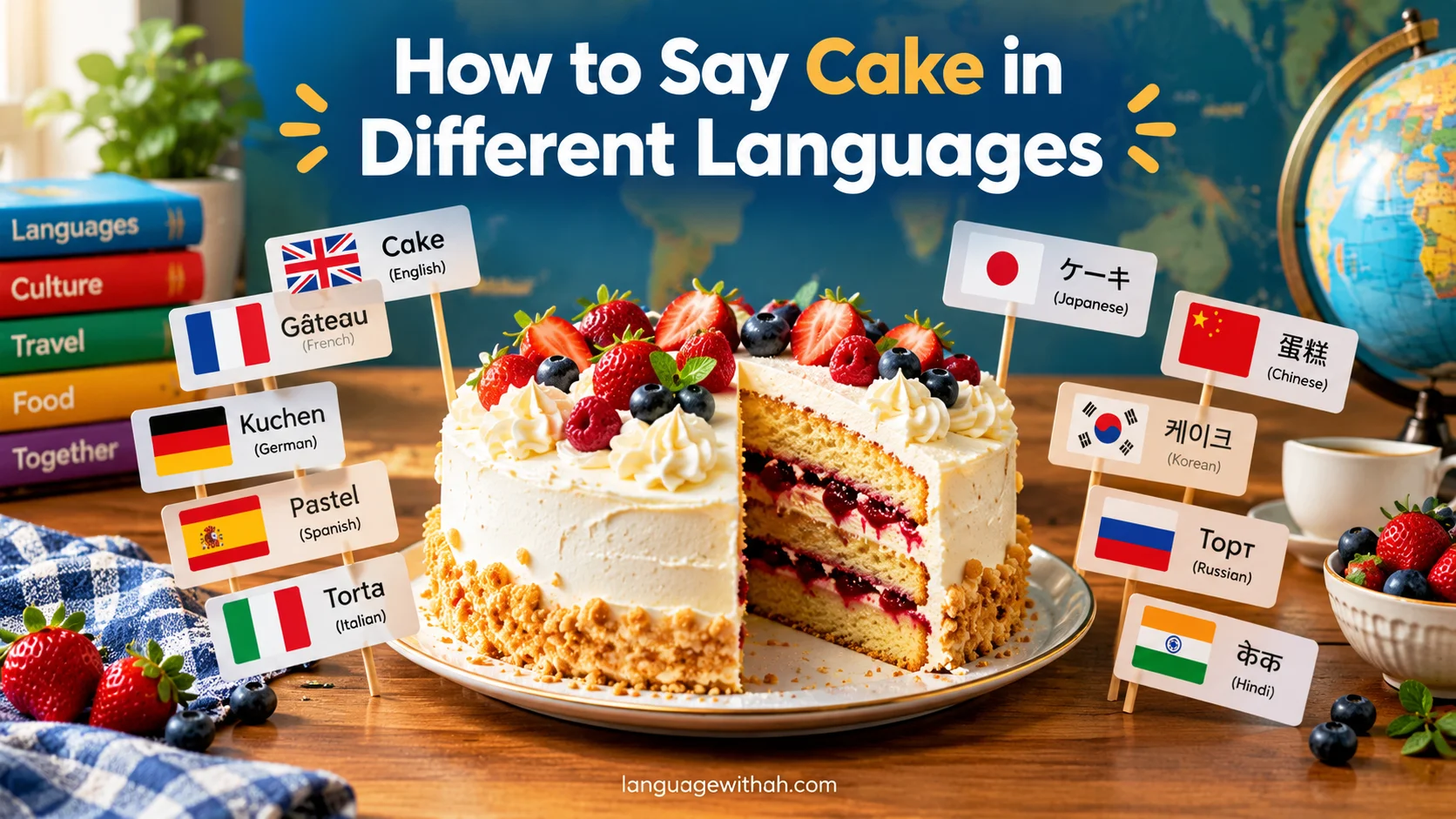
Cake is a beloved dessert enjoyed at birthdays, weddings, family gatherings, holidays, and celebrations around the world. Although the ingredients and baking traditions may differ, the word for cake offers an interesting glimpse into how languages describe food and culture. Learning how to say cake in 70 different languages can help you communicate while traveling, understand international recipes, and share a little sweetness with people from different backgrounds.
The English word cake can refer to many baked treats, including sponge cakes, chocolate cakes, cheesecakes, and celebration cakes. However, not every language uses one word for all these varieties. Some languages have a general term for cake, while others distinguish between pastries, sweet breads, and particular desserts. Pronunciation and spelling can also vary by region.
In this guide, you will discover cake translations across European, Asian, African, and Middle Eastern languages, along with pronunciation guides and example sentences. You will also learn about regional differences, useful food vocabulary, and common translation mistakes. Whether you are a language learner, a traveler exploring local bakeries, or someone preparing a multilingual birthday message, this guide will help you choose expressions that make sense in context.
Interesting Facts About Cake
- Cake has different names around the world: Many languages have a general word for cake, but the term may cover a different range of baked desserts than the English word.
- Celebration cakes are culturally important: Cakes commonly appear at birthdays, weddings, anniversaries, and other special occasions, although traditions differ between communities.
- Some words describe particular types of cake: A language may distinguish sponge cake, fruitcake, cheesecake, and sweet bread instead of treating them as interchangeable.
- Borrowed words are common in food vocabulary: Languages sometimes adopt or adapt foreign food names as new recipes and baking styles become familiar.
- Pronunciation follows local sound systems: Even when two languages use similar spellings, their vowels and consonants may sound different.
- A cake is not always the same as a pastry: Words translated as cake, pie, tart, or sweet bread can overlap in everyday use without referring to exactly the same food.
- Context matters when ordering dessert: Knowing whether you want a whole cake, a slice, or a specific flavor can make communication in a bakery much easier.
What Does Cake Mean?
A cake is generally a sweet baked food made from ingredients such as flour, sugar, eggs, and fat, often combined with flavorings, fruit, chocolate, or other ingredients. It may be decorated with frosting, cream, icing, or toppings, depending on the recipe.
The word can describe many desserts, from a simple homemade sponge cake to a layered birthday cake. Some cakes are rich and dense, while others are light and airy. Cheesecakes and flourless cakes also fall under the broad English category, even though their ingredients and preparation methods can differ considerably.
Cake also has a celebratory meaning in many settings. A birthday cake, for example, can represent a shared occasion, while a wedding cake may be part of a traditional ceremony.
However, translating cake is not always straightforward. A word used for a traditional European-style cake may not describe a local steamed dessert or sweet rice cake precisely. When ordering food or translating a recipe, the type of cake is often just as important as the word itself.
Why Can Cake Have Different Translations?
Cake has different translations because languages categorize foods according to their own culinary traditions, histories, and everyday usage. A word that broadly means cake in one language may refer more specifically to a pastry, sweet loaf, or celebratory dessert in another.
Several factors influence the best translation:
- Context: A birthday cake may have a more specific name than a simple baked cake.
- Regional variation: Speakers in different countries may use different words for similar desserts.
- Culinary traditions: Local cakes can be made from rice, nuts, fruit, cheese, or other ingredients rather than the standard flour-and-sugar mixture.
- Borrowed vocabulary: Some languages use adapted versions of the English word, while others have established native terms.
- Grammar and sentence structure: The word may change form depending on whether the sentence refers to one cake, several cakes, or a particular cake.
- Written and spoken language: A word in a recipe may differ from the casual term used when chatting with friends.
The translations below focus on the general meaning of cake as a sweet dessert, rather than one specific recipe. Where a language has important distinctions, the accompanying notes explain them.
European Languages
Europe has a wide range of languages, including Romance, Germanic, Slavic, and Uralic languages. Many share related food vocabulary, but their words for cake can differ according to local baking traditions. The following table gives general dessert terms and simple examples.
| 🌍 Language | Country/Region | Translation | Pronunciation | Example Sentence |
| English | International | Cake | kayk | I like cake. |
| American English 🇺🇸 | United States | Cake | kayk | This cake is delicious. |
| British English 🇬🇧 | United Kingdom | Cake | kayk | Would you like some cake? |
| Australian English 🇦🇺 | Australia | Cake | kayk | We bought a chocolate cake. |
| Spanish | Spain, Mexico, Latin America | Pastel / tarta | pahs-TEL / TAR-tah | Me gusta el pastel. — I like cake. |
| French | France, Belgium, parts of Canada | Gâteau | gah-TOH | J’aime le gâteau. — I like cake. |
| German | Germany, Austria, Switzerland | Kuchen | KOO-khen | Ich mag Kuchen. — I like cake. |
| Italian | Italy, Switzerland | Torta | TOR-tah | Mi piace la torta. — I like cake. |
| Portuguese | Portugal, Brazil | Bolo | BOH-loo | Eu gosto de bolo. — I like cake. |
| Dutch | Netherlands, Belgium | Taart / cake | tahrt / kayk | Ik hou van taart. — I like cake. |
| Swedish | Sweden, Finland | Tårta | TOR-tah | Jag tycker om tårta. — I like cake. |
| Norwegian | Norway | Kake | KAH-keh | Jeg liker kake. — I like cake. |
| Danish | Denmark | Kage | KAY-eh | Jeg kan godt lide kage. — I like cake. |
| Finnish | Finland | Kakku | KAHK-koo | Pidän kakusta. — I like cake. |
| Icelandic | Iceland | Kaka | KAH-ka | Mér finnst kaka góð. — I think cake is good. |
| Irish | Ireland | Cáca | KAW-kuh | Is maith liom cáca. — I like cake. |
| Welsh | Wales | Teisen | TAY-sen | Dw i’n hoffi teisen. — I like cake. |
| Polish | Poland | Ciasto | CHYAS-toh | Lubię ciasto. — I like cake. |
| Czech | Czechia | Dort | dort | Mám rád dort. — I like cake. |
| Slovak | Slovakia | Torta | TOR-tah | Mám rád tortu. — I like cake. |
| Ukrainian | Ukraine | Торт | tort | Я люблю торт. — I like cake. |
| Russian | Russia and neighboring communities | Торт | tort | Я люблю торт. — I like cake. |
| Romanian | Romania, Moldova | Prăjitură / tort | pruh-zhee-TOO-ruh / tort | Îmi place tortul. — I like cake. |
| Hungarian | Hungary | Torta | TOR-tah | Szeretem a tortát. — I like cake. |
| Greek | Greece, Cyprus | Κέικ | keik | Μου αρέσει το κέικ. — I like cake. |
| Bulgarian | Bulgaria | Торта | TOR-tah | Обичам торта. — I like cake. |
| Croatian | Croatia | Torta | TOR-tah | Volim tortu. — I like cake. |
| Serbian | Serbia and neighboring communities | Торта | TOR-tah | Волим торту. — I like cake. |
| Slovenian | Slovenia | Torta | TOR-tah | Rad imam torto. — I like cake. |
| Lithuanian | Lithuania | Tortas | TOR-tahs | Man patinka tortas. — I like cake. |
| Latvian | Latvia | Kūka | KOO-kah | Man garšo kūka. — I like cake. |
| Estonian | Estonia | Kook | kook | Mulle meeldib kook. — I like cake. |
English varieties: Is the word different?
The general word cake is the same in American, British, and Australian English. Pronunciation and accent differ, but the spelling and basic meaning do not change.
Other English food terms can vary: sponge cake, fruitcake, pound cake, and tea cake may refer to different recipes or traditions depending on the region. When ordering, naming the flavor or style can be more helpful than relying on the word cake alone.
Cultural notes
- In Spanish, pastel is common in much of Latin America, while tarta is frequently used for cakes and tarts in Spain. Usage varies by country and dessert.
- French gâteau is a broad term for cake, while tarte generally refers to a tart.
- German Kuchen often refers to everyday cakes and baked desserts, while Torte commonly describes a layered or decorated cake.
- Italian torta is widely used for cakes, but the exact dessert can be clarified with a flavor or style.
- In Polish, ciasto can mean cake or a broader range of baked sweets; tort is especially associated with a layered celebration cake.
- Finnish kakku and Estonian kook illustrate how related-looking words can still have distinct local pronunciations.
Read More: How to Say Calm in Different Languages
Asian Languages
Asia contains many language families and writing systems, from Chinese characters and Japanese kana to South Asian scripts and Southeast Asian alphabets. Cake translations also reflect local desserts, including steamed cakes, rice-based sweets, and Western-style baked cakes.
The terms below refer to cake in a general or commonly understood dessert sense. For traditional local foods, a more specific name may be appropriate.
| 🌍 Language | Country/Region | Translation | Pronunciation | Example Sentence |
| Mandarin Chinese | China, Taiwan, Singapore | 蛋糕 | dàng gāo | 我喜欢蛋糕。— I like cake. |
| Cantonese | Hong Kong, Guangdong | 蛋糕 | daan6 gou1 | 我鍾意蛋糕。— I like cake. |
| Japanese | Japan | ケーキ | kēki | ケーキが好きです。— I like cake. |
| Korean | South Korea, North Korea | 케이크 | keikeu | 케이크를 좋아해요. — I like cake. |
| Hindi | India | केक | kek | मुझे केक पसंद है। — I like cake. |
| Urdu | Pakistan, India | کیک | kek | مجھے کیک پسند ہے۔ — I like cake. |
| Bengali | Bangladesh, India | কেক | kek | আমার কেক ভালো লাগে। — I like cake. |
| Punjabi | India, Pakistan | ਕੇਕ / کیک | kek | ਮੈਨੂੰ ਕੇਕ ਪਸੰਦ ਹੈ۔ — I like cake. |
| Gujarati | India | કેક | kek | મને કેક ગમે છે. — I like cake. |
| Marathi | India | केक | kek | मला केक आवडतो. — I like cake. |
| Tamil | India, Sri Lanka, Singapore | கேக் | kēk | எனக்கு கேக் பிடிக்கும். — I like cake. |
| Telugu | India | కేక్ | kēk | నాకు కేక్ ఇష్టం. — I like cake. |
| Kannada | India | ಕೇಕ್ | kēk | ನನಗೆ ಕೇಕ್ ಇಷ್ಟ. — I like cake. |
| Malayalam | India | കേക്ക് | kēk | എനിക്ക് കേക്ക് ഇഷ്ടമാണ്. — I like cake. |
| Nepali | Nepal, India | केक | kek | मलाई केक मन पर्छ। — I like cake. |
| Sinhala | Sri Lanka | කේක් | kēk | මම කේක්වලට කැමතියි. — I like cake. |
| Thai | Thailand | เค้ก | khék | ฉันชอบเค้ก — I like cake. |
| Vietnamese | Vietnam | Bánh kem / bánh ngọt | banh kem / banh ngot | Tôi thích bánh kem. — I like cream cake. |
| Indonesian | Indonesia | Kue | koo-eh | Saya suka kue. — I like cake. |
| Malay | Malaysia, Brunei, Singapore | Kek | kehk | Saya suka kek. — I like cake. |
| Filipino (Tagalog) | Philippines | Keyk / cake | keyk | Gusto ko ng keyk. — I like cake. |
| Burmese | Myanmar | ကိတ်မုန့် | keiʔ moun | ကိတ်မုန့်ကို ကြိုက်တယ်။ — I like cake. |
| Khmer | Cambodia | នំខេក | num khaek | ខ្ញុំចូលចិត្តនំខេក។ — I like cake. |
| Lao | Laos | ເຄັກ | khek | ຂ້ອຍມັກເຄັກ. — I like cake. |
| Mongolian | Mongolia | Бялуу | byaa-loo | Би бялуунд дуртай. — I like cake. |
| Kazakh | Kazakhstan | Торт | tort | Мен тортты жақсы көремін. — I like cake. |
| Uzbek | Uzbekistan | Tort | tort | Men tortni yaxshi ko‘raman. — I like cake. |
Cultural notes
- Mandarin 蛋糕 (dàngāo) is a common general term for cake. In Cantonese, the characters are similar, but the pronunciation and tones differ.
- Japanese ケーキ and Korean 케이크 are loanwords used for many Western-style cakes. Local traditional sweets usually have their own names.
- In Vietnamese, bánh kem often refers to a cream-frosted cake, while bánh ngọt is a broader term for sweet baked goods.
- Indonesian kue is broader than the English word cake and can include various cakes, pastries, and traditional sweets.
- Hindi and Urdu frequently use the borrowed word for cake in everyday conversation, especially when discussing modern bakery products.
- In many South Asian languages, a borrowed word may be the clearest term for a Western-style celebration cake, even when the language also has words for traditional sweets.
African Languages
Africa is home to thousands of languages and a remarkable range of food traditions. English and French loanwords appear in some modern bakery settings, while many languages have their own everyday food vocabulary. The examples below use general terms for cake where practical.
| 🌍 Language | Country/Region | Translation | Pronunciation | Example Sentence |
| Swahili | Tanzania, Kenya, East Africa | Keki | KEH-kee | Ninapenda keki. — I like cake. |
| Afrikaans | South Africa, Namibia | Koek | kook | Ek hou van koek. — I like cake. |
| Zulu | South Africa | Ikhekhe | ee-KHEH-kheh | Ngiyalithanda ikhekhe. — I like cake. |
| Xhosa | South Africa | Ikeyiki | ee-kay-YEE-kee | Ndiyayithanda ikeyiki. — I like cake. |
| Amharic | Ethiopia | ኬክ | kek | ኬክ እወዳለሁ። — I like cake. |
| Yoruba | Nigeria, West Africa | Kẹ́ẹ̀kì | keh-eh-kee | Mo fẹ́ràn kẹ́ẹ̀kì. — I like cake. |
| Igbo | Nigeria | Achicha | ah-chee-chah | Achọrọ m achicha. — I want cake. |
| Hausa | Nigeria, Niger, West Africa | Kek | kek | Ina son kek. — I like cake. |
| Somali | Somalia, Horn of Africa | Keeg | keeg | Waxaan jeclahay keeg. — I like cake. |
| Shona | Zimbabwe | Keke | KEH-keh | Ndinoda keke. — I like cake. |
| Sesotho | Lesotho, South Africa | Keke | KEH-keh | Ke rata keke. — I like cake. |
| Setswana | Botswana, South Africa | Keke | KEH-keh | Ke rata keke. — I like cake. |
| Kinyarwanda | Rwanda | Gâteau / keke | gah-TOH / KEH-keh | Nkunda keke. — I like cake. |
| Malagasy | Madagascar | Mofomamy | moo-foo-MAH-mee | Tiako ny mofomamy. — I like cake. |
Cultural notes
- Swahili keki and several Southern African terms resemble international words for cake, reflecting the movement of modern bakery vocabulary across languages.
- In Yoruba, kẹ́ẹ̀kì is a borrowed term. The accent marks represent tones and help distinguish pronunciation.
- Malagasy mofomamy is a broader sweet-food term and can refer to cakes and other sweet preparations, depending on context.
- In Igbo, achicha can refer to food more broadly and is not a precise equivalent of every Western-style cake. For a specific bakery item, explaining the type may be clearer.
- Loanwords can be useful when ordering a familiar bakery product, but local traditional sweets often have more specific names.
Middle Eastern Languages
The Middle East includes several distinct language families, scripts, and regional dialects. Arabic, Persian, Hebrew, Kurdish, and Turkish have different histories and grammatical structures, so their cake vocabulary should not be treated as interchangeable.
| 🌍 Language | Country/Region | Translation | Pronunciation | Example Sentence |
| Arabic (Modern Standard Arabic) | Middle East, North Africa | كعكة | kaʿ-kah | أحب الكعكة. — I like cake. |
| Persian (Farsi) | Iran | کیک | keyk | من کیک دوست دارم. — I like cake. |
| Hebrew | Israel | עוגה | oo-GAH | אני אוהב עוגה. — I like cake. |
| Kurdish (Kurmanji) | Türkiye, Iraq, Syria, Iran | Kek | kek | Ez kekê hez dikim. — I like cake. |
| Turkish | Türkiye, Cyprus | Pasta | PAHS-tah | Pastayı seviyorum. — I like cake. |
| Armenian | Armenia and Armenian communities worldwide | Տորթ | tort | Ես սիրում եմ տորթ։ — I like cake. |
Cultural notes
- Arabic: كعكة is a general word for cake, but regional speech may use other terms, including borrowed vocabulary. Usage varies between countries and dialects.
- Persian: کیک is commonly used for Western-style cakes. Traditional sweets may have entirely different names.
- Hebrew: עוגה is the general word for cake. The sentence changes according to the speaker’s gender: אני אוהב עוגה is typically masculine, while אני אוהבת עוגה is typically feminine.
- Turkish: Pasta means cake in this context, especially a cream or celebration cake. It should not be confused with the English word pasta for noodles.
- Armenian: Տորթ commonly refers to a cake, particularly a decorated or layered cake.
Other World Languages
Beyond Europe, Asia, Africa, and the Middle East, many communities have their own languages and food traditions. Some use established words for traditional sweet foods, while others use borrowed vocabulary for modern bakery cakes.
| 🌍 Language | Country/Region | Translation | Pronunciation | Example Sentence |
| Māori | New Zealand | Keke | KEH-keh | He pai ki ahau te keke. — I like cake. |
| Samoan | Samoa, Pacific Islands | Keke | KEH-keh | Ou te fiafia i le keke. — I like cake. |
| Hawaiian | Hawaiʻi | Keke | KEH-keh | Makemake au i ke keke. — I like cake. |
| Quechua | Andes, including Peru and Bolivia | Torta | TOR-tah | Me gusta la torta. — I like cake. |
| Guarani | Paraguay and neighboring regions | Torta | TOR-tah | Che gusta torta. — I like cake. |
| Haitian Creole | Haiti | Gato | gah-TOH | Mwen renmen gato. — I like cake. |
| Esperanto | International constructed language | Kuko | KOO-koh | Mi ŝatas kukon. — I like cake. |
Cultural notes
- Māori, Samoan, and Hawaiian use forms of keke for cake, although pronunciation and local food contexts differ.
- In Quechua and Guarani, food vocabulary can vary across varieties and communities. The examples above use a familiar borrowed term rather than claiming that it is the only traditional equivalent.
- Haitian Creole gato is used for cake and is related historically to French gâteau.
- Esperanto kuko is the general word for cake; kukon is its accusative form in the example sentence.
Quick Reference: Cake in Different Languages
Use this table to look up the word for cake quickly. Some languages use a broad term for sweet baked foods, while others distinguish a decorated celebration cake from an everyday cake.
| Language | Translation |
| English | Cake |
| American English | Cake |
| British English | Cake |
| Australian English | Cake |
| Spanish | Pastel / tarta |
| French | Gâteau |
| German | Kuchen |
| Italian | Torta |
| Portuguese | Bolo |
| Dutch | Taart / cake |
| Swedish | Tårta |
| Norwegian | Kake |
| Danish | Kage |
| Finnish | Kakku |
| Icelandic | Kaka |
| Irish | Cáca |
| Welsh | Teisen |
| Polish | Ciasto |
| Czech | Dort |
| Slovak | Torta |
| Ukrainian | Торт |
| Russian | Торт |
| Romanian | Prăjitură / tort |
| Hungarian | Torta |
| Greek | Κέικ |
| Bulgarian | Торта |
| Croatian | Torta |
| Serbian | Торта |
| Slovenian | Torta |
| Lithuanian | Tortas |
| Latvian | Kūka |
| Estonian | Kook |
| Mandarin Chinese | 蛋糕 |
| Cantonese | 蛋糕 |
| Japanese | ケーキ |
| Korean | 케이크 |
| Hindi | केक |
| Urdu | کیک |
| Bengali | কেক |
| Punjabi | ਕੇਕ / کیک |
| Gujarati | કેક |
| Marathi | केक |
| Tamil | கேக் |
| Telugu | కేక్ |
| Kannada | ಕೇಕ್ |
| Malayalam | കേക്ക് |
| Nepali | केक |
| Sinhala | කේක් |
| Thai | เค้ก |
| Vietnamese | Bánh kem / bánh ngọt |
| Indonesian | Kue |
| Malay | Kek |
| Filipino (Tagalog) | Keyk / cake |
| Burmese | ကိတ်မုန့် |
| Khmer | នំខេក |
| Lao | ເຄັກ |
| Mongolian | Бялуу |
| Kazakh | Торт |
| Uzbek | Tort |
| Swahili | Keki |
| Afrikaans | Koek |
| Zulu | Ikhekhe |
| Xhosa | Ikeyiki |
| Amharic | ኬክ |
| Yoruba | Kẹ́ẹ̀kì |
| Igbo | Achicha |
| Hausa | Kek |
| Somali | Keeg |
| Shona | Keke |
| Sesotho | Keke |
| Setswana | Keke |
| Kinyarwanda | Keke / gâteau |
| Malagasy | Mofomamy |
| Arabic | كعكة |
| Persian (Farsi) | کیک |
| Hebrew | עוגה |
| Kurdish (Kurmanji) | Kek |
| Turkish | Pasta |
| Armenian | Տորթ |
| Māori | Keke |
| Samoan | Keke |
| Hawaiian | Keke |
| Quechua | Torta |
| Guarani | Torta |
| Haitian Creole | Gato |
| Esperanto | Kuko |
How to Choose the Right Translation
The best translation depends on what kind of cake you mean, where you are, and who you are speaking to.
- For everyday conversation: Use the general word for cake in the relevant language.
- For birthdays and celebrations: Look for the term commonly used for a decorated or layered cake.
- For ordering in a bakery: Mention the flavor or style, such as chocolate cake, sponge cake, or cheesecake.
- For recipes: Check whether the target-language term refers to the same ingredients and preparation method.
- For messages and captions: A simple, familiar term is usually sufficient, especially when wishing someone a happy birthday.
- For formal writing: Prefer standard spelling and the established term used in the intended region.
When communicating with someone who speaks a language you are learning, it is useful to show the written word as well as practice saying it aloud. A written translation can help prevent misunderstandings when two words sound similar.
Common Mistakes When Translating Cake
Learning a word is a good start, but a few common mistakes can lead to confusion.
- Translating every dessert as cake. A tart, pastry, sweet bread, and cake may be different categories. Choose the word that best describes the actual food.
- Assuming one translation works everywhere. Spanish pastel and tarta, for example, have different regional patterns of use.
- Ignoring local culinary traditions. A traditional rice cake may not resemble a Western-style sponge cake.
- Using misleading pronunciation. Similar spelling does not guarantee similar sounds. Pay attention to vowel quality, stress, and tones.
- Confusing borrowed words with native vocabulary. A loanword may be common in a bakery but not cover every traditional sweet.
- Forgetting grammatical agreement. In some languages, a sentence changes according to gender, number, or the grammatical role of the word.
- Assuming a word has only one meaning. Indonesian kue, for instance, can refer to a wider variety of sweet foods than the English word cake.
A useful rule: Translate the food and the situation, not just the English word.
Why Learn Cake in Different Languages?
Learning food vocabulary is a practical way to make language learning part of everyday life. The word cake is especially useful because it appears in recipes, restaurant menus, bakeries, birthday invitations, and conversations about celebrations.
Knowing the correct translation can help you order dessert while traveling, understand a foreign-language recipe, or communicate with friends and family who speak another language. It also introduces you to regional vocabulary, different writing systems, and the ways languages borrow words from one another.
Food words can reveal useful cultural distinctions, too. Learning that a language separates a layered celebration cake from an everyday baked cake gives you more precise vocabulary than simply memorizing a dictionary equivalent.
For learners, an effective approach is to practice the word in a short sentence, listen to its pronunciation, and connect it with a real object or picture. Reviewing a few words at a time is often more useful than memorizing a long list without context.
FAQs:
How do you say cake in different languages?
Cake has different names around the world. Examples include gâteau in French, torta in Italian, bolo in Portuguese, Kuchen in German, keki in Swahili, and 蛋糕 (dàngāo) in Mandarin Chinese.
What is the French word for cake?
The French word for cake is gâteau, pronounced approximately gah-TOH. The word tarte is used for a tart, which is a different type of dessert.
What is the Spanish word for cake?
Spanish uses pastel, tarta, and other regional terms. Pastel is common in many Latin American countries, while tarta is frequently used in Spain. The best choice depends on the country and type of dessert.
How do you say cake in Japanese?
Cake is ケーキ (kēki) in Japanese. It is a loanword commonly used for Western-style cakes, including chocolate cakes and birthday cakes.
How do you say cake in Chinese?
In Mandarin Chinese, cake is 蛋糕 (dàngāo). In Cantonese, the same characters are pronounced daan6 gou1 in Jyutping romanization.
Conclusion:
Learning how to say cake in 70 different languages is a simple way to explore the relationship between vocabulary, food, and culture. From French gâteau and Italian torta to Japanese ケーキ and Mandarin 蛋糕, each language offers its own way of describing a familiar dessert. Although many translations are easy to recognize, they do not always refer to precisely the same kinds of food.














1 thought on “How to Say Cake in Different Languages”