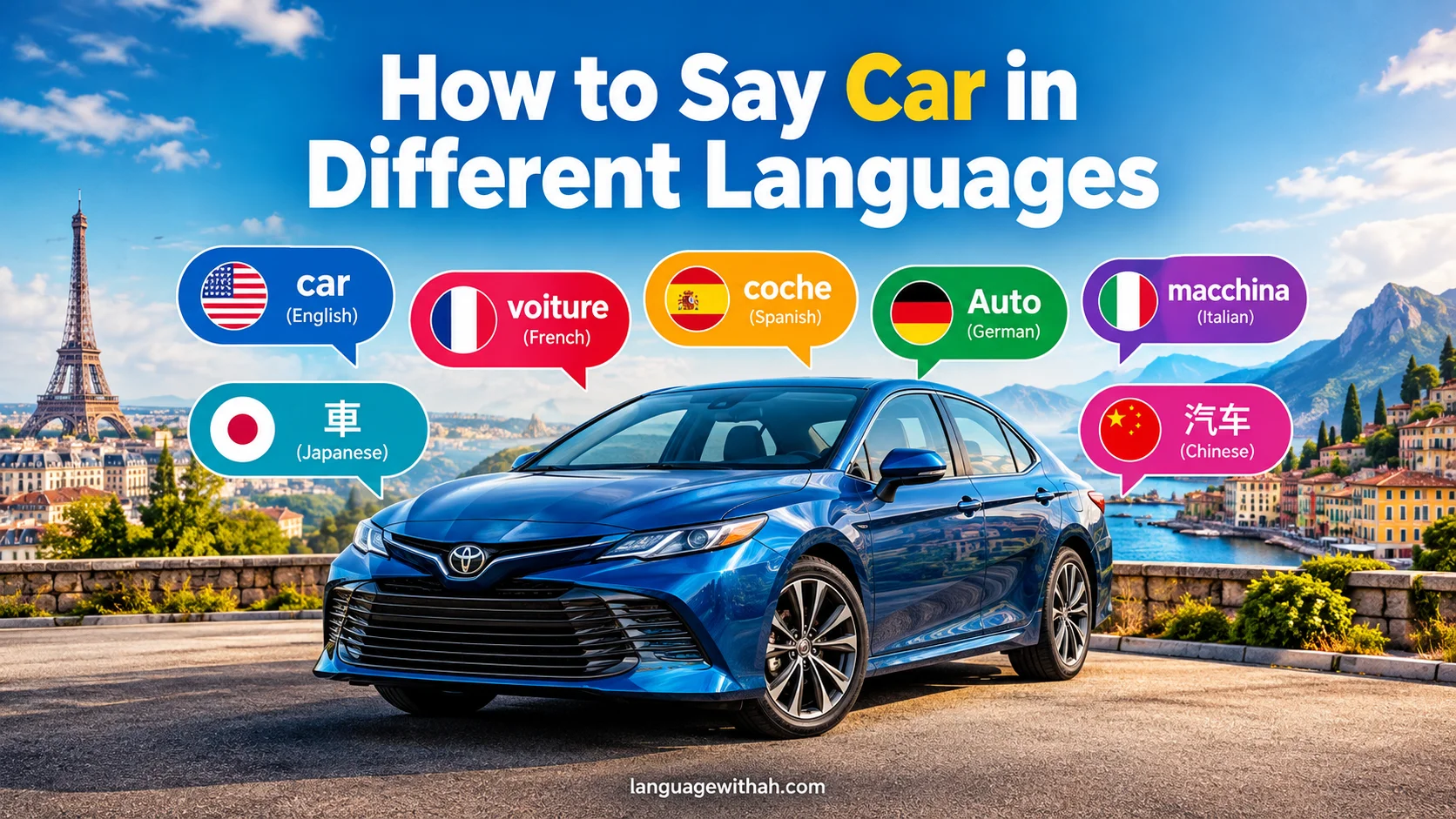
A car is more than a way to travel: it can represent independence, convenience, family trips, road adventures, and everyday life. Learning how to say car in different languages is a practical way to expand your vocabulary, prepare for international travel, and communicate with people from different linguistic backgrounds. Whether you are asking about a rental car, discussing a vehicle with a friend, or learning basic words for a new language, knowing the right expression can make conversations easier.
The word car has different forms across languages. Spanish speakers use coche in much of Spain and carro or auto in many Latin American countries. French uses voiture, while German uses Auto or Wagen in appropriate contexts. These differences show why a useful translation involves more than replacing one word with another.
In this guide, you will discover translations of car in more than 70 languages, with pronunciation guides, example sentences, regional distinctions, and practical learning tips. You will also learn how to recognize informal expressions and choose wording that suits your situation.
Interesting Facts About Car in Different Languages
- One object, many words: The everyday English word car corresponds to different words in other languages, including voiture in French, coche in Spanish, and Auto in German.
- Regional Spanish varies: Coche is common in Spain, while carro is widely used in several Latin American countries. Auto is also common in parts of Latin America.
- Some languages have borrowed words: German uses Auto, a shortened form related to Automobil. Borrowed vehicle terminology is common in many modern languages.
- Cars and automobiles are not always described identically: A language may distinguish an everyday passenger car from a vehicle used for commercial transport.
- Writing systems differ: The word for car may appear in Latin, Cyrillic, Arabic, Devanagari, Chinese, Japanese, or other scripts, depending on the language.
- Pronunciation is not universal: A familiar-looking word can have a different sound in another language, so spelling alone is not a reliable pronunciation guide.
- Context matters: In a conversation about buying a vehicle, renting transportation, or describing a traffic jam, different expressions may be more natural depending on the language.
What Does Car Mean?
A car is a motor vehicle, usually with four wheels, designed primarily to carry people on roads. It is commonly used for commuting, shopping, family travel, and leisure trips.
In everyday conversation, car usually refers to a passenger vehicle rather than a bus, truck, motorcycle, or bicycle. The term can also appear in expressions such as car keys, car park, car rental, and car accident.
When translating the word, the goal is to identify the equivalent that people naturally use for an ordinary passenger vehicle. Some languages have several options, and the best one may depend on the country. For example, a Spanish speaker in Spain may say coche, whereas a speaker in Mexico may commonly say carro or auto.
Why Can Car Have Different Translations?
The word car does not have one universal translation because languages develop their own vocabulary, conventions, and regional preferences.
Several factors influence the choice:
- Regional usage: People in different countries may use different words for the same vehicle.
- Formality: A technical document may use a more formal term than a conversation with a friend.
- Local vocabulary: Borrowed words and traditional terms can coexist within the same language.
- Context: A passenger car, racing car, and railway car may require different translations.
- Grammar: Some languages change articles, adjectives, or word endings according to grammatical gender, number, or case.
- Writing systems: A translation may require native-script spelling and a romanized form for learners.
- Spoken versus written language: An expression commonly heard in conversation may not be the preferred term in formal writing.
For this article, car means an ordinary passenger motor vehicle. The translations below focus on that meaning rather than railway cars, shopping carts, or other objects.
European Languages
Europe has several language families, including Germanic, Romance, Slavic, and Uralic languages. Although many European languages share related vocabulary, the everyday word for a car can differ considerably. Regional habits also matter, particularly in languages spoken across multiple countries.
The following table focuses on the ordinary passenger car.
| 🌍 Language | Country/Region | Translation | Pronunciation | Example Sentence |
| English | UK, US, international | Car | kahr | My car is new. — My car is new. |
| American English 🇺🇸 | United States | Car | kahr | I need a car. — I need a car. |
| British English 🇬🇧 | United Kingdom | Car | kahr | The car is outside. — The car is outside. |
| Australian English 🇦🇺 | Australia | Car | kahr | We bought a car. — We bought a car. |
| Spanish | Spain, Latin America | Coche / carro / auto | KOH-cheh / KAH-rroh / OW-toh | Mi coche es nuevo. — My car is new. |
| French | France, Belgium, Canada, parts of Africa | Voiture | vwah-TÜR | Ma voiture est rouge. — My car is red. |
| German | Germany, Austria, Switzerland | Auto | OW-toh | Mein Auto ist neu. — My car is new. |
| Italian | Italy, Switzerland | Automobile / macchina | ow-toh-MOH-bee-leh / MAK-kee-nah | La mia macchina è nuova. — My car is new. |
| Portuguese | Portugal, Brazil, other Portuguese-speaking regions | Carro | KAH-roo | O carro é novo. — The car is new. |
| Dutch | Netherlands, Belgium | Auto / auto(mobiel) | OW-toh | Mijn auto is nieuw. — My car is new. |
| Swedish | Sweden, parts of Finland | Bil | beel | Min bil är ny. — My car is new. |
| Norwegian | Norway | Bil | beel | Bilen min er ny. — My car is new. |
| Danish | Denmark | Bil | beel | Min bil er ny. — My car is new. |
| Finnish | Finland | Auto / henkilöauto | OW-toh / HEN-kee-lö-ow-toh | Minun autoni on uusi. — My car is new. |
| Icelandic | Iceland | Bíll | beetl, approximately | Bíllinn minn er nýr. — My car is new. |
| Irish | Ireland | Carr | kahr | Tá carr agam. — I have a car. |
| Welsh | Wales | Car | kahr | Mae gen i gar. — I have a car. |
| Polish | Poland | Samochód | sah-moh-HOOT | Mam nowy samochód. — I have a new car. |
| Czech | Czechia | Auto / automobil | OW-toh / OW-toh-moh-beel | Mám nové auto. — I have a new car. |
| Slovak | Slovakia | Auto | OW-toh | Mám nové auto. — I have a new car. |
| Ukrainian | Ukraine | Автомобіль (avtomobil) | av-toh-moh-BEEL | У мене є автомобіль. — I have a car. |
| Russian | Russia and other Russian-speaking communities | Машина (mashina) / автомобиль (avtomobil) | mah-SHEE-nah / av-toh-moh-BEEL | У меня новая машина. — I have a new car. |
| Romanian | Romania, Moldova | Mașină | mah-SHEE-nuh | Am o mașină nouă. — I have a new car. |
| Hungarian | Hungary | Autó | OW-toh | Van egy új autóm. — I have a new car. |
| Greek | Greece, Cyprus | Αυτοκίνητο (aftokínito) | af-toh-KEE-nee-toh | Έχω ένα καινούργιο αυτοκίνητο. — I have a new car. |
| Bulgarian | Bulgaria | Кола (kola) | koh-LAH | Имам нова кола. — I have a new car. |
| Croatian | Croatia | Automobil / auto | ow-toh-moh-BEEL / OW-toh | Imam novi auto. — I have a new car. |
| Serbian | Serbia and neighboring communities | Ауто (auto) / кола (kola) | OW-toh / KOH-lah | Имам нови ауто. — I have a new car. |
| Slovenian | Slovenia | Avto | OWV-toh | Imam nov avto. — I have a new car. |
| Lithuanian | Lithuania | Automobilis / automobilis (auto) | ow-toh-moh-BEE-lis | Mano automobilis naujas. — My car is new. |
| Latvian | Latvia | Automašīna | ow-toh-mah-SHEE-nah | Mana automašīna ir jauna. — My car is new. |
| Estonian | Estonia | Auto | OW-toh | Minu auto on uus. — My car is new. |
Cultural and regional notes
- Spanish: Coche is particularly familiar in Spain; carro is common in many Latin American countries, while auto is widely used in several South American countries.
- French: Voiture is the usual everyday term for a passenger car. Automobile also exists and can sound more formal or technical.
- German: Auto is common in everyday speech, while Wagen appears in compounds and certain regional or contextual uses.
- Italian: Macchina literally means “machine” but commonly refers to a car in everyday conversation. Automobile is also correct.
- Russian: Машина is a very common conversational term, while автомобиль is more explicit and can sound more formal.
- Serbian: Both Cyrillic and Latin scripts are used. The example above uses Cyrillic, while the pronunciation guide uses Latin letters.
The three English varieties above use the same word, car. Differences are more noticeable in surrounding vocabulary: for example, British English often uses car park, while American English commonly uses parking lot.
Read More: How to Say Candle in Different Languages
Asian Languages
Asia includes languages from many different families, with writing systems ranging from Chinese characters to alphabets and abugidas. Some languages use native words, while others use borrowed or internationally recognizable vehicle terms.
Pronunciation guides below are simplified for learners. Where relevant, the table includes the native script alongside romanization.
| 🌍 Language | Country/Region | Translation | Pronunciation | Example Sentence |
| Mandarin Chinese | China, Taiwan, Singapore | 汽车 (qìchē) | chee-chuh, with tones: qìchē | 我的汽车很新。— My car is new. |
| Cantonese | Hong Kong, Guangdong | 車 (ce1) | cheh, high level tone | 我有一架車。— I have a car. |
| Japanese | Japan | 車 (くるま, kuruma) | koo-roo-mah | 私は車を持っています。— I have a car. |
| Korean | South Korea, North Korea | 자동차 (jadongcha) | jah-dong-chah | 제 차는 새 차예요. — My car is new. |
| Hindi | India | कार (kār) | kaar | मेरी कार नई है। — My car is new. |
| Urdu | Pakistan, India | گاڑی (gaari) | GAA-ree | میری گاڑی نئی ہے۔ — My car is new. |
| Bengali | Bangladesh, India | গাড়ি (gāṛi) | GAA-ree, with a retroflex ṛ | আমার গাড়ি নতুন। — My car is new. |
| Punjabi | Punjab, India and Pakistan | ਗੱਡੀ (gaḍḍī) / گاڈی (gaḍḍī) | GUD-dee, approximately | ਮੇਰੀ ਗੱਡੀ ਨਵੀਂ ਹੈ। — My car is new. |
| Gujarati | India | કાર (kār) | kaar | મારી કાર નવી છે. — My car is new. |
| Marathi | India | गाडी (gāḍī) | GAA-dee | माझी गाडी नवीन आहे. — My car is new. |
| Tamil | India, Sri Lanka, diaspora | கார் (kār) | kaar | என் கார் புதியது. — My car is new. |
| Telugu | India | కారు (kāru) | KAA-roo | నా కారు కొత్తది. — My car is new. |
| Kannada | India | ಕಾರು (kāru) | KAA-roo | ನನ್ನ ಕಾರು ಹೊಸದು. — My car is new. |
| Malayalam | India | കാർ (kār) | kaar | എന്റെ കാർ പുതിയതാണ്. — My car is new. |
| Nepali | Nepal, Himalayan communities | गाडी (gāḍī) | GAA-dee | मेरो गाडी नयाँ छ। — My car is new. |
| Sinhala | Sri Lanka | කාර් එක (kār eka) | kaar EH-kah | මගේ කාර් එක අලුත්. — My car is new. |
| Thai | Thailand | รถยนต์ (rot yon) | roht-yohn | รถของฉันใหม่ — My car is new. |
| Vietnamese | Vietnam | Ô tô | oh-toh | Xe ô tô của tôi còn mới. — My car is still new. |
| Indonesian | Indonesia | Mobil | MOH-beel | Mobil saya baru. — My car is new. |
| Malay | Malaysia, Brunei, Singapore | Kereta | kuh-REH-tah | Kereta saya baharu. — My car is new. |
| Filipino/Tagalog | Philippines | Kotse | KOT-seh | Bago ang kotse ko. — My car is new. |
| Burmese | Myanmar | ကား (ka:) | kaa, with a long vowel | ကျွန်တော့်ကားအသစ်ပါ။ — My car is new. |
| Khmer | Cambodia | រថយន្ត (rot yon) | roht-yohn | រថយន្តរបស់ខ្ញុំថ្មី។ — My car is new. |
| Lao | Laos | ລົດ (lot) | loht | ລົດຂອງຂ້ອຍໃໝ່. — My car is new. |
| Mongolian | Mongolia | Машин (mashin) | mah-SHEEN | Миний машин шинэ. — My car is new. |
| Kazakh | Kazakhstan | Көлік (kölik) / автокөлік | kuh-LEEK / ow-toh-kuh-LEEK | Менің көлігім жаңа. — My car is new. |
| Uzbek | Uzbekistan | Mashina | mah-shee-NAH | Mening mashinam yangi. — My car is new. |
| Turkish | Türkiye, Cyprus, diaspora | Araba | ah-rah-BAH | Arabam yeni. — My car is new. |
Cultural and regional notes
- Chinese: 汽车 is a common Mandarin term for a motor vehicle. In Cantonese, 車 is widely used for car, with context helping distinguish it from other kinds of vehicles.
- Japanese: 車 (kuruma) is the ordinary word for a car. 自動車 (jidōsha) is a more formal or technical term.
- Korean: 자동차 (jadongcha) means automobile, while 차 (cha) is a shorter everyday form.
- Hindi and Urdu: Both कार and گاڑی are understood in their respective language contexts, though گاڑی can refer more broadly to a vehicle. In Urdu, the script is written from right to left.
- Punjabi: Script differs by region: Gurmukhi is widely used in Indian Punjab, while Shahmukhi is used in Pakistani Punjab.
- Malay and Indonesian: Kereta is the standard Malay word for car, while mobil is the everyday Indonesian term. In Malay, kereta can also appear in expressions related to trains, depending on the full phrase.
- Filipino: Kotse is a familiar everyday term; sasakyan is a broader word for a vehicle.
African Languages
Africa is home to hundreds of languages and many distinct linguistic traditions. Words for cars may reflect local vocabulary, historical contact, and borrowing from languages used in education, government, or trade. The following examples represent particular languages and communities rather than the entire continent.
| 🌍 Language | Country/Region | Translation | Pronunciation | Example Sentence |
| Swahili | Tanzania, Kenya, East Africa | Gari | GAH-ree | Gari langu ni jipya. — My car is new. |
| Afrikaans | South Africa, Namibia | Motor | MOH-tuhr | My motor is nuut. — My car is new. |
| Zulu | South Africa | Imoto | ee-MOH-toh | Imoto yami yintsha. — My car is new. |
| Xhosa | South Africa | Imoto | ee-MOH-toh | Imoto yam intsha. — My car is new. |
| Amharic | Ethiopia | መኪና (mekina) | meh-KEE-nah | መኪናዬ አዲስ ናት። — My car is new. |
| Yoruba | Nigeria, Benin | Ọkọ̀ ayọ́kẹ́lẹ́ | aw-KAW ah-yaw-keh-LEH | Ọkọ̀ ayọ́kẹ́lẹ́ mi tuntun ni. — My car is new. |
| Igbo | Nigeria | Ụgbọ ala | oo-gboh AH-lah | Ụgbọ ala m dị ọhụrụ. — My car is new. |
| Hausa | Nigeria, Niger, West Africa | Mota | MOH-tah | Motata sabuwa ce. — My car is new. |
| Somali | Somalia, Horn of Africa | Baabuur | baa-BOOR | Baabuurkaygu waa cusub yahay. — My car is new. |
| Shona | Zimbabwe | Mota | MOH-tah | Mota yangu itsva. — My car is new. |
| Sesotho | Lesotho, South Africa | Koloi | koh-LOY | Koloi ea ka e ncha. — My car is new. |
| Setswana | Botswana, South Africa | Koloi | koh-LOY | Koloi ya me e ntšha. — My car is new. |
| Kinyarwanda | Rwanda | Imodoka | ee-moh-DOH-kah | Imodoka yanjye ni nshya. — My car is new. |
| Malagasy | Madagascar | Fiara | fee-AH-rah | Vaovao ny fiarako. — My car is new. |
Cultural and regional notes
- Swahili: Gari is the everyday term for a car and can also refer more broadly to a vehicle.
- Afrikaans: Motor is widely understood as a car in everyday usage, although its meaning can depend on context.
- Zulu and Xhosa: Both use imoto for a car. The languages are related but distinct, with their own grammar and pronunciation.
- Hausa: Mota is a common word for car and is used across multiple communities in West Africa.
- Sesotho and Setswana: Koloi is used in both languages, but pronunciation and grammatical details should be learned within each language.
Middle Eastern Languages
The Middle East contains several language families, including Semitic, Iranian, and Turkic languages. Even when two languages use related words or similar scripts, their vocabulary and grammar may be quite different. Arabic, in particular, has a formal written standard alongside many regional spoken varieties.
| 🌍 Language | Country/Region | Translation | Pronunciation | Example Sentence |
| Arabic (Modern Standard Arabic) | Middle East, North Africa | سيارة (sayyāra) | say-YAA-rah | سيارتي جديدة. — My car is new. |
| Persian (Farsi) | Iran and Persian-speaking communities | ماشین (māshin) | maa-SHEEN | ماشین من نو است. — My car is new. |
| Hebrew | Israel | מכונית (mekhonit) | meh-khoh-NEET | המכונית שלי חדשה. — My car is new. |
| Kurdish (Kurmanji) | Kurdish communities in Türkiye, Syria, Iraq, Iran | Otomobîl / erebe | oh-toh-moh-BEEL / eh-reh-BEH | Ereba min nû ye. — My car is new. |
| Armenian | Armenia and diaspora | Մեքենա (mekhena) | meh-kheh-NAH | Իմ մեքենան նոր է։ — My car is new. |
Cultural and regional notes
- Arabic: Sayyāra is a standard Arabic term for a car. In some spoken dialects, other words are common, including ʿarabiyya in parts of the Levant and Egypt. Usage varies by country.
- Persian: Māshin is common in everyday speech. The language is written in a modified Arabic-based script, but Persian is a distinct language.
- Hebrew: Mekhonit is a standard word for a passenger car. Other terms may appear in technical or colloquial contexts.
- Kurdish: Vocabulary varies across Kurdish varieties, including Kurmanji and Sorani. The terms shown here should not be assumed to be interchangeable in every community.
- Armenian: Մեքենա is an everyday term for a car, while more specific automotive terms may appear in formal or technical writing.
Other World Languages
The following languages add examples from the Pacific, the Americas, and international language learning. Their inclusion also highlights that languages do not always fit neatly into geographic categories.
| 🌍 Language | Country/Region | Translation | Pronunciation | Example Sentence |
| Māori | New Zealand | Motokā | moh-toh-KAA | He motokā hou tōku. — I have a new car. |
| Samoan | Samoa and Pacific communities | Ta’avale | tah-ah-VAH-leh | E fou la’u ta’avale. — My car is new. |
| Tongan | Tonga | Me’alele | meh-ah-LEH-leh | ‘Oku fo’ou ‘eku me’alele. — My car is new. |
| Hawaiian | Hawaiʻi | Kaʻa | kah-AH | He kaʻa hou koʻu. — I have a new car. |
| Quechua | Andean regions of South America | Carro / auto (borrowed terms; local usage varies) | KAH-rroh / OW-toh | Borrowed vehicle terms vary by Quechua variety and region. |
| Guarani | Paraguay and neighboring regions | Mba’yrumýi (motor vehicle terminology varies) | mba-yoo-roo-MEE, approximately | Local expressions vary; Spanish-derived auto is also encountered in bilingual settings. |
| Haitian Creole | Haiti and diaspora | Machin | mah-SHEEN | Machin mwen an nèf. — My car is new. |
| Esperanto | International constructed language | Aŭto | OW-toh | Mia aŭto estas nova. — My car is new. |
Note on Indigenous languages: Quechua and Guarani each include regional varieties, and modern automotive vocabulary may differ between communities. Where a local equivalent is uncertain, it is better to acknowledge variation than to present a borrowed term as a universal traditional word.
Quick Reference: Car in Different Languages
Use this table to look up the everyday word for car quickly. Where a language has meaningful regional alternatives, more than one form is listed.
| Language | Translation |
| English | Car |
| American English | Car |
| British English | Car |
| Australian English | Car |
| Spanish | Coche / carro / auto |
| French | Voiture |
| German | Auto |
| Italian | Macchina / automobile |
| Portuguese | Carro |
| Dutch | Auto |
| Swedish | Bil |
| Norwegian | Bil |
| Danish | Bil |
| Finnish | Auto |
| Icelandic | Bíll |
| Irish | Carr |
| Welsh | Car |
| Polish | Samochód |
| Czech | Auto |
| Slovak | Auto |
| Ukrainian | Автомобіль |
| Russian | Машина / автомобиль |
| Romanian | Mașină |
| Hungarian | Autó |
| Greek | Αυτοκίνητο |
| Bulgarian | Кола |
| Croatian | Auto / automobil |
| Serbian | Ауто / кола |
| Slovenian | Avto |
| Lithuanian | Automobilis |
| Latvian | Automašīna |
| Estonian | Auto |
| Mandarin Chinese | 汽车 |
| Cantonese | 車 |
| Japanese | 車 |
| Korean | 자동차 |
| Hindi | कार |
| Urdu | گاڑی |
| Bengali | গাড়ি |
| Punjabi | ਗੱਡੀ / گاڈی |
| Gujarati | કાર |
| Marathi | गाडी |
| Tamil | கார் |
| Telugu | కారు |
| Kannada | ಕಾರು |
| Malayalam | കാർ |
| Nepali | गाडी |
| Sinhala | කාර් එක |
| Thai | รถยนต์ |
| Vietnamese | Ô tô |
| Indonesian | Mobil |
| Malay | Kereta |
| Filipino/Tagalog | Kotse |
| Burmese | ကား |
| Khmer | រថយន្ត |
| Lao | ລົດ |
| Mongolian | Машин |
| Kazakh | Көлік |
| Uzbek | Mashina |
| Turkish | Araba |
| Swahili | Gari |
| Afrikaans | Motor |
| Zulu | Imoto |
| Xhosa | Imoto |
| Amharic | መኪና |
| Yoruba | Ọkọ̀ ayọ́kẹ́lẹ́ |
| Igbo | Ụgbọ ala |
| Hausa | Mota |
| Somali | Baabuur |
| Shona | Mota |
| Sesotho | Koloi |
| Setswana | Koloi |
| Kinyarwanda | Imodoka |
| Malagasy | Fiara |
| Arabic | سيارة |
| Persian | ماشین |
| Hebrew | מכונית |
| Kurdish (Kurmanji) | Otomobîl / erebe |
| Armenian | Մեքենա |
| Māori | Motokā |
| Samoan | Ta’avale |
| Tongan | Me’alele |
| Hawaiian | Kaʻa |
| Quechua | Carro / auto (regional borrowing) |
| Guarani | Local terminology varies; auto is also encountered |
| Haitian Creole | Machin |
| Esperanto | Aŭto |
How to Choose the Right Translation
The best translation of car depends on where you are, who you are speaking with, and the situation.
- Consider the region. If you are speaking Spanish in Spain, coche is a useful choice. In Mexico, carro is commonly used.
- Think about the context. Everyday conversation may favor a short, familiar term, while technical writing may use a more formal word.
- Learn the local pronunciation. Correct pronunciation helps listeners understand you, even when your vocabulary is limited.
- Use the right writing system. When learning Mandarin, Japanese, Arabic, or another language with a different script, learn the native spelling alongside romanization.
- Check the complete expression. A word that means car may take different grammatical forms when used with possessives, articles, or adjectives.
Learning tip: When preparing for a trip, learn the word for car alongside useful phrases such as “Where can I rent a car?”, “My car is here,” and “I need a taxi.” These expressions are often more useful in real conversations than isolated vocabulary.
Common Mistakes When Translating Car
Even a simple word can cause confusion when regional and grammatical differences are overlooked.
- Translating word for word: A dictionary equivalent may not be the most natural choice for everyday conversation.
- Ignoring regional variation: Using coche in every Spanish-speaking country overlooks the widespread use of carro and auto elsewhere.
- Confusing related vehicle terms: Words for a car, truck, bus, railway carriage, and cart may differ.
- Assuming similar spelling means similar pronunciation: Words that look familiar may have different sounds in the target language.
- Ignoring grammatical gender: In languages with grammatical gender, articles and adjectives may need to agree with the noun.
- Mixing dialects: A sentence can combine words from different regional varieties in a way that sounds unusual to local speakers.
- Relying only on romanization: Romanization helps beginners, but it cannot always represent every sound or tone precisely.
- Treating borrowed words as universal: A word used in one region may be uncommon in another, even within the same language.
The most reliable approach is to learn a word in a complete, natural sentence and check whether it fits the intended region.
Why Learn Car in Different Languages?
Learning how to say car in different languages is a small but practical step toward broader language learning. Everyday vocabulary helps you recognize signs, understand conversations, ask questions, and communicate while traveling.
This particular word is useful in situations involving transportation, car rentals, directions, vehicle repairs, and everyday discussions about commuting. Learning its regional variations also shows how languages adapt vocabulary to local needs.
Comparing translations can help you notice patterns in pronunciation, grammar, writing systems, and borrowed vocabulary. It can also help you remember words by connecting them with real-life situations rather than memorizing isolated lists.
Most importantly, learning a word from another language encourages you to pay attention to how people actually communicate. A little awareness of local usage can make your conversations clearer and more respectful. Pair the vocabulary with useful sentences, listen to reliable pronunciation examples, and practice in context to build confidence over time.
FAQs:
How do you say car in different languages?
The word varies by language. Examples include voiture in French, Auto in German, coche in Spanish, gari in Swahili, araba in Turkish, and mobil in Indonesian.
What is the most natural translation of car?
There is no single translation that is best for every language. The natural equivalent depends on the target language and region. For instance, coche is common in Spain, while carro is common in Mexico.
Can the word for car change by country?
Yes. Countries that share a language may use different everyday terms. Spanish-speaking regions provide a clear example, with coche, carro, and auto used in different places.
Why do some languages have multiple words for car?
Languages may have formal terms, informal terms, borrowed words, and regional alternatives. Some words also have broader meanings, referring to vehicles generally rather than only passenger cars.
Does pronunciation change between regions?
Yes. Pronunciation can vary by accent, dialect, and local speech patterns. Even when the written word is identical, its sounds may differ between speakers.
Conclusion:
Learning how to say car in different languages offers a practical introduction to the vocabulary people use in everyday life around the world. From voiture in French and coche in Spanish to gari in Swahili and araba in Turkish, each translation reflects the vocabulary and conventions of its language community. The most useful translation is not necessarily the one that resembles the English word most closely. Context, regional usage, grammar, and pronunciation all influence how naturally a word fits into a conversation.














1 thought on “How to Say Car in Different Languages”