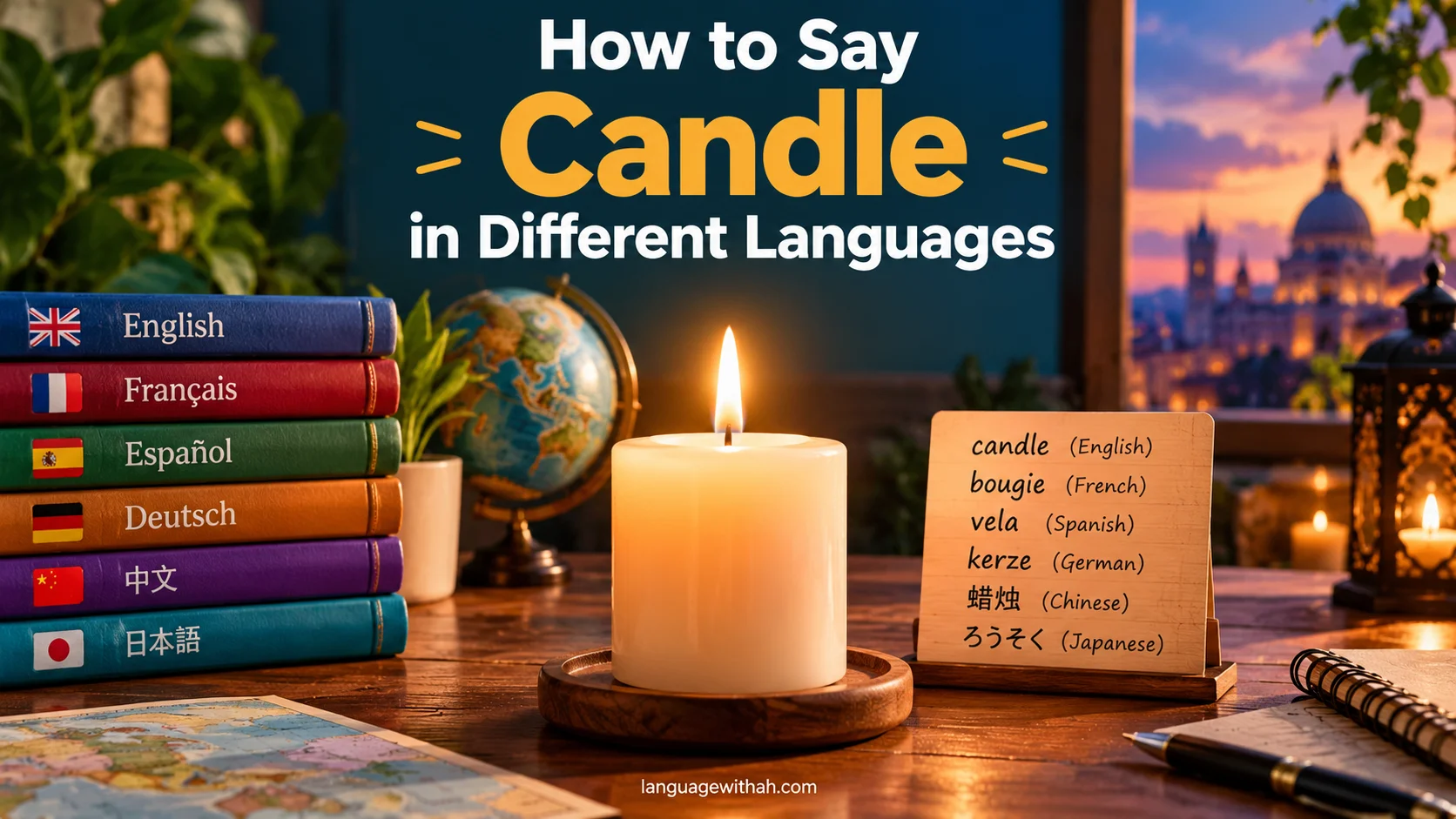
A candle is a simple object with many meanings: it provides light, creates a peaceful atmosphere, decorates a celebration, and can symbolize hope, remembrance, or devotion. Learning how to say candle in 70 different languages helps you explore how people around the world name this familiar object and use it in everyday conversations.
The English word candle generally refers to a cylinder or similar shape made from wax or another fuel, with a wick that burns to produce light. However, translations can differ depending on the material, the type of candle, and its purpose. A birthday candle, a scented candle, and a candle used in a religious ceremony may have more specific names in some languages.
These translations are useful for language learners, travelers, students, families, writers, and anyone curious about other cultures. They can also help when shopping abroad, describing a household item, writing a greeting card, or discussing celebrations in another language.
Interesting Facts About Candle
- Candles have several uses: They can provide light, decorate a room, mark celebrations, or serve as part of a ceremony.
- The word changes across languages: For example, Spanish uses vela, French uses bougie, and German uses Kerze for an ordinary candle.
- One word can have several meanings: In Spanish, vela can also refer to a sail, depending on the context.
- Candle types may have specific names: Birthday candles, tea lights, and scented candles may use additional descriptive words.
- Writing systems differ: Some languages write the word using Latin letters, while others use Arabic, Devanagari, Chinese, Japanese, or other scripts.
- Pronunciation is not always obvious: A familiar-looking word may sound quite different from English because each language follows its own sound patterns.
- Candles can carry symbolic meaning: They may be associated with remembrance, celebration, prayer, or creating a welcoming atmosphere, depending on the occasion and community.
What Does Candle Mean?
A candle is an object made from wax or another combustible material, usually with a wick that burns to produce light. Many traditional candles are cylindrical, although candles can come in many shapes and sizes.
The word also appears in expressions connected with celebrations and everyday life. For example, people light birthday candles, place candles on a dinner table, or use scented candles to create a relaxing atmosphere.
In some contexts, a candle may represent hope, remembrance, peace, or devotion. These associations depend on the occasion and cultural setting rather than being part of the word’s literal definition.
When translating candle, it is important to distinguish an ordinary candle from related objects, such as a lamp, lantern, oil light, or electric candle. Those items may serve a similar purpose but are not always described by the same word.
Why Can Candle Have Different Translations?
The word candle does not have one universal translation because each language has its own vocabulary, grammar, and naming conventions. Most languages have a general word for an ordinary candle, but specialized candles may require additional words.
Several factors influence the best translation:
- Context: A candle on a birthday cake may be described differently from a candle used for decoration.
- Formality: Everyday speech may use a shorter or more familiar expression than a technical description.
- Regional variation: Some languages have different words or pronunciations across countries and dialects.
- Grammar and gender: Nouns may be masculine, feminine, or neuter, which can affect articles and adjectives.
- Writing systems: Some languages use a different script, so romanization helps readers understand pronunciation.
- Natural expression: Translating a complete sentence requires correct grammar, not simply replacing each English word.
The tables below focus on the ordinary wax candle with a wick. Pronunciation guides are approximate aids for English-speaking readers, not substitutes for listening to native speech.
European Languages
European languages belong to several language families, including Germanic, Romance, Slavic, and Uralic. Although many share historical connections, their everyday words for a candle can look and sound very different. The examples below use the ordinary meaning of a candle in a household or decorative setting.
English varieties
American, British, and Australian English use the same basic word: candle. There is no standard regional difference in the spelling of this word, although individual accents may pronounce it slightly differently.
| 🌍 Language | Country/Region | Translation | Pronunciation | Example Sentence |
| English | International | Candle | KAN-dəl | I lit a candle. |
| American English 🇺🇸 | United States | Candle | KAN-dəl | I lit a candle. |
| British English 🇬🇧 | United Kingdom | Candle | KAN-dəl | I lit a candle. |
| Australian English 🇦🇺 | Australia | Candle | KAN-dəl | I lit a candle. |
English example meaning: I lit a candle.
European language translations
| 🌍 Language | Country/Region | Translation | Pronunciation | Example Sentence |
| Spanish | Spain, Latin America | Vela | BEH-lah | Encendí una vela. — I lit a candle. |
| French | France, Belgium, Canada | Bougie | boo-ZHEE | J’allume une bougie. — I am lighting a candle. |
| German | Germany, Austria | Kerze | KEHR-tsuh | Ich zünde eine Kerze an. — I light a candle. |
| Italian | Italy, Switzerland | Candela | kan-DEH-lah | Accendo una candela. — I light a candle. |
| Portuguese | Portugal, Brazil | Vela | VEH-lah | Acendi uma vela. — I lit a candle. |
| Dutch | Netherlands, Belgium | Kaars | kahrs | Ik steek een kaars aan. — I light a candle. |
| Swedish | Sweden, Finland | Ljus | YOOS | Jag tänder ett ljus. — I light a candle. |
| Norwegian | Norway | Stearinlys | steh-ah-REEN-lees | Jeg tenner et stearinlys. — I light a candle. |
| Danish | Denmark | Stearinlys | steh-ah-REEN-lees | Jeg tænder et stearinlys. — I light a candle. |
| Finnish | Finland | Kynttilä | KÜNT-ti-lä | Sytytän kynttilän. — I light a candle. |
| Icelandic | Iceland | Kerti | KEHR-ti | Ég kveiki á kerti. — I light a candle. |
| Irish | Ireland | Coinneal | KIN-yal | Lasaim coinneal. — I light a candle. |
| Welsh | Wales | Cannwyll | KAN-will | Rwy’n cynnau cannwyll. — I light a candle. |
| Polish | Poland | Świeca | SHFYEH-tsah | Zapalam świecę. — I light a candle. |
| Czech | Czechia | Svíčka | SVEECH-kah | Zapálím svíčku. — I will light a candle. |
| Slovak | Slovakia | Sviečka | SVYECH-kah | Zapálim sviečku. — I will light a candle. |
| Ukrainian | Ukraine | Свічка | svich-KAH | Я запалюю свічку. — I am lighting a candle. |
| Russian | Russia and other Russian-speaking communities | Свеча | svee-CHA | Я зажигаю свечу. — I am lighting a candle. |
| Romanian | Romania, Moldova | Lumânare | loo-muh-NAH-reh | Aprind o lumânare. — I light a candle. |
| Hungarian | Hungary | Gyertya | DYER-tyah | Meggyújtok egy gyertyát. — I light a candle. |
| Greek | Greece, Cyprus | Κερί | keh-REE | Ανάβω ένα κερί. — I light a candle. |
| Bulgarian | Bulgaria | Свещ | svyesht | Запалвам свещ. — I light a candle. |
| Croatian | Croatia | Svijeća | SVYEH-chah | Palim svijeću. — I light a candle. |
| Serbian | Serbia and neighboring regions | Свећа | SVEH-chah | Палимо свећу. — We light a candle. |
| Slovenian | Slovenia | Sveča | SVEH-chah | Prižgem svečo. — I light a candle. |
| Lithuanian | Lithuania | Žvakė | ZHVAH-keh | Uždegu žvakę. — I light a candle. |
| Latvian | Latvia | Svece | SVEH-tseh | Es aizdedzu sveci. — I light a candle. |
| Estonian | Estonia | Küünal | KÜÜ-nal | Süütan küünla. — I light a candle. |
European cultural and vocabulary notes
- In Spanish, vela can also mean “sail,” so the surrounding sentence helps establish the intended meaning.
- In French, bougie is the everyday word for a candle; chandelle also exists and can have a more traditional or literary feel in some contexts.
- In German, Kerze is the general word, while Teelicht refers to a tea light.
- In Swedish, ljus means “light” as well as “candle” in the relevant context. Stearinljus is more specific.
- In Norwegian and Danish, stearinlys is a common term for a candle, especially one made of stearin, while lys can be used more generally.
- The Slavic languages in the table have related-looking words in some cases, but spelling, pronunciation, and grammatical forms differ.
Read More: How to Say Cake in Different Languages
Asian Languages
Asia contains an enormous variety of languages, scripts, and linguistic traditions. A candle may be described with a native-script word, a borrowed term, or a more specific expression depending on the language. The following translations refer to an ordinary candle rather than an electric light or oil lamp.
| 🌍 Language | Country/Region | Translation | Pronunciation | Example Sentence |
| Mandarin Chinese | China, Taiwan, Singapore | 蜡烛 / 蠟燭 | làzhú | 我点燃了一支蜡烛。— I lit a candle. |
| Cantonese | Hong Kong, Guangdong | 蠟燭 | laat⁶ zuk¹ | 我點著咗支蠟燭。— I lit a candle. |
| Japanese | Japan | ろうそく (蝋燭) | rōsoku | ろうそくに火をつけました。— I lit a candle. |
| Korean | South Korea, North Korea | 양초 | yang-cho | 양초에 불을 붙였어요. — I lit a candle. |
| Hindi | India | मोमबत्ती | mom-bat-tee | मैंने मोमबत्ती जलाई। — I lit a candle. |
| Urdu | Pakistan, India | موم بتی | mom-bat-tee | میں نے موم بتی جلائی۔ — I lit a candle. |
| Bengali | Bangladesh, India | মোমবাতি | mom-ba-ti | আমি একটি মোমবাতি জ্বালালাম। — I lit a candle. |
| Punjabi | India, Pakistan | ਮੋਮਬੱਤੀ / موم بتی | mom-bat-tee | ਮੈਂ ਮੋਮਬੱਤੀ ਜਗਾਈ। — I lit a candle. |
| Gujarati | India | મીણબત્તી | meen-bat-tee | મેં મીણબત્તી પ્રગટાવી. — I lit a candle. |
| Marathi | India | मेणबत्ती | men-bat-tee | मी मेणबत्ती लावली. — I lit a candle. |
| Tamil | India, Sri Lanka, Singapore | மெழுகுவர்த்தி | meḻugu-varthi | நான் மெழுகுவர்த்தியை ஏற்றினேன். — I lit a candle. |
| Telugu | India | కొవ్వొత్తి | kov-vot-ti | నేను కొవ్వొత్తిని వెలిగించాను. — I lit a candle. |
| Kannada | India | ಮೇಣದ ಬತ್ತಿ | mēṇada batti | ನಾನು ಮೇಣದ ಬತ್ತಿಯನ್ನು ಹಚ್ಚಿದೆ. — I lit a candle. |
| Malayalam | India | മെഴുകുതിരി | me-zhuku-thiri | ഞാൻ മെഴുകുതിരി കത്തിച്ചു. — I lit a candle. |
| Nepali | Nepal | मैनबत्ती | main-bat-tee | मैले मैनबत्ती बालेँ। — I lit a candle. |
| Sinhala | Sri Lanka | ඉටිපන්දම | i-ti-pan-da-ma | මම ඉටිපන්දමක් දැල්වුවා. — I lit a candle. |
| Thai | Thailand | เทียน | thian | ฉันจุดเทียนแล้ว — I lit a candle. |
| Vietnamese | Vietnam | Nến | nen (falling tone) | Tôi thắp một cây nến. — I lit a candle. |
| Indonesian | Indonesia | Lilin | LEE-lin | Saya menyalakan lilin. — I lit a candle. |
| Malay | Malaysia, Brunei, Singapore | Lilin | LEE-lin | Saya menyalakan lilin. — I lit a candle. |
| Filipino/Tagalog | Philippines | Kandila | kan-DEE-lah | Nagsindi ako ng kandila. — I lit a candle. |
| Burmese | Myanmar | ဖယောင်းတိုင် | pə-yáun-daing | ဖယောင်းတိုင်တစ်တိုင် ထွန်းလိုက်တယ်။ — I lit a candle. |
| Khmer | Cambodia | ទៀន | tien | ខ្ញុំបានអុជទៀនមួយ។ — I lit a candle. |
| Lao | Laos | ທຽນ | thian | ຂ້ອຍຈູດທຽນ. — I light a candle. |
| Mongolian | Mongolia | Лаа | laa | Би лаа асаалаа. — I lit a candle. |
| Kazakh | Kazakhstan | Шам | sham | Мен шам жақтым. — I lit a candle. |
| Uzbek | Uzbekistan | Sham | shahm | Men sham yoqdim. — I lit a candle. |
Asian cultural and vocabulary notes
- Mandarin Chinese uses 蜡烛 in simplified characters and 蠟燭 in traditional characters. Pinyin tones are important: làzhú.
- Cantonese has its own pronunciation and spoken grammar. The Jyutping-style pronunciation above uses tone numbers; it should not be read as Mandarin.
- Japanese uses ろうそく for a candle. The kanji spelling 蝋燭 is also used, although the hiragana form is often easier for learners.
- Hindi and Urdu share the expression मोमबत्ती / موم بتی in everyday use, but the writing systems differ.
- Indonesian and Malay both use lilin. Their sentence patterns may be similar, but the languages are distinct and should not be treated as interchangeable in every situation.
- In Vietnamese, nến is a short word with a tone. Pronouncing the tone correctly helps distinguish it from other syllables.
African Languages
Africa is home to thousands of languages and many distinct language families. Words for everyday objects can differ substantially between neighboring communities, and some languages use borrowed vocabulary alongside inherited words. The examples below identify a representative region for each language and use the ordinary meaning of a candle.
| 🌍 Language | Country/Region | Translation | Pronunciation | Example Sentence |
| Swahili | Tanzania, Kenya, East Africa | Mshumaa | m-shoo-MAA | Nimewasha mshumaa. — I lit a candle. |
| Afrikaans | South Africa, Namibia | Kers | kehrs | Ek steek ‘n kers aan. — I light a candle. |
| Zulu | South Africa | Ikhandlela | ee-khan-dleh-lah | Ngikhanyisa ikhandlela. — I light a candle. |
| Xhosa | South Africa | Ikhandlela | ee-khan-dleh-lah | Ndilayita ikhandlela. — I light a candle. |
| Amharic | Ethiopia | ሻማ | sha-ma | ሻማ አበራሁ። — I lit a candle. |
| Yoruba | Nigeria, West Africa | Abẹla | ah-BEH-lah | Mo tan abẹla. — I lit a candle. |
| Igbo | Nigeria | Kandụl | kan-dool | M mụnyere kandụl. — I lit a candle. |
| Hausa | Nigeria, Niger, West Africa | Kyandir | kyan-deer | Na kunna kyandir. — I lit a candle. |
| Somali | Somalia, Horn of Africa | Shumac | SHOO-makh | Waxaan shiday shumac. — I lit a candle. |
| Shona | Zimbabwe | Kenduru | ken-DOO-roo | Ndabatidza kenduru. — I lit a candle. |
| Sesotho | Lesotho, South Africa | Kerese | keh-REH-seh | Ke hotetsa kerese. — I light a candle. |
| Setswana | Botswana, South Africa | Kerese | keh-REH-seh | Ke gotetsa kerese. — I light a candle. |
| Kinyarwanda | Rwanda | Buji | BOO-jee | Nacanye buji. — I lit a candle. |
| Malagasy | Madagascar | Labozia | la-bo-ZEE-ah | Nandrehitra labozia aho. — I lit a candle. |
African cultural and vocabulary notes
- Swahili is widely used across East Africa, but local speech and vocabulary can vary.
- Zulu and Xhosa are distinct Nguni languages. Although ikhandlela is used in both, their pronunciation and sentence patterns are not identical.
- Afrikaans uses kers for a candle. The related English word “Christmas” does not mean candle; context matters when learning related vocabulary.
- Yoruba uses tone marks in standard writing. Learners should pay attention to them when studying pronunciation.
- Sesotho and Setswana have similar-looking vocabulary in some areas, but they are separate languages with their own grammar.
Middle Eastern Languages
The Middle East includes Arabic, Hebrew, Persian, Kurdish, Turkish, and other language traditions. Even where languages share a geographic region, their words and writing systems can be quite different. Arabic also has a distinction between Modern Standard Arabic and regional spoken dialects.
| 🌍 Language | Country/Region | Translation | Pronunciation | Example Sentence |
| Arabic (Modern Standard Arabic) | Middle East, North Africa | شمعة | shamʿa | أَشْعَلْتُ شَمْعَةً. — I lit a candle. |
| Persian (Farsi) | Iran, Persian-speaking communities | شمع | shamʿ | من یک شمع روشن کردم. — I lit a candle. |
| Hebrew | Israel | נר | ner | הדלקתי נר. — I lit a candle. |
| Kurdish (Kurmanji) | Türkiye, Iraq, Syria, Iran | Mûm | moom | Ez mûmek pêxistim. — I lit a candle. |
| Turkish | Türkiye, Cyprus | Mum | moom | Bir mum yaktım. — I lit a candle. |
| Armenian | Armenia and Armenian-speaking communities | Մոմ | mom | Ես մոմ վառեցի։ — I lit a candle. |
Middle Eastern cultural and vocabulary notes
- In Modern Standard Arabic, shamʿa (شمعة) is a standard word for a candle. Regional dialects may differ in pronunciation and everyday usage.
- Persian uses shamʿ (شمع), a word that can also refer to wax in certain contexts.
- In Hebrew, ner (נר) means candle and can also be associated with a lamp or light in particular expressions.
- Kurdish has several varieties. The table uses Kurmanji, so its translation should not automatically be applied to Sorani or every other Kurdish variety.
- Turkish uses mum for a candle. Although the word is short, it should not be confused with the English word “mom.”
Other World Languages
Some languages are best grouped separately because they are associated with Oceania, the Americas, or international communication rather than the regions above. Their translations also demonstrate how familiar household objects are named in different linguistic systems.
| 🌍 Language | Country/Region | Translation | Pronunciation | Example Sentence |
| Māori | New Zealand | Rāma | RAA-ma | Ka tahuna e au te rama. — I light the candle. |
| Samoan | Samoa, Pacific Islands | Moligaʻo | mo-lee-nga-OH | Ua ou tutuina le moligaʻo. — I lit the candle. |
| Tongan | Tonga, Pacific Islands | Teʻelā | teh-eh-LAA | Naʻá ku tutu ʻa e teʻelā. — I lit the candle. |
| Hawaiian | Hawaiʻi | Ihoiho | ee-ho-ee-ho | Ua hoʻā au i ka ihoiho. — I lit the candle. |
| Quechua | Andes, including Peru and Bolivia | Vela | VEH-lah | Vela-ta rupachini. — I light the candle. |
| Guarani | Paraguay and neighboring regions | Tendy | ten-DÜ | Ahesape’a peteĩ tendy. — I light a candle. |
| Haitian Creole | Haiti | Bouji | boo-ZHEE | Mwen limen yon bouji. — I light a candle. |
| Esperanto | International constructed language | Kandelo | kan-DEH-lo | Mi ekbruligis kandelon. — I lit a candle. |
Notes on less widely taught languages
The word vela in Quechua may be used as a loanword in some communities; vocabulary can vary among Quechua varieties. The Guarani and Māori examples are intended as simple illustrations, and learners should consult a speaker of the relevant variety for high-stakes or formal use. Regional variation matters especially in languages with multiple dialects and different orthographic conventions.
Quick Reference: Candle in Different Languages
Use this table to find the word for an ordinary candle quickly. For English regional varieties, the translation remains the same; for languages with regional differences, the entry reflects the variety identified in the regional section.
| Language | Translation |
| English | Candle |
| American English | Candle |
| British English | Candle |
| Australian English | Candle |
| Spanish | Vela |
| French | Bougie |
| German | Kerze |
| Italian | Candela |
| Portuguese | Vela |
| Dutch | Kaars |
| Swedish | Ljus |
| Norwegian | Stearinlys |
| Danish | Stearinlys |
| Finnish | Kynttilä |
| Icelandic | Kerti |
| Irish | Coinneal |
| Welsh | Cannwyll |
| Polish | Świeca |
| Czech | Svíčka |
| Slovak | Sviečka |
| Ukrainian | Свічка |
| Russian | Свеча |
| Romanian | Lumânare |
| Hungarian | Gyertya |
| Greek | Κερί |
| Bulgarian | Свещ |
| Croatian | Svijeća |
| Serbian | Свећа |
| Slovenian | Sveča |
| Lithuanian | Žvakė |
| Latvian | Svece |
| Estonian | Küünal |
| Mandarin Chinese | 蜡烛 / 蠟燭 |
| Cantonese | 蠟燭 |
| Japanese | ろうそく |
| Korean | 양초 |
| Hindi | मोमबत्ती |
| Urdu | موم بتی |
| Bengali | মোমবাতি |
| Punjabi | ਮੋਮਬੱਤੀ / موم بتی |
| Gujarati | મીણબત્તી |
| Marathi | मेणबत्ती |
| Tamil | மெழுகுவர்த்தி |
| Telugu | కొవ్వొత్తి |
| Kannada | ಮೇಣದ ಬತ್ತಿ |
| Malayalam | മെഴുകുതിരി |
| Nepali | मैनबत्ती |
| Sinhala | ඉටිපන්දම |
| Thai | เทียน |
| Vietnamese | Nến |
| Indonesian | Lilin |
| Malay | Lilin |
| Filipino/Tagalog | Kandila |
| Burmese | ဖယောင်းတိုင် |
| Khmer | ទៀន |
| Lao | ທຽນ |
| Mongolian | Лаа |
| Kazakh | Шам |
| Uzbek | Sham |
| Swahili | Mshumaa |
| Afrikaans | Kers |
| Zulu | Ikhandlela |
| Xhosa | Ikhandlela |
| Amharic | ሻማ |
| Yoruba | Abẹla |
| Igbo | Kandụl |
| Hausa | Kyandir |
| Somali | Shumac |
| Shona | Kenduru |
| Sesotho | Kerese |
| Setswana | Kerese |
| Kinyarwanda | Buji |
| Malagasy | Labozia |
| Arabic (Modern Standard Arabic) | شمعة |
| Persian (Farsi) | شمع |
| Hebrew | נר |
| Kurdish (Kurmanji) | Mûm |
| Turkish | Mum |
| Armenian | Մոմ |
| Māori | Rāma |
| Samoan | Moligaʻo |
| Tongan | Teʻelā |
| Hawaiian | Ihoiho |
| Quechua | Vela |
| Guarani | Tendy |
| Haitian Creole | Bouji |
| Esperanto | Kandelo |
How to Choose the Right Translation
The best translation depends on where, how, and with whom you plan to use the word.
- Consider your audience. If you are speaking with someone from a particular country, check whether their variety of the language uses a different everyday term.
- Think about the object. A scented candle, birthday candle, tea light, and ceremonial candle may need a descriptive word in addition to the general noun.
- Check the writing system. Learn the native spelling as well as the pronunciation. This is especially useful when reading labels or shopping in another country.
- Use a complete sentence. Learning “I lit a candle” alongside the noun helps you understand how the word behaves grammatically.
- Pay attention to formality. A term used in everyday conversation may not be the preferred wording in a religious, technical, or literary context.
- Listen to spoken examples. Audio from reliable language-learning resources can help you identify sounds that English pronunciation guides cannot represent perfectly.
Learning tip: Memorize the word together with an article, verb, or short example sentence when possible. This can help you remember the word’s grammatical behavior, not just its spelling.
Common Mistakes When Translating Candle
Even a familiar object can create confusion when its name is translated without context.
- Translating word for word. A sentence that works in English may require a different structure in another language. Translate the meaning, not just the individual words.
- Confusing candles with lamps. A candle burns fuel through a wick; a lamp or lantern may use a different light source. Similar purposes do not make the words interchangeable.
- Ignoring regional variation. One dialect’s everyday word may not be equally familiar in every region where the language is spoken.
- Overlooking grammatical gender. In languages with gendered nouns, articles and adjectives may need to agree with the word for candle.
- Using misleading pronunciation guides. English-style spelling approximations cannot fully capture every sound or tone. Use recognized romanization systems when available.
- Mixing writing systems. Do not assume that a transliteration replaces the native script. Learning both makes reading and communication more reliable.
- Assuming every candle is the same. A birthday candle or tea light may have a more specific name than a large decorative candle.
The safest approach is to check a translation in context and confirm that the example sentence uses the intended meaning.
Why Learn Candle in Different Languages?
Learning the word candle in different languages is a practical way to expand everyday vocabulary. Because candles appear in homes, shops, celebrations, and ceremonies, the word can be useful for travelers, language students, and anyone communicating across cultures.
Studying these translations also shows how languages organize familiar concepts differently. Some words are short, others contain several syllables, and some are written in scripts that may be new to English speakers. Comparing them encourages curiosity about pronunciation, grammar, and vocabulary.
For travelers, knowing the local word can make it easier to ask for a candle in a shop or understand a product label. For students, it provides a simple example of how nouns fit into complete sentences. For writers and families, it can add a thoughtful multilingual touch to a message or celebration.
The greatest value comes from learning more than a single word. Pairing translation, pronunciation, and natural usage gives you a stronger foundation for real communication.
FAQs:
How do you say candle in different languages?
The word candle has different translations around the world. Examples include vela in Spanish, bougie in French, Kerze in German, 蜡烛 in Mandarin Chinese, मोमबत्ती in Hindi, and شمعة in Arabic.
What is the most natural translation of candle?
The most natural translation depends on the language and context. For example, Spanish uses vela and French uses bougie for an ordinary candle. These are suitable everyday translations in their respective languages.
Can the translation of candle change by country?
Yes. Regional vocabulary can vary even when people speak the same language. Pronunciation, preferred expressions, and specialized candle terminology may differ between countries and communities.
Why do some languages have different words for candles?
Languages develop their own vocabulary through historical change, cultural contact, and everyday usage. Some also distinguish between candle types, such as birthday candles, tea lights, and ceremonial candles.
How do you pronounce candle in Spanish and French?
In Spanish, vela is approximately pronounced BEH-lah. In French, bougie is approximately pronounced boo-ZHEE. These English-friendly guides are approximations rather than exact phonetic transcriptions.
Conclusion:
Learning how to say candle in different languages reveals how a familiar everyday object can be described in many different ways. From Spanish vela and French bougie to Japanese ろうそく and Arabic شمعة, each translation offers an opportunity to explore another language’s vocabulary and writing system.
The most useful approach is to look beyond the individual word. Context, pronunciation, regional variation, and grammatical structure all influence how a translation works in real communication. A term that describes an ordinary candle may need an additional word when referring to a scented candle, birthday candle, or ceremonial object.














1 thought on “How to Say Candle in Different Languages”