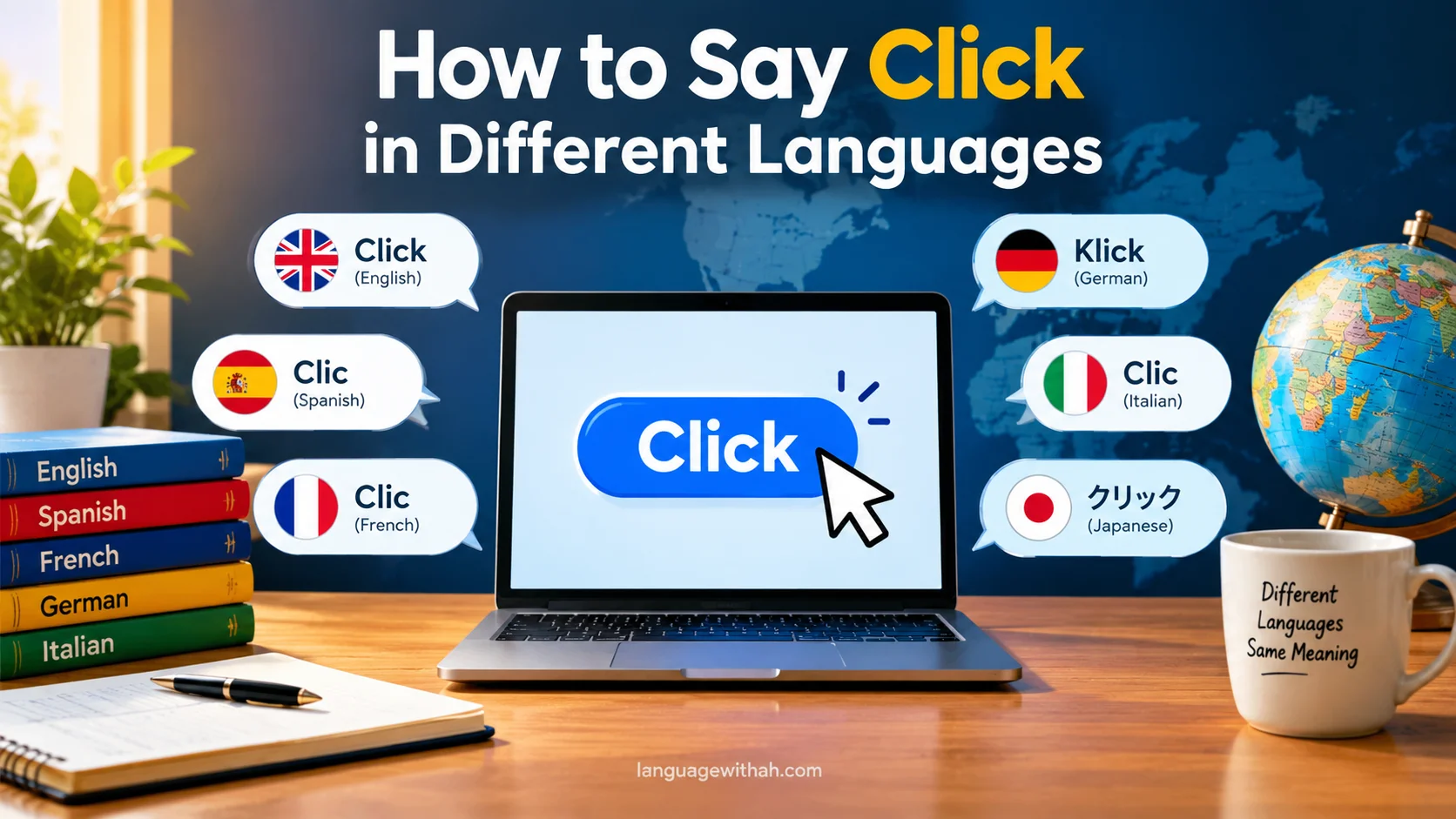
The word click is a small but extremely useful part of modern communication. In English, it commonly describes the action of pressing a computer mouse button, selecting a link, opening an icon, or choosing something on a website or app. When you learn Click in 70 Different Languages, however, you quickly discover that languages do not always describe this action in exactly the same way. Some use a word borrowed from English, while others use a native verb meaning press, tap, select, or make a short clicking action.
Learning how to express click in another language can be useful when traveling, studying technology, translating instructions, helping someone use a website, or communicating with international friends and colleagues. It also shows how everyday technology becomes part of different languages and cultures.
This guide focuses primarily on the computer and internet meaning of click. The natural wording can change according to context, formality, region, grammar, and local technology vocabulary. For that reason, a natural translation is often more useful than a strict word-for-word translation.
Interesting Facts About Click in Different Languages
Click has several meanings in English. It can describe a computer action, a short sharp sound, or even the moment when people suddenly understand or connect with an idea.
In computer terminology, many languages have adopted forms related to the English word click, especially in technology and software contexts.
Some languages use a native expression rather than a direct borrowing. For example, Spanish uses hacer clic, while Turkish commonly uses tıklamak for the computer action.
Chinese uses 点击 (diǎnjī) for the computer action. The expression is quite different from simply transliterating the English word.
Japanese uses クリックする (kurikku suru) in computer contexts, showing how an English technology term can be incorporated into another language’s grammar.
In some languages, a phrase meaning press a button may be used naturally where English would say “click.” Urdu, for example, can use wording involving pressing a button as well as the borrowed form “click.”
A translation for the computer action should not automatically be used for the sound made by a switch, camera, door, or other object. Dictionaries distinguish these meanings.
In the context of computers, click means to press a button on a mouse or another pointing device to perform an action. You might click a link, icon, menu, button, image, checkbox, or file.
For example:
Click the button to continue.
Here, “click” is a computer instruction. It tells the reader to select something by pressing the mouse or another control.
The word can also have other meanings. A click can be a short, sharp sound, such as the sound made by a switch. Someone may also say that two people click, meaning they get along naturally. Another expression, “it clicked,” can mean that someone suddenly understood something.
This article concentrates on the computer and digital meaning, because that is the most useful interpretation for translation, websites, software instructions, and language-learning contexts.
Why Can Click Have Different Translations?
There is no single universal translation of click because languages organize the idea differently.
A language may use:
A borrowed technology term, such as a form related to “click.”
A native verb meaning press.
A word meaning tap or select.
A phrase meaning make a click.
A verb specifically associated with operating a mouse.
A different expression depending on whether the action is performed with a mouse, touchscreen, or keyboard.
For example, Spanish commonly uses hacer clic, while German uses klicken, Italian uses cliccare, and Turkish uses tıklamak.
The phrase can also change according to grammar and formality. Some languages need an infinitive, while others commonly use an imperative when giving a computer instruction.
Another important distinction is between clicking a mouse and simply pressing a button. In some languages, both ideas can overlap in everyday technical instructions. Therefore, the most useful translation is the one that sounds natural in the intended situation rather than the one that copies the English structure exactly.
Click in 80 Different Languages
The tables below focus on the computer/web meaning of click. The “Translation” column gives a natural way to ask “How do you say ‘click’?” or names the relevant computer-action expression. Example sentences demonstrate normal usage.
European Languages
Europe contains several major language families, including Romance, Germanic, Slavic, Celtic, Uralic, and others. As a result, the word click can look very similar across some languages while being quite different in others. Technology has also encouraged many European languages to adopt related forms of the English term.
American English 🇺🇸
🌍 Language
Country/Region
Translation
Pronunciation
Example Sentence
American English
United States
How do you say “click”?
how doo yoo say klik
Click the button to open the page.
British English 🇬🇧
🌍 Language
Country/Region
Translation
Pronunciation
Example Sentence
British English
United Kingdom
How do you say “click”?
how duh yoo say klik
Click the link to continue.
Australian English 🇦🇺
🌍 Language
Country/Region
Translation
Pronunciation
Example Sentence
Australian English
Australia
How do you say “click”?
how duh yoo say klik
Click the icon to open the app.
The three major English varieties use the same basic computer verb, click. The pronunciation and some surrounding vocabulary can vary, but there is no need to invent a separate Australian or British translation.
Spanish 🇪🇸🇲🇽
🌍 Language
Country/Region
Translation
Pronunciation
Example Sentence
Spanish
Spain and Latin America
¿Cómo se dice “hacer clic”?
KOH-moh seh DEE-seh ah-SAIR klik
Haz clic en el botón para continuar. — Click the button to continue.
Spanish commonly uses hacer clic, although regional alternatives such as pinchar can also occur in some varieties and contexts.
French 🇫🇷
🌍 Language
Country/Region
Translation
Pronunciation
Example Sentence
French
France and Francophone regions
Comment dit-on « cliquer » ?
koh-MAHN dee-TOHN klee-KAY
Cliquez sur le bouton pour continuer. — Click the button to continue.
The computer verb cliquer is standard technology vocabulary, while clic is the related noun.
Klicken Sie auf den Button, um fortzufahren. — Click the button to continue.
Italian 🇮🇹
🌍 Language
Country/Region
Translation
Pronunciation
Example Sentence
Italian
Italy
Come si dice “cliccare”?
KOH-meh see DEE-cheh klee-KAH-reh
Clicca sul pulsante per continuare. — Click the button to continue.
Portuguese 🇵🇹🇧🇷
🌍 Language
Country/Region
Translation
Pronunciation
Example Sentence
Portuguese
Portugal and Brazil
Como se diz “clicar”?
KOH-moo seh deez klee-KAR
Clique no botão para continuar. — Click the button to continue.
Clicar is widely used for the computer action in Portuguese. Brazilian and European Portuguese may differ in other parts of the sentence, but the core technology verb is familiar in both.
Dutch 🇳🇱
🌍 Language
Country/Region
Translation
Pronunciation
Example Sentence
Dutch
Netherlands, Belgium
Hoe zeg je “klikken”?
hoo zek yuh KLIK-en
Klik op de knop om verder te gaan. — Click the button to continue.
Swedish 🇸🇪
🌍 Language
Country/Region
Translation
Pronunciation
Example Sentence
Swedish
Sweden
Hur säger man “klicka”?
hoor SAY-er mahn KLIK-ka
Klicka på knappen för att fortsätta. — Click the button to continue.
Norwegian 🇳🇴
🌍 Language
Country/Region
Translation
Pronunciation
Example Sentence
Norwegian
Norway
Hvordan sier man “klikke”?
VOOR-dahn seer mahn KLIK-keh
Klikk på knappen for å fortsette. — Click the button to continue.
Danish 🇩🇰
🌍 Language
Country/Region
Translation
Pronunciation
Example Sentence
Danish
Denmark
Hvordan siger man “klikke”?
VOOR-dahn SEE-er mahn KLIK-eh
Klik på knappen for at fortsætte. — Click the button to continue.
Finnish 🇫🇮
🌍 Language
Country/Region
Translation
Pronunciation
Example Sentence
Finnish
Finland
Miten sanotaan “napsauttaa”?
MEE-ten sah-noh-TAHN NAP-sowt-tah
Napsauta painiketta jatkaaksesi. — Click the button to continue.
Finnish commonly uses verbs related to napsauttaa and klikkaus for computer clicking; usage can vary by context.
Icelandic 🇮🇸
🌍 Language
Country/Region
Translation
Pronunciation
Example Sentence
Icelandic
Iceland
Hvernig segir maður “smella”?
KVER-nig SAY-reer MAY-thur SMET-la
Smelltu á hnappinn til að halda áfram. — Click the button to continue.
Irish 🇮🇪
🌍 Language
Country/Region
Translation
Pronunciation
Example Sentence
Irish
Ireland
Conas a deirtear “cliceáil”?
KUN-us uh DER-shur KLIK-ale
Cliceáil ar an gcnaipe chun leanúint ar aghaidh. — Click the button to continue.
Welsh 🏴
🌍 Language
Country/Region
Translation
Pronunciation
Example Sentence
Welsh
Wales
Sut mae dweud “clicio”?
sit my dow-id KLIK-yoh
Cliciwch ar y botwm i barhau. — Click the button to continue.
Polish 🇵🇱
🌍 Language
Country/Region
Translation
Pronunciation
Example Sentence
Polish
Poland
Jak powiedzieć „kliknąć”?
yahk poh-VYEH-jetch KLIK-nonch
Kliknij przycisk, aby kontynuować. — Click the button to continue.
Czech 🇨🇿
🌍 Language
Country/Region
Translation
Pronunciation
Example Sentence
Czech
Czech Republic
Jak se řekne „kliknout“?
yahk seh RZHEK-neh KLIK-noot
Klikněte na tlačítko pro pokračování. — Click the button to continue.
Slovak 🇸🇰
🌍 Language
Country/Region
Translation
Pronunciation
Example Sentence
Slovak
Slovakia
Ako sa povie „kliknúť“?
AH-koh sah POH-vyeh KLIK-noot
Kliknite na tlačidlo pre pokračovanie. — Click the button to continue.
Ukrainian 🇺🇦
🌍 Language
Country/Region
Translation
Pronunciation
Example Sentence
Ukrainian
Ukraine
Як сказати «клікнути»?
yak skah-ZAH-ty KLIK-noo-ty
Натисніть кнопку, щоб продовжити. — Click the button to continue.
Ukrainian technical usage includes forms related to клікати / клікнути, while натискати means to press and is also natural in instructions.
Russian 🇷🇺
🌍 Language
Country/Region
Translation
Pronunciation
Example Sentence
Russian
Russia and Russian-speaking regions
Как сказать «кликнуть»?
kak skah-ZAHT KLIK-noot
Нажмите кнопку, чтобы продолжить. — Click the button to continue.
Romanian 🇷🇴
🌍 Language
Country/Region
Translation
Pronunciation
Example Sentence
Romanian
Romania, Moldova
Cum se spune „a face clic”?
koom seh SPOO-neh ah fah-cheh klik
Faceți clic pe buton pentru a continua. — Click the button to continue.
Hungarian 🇭🇺
🌍 Language
Country/Region
Translation
Pronunciation
Example Sentence
Hungarian
Hungary
Hogyan mondjuk azt, hogy „kattintani”?
HOH-dyan MOND-yook azt, hod KAT-tin-tah-nee
Kattintson a gombra a folytatáshoz. — Click the button to continue.
Hungarian commonly uses kattintás / kattintani for a computer click.
Asia includes hundreds of languages and several unrelated writing systems. In technology vocabulary, some languages have adopted English-derived terms, while others use native verbs meaning press, tap, or select. This is especially noticeable when comparing languages such as Chinese, Japanese, Korean, Hindi, Urdu, and Southeast Asian languages.
Mandarin Chinese 🇨🇳
🌍 Language
Country/Region
Translation
Pronunciation
Example Sentence
Mandarin Chinese
China, Taiwan and Chinese-speaking communities
怎么说“点击”?
zěnme shuō “diǎnjī”
点击按钮继续。 — Click the button to continue.
For Simplified Chinese, 点击 (diǎnjī) is a standard computer expression. Traditional Chinese commonly uses 點擊.
Cantonese 🇭🇰
🌍 Language
Country/Region
Translation
Pronunciation
Example Sentence
Cantonese
Hong Kong, Macau and Cantonese-speaking communities
點樣講「撳」?
dim yeung gong “yam”
撳個掣繼續。 — Click the button to continue.
Japanese 🇯🇵
🌍 Language
Country/Region
Translation
Pronunciation
Example Sentence
Japanese
Japan
「クリックする」は何と言いますか?
“kurikku suru” wa nan to iimasu ka
ボタンをクリックしてください。 — Please click the button.
Japanese commonly uses the borrowed computer verb クリックする.
Korean 🇰🇷
🌍 Language
Country/Region
Translation
Pronunciation
Example Sentence
Korean
South Korea
“클릭하다”를 어떻게 말해요?
keul-lik-ha-da-reul eo-tteo-ke mal-hae-yo
버튼을 클릭하세요. — Click the button.
Hindi 🇮🇳
🌍 Language
Country/Region
Translation
Pronunciation
Example Sentence
Hindi
India
“क्लिक करना” कैसे कहते हैं?
klik kar-na kaise kehte hain
जारी रखने के लिए बटन पर क्लिक करें। — Click the button to continue.
Hindi commonly uses the English-derived क्लिक करना in computer contexts.
Urdu 🇵🇰
🌍 Language
Country/Region
Translation
Pronunciation
Example Sentence
Urdu
Pakistan, India
“کلک کرنا” کیسے کہتے ہیں؟
klik kar-na kaise kehte hain
جاری رکھنے کے لیے بٹن پر کلک کریں۔ — Click the button to continue.
Urdu can also describe the action through wording meaning press the button, particularly in explanatory contexts.
Bengali 🇧🇩🇮🇳
🌍 Language
Country/Region
Translation
Pronunciation
Example Sentence
Bengali
Bangladesh, West Bengal
“ক্লিক করা” কীভাবে বলবেন?
klik kora kee-bha-be bol-ben
চালিয়ে যেতে বোতামে ক্লিক করুন। — Click the button to continue.
Punjabi 🇮🇳🇵🇰
🌍 Language
Country/Region
Translation
Pronunciation
Example Sentence
Punjabi
Punjab regions of India and Pakistan
“ਕਲਿੱਕ ਕਰਨਾ” ਕਿਵੇਂ ਕਹਿੰਦੇ ਹਨ?
klik kar-na kiven kehnde han
ਜਾਰੀ ਰੱਖਣ ਲਈ ਬਟਨ ‘ਤੇ ਕਲਿੱਕ ਕਰੋ। — Click the button to continue.
Gujarati 🇮🇳
🌍 Language
Country/Region
Translation
Pronunciation
Example Sentence
Gujarati
Gujarat, India
“ક્લિક કરવું” કેવી રીતે કહેવું?
klik kar-vun ke-vee ree-teh keh-vun
ચાલુ રાખવા માટે બટન પર ક્લિક કરો. — Click the button to continue.
Marathi 🇮🇳
🌍 Language
Country/Region
Translation
Pronunciation
Example Sentence
Marathi
Maharashtra, India
“क्लिक करणे” कसे म्हणतात?
klik kar-ne ka-seh mhan-taat
पुढे जाण्यासाठी बटणावर क्लिक करा. — Click the button to continue.
Tamil 🇮🇳🇱🇰
🌍 Language
Country/Region
Translation
Pronunciation
Example Sentence
Tamil
Tamil Nadu, Sri Lanka
“கிளிக் செய்ய” எப்படி சொல்வது?
klik sey-ya eppadi sol-vadhu
தொடர பொத்தானைக் கிளிக் செய்யவும். — Click the button to continue.
Telugu 🇮🇳
🌍 Language
Country/Region
Translation
Pronunciation
Example Sentence
Telugu
Andhra Pradesh, Telangana
“క్లిక్ చేయడం” ఎలా చెప్పాలి?
klik chey-a-dam ela chep-pa-lee
కొనసాగించడానికి బటన్ను క్లిక్ చేయండి. — Click the button to continue.
Kannada 🇮🇳
🌍 Language
Country/Region
Translation
Pronunciation
Example Sentence
Kannada
Karnataka, India
“ಕ್ಲಿಕ್ ಮಾಡುವುದು” ಹೇಗೆ ಹೇಳುವುದು?
klik maa-du-vu-du he-ge hel-vu-du
ಮುಂದುವರಿಯಲು ಬಟನ್ ಕ್ಲಿಕ್ ಮಾಡಿ. — Click the button to continue.
Malayalam 🇮🇳
🌍 Language
Country/Region
Translation
Pronunciation
Example Sentence
Malayalam
Kerala, India
“ക്ലിക്ക് ചെയ്യുക” എങ്ങനെ പറയാം?
klik chey-yu-ka en-gane pa-ra-yam
തുടരാൻ ബട്ടൺ ക്ലിക്ക് ചെയ്യുക. — Click the button to continue.
Nepali 🇳🇵
🌍 Language
Country/Region
Translation
Pronunciation
Example Sentence
Nepali
Nepal
“क्लिक गर्नु” कसरी भन्ने?
klik gar-nu kasari bhan-ne
जारी राख्न बटनमा क्लिक गर्नुहोस्। — Click the button to continue.
Sinhala 🇱🇰
🌍 Language
Country/Region
Translation
Pronunciation
Example Sentence
Sinhala
Sri Lanka
“ක්ලික් කරන්න” කියන්නේ කොහොමද?
klik karan-na kiyan-ne ko-ho-ma-da
ඉදිරියට යාමට බොත්තම ක්ලික් කරන්න. — Click the button to continue.
Thai 🇹🇭
🌍 Language
Country/Region
Translation
Pronunciation
Example Sentence
Thai
Thailand
“คลิก” พูดว่าอย่างไร?
klik poot waa yang-rai
คลิกปุ่มเพื่อดำเนินการต่อ — Click the button to continue.
Thai commonly uses คลิก (khlík) in computer contexts.
Vietnamese 🇻🇳
🌍 Language
Country/Region
Translation
Pronunciation
Example Sentence
Vietnamese
Vietnam
“nhấp chuột” nói thế nào?
nyup choot noi teh nao
Nhấp vào nút để tiếp tục. — Click the button to continue.
Nhấp chuột is a common Vietnamese computer expression for clicking with a mouse.
Indonesian 🇮🇩
🌍 Language
Country/Region
Translation
Pronunciation
Example Sentence
Indonesian
Indonesia
Bagaimana mengatakan “klik”?
bah-GAI-ma-na meng-ah-TA-kan klik
Klik tombol untuk melanjutkan. — Click the button to continue.
Malay 🇲🇾
🌍 Language
Country/Region
Translation
Pronunciation
Example Sentence
Malay
Malaysia, Brunei, Singapore
Bagaimana hendak mengatakan “klik”?
bah-GAI-ma-na hen-dak meng-a-TA-kan klik
Klik butang untuk meneruskan. — Click the button to continue.
Filipino / Tagalog 🇵🇭
🌍 Language
Country/Region
Translation
Pronunciation
Example Sentence
Filipino / Tagalog
Philippines
Paano sabihin ang “i-click”?
pa-A-no sa-BI-hin ang ee-klik
I-click ang button para magpatuloy. — Click the button to continue.
Burmese 🇲🇲
🌍 Language
Country/Region
Translation
Pronunciation
Example Sentence
Burmese
Myanmar
“ကလစ်နှိပ်သည်” ကို ဘယ်လိုပြောမလဲ?
ka-lit hneit-thi ko beh-lo pyaw-ma-le
ဆက်ရန် ခလုတ်ကို ကလစ်နှိပ်ပါ။ — Click the button to continue.
Khmer 🇰🇭
🌍 Language
Country/Region
Translation
Pronunciation
Example Sentence
Khmer
Cambodia
“ចុច” តើនិយាយយ៉ាងដូចម្តេច?
choh te ni-yeay yang doch-mech
ចុចប៊ូតុងដើម្បីបន្ត។ — Click the button to continue.
Lao 🇱🇦
🌍 Language
Country/Region
Translation
Pronunciation
Example Sentence
Lao
Laos
“ຄລິກ” ເວົ້າແນວໃດ?
klik wao naew-dai
ຄລິກປຸ່ມເພື່ອສືບຕໍ່. — Click the button to continue.
Mongolian 🇲🇳
🌍 Language
Country/Region
Translation
Pronunciation
Example Sentence
Mongolian
Mongolia
“дарж сонгох”-ыг яаж хэлэх вэ?
darzh song-gokh-iig yaazh khel-ekh ve
Үргэлжлүүлэхийн тулд товчийг дарна уу. — Click the button to continue.
Kazakh 🇰🇿
🌍 Language
Country/Region
Translation
Pronunciation
Example Sentence
Kazakh
Kazakhstan
«Клик» қалай айтылады?
klik qalay ay-ty-la-dy
Жалғастыру үшін батырманы басыңыз. — Click the button to continue.
Uzbek 🇺🇿
🌍 Language
Country/Region
Translation
Pronunciation
Example Sentence
Uzbek
Uzbekistan and Uzbek-speaking regions
“Klik” qanday aytiladi?
klik qan-day ay-ti-la-di
Davom etish uchun tugmani bosing. — Click the button to continue.
Turkish 🇹🇷
🌍 Language
Country/Region
Translation
Pronunciation
Example Sentence
Turkish
Turkey and Turkish-speaking regions
“Tıklamak” nasıl denir?
tuk-lah-MAK na-suhl deh-NEER
Devam etmek için düğmeye tıklayın. — Click the button to continue.
Turkish uses tıklamak for the computer action; this is distinct from sound-related meanings such as tık.
African Languages
Africa has enormous linguistic diversity, with languages from several unrelated families. Computer terminology may involve borrowed words, native verbs meaning press or tap, or expressions that have developed naturally in digital contexts. The same English concept can therefore look quite different from one African language to another.
Swahili 🇰🇪🇹🇿
🌍 Language
Country/Region
Translation
Pronunciation
Example Sentence
Swahili
Kenya, Tanzania and East Africa
Unasemaje “kubofya”?
oo-na-seh-MEH-jeh koo-BOF-ya
Bofya kitufe ili kuendelea. — Click the button to continue.
Bofya is commonly used for the computer action of clicking.
Afrikaans 🇿🇦
🌍 Language
Country/Region
Translation
Pronunciation
Example Sentence
Afrikaans
South Africa, Namibia
Hoe sê mens “klik”?
hoo say mens klik
Klik op die knoppie om voort te gaan. — Click the button to continue.
Zulu 🇿🇦
🌍 Language
Country/Region
Translation
Pronunciation
Example Sentence
Zulu
South Africa
Uthi kanjani “chofoza”?
oo-tee KAHN-ya-nee cho-FOH-za
Chofoza inkinobho ukuze uqhubeke. — Click the button to continue.
Xhosa 🇿🇦
🌍 Language
Country/Region
Translation
Pronunciation
Example Sentence
Xhosa
South Africa
Uthi njani “cofa”?
oo-tee NYAH-nee KOH-fa
Cofa iqhosha ukuze uqhubeke. — Click the button to continue.
Amharic 🇪🇹
🌍 Language
Country/Region
Translation
Pronunciation
Example Sentence
Amharic
Ethiopia
“ጠቅ ማድረግ” እንዴት ይባላል?
t’ek yeh-mah-dreg en-deet yee-bah-lal
ለመቀጠል አዝራሩን ጠቅ ያድርጉ። — Click the button to continue.
Yoruba 🇳🇬
🌍 Language
Country/Region
Translation
Pronunciation
Example Sentence
Yoruba
Nigeria and neighboring regions
Báwo ni a ṣe ń sọ “tẹ”?
BAH-woh nee ah sheh n shoh teh
Tẹ bọtini náà láti tẹ̀síwájú. — Click the button to continue.
Igbo 🇳🇬
🌍 Language
Country/Region
Translation
Pronunciation
Example Sentence
Igbo
Nigeria
Kedu ka e si asị “pịa”?
keh-doo kah eh see ah-see pee-ah
Pịa bọtịnụ ahụ ka ị gaa n’ihu. — Click the button to continue.
Hausa 🇳🇬🇳🇪
🌍 Language
Country/Region
Translation
Pronunciation
Example Sentence
Hausa
Nigeria, Niger and West Africa
Yaya ake cewa “danna”?
YAH-yah AH-keh CHEH-wah DAN-na
Danna maɓallin don ci gaba. — Click the button to continue.
Somali 🇸🇴
🌍 Language
Country/Region
Translation
Pronunciation
Example Sentence
Somali
Somalia and Somali-speaking regions
Sidee loo yiraahdaa “guji”?
SEE-deh loo yee-RAH-dah goo-jee
Guji badhanka si aad u sii waddo. — Click the button to continue.
Shona 🇿🇼
🌍 Language
Country/Region
Translation
Pronunciation
Example Sentence
Shona
Zimbabwe
“Tinya” zvinonzi sei?
TIN-yah zvi-NOHN-see say
Tinya bhatani kuti uenderere mberi. — Click the button to continue.
Sesotho 🇱🇸🇿🇦
🌍 Language
Country/Region
Translation
Pronunciation
Example Sentence
Sesotho
Lesotho, South Africa
“Tobetsa” ho thoe’ng?
toh-BET-sa hoh THEH-ong
Tobetsa konopo ho tsoela pele. — Click the button to continue.
Kinyarwanda 🇷🇼
🌍 Language
Country/Region
Translation
Pronunciation
Example Sentence
Kinyarwanda
Rwanda
“Kanda” bivugwa gute?
KAN-da bee-VOOG-wa goo-teh
Kanda buto kugira ngo ukomeze. — Click the button to continue.
Middle Eastern Languages
The Middle East contains several distinct language families and traditions. Computer vocabulary can therefore differ substantially between Arabic, Persian, Hebrew, Kurdish, and Armenian. Arabic also requires particular care because Modern Standard Arabic and regional spoken varieties are not identical.
Arabic 🇸🇦🇪🇬
🌍 Language
Country/Region
Translation
Pronunciation
Example Sentence
Arabic
Middle East and North Africa
كيف نقول «انقر»؟
kay-fa na-QOOL “in-qur”
انقر على الزر للمتابعة. — Click the button to continue.
For a broad written context, انقر (inqur) is an appropriate Modern Standard Arabic computer instruction. Regional spoken Arabic may use different everyday wording.
Persian 🇮🇷
🌍 Language
Country/Region
Translation
Pronunciation
Example Sentence
Persian
Iran and Persian-speaking communities
«کلیک کردن» را چگونه میگویند؟
klik kar-dan ra che-goo-neh mee-go-yand
برای ادامه روی دکمه کلیک کنید. — Click the button to continue.
Persian commonly uses کلیک کردن (klik kardan) for the computer action.
Hebrew 🇮🇱
🌍 Language
Country/Region
Translation
Pronunciation
Example Sentence
Hebrew
Israel
איך אומרים “ללחוץ”?
ekh om-REEM lil-LOHTS
לחצו על הכפתור כדי להמשיך. — Click the button to continue.
In Hebrew computer instructions, wording based on ללחוץ (“to press”) is very natural for clicking a button.
Kurdish (Kurmanji) 🇹🇷🇮🇶🇸🇾
🌍 Language
Country/Region
Translation
Pronunciation
Example Sentence
Kurdish (Kurmanji)
Kurdish-speaking regions
“Bitikîne” çawa tê gotin?
bee-tee-KEE-neh cha-WAH teh go-TIN
Ji bo berdewamkirinê li ser bişkojikê bitikîne. — Click the button to continue.
Armenian 🇦🇲
🌍 Language
Country/Region
Translation
Pronunciation
Example Sentence
Armenian
Armenia and Armenian-speaking communities
«Կտտացնել» ինչպե՞ս ասել։
kt-ta-tsnel inch-PES a-SEHL
Շարունակելու համար սեղմեք կոճակը։ — Click the button to continue.
In practical Armenian instructions, սեղմել (“press”) is a natural way to describe operating a button or control.
Other World Languages
Some useful languages fall outside the main regional groups above. These examples show how the computer concept can also be expressed in Polynesian and Creole languages.
Māori 🇳🇿
🌍 Language
Country/Region
Translation
Pronunciation
Example Sentence
Māori
New Zealand
Me pēhea te kī “pāwhiri”?
meh PEH-heh teh kee PAH-fi-ree
Pāwhiria te pātene kia haere tonu. — Click the button to continue.
Samoan 🇼🇸
🌍 Language
Country/Region
Translation
Pronunciation
Example Sentence
Samoan
Samoa and Samoan-speaking communities
E fa’apefea ona fai “kiliki”?
eh fah-ah-peh-FEH-ah oh-na fai kee-lee-kee
Kiliki le faamau e faaauau ai. — Click the button to continue.
Hawaiian 🇺🇸
🌍 Language
Country/Region
Translation
Pronunciation
Example Sentence
Hawaiian
Hawaiʻi
Pehea e ʻōlelo ai “kaomi”?
peh-HEH-ah eh OH-leh-loh eye KOW-mee
Kaomi i ke pihi e hoʻomau ai. — Click the button to continue.
Haitian Creole 🇭🇹
🌍 Language
Country/Region
Translation
Pronunciation
Example Sentence
Haitian Creole
Haiti
Kijan pou di “klike”?
kee-ZHAHN poo dee klee-keh
Klike sou bouton an pou kontinye. — Click the button to continue.
Cultural and Usage Notes
The tables show an important feature of multilingual technology vocabulary: “click” is not always translated with a single equivalent word.
In many European languages, an English-derived form has become common in digital contexts. French has cliquer, German has klicken, Italian has cliccare, and Dutch has klikken.
In other languages, a native verb can be more natural. Chinese uses 点击, Vietnamese uses nhấp chuột, and several African languages use verbs whose broader meanings include pressing or tapping.
The distinction between click, tap, and press is particularly important on modern devices. A mouse is usually clicked, while a touchscreen is normally tapped. However, localized software instructions may use a broader word such as “press” when describing a button.
English Varieties: Is Click Different in the United States, Britain, and Australia?
No major translation difference is necessary.
American English: click
British English: click
Australian English: click
The basic computer meaning remains the same. Pronunciation is broadly similar, although accents naturally differ. Creating three completely different translations would be misleading.
Click vs. Click Sound
The computer verb should not be confused with the noun meaning a short, sharp sound.
For example:
Click the link. → computer action
I heard a click. → sound
The camera clicked. → mechanical/shutter sound
We clicked immediately. → got along well
This distinction matters because dictionaries often list different translations for the verb, noun, and sound-related senses.
Pronunciation Guidelines for Click in Different Languages
Pronunciation becomes especially important when a translated word uses a writing system unfamiliar to English speakers.
For languages such as Chinese, Japanese, Korean, Arabic, Hindi, Bengali, Thai, Hebrew, and Armenian, the table provides either a Latin-script pronunciation guide or a practical transliteration.
A few principles can make pronunciation easier:
Mandarin: use the pinyin spelling and remember that tones affect meaning.
Japanese:kurikku represents the borrowed word “click” in Japanese pronunciation.
Korean:keullik is based on the Korean pronunciation of the borrowed technology term.
Arabic: transliteration marks such as ʿ can represent sounds that do not have a direct English equivalent.
Hindi and Urdu: the pronunciation of borrowed technology vocabulary is often close to the English source but follows the phonetic patterns of the local language.
Vietnamese:nhấp chuột should be pronounced as Vietnamese rather than as an English approximation of “click.”
European languages: words such as cliquer, klicken, cliccare, klikken, and klikke have their own language-specific vowel and consonant patterns.
For serious language study, audio from a native speaker or a reputable dictionary is preferable to relying only on an English-style pronunciation guide.
Quick Reference: Click in Different Languages
Language
Translation
American English
click
British English
click
Australian English
click
Spanish
hacer clic
French
cliquer
German
klicken
Italian
cliccare
Portuguese
clicar
Dutch
klikken
Swedish
klicka
Norwegian
klikke
Danish
klikke
Finnish
napsauttaa
Icelandic
smella
Irish
cliceáil
Welsh
clicio
Polish
kliknąć
Czech
kliknout
Slovak
kliknúť
Ukrainian
клікнути
Russian
кликнуть
Romanian
a face clic
Hungarian
kattintani
Greek
κάνω κλικ
Bulgarian
кликвам
Croatian
kliknuti
Serbian
kliknuti
Slovenian
klikniti
Lithuanian
spustelėti
Latvian
noklikšķināt
Estonian
klõpsama
Albanian
kliko
Mandarin Chinese
点击
Cantonese
撳
Japanese
クリックする
Korean
클릭하다
Hindi
क्लिक करना
Urdu
کلک کرنا
Bengali
ক্লিক করা
Punjabi
ਕਲਿੱਕ ਕਰਨਾ
Gujarati
ક્લિક કરવું
Marathi
क्लिक करणे
Tamil
கிளிக் செய்ய
Telugu
క్లిక్ చేయడం
Kannada
ಕ್ಲಿಕ್ ಮಾಡುವುದು
Malayalam
ക്ലിക്ക് ചെയ്യുക
Nepali
क्लिक गर्नु
Sinhala
ක්ලික් කරන්න
Thai
คลิก
Vietnamese
nhấp chuột
Indonesian
klik
Malay
klik
Filipino
i-click
Burmese
ကလစ်နှိပ်သည်
Khmer
ចុច
Lao
ຄລິກ
Mongolian
дарж сонгох
Kazakh
клик
Uzbek
klik
Turkish
tıklamak
Swahili
bofya
Afrikaans
klik
Zulu
chofoza
Xhosa
cofa
Amharic
ጠቅ ማድረግ
Yoruba
tẹ
Igbo
pịa
Hausa
danna
Somali
guji
Shona
tinya
Sesotho
tobetsa
Kinyarwanda
kanda
Arabic
انقر
Persian
کلیک کردن
Hebrew
ללחוץ
Kurdish (Kurmanji)
bitikîne
Armenian
կտտացնել
Māori
pāwhiri
Samoan
kiliki
Hawaiian
kaomi
Haitian Creole
klike
How to Choose the Right Translation
The best translation of click depends on the situation.
Consider the device
If you are talking about a computer mouse, a word specifically associated with mouse clicking may be appropriate. For a smartphone or tablet, tap may be more natural than click.
Consider the audience
A software manual may use standardized technical vocabulary, while a casual conversation may use a simpler expression such as press the button.
Consider the region
A language can have different vocabulary preferences in different countries. This is especially important for languages spoken across multiple countries, such as Spanish, Portuguese, Arabic, English, French, and Chinese varieties.
Consider the grammatical form
English can simply use click, but another language may require an infinitive, a conjugated verb, or a phrase. For example, Spanish commonly uses hacer clic, while German uses klicken.
Consider the level of formality
Computer instructions may use a polite or formal imperative, particularly in software, websites, educational materials, and customer-service instructions.
Common Mistakes When Translating Click
1. Translating the English word mechanically
Not every language needs a direct equivalent of the English spelling click. Some languages naturally use a completely different verb.
2. Confusing the verb with the noun
The English noun click can mean a sound or a mouse action. A translation appropriate for one meaning may be wrong for the other.
3. Ignoring touchscreens
On a touchscreen, tap can be more accurate than click. Translating every digital interaction as a mouse click can sound outdated or technically imprecise.
4. Assuming borrowed vocabulary is universal
A language may use an English-derived technical word in one country or software environment while another community prefers a native expression.
5. Forgetting grammatical agreement
Some languages change the form of the verb according to person, number, tense, mood, or politeness. A dictionary infinitive is not always the correct form for a sentence.
6. Using the wrong regional variety
A translation that is perfectly understandable in one region may sound unusual elsewhere. This is particularly relevant for multilingual countries and international languages.
7. Using unreliable pronunciation spellings
An English-style spelling can sometimes give learners the wrong pronunciation. Romanization is a guide, not a replacement for hearing the language spoken naturally.
Why Learn Click in Different Languages?
Learning a simple technology word such as click can be surprisingly useful for language learners.
First, it introduces vocabulary that appears frequently on websites, applications, computers, tutorials, forms, and digital instructions. These are words learners encounter even when they are still at an intermediate level.
Second, it shows how languages respond to technological change. Some adopt international vocabulary, while others create or preserve native terms. Comparing these forms can make vocabulary study more interesting.
Learning the word can also help travelers and international students follow basic digital instructions. If someone tells you to click, press, select, or open something in another language, recognizing the relevant expression can save time.
Most importantly, multilingual vocabulary encourages curiosity about how different languages organize familiar ideas. A small word like click can reveal differences in grammar, pronunciation, borrowing, and cultural usage.
FAQs:
How do you say click in different languages?
There are many ways to express click. Examples include hacer clic in Spanish, cliquer in French, klicken in German, cliccare in Italian, 点击 (diǎnjī) in Mandarin Chinese, クリックする (kurikku suru) in Japanese, and tıklamak in Turkish. The exact expression depends on the language and context.
What is the most natural translation of click?
There is no single translation that is natural in every language. The best choice depends on whether you mean clicking a mouse, pressing a button, tapping a screen, or making a clicking sound.
Can the translation of click change by country?
Yes. A language spoken in multiple countries can have regional differences. Spanish, Portuguese, Arabic, English, and Chinese are examples where regional usage may matter.
Why do some languages have multiple translations for click?
The English word covers several meanings. It can refer to a computer action, a sound, social compatibility, or sudden understanding. Different meanings naturally require different translations.
Does pronunciation change between regions?
It can. Borrowed technology words may receive different pronunciation patterns depending on the language and region. Even when the written word remains similar, the surrounding sounds and accent can change.
Conclusion:
Learning how to say click in different languages is a useful reminder that even familiar technology vocabulary does not translate identically everywhere. Some languages borrow an English-derived term, while others use expressions meaning press, tap, select, or operate a button. The right choice depends on the device, sentence, region, and intended audience.
For language learners, the most important lesson is to look beyond the dictionary equivalent. A technically correct word may still sound unnatural if it is used in the wrong grammatical form or regional context. Pronunciation, formality, and cultural usage can matter just as much as vocabulary.














1 thought on “How to Say Click in Different Languages”