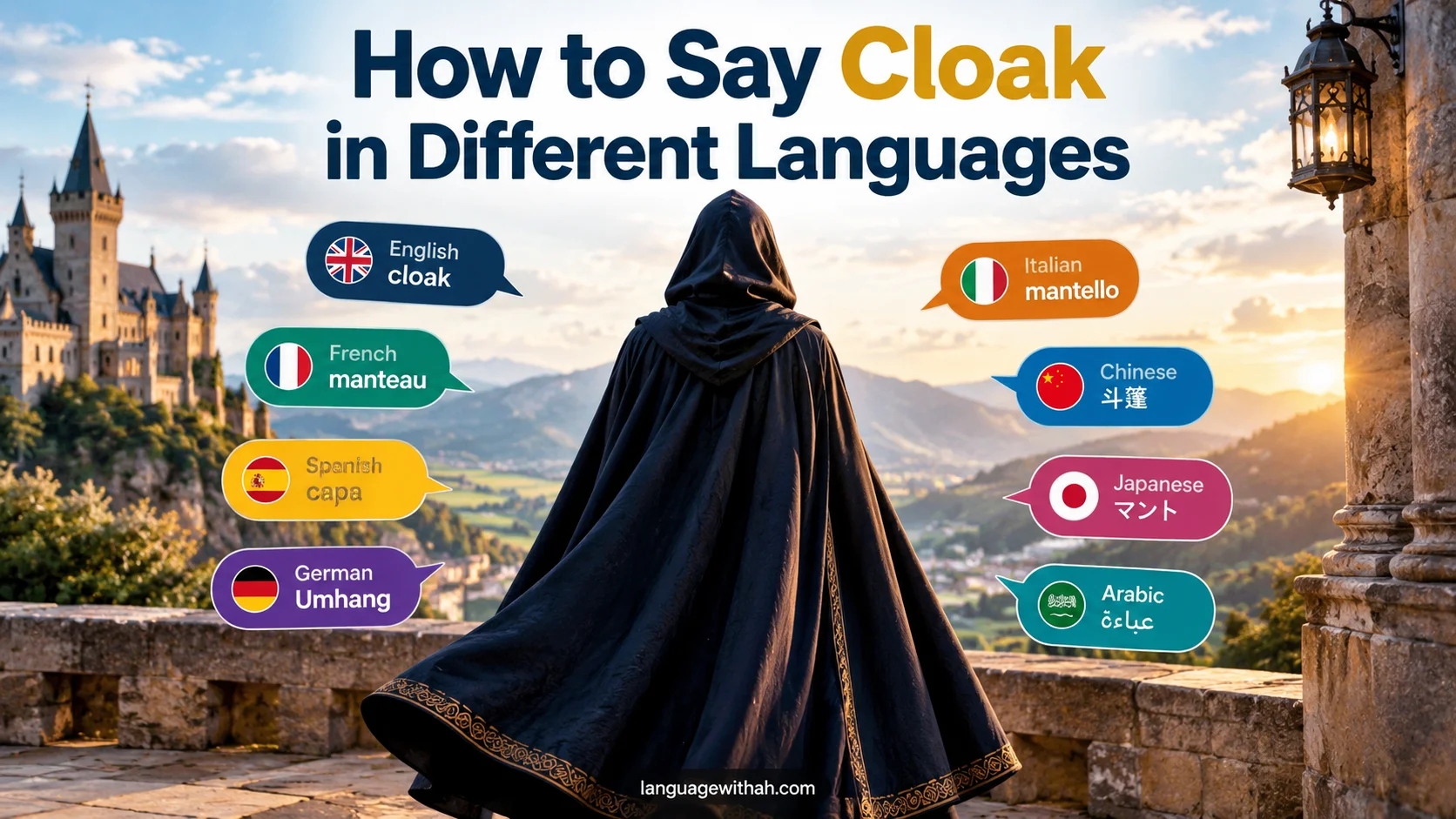
A cloak is a loose outer garment that covers the body and is usually worn over other clothing. The word can also describe a long, flowing covering in historical, fantasy, theatrical, or ceremonial settings. When learning how to say Cloak in 70 Different Languages, it is useful to remember that some languages use a general word for a cape, mantle, or outer garment rather than a perfect one-word equivalent.
The best translation can depend on historical period, clothing style, region, and context. A medieval cloak, a hooded fantasy cloak, and a modern cape may not always be described with exactly the same word. Some languages also have separate terms for garments with sleeves, hoods, or specific cultural designs.
This guide focuses primarily on cloak as a loose outer garment or mantle. It includes translations, pronunciation guides, example sentences, regional notes, and cultural context across more than 70 languages. Where a language has an important distinction between a cloak, cape, mantle, or similar garment, that difference is noted rather than forcing an artificial one-to-one translation.
Interesting Facts About Cloak
- The English word cloak commonly refers to a loose outer garment worn over other clothes, especially in historical or formal contexts.
- In some languages, the closest everyday word may mean cape, mantle, poncho, or outer covering, depending on the garment’s design.
- Historical clothing terminology can be more specific than modern vocabulary. A garment described as a cloak in English may have a different traditional name in another language.
- Cloak can also be used figuratively in English, as in “a cloak of secrecy.” This meaning normally requires a different expression in translation.
- Fantasy literature and films often use words for traditional cloaks even when modern speakers rarely wear such garments.
- In languages with grammatical gender, the word for cloak may require a corresponding article or adjective form.
- Pronunciation guides in this article are reader-friendly approximations. They are intended to help English speakers rather than replace formal phonetic transcription.
What Does Cloak Mean?
A cloak is a loose piece of clothing worn over the body, generally extending from the shoulders downward. Traditional cloaks may be fastened around the neck, while some have a hood.
The word can describe historical clothing, ceremonial garments, theatrical costumes, fantasy clothing, or a general outer covering. For example, someone might wear a dark cloak in a historical reenactment or a fantasy character might be described as wearing a hooded cloak.
In English, cloak also has a figurative meaning. A phrase such as “under a cloak of secrecy” means that something is hidden or concealed. This metaphorical use should not automatically be translated with the ordinary clothing word.
Why Can Cloak Have Different Translations?
There is no single perfect translation for every use of cloak. Languages divide clothing concepts differently.
The appropriate word can depend on:
- Context: historical, modern, fantasy, theatrical, or ceremonial.
- Garment design: a cloak, cape, mantle, or poncho may have different characteristics.
- Formality: literary vocabulary can differ from everyday clothing terminology.
- Region: neighboring countries may use different words for similar garments.
- Historical period: an old term may be more appropriate for medieval or traditional clothing.
- Literal versus natural translation: a dictionary equivalent may not always sound natural in a complete sentence.
- Figurative meaning: “cloak” meaning concealment usually needs a different translation.
For this article, the main meaning is cloak as a loose outer garment.
European Languages
Europe contains several language families, so clothing vocabulary varies considerably. Some languages have a direct word for a cloak, while others commonly use a related term such as cape, mantle, or long outer garment. The examples below favor natural vocabulary for the clothing sense rather than forcing literal translations.
English Varieties
| 🌍 Language | Country/Region | Translation | Pronunciation | Example Sentence |
| American English 🇺🇸 | United States | cloak | klohk | She wore a dark cloak over her dress. — She wore a dark outer garment. |
| British English 🇬🇧 | United Kingdom | cloak | klohk | The actor wore a long cloak for the historical scene. — The actor wore a long outer garment. |
| Australian English 🇦🇺 | Australia | cloak | klohk | The costume included a black cloak. — The costume included a black outer garment. |
The word cloak is essentially the same in these English varieties. Differences may occur in accent or context, but there is no need to invent separate translations.
Western, Northern, and Southern Europe
| 🌍 Language | Country/Region | Translation | Pronunciation | Example Sentence |
| Spanish | Spain, Latin America | capa | KAH-pah | Llevaba una capa negra. — She was wearing a black cloak. |
| French | France, Belgium, Canada | cape | kahp | Il porte une longue cape noire. — He is wearing a long black cloak. |
| German | Germany, Austria, Switzerland | Umhang | OOM-hahng | Er trägt einen langen Umhang. — He is wearing a long cloak. |
| Italian | Italy, Switzerland | mantello | mahn-TEL-loh | Indossa un lungo mantello. — He is wearing a long cloak. |
| Portuguese | Portugal, Brazil | capa | KAH-pah | Ele usa uma capa escura. — He wears a dark cloak. |
| Dutch | Netherlands, Belgium | mantel | MAHN-tel | Hij draagt een lange mantel. — He is wearing a long cloak. |
| Swedish | Sweden, Finland | mantel | MAHN-tel | Han bär en lång mantel. — He is wearing a long cloak. |
| Norwegian | Norway | kappe | KAH-peh | Han har på seg en lang kappe. — He is wearing a long cloak. |
| Danish | Denmark | kappe | KAH-beh | Han har en lang kappe på. — He is wearing a long cloak. |
| Finnish | Finland | viitta | VEE-tah | Hän käyttää pitkää viittaa. — He is wearing a long cloak. |
| Icelandic | Iceland | kápa | KOW-pah | Hún klæðist langri kápu. — She is wearing a long cloak. |
| Irish | Ireland | clóca | KLOH-kah | Tá clóca fada uirthi. — She is wearing a long cloak. |
| Welsh | Wales | clogyn | KLOG-in | Mae hi’n gwisgo clogyn hir. — She is wearing a long cloak. |
| Greek | Greece, Cyprus | μανδύας | man-THEE-as | Φοράει έναν μακρύ μανδύα. — He is wearing a long cloak. |
Cultural note: Several European languages have more than one clothing term that could overlap with cloak. For example, a cape may be sleeveless and shorter, while a traditional mantle or cloak can be longer and more enveloping.
Read More: How to Say Closure in Different Languages
Central and Eastern Europe
| 🌍 Language | Country/Region | Translation | Pronunciation | Example Sentence |
| Polish | Poland | płaszcz | PWASHCH | Ma na sobie długi płaszcz. — He is wearing a long outer garment. |
| Czech | Czechia | plášť | PLASHCHT | Má na sobě dlouhý plášť. — He is wearing a long cloak/outer garment. |
| Slovak | Slovakia | plášť | PLASHCH | Má na sebe dlhý plášť. — He is wearing a long outer garment. |
| Ukrainian | Ukraine | плащ | plashch | Він носить довгий плащ. — He is wearing a long cloak. |
| Russian | Russia and other Russian-speaking regions | плащ | plashch | Он носит длинный плащ. — He is wearing a long outer garment. |
| Bulgarian | Bulgaria | мантия | MAN-tee-yah | Той носи дълга мантия. — He is wearing a long cloak. |
| Croatian | Croatia | plašt | plahsh-t | Nosi dugi plašt. — He is wearing a long cloak. |
| Serbian | Serbia and neighboring regions | plašt | plahsh-t | Nosi dugi plašt. — He is wearing a long cloak. |
| Slovenian | Slovenia | plašč | PLAHSHCH | Nosi dolg plašč. — He is wearing a long outer garment. |
| Romanian | Romania, Moldova | mantie | MAHN-tee-eh | Poartă o mantie lungă. — He is wearing a long cloak. |
| Hungarian | Hungary | köpeny | KUR-peny | Hosszú köpenyt visel. — He is wearing a long cloak. |
| Lithuanian | Lithuania | apsiaustas | ap-see-OW-stahs | Jis dėvi ilgą apsiaustą. — He is wearing a long cloak. |
| Latvian | Latvia | apmetnis | ahp-MET-nis | Viņš valkā garu apmetni. — He is wearing a long cloak. |
| Estonian | Estonia | keep | KAYP | Ta kannab pikka keepi. — He is wearing a long cloak. |
Regional note: Slavic languages frequently use related clothing vocabulary for cloaks, capes, and long outer garments. The exact English choice depends on the garment’s shape and historical context.
Asian Languages
Asia contains hundreds of languages and numerous writing systems. A garment called a cloak in English may correspond to a traditional mantle, robe, cape, shawl-like covering, or other outer garment in an Asian language. The translations below therefore prioritize understandable, context-appropriate vocabulary.
| 🌍 Language | Country/Region | Translation | Pronunciation | Example Sentence |
| Mandarin Chinese | China, Taiwan, Singapore | 斗篷 | dòu peng | 他穿着一件黑色斗篷。 — He is wearing a black cloak. |
| Cantonese | Hong Kong, Guangdong | 斗篷 | dau6 pung4 | 佢着住一件黑色斗篷。 — He is wearing a black cloak. |
| Japanese | Japan | マント | mant-o | 彼は黒いマントを着ている。 — He is wearing a black cloak. |
| Korean | South Korea, North Korea | 망토 | mang-to | 그는 검은 망토를 입고 있어요. — He is wearing a black cloak. |
| Hindi | India | चोग़ा | cho-gha | उसने एक लंबा चोग़ा पहना है। — He is wearing a long cloak-like garment. |
| Urdu | Pakistan, India | چغہ | cho-gha | اس نے ایک لمبا چغہ پہنا ہوا ہے۔ — He is wearing a long cloak-like garment. |
| Bengali | Bangladesh, India | আলখাল্লা | al-khal-la | সে একটি লম্বা আলখাল্লা পরেছে। — He is wearing a long cloak-like robe. |
| Punjabi | India, Pakistan | ਚੋਗਾ / چوغہ | cho-gha | ਉਸ ਨੇ ਲੰਮਾ ਚੋਗਾ ਪਾਇਆ ਹੋਇਆ ਹੈ। — He is wearing a long cloak-like garment. |
| Gujarati | India | ઝભ્ભો | jhab-bho | તેણે લાંબો ઝભ્ભો પહેર્યો છે. — He is wearing a long loose outer garment. |
| Marathi | India | झगा | jha-ga | त्याने लांब झगा घातला आहे. — He is wearing a long cloak-like garment. |
| Tamil | India, Sri Lanka | மேலங்கி | may-la-ngi | அவர் நீண்ட மேலங்கியை அணிந்துள்ளார். — He is wearing a long outer garment. |
| Telugu | India | అంగీ / పైవస్త్రం | an-gee / pai-vas-tram | అతను పొడవైన పైవస్త్రం ధరించాడు. — He is wearing a long outer garment. |
| Kannada | India | ಮೇಲಂಗಿ | may-lang-gee | ಅವನು ಉದ್ದನೆಯ ಮೇಲಂಗಿಯನ್ನು ಧರಿಸಿದ್ದಾನೆ. — He is wearing a long outer garment. |
| Malayalam | India | മേലങ്കി | may-lang-gee | അവൻ നീളമുള്ള മേലങ്കി ധരിച്ചിരിക്കുന്നു. — He is wearing a long outer garment. |
| Nepali | Nepal | लबादा | la-ba-da | उसले लामो लबादा लगाएको छ। — He is wearing a long cloak. |
| Sinhala | Sri Lanka | සළුව | sa-lu-wa | ඔහු දිගු සළුවක් පැළඳ සිටී. — He is wearing a long covering garment. |
| Thai | Thailand | เสื้อคลุม | suea-khlum | เขาสวมเสื้อคลุมยาวสีดำ — He is wearing a long black cloak/outer garment. |
| Vietnamese | Vietnam | áo choàng | ow chwang | Anh ấy mặc một chiếc áo choàng dài. — He is wearing a long cloak. |
| Indonesian | Indonesia | jubah | JOO-bah | Dia mengenakan jubah hitam panjang. — He is wearing a long black cloak. |
| Malay | Malaysia, Brunei, Singapore | jubah | JOO-bah | Dia memakai jubah hitam yang panjang. — He is wearing a long black cloak. |
| Filipino/Tagalog | Philippines | balabal | bah-lah-bal | Nagsuot siya ng mahabang balabal. — He put on a long cloak. |
| Burmese | Myanmar | အင်္ကျီရှည် | in-gyi shay | သူက အင်္ကျီရှည်အနက်ကို ဝတ်ထားတယ်။ — He is wearing a long black outer garment. |
| Khmer | Cambodia | អាវធំ | av thom | គាត់ពាក់អាវធំវែង។ — He is wearing a long outer garment. |
| Lao | Laos | ເສື້ອຄຸມ | suea khum | ລາວໃສ່ເສື້ອຄຸມຍາວ. — He is wearing a long cloak/outer covering. |
| Mongolian | Mongolia | нөмрөг | nom-rog | Тэр урт нөмрөг өмссөн. — He is wearing a long cloak. |
| Kazakh | Kazakhstan | шапан | sha-pan | Ол ұзын шапан киген. — He is wearing a long traditional outer garment. |
| Uzbek | Uzbekistan | chopon | cho-pon | U uzun chopon kiygan. — He is wearing a long traditional outer garment. |
| Persian | Iran, Afghanistan, Tajikistan | شنل | shenel | او یک شنل بلند پوشیده است. — He is wearing a long cloak. |
| Turkish | Turkey, Cyprus and surrounding regions | pelerin | peh-leh-REEN | Uzun bir pelerin giyiyor. — He is wearing a long cloak. |
Important cultural note: Some South and Central Asian words above refer to traditional loose outer garments rather than a European-style cloak. For example, chopon and shapan describe culturally specific garments. They are useful equivalents when discussing a long, loose outer covering, but they should not be treated as identical garments in every historical context.
African Languages
Africa has exceptional linguistic diversity, with language families including Niger-Congo, Afroasiatic, Nilo-Saharan, and others. Clothing terminology can be highly culture-specific, so a general word for a cloak, cape, robe, or outer covering may be more natural than an exact European-style equivalent.
| 🌍 Language | Country/Region | Translation | Pronunciation | Example Sentence |
| Swahili | Kenya, Tanzania, East Africa | joho | JOH-hoh | Amevaa joho refu jeusi. — He is wearing a long black cloak. |
| Afrikaans | South Africa, Namibia | mantel | MAN-tel | Hy dra ‘n lang mantel. — He is wearing a long cloak. |
| Zulu | South Africa | ingubo | in-GOO-boh | Ugqoke ingubo ende. — He is wearing a long covering garment. |
| Xhosa | South Africa | ingubo | in-GOO-boh | Unxibe ingubo ende. — He is wearing a long covering garment. |
| Amharic | Ethiopia | ካባ | ka-ba | ረጅም ካባ ለብሷል። — He is wearing a long cloak. |
| Yoruba | Nigeria, Benin | aṣọ ìbora | ah-shaw ee-boh-rah | Ó wọ aṣọ ìbora gígùn. — He is wearing a long covering garment. |
| Igbo | Nigeria | uwe mwụda | oo-weh mwoo-dah | O yi uwe mwụda ogologo. — He is wearing a long outer garment. |
| Hausa | Nigeria, Niger and West Africa | alkyabba | al-kyab-bah | Ya sa doguwar alkyabba. — He is wearing a long cloak. |
| Somali | Somalia, Somaliland, Djibouti | go’ | goh | Wuxuu xirtay go’ dheer. — He is wearing a long traditional wrap. |
| Shona | Zimbabwe | jasi | JAH-see | Akapfeka jasi refu. — He is wearing a long outer garment. |
| Sesotho | Lesotho, South Africa | kobo | KOH-boh | O apere kobo e telele. — He is wearing a long covering garment. |
| Setswana | Botswana, South Africa | kobo | KOH-boh | O apere kobo e telele. — He is wearing a long covering garment. |
| Kinyarwanda | Rwanda | umwambaro | oom-wam-bah-roh | Yambaye umwambaro muremure. — He is wearing a long outer garment. |
| Malagasy | Madagascar | kapa | KAH-pah | Manao kapa lava izy. — He is wearing a long cloak-like garment. |
Cultural note: African clothing vocabulary should not be reduced to European clothing categories. A word that can be used for a cloak-like covering may also refer to a traditional wrap, blanket, robe, or other garment with its own cultural significance.
Middle Eastern Languages
The Middle East includes several distinct linguistic traditions. Arabic itself has many regional varieties, while Persian, Hebrew, Kurdish, Turkish, and Armenian have their own vocabulary. For Arabic, Modern Standard Arabic is distinguished here from everyday dialects where useful.
| 🌍 Language | Country/Region | Translation | Pronunciation | Example Sentence |
| Modern Standard Arabic | Middle East, North Africa | عباءة | ʿabāʾa | يرتدي عباءة سوداء طويلة. — He is wearing a long black cloak. |
| Egyptian Arabic | Egypt | عباءة | ʿabaya | هو لابس عباءة سوداء. — He is wearing a black cloak. |
| Hebrew | Israel | גלימה | gli-mah | הוא לובש גלימה שחורה. — He is wearing a black cloak. |
| Kurdish (Kurmanji) | Kurdistan regions | cil | jeel | Ew cilê dirêj li xwe kiriye. — He is wearing a long outer garment. |
| Persian | Iran, Afghanistan, Tajikistan | شنل | shenel | او شنل بلندی پوشیده است. — He is wearing a long cloak. |
| Turkish | Turkey, Cyprus | pelerin | peh-leh-REEN | Uzun bir pelerin giydi. — He wore a long cloak. |
| Armenian | Armenia and Armenian communities | թիկնոց | tik-NOTS | Նա երկար թիկնոց է հագել։ — He is wearing a long cloak. |
A note about Arabic
عباءة (ʿabāʾa/abaya) is a culturally specific loose outer garment and is often translated into English as cloak, robe, or abaya, depending on context. It should not automatically be treated as identical to the European medieval cloak.
Likewise, regional Arabic dialects may use different clothing vocabulary. Modern Standard Arabic is useful for formal writing, while everyday spoken Arabic varies substantially between countries.
Other World Languages
A few additional languages help demonstrate how widely clothing vocabulary differs around the world.
| 🌍 Language | Country/Region | Translation | Pronunciation | Example Sentence |
| Māori | New Zealand | korowai | koh-roh-wai | Kei te mau ia i te korowai. — He is wearing a cloak-like traditional garment. |
| Samoan | Samoa | ‘ofu | OH-foo | O loo ia ofuina se ‘ofu umi. — He is wearing a long garment. |
| Tongan | Tonga | kofu | KOH-foo | ʻOku ne tui ha kofu lōloa. — He is wearing a long garment. |
| Hawaiian | Hawaii | ʻahu | AH-hoo | Ua ʻaʻahu ʻo ia i ka ʻahu. — He is wearing a cloak-like covering. |
| Quechua | Andes, South America | punchu | POON-choo | Payqa punchuta churakun. — He puts on a poncho-like outer garment. |
| Guarani | Paraguay and surrounding regions | ao | AH-oh | Ha’e omonde ao puku. — He wears a long outer garment. |
| Haitian Creole | Haiti | kap | kahp | Li mete yon kap nwa. — He puts on a black cape/cloak. |
| Esperanto | International | mantelo | mahn-TEH-loh | Li portas longan mantelon. — He is wearing a long cloak. |
Cultural note: Some of these terms refer to garments with distinctive cultural forms. A korowai, for example, is a traditional Māori cloak with significant cultural meaning, while a punchu/poncho is structurally different from a European cloak. Translation therefore works best when readers understand the garment being discussed.
Quick Reference: Cloak in Different Languages
| Language | Translation |
| American English | cloak |
| British English | cloak |
| Australian English | cloak |
| Spanish | capa |
| French | cape |
| German | Umhang |
| Italian | mantello |
| Portuguese | capa |
| Dutch | mantel |
| Swedish | mantel |
| Norwegian | kappe |
| Danish | kappe |
| Finnish | viitta |
| Icelandic | kápa |
| Irish | clóca |
| Welsh | clogyn |
| Greek | μανδύας |
| Polish | płaszcz |
| Czech | plášť |
| Slovak | plášť |
| Ukrainian | плащ |
| Russian | плащ |
| Bulgarian | мантия |
| Croatian | plašt |
| Serbian | plašt |
| Slovenian | plašč |
| Romanian | mantie |
| Hungarian | köpeny |
| Lithuanian | apsiaustas |
| Latvian | apmetnis |
| Estonian | keep |
| Mandarin Chinese | 斗篷 |
| Cantonese | 斗篷 |
| Japanese | マント |
| Korean | 망토 |
| Hindi | चोग़ा |
| Urdu | چغہ |
| Bengali | আলখাল্লা |
| Punjabi | ਚੋਗਾ / چوغہ |
| Gujarati | ઝભ્ભો |
| Marathi | झगा |
| Tamil | மேலங்கி |
| Telugu | పైవస్త్రం |
| Kannada | ಮೇಲಂಗಿ |
| Malayalam | മേലങ്കി |
| Nepali | लबादा |
| Sinhala | සළුව |
| Thai | เสื้อคลุม |
| Vietnamese | áo choàng |
| Indonesian | jubah |
| Malay | jubah |
| Filipino/Tagalog | balabal |
| Burmese | အင်္ကျီရှည် |
| Khmer | អាវធំ |
| Lao | ເສື້ອຄຸມ |
| Mongolian | нөмрөг |
| Kazakh | шапан |
| Uzbek | chopon |
| Persian | شنل |
| Turkish | pelerin |
| Swahili | joho |
| Afrikaans | mantel |
| Zulu | ingubo |
| Xhosa | ingubo |
| Amharic | ካባ |
| Yoruba | aṣọ ìbora |
| Igbo | uwe mwụda |
| Hausa | alkyabba |
| Somali | go’ |
| Shona | jasi |
| Sesotho | kobo |
| Setswana | kobo |
| Kinyarwanda | umwambaro |
| Malagasy | kapa |
| Modern Standard Arabic | عباءة |
| Egyptian Arabic | عباءة |
| Hebrew | גלימה |
| Kurdish (Kurmanji) | cil |
| Armenian | թիկնոց |
| Māori | korowai |
| Samoan | ‘ofu |
| Tongan | kofu |
| Hawaiian | ʻahu |
| Quechua | punchu |
| Guarani | ao |
| Haitian Creole | kap |
| Esperanto | mantelo |
How to Choose the Right Translation
The best translation of cloak depends on what kind of garment you mean.
- Describe the garment first. A hooded, ankle-length cloak may require a different term from a short cape.
- Consider the setting. Historical fiction, fantasy, modern fashion, and traditional clothing can use different vocabulary.
- Check the region. A language may have different everyday terms across countries.
- Consider formality. Literary or historical words may sound unusual in ordinary conversation.
- Respect cultural clothing names. A traditional garment should not automatically be treated as an exact equivalent of a European cloak.
- Use context rather than word-for-word translation. A natural sentence is usually more useful than a dictionary substitution.
If you are writing a story, costume description, travel message, or language-learning exercise, choose the translation that matches the specific garment and situation.
Common Mistakes When Translating Cloak
1. Treating every cape as a cloak
A cape is often shorter or shaped differently from a traditional cloak. Some languages use one general word for both, while English distinguishes them.
2. Translating only the dictionary word
A dictionary may provide several possible translations. The correct choice depends on whether you mean a historical garment, fantasy cloak, robe, mantle, cape, or traditional covering.
3. Ignoring regional vocabulary
Languages such as Arabic, Chinese, and Spanish have substantial regional variation. A word used in one location may not be the most natural choice elsewhere.
4. Confusing traditional garments with exact equivalents
Words such as korowai, chopon, shapan, and abaya have specific cultural meanings. Calling each simply a “cloak” can hide important differences.
5. Using incorrect pronunciation
Non-Latin writing systems require careful romanization or transliteration. An approximate English spelling can sometimes give a misleading pronunciation.
6. Forgetting the figurative meaning
English can use cloak to mean concealment, as in “a cloak of secrecy.” The clothing translation should not automatically be used in that situation.
Why Learn Cloak in Different Languages?
Learning the word cloak in different languages is a small but useful way to expand vocabulary beyond simple everyday objects. Clothing terms reveal how languages categorize the physical world and how cultural traditions influence vocabulary.
For language learners, comparing words such as capa, Umhang, mantello, 斗篷, and pelerin can introduce differences in pronunciation, grammar, and cultural meaning. Travelers may also encounter traditional clothing whose names do not have exact English equivalents.
For writers, students, costume designers, and readers of historical or fantasy literature, knowing the appropriate foreign-language expression can make descriptions more precise. Most importantly, learning these terms encourages respect for the fact that similar-looking garments can have very different histories and cultural meanings.
FAQs:
How do you say cloak in different languages?
The word varies widely. For example, cloak is capa in Spanish, cape in French, Umhang in German, mantello in Italian, 斗篷 (dòupeng) in Mandarin Chinese, pelerin in Turkish, and jubah in Indonesian.
What is the most natural translation of cloak?
There is no single universal translation. The most natural choice depends on the style of garment and context. A traditional cloak, cape, mantle, and robe may require different words.
Can the translation change by country?
Yes. Regional variation can affect clothing vocabulary. Arabic is a particularly clear example because formal Arabic and regional varieties can use different expressions.
Is cloak the same as cape?
Not always. In English, a cloak is generally a loose outer garment that can be long and enveloping, while a cape is often shorter or differently shaped. Other languages may use one word for both concepts.
How do you pronounce cloak in English?
English cloak is pronounced approximately “klohk.” The vowel is similar to the sound in go in many English accents.
Conclusion:
Learning how to say Cloak in 70 Different Languages shows why translation is about more than replacing one English word with another. A cloak can be a historical garment, a fantasy costume, a ceremonial covering, or a culturally specific form of outerwear, and different languages may divide these ideas in different ways.
The translations in this guide include capes, mantles, robes, traditional outer garments, and cloak-like coverings where those distinctions matter. Context is therefore essential. Before using a foreign-language word, consider the garment’s design, the region, the relationship between speakers, and whether the setting is modern, historical, literary, or traditional.













1 thought on “How to Say Cloak in Different Languages”