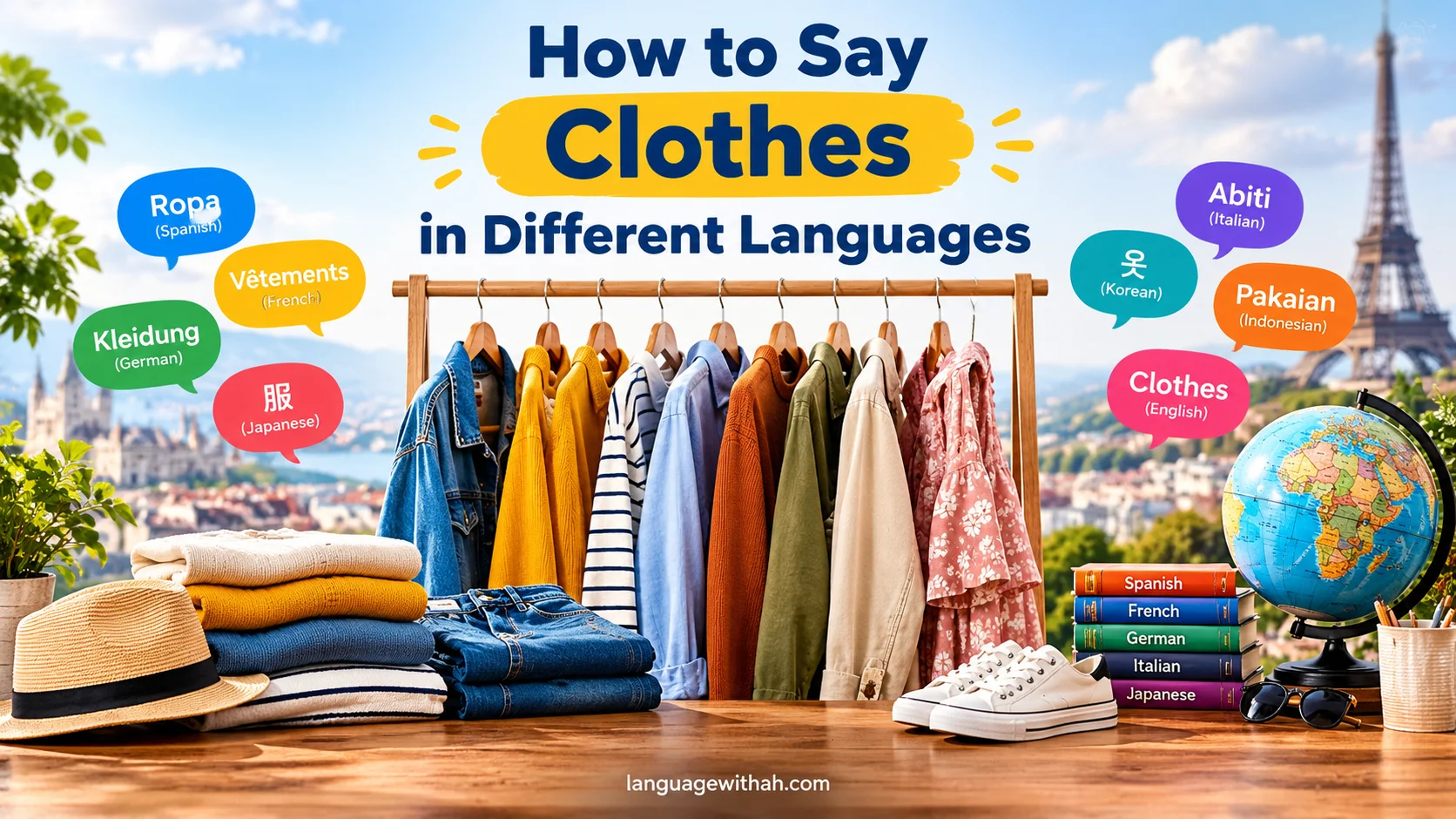
Clothes are the garments people wear for comfort, protection, cultural expression, and personal style. Learning how to say clothes in 70 different languages is a useful way to expand your vocabulary, prepare for international travel, and communicate more naturally when shopping for clothing abroad. Although English uses the general word clothes, other languages may use a plural noun, a collective expression, or a word that refers more broadly to clothing and garments.
The translation you choose can depend on the situation. Asking where to buy clothes is different from discussing traditional clothing, describing someone’s outfit, or talking about a single item such as a shirt or jacket. Some languages also distinguish between clothing as a general category, garments as individual objects, and the act of getting dressed.
This guide explores the word clothes in different languages, including European, Asian, African, Middle Eastern, and other world languages. Each entry includes a representative country or region, the translation, a pronunciation guide, and an example sentence with its English meaning. You will also find useful cultural notes, common translation mistakes, and practical tips for choosing the right expression. Because language usage varies by region and context, some entries include distinctions between formal, informal, and everyday expressions.
Interesting Facts About Clothes
- Clothes and clothing are not grammatically identical: English commonly uses clothes as a plural noun, while clothing is generally an uncountable noun.
- Some languages use collective nouns: A word for clothing may refer to garments collectively rather than functioning like the English plural word clothes.
- Traditional clothing often has its own vocabulary: A language may have specific words for garments associated with ceremonies, seasons, occupations, or regional traditions.
- Clothes are different from an outfit: Clothes can refer to garments in general, while an outfit usually means a coordinated set of garments worn together.
- Shopping expressions can differ from dictionary translations: A natural phrase for buying clothes may use a word or construction that differs from the basic noun for clothing.
- Borrowed words appear in clothing vocabulary: International fashion and trade have helped words for particular garments travel between languages, although their meanings and pronunciations can change.
- Context helps determine the best word: A discussion about washing clothes, choosing an outfit, or wearing traditional garments may call for different expressions.
What Does Clothes Mean?
Clothes means the garments people wear on their bodies, including shirts, trousers, dresses, skirts, coats, and other wearable items. The word generally describes clothing collectively rather than one specific garment.
People use the word in everyday situations such as shopping, packing for a trip, doing laundry, choosing an outfit, or discussing fashion. For example, “I need new clothes” refers to garments in general, while “I need a new shirt” identifies one particular item.
Clothes can also carry personal and cultural meaning. A uniform may communicate a person’s role, while traditional garments can reflect regional history, community practices, or ceremonial occasions. However, the word itself does not automatically imply any particular style or cultural significance.
When translating clothes, it is important to preserve this general meaning. A word for clothing or garments collectively is usually more appropriate than a translation meaning only fashion, a costume, or a single item of apparel.
Why Can Clothes Have Different Translations?
The word clothes does not have one universal equivalent because languages organize vocabulary and grammar differently.
- Context: A general discussion about clothing may use a different expression from a conversation about laundry or shopping.
- Grammar: Some languages use plural nouns, while others use collective or mass nouns.
- Formality: Everyday speech may favor a familiar word, while formal writing may use a more technical term for apparel.
- Regional dialects: Speakers in different countries or regions may prefer different words for the same general concept.
- Cultural conventions: Particular garments may have specific names that cannot be replaced by a broad word for clothes.
- Literal versus natural translation: A dictionary equivalent may be understandable but not the most natural choice in a complete sentence.
- Spoken versus written language: Informal conversation, advertising, and formal descriptions of clothing may use different vocabulary.
For this article, the goal is to give the most useful general expression for clothes or clothing in each language, rather than mechanically translating the English word into an unnatural phrase.
European Languages
European languages belong to several language families, including Germanic, Romance, Slavic, and Uralic languages. Their words for clothes differ in grammar, pronunciation, and everyday usage. The following entries focus on general clothing rather than a specific outfit or garment.
| 🌍 Language | Country/Region | Translation | Pronunciation | Example Sentence |
| English | International | Clothes | klohz | I need new clothes. |
| American English 🇺🇸 | United States | Clothes | klohz | I bought some new clothes. |
| British English 🇬🇧 | United Kingdom | Clothes | klohz | I need some new clothes. |
| Australian English 🇦🇺 | Australia | Clothes | klohz | I packed my clothes. |
| Spanish | Spain, Latin America | Ropa | ROH-pah | Necesito ropa nueva. — I need new clothes. |
| French | France, Belgium, Canada | Vêtements | vet-MAHN | J’achète des vêtements. — I’m buying clothes. |
| German | Germany, Austria | Kleidung | KLY-dung | Ich brauche neue Kleidung. — I need new clothes. |
| Italian | Italy, Switzerland | Vestiti | ves-TEE-tee | Ho comprato dei vestiti. — I bought some clothes. |
| Portuguese | Portugal, Brazil | Roupas | HOH-pahs (Brazilian Portuguese) | Preciso de roupas novas. — I need new clothes. |
| Dutch | Netherlands, Belgium | Kleding | KLAY-ding | Ik koop nieuwe kleding. — I’m buying new clothes. |
| Swedish | Sweden, Finland | Kläder | KLEH-der | Jag behöver nya kläder. — I need new clothes. |
| Norwegian | Norway | Klær | klehr | Jeg trenger nye klær. — I need new clothes. |
| Danish | Denmark | Tøj | toy | Jeg har købt nyt tøj. — I bought new clothes. |
| Finnish | Finland | Vaatteet | VAHT-teet | Tarvitsen uusia vaatteita. — I need new clothes. |
| Icelandic | Iceland | Föt | fuht | Ég þarf ný föt. — I need new clothes. |
| Irish | Ireland | Éadaí | AY-dee | Tá éadaí nua de dhíth orm. — I need new clothes. |
| Welsh | Wales | Dillad | DILL-ad | Mae angen dillad newydd arnaf. — I need new clothes. |
| Polish | Poland | Ubrania | oo-BRAH-nya | Potrzebuję nowych ubrań. — I need new clothes. |
| Czech | Czechia | Oblečení | ob-leh-CHEH-nee | Potřebuji nové oblečení. — I need new clothes. |
| Slovak | Slovakia | Oblečenie | ob-leh-CHEH-nyeh | Potrebujem nové oblečenie. — I need new clothes. |
| Ukrainian | Ukraine | Одяг | O-dyah | Мені потрібен новий одяг. — I need new clothes. |
| Russian | Russia and other Russian-speaking regions | Одежда | a-DEZH-da | Мне нужна новая одежда. — I need new clothes. |
| Romanian | Romania, Moldova | Haine | HAH-ee-neh | Am nevoie de haine noi. — I need new clothes. |
| Hungarian | Hungary | Ruhák | ROO-hahk | Új ruhákra van szükségem. — I need new clothes. |
| Greek | Greece, Cyprus | Ρούχα | ROO-kha | Χρειάζομαι καινούρια ρούχα. — I need new clothes. |
| Bulgarian | Bulgaria | Дрехи | DREH-khee | Имам нужда от нови дрехи. — I need new clothes. |
| Croatian | Croatia | Odjeća | OD-yeh-cha | Trebam novu odjeću. — I need new clothes. |
| Serbian | Serbia and neighboring regions | Одећа | o-DEH-cha | Треба ми нова одећа. — I need new clothes. |
| Slovenian | Slovenia | Oblačila | ob-lah-CHEE-lah | Potrebujem nova oblačila. — I need new clothes. |
| Lithuanian | Lithuania | Drabužiai | dra-boo-ZHY-eye | Man reikia naujų drabužių. — I need new clothes. |
| Latvian | Latvia | Apģērbs | ap-GYERBS | Man vajag jaunas drēbes. — I need new clothes. |
| Estonian | Estonia | Riided | REE-dehd | Mul on uusi riideid vaja. — I need new clothes. |
English varieties: What changes?
American, British, and Australian English all use clothes for the general category of garments. The basic word is the same, although accent and related clothing vocabulary can differ. For instance, pants usually means trousers in American English, while in British English it commonly means underwear; Australian usage also varies by context.
Another useful distinction is between clothes, clothing, and outfit. Clothes refers to garments generally, clothing is a broader collective term often used in formal descriptions, and outfit usually refers to a particular combination of garments.
Cultural note
European languages do not all treat clothing nouns in the same way. Spanish ropa, French vêtements, and German Kleidung are common general terms, but their grammatical behavior differs. When speaking naturally, learn the complete expression, such as necesito ropa nueva in Spanish, rather than relying on an isolated dictionary entry.
Read More: How to Say Color in Different Languages
Asian Languages
Asia contains many language families and writing systems, from Chinese characters to Devanagari, Arabic-derived scripts, and Southeast Asian scripts. The words below express the general idea of clothes or clothing, with romanization or pronunciation guidance to help learners read them.
| 🌍 Language | Country/Region | Translation | Pronunciation | Example Sentence |
| Mandarin Chinese | China, Taiwan, Singapore | 衣服 | yīfu (ee-foo) | 我需要买新衣服。— I need to buy new clothes. |
| Cantonese | Hong Kong, Guangdong | 衣服 | ji1 fu6 (Yee-foo, approximate) | 我想買新衫。— I want to buy new clothes. |
| Japanese | Japan | 服(服・衣服) | fuku / ifuku (foo-koo / ee-foo-koo) | 新しい服を買いたいです。— I want to buy new clothes. |
| Korean | South Korea, North Korea | 옷 | ot (roughly oht) | 새 옷을 사고 싶어요. — I want to buy new clothes. |
| Hindi | India | कपड़े | kapṛe (KUP-ray) | मुझे नए कपड़े चाहिए। — I need new clothes. |
| Urdu | Pakistan, India | کپڑے | kapray (KUP-ray) | مجھے نئے کپڑے چاہئیں۔ — I need new clothes. |
| Bengali | Bangladesh, India | কাপড় / জামাকাপড় | kapoṛ / jama-kapor (KAH-por / jah-mah-kah-por) | আমার নতুন জামাকাপড় দরকার। — I need new clothes. |
| Punjabi | Punjab, India and Pakistan | ਕੱਪੜੇ / کپڑے | kapṛe (KUP-ray) | ਮੈਨੂੰ ਨਵੇਂ ਕੱਪੜੇ ਚਾਹੀਦੇ ਹਨ। — I need new clothes. |
| Gujarati | Gujarat, India | કપડાં | kapḍā̃ (KUP-daan, approximate) | મારે નવાં કપડાં જોઈએ છે. — I need new clothes. |
| Marathi | Maharashtra, India | कपडे | kapḍe (KUP-day) | मला नवीन कपडे हवे आहेत. — I need new clothes. |
| Tamil | Tamil Nadu, Sri Lanka, Singapore | ஆடைகள் / துணிகள் | āḍaigaḷ / thuṇigaḷ (aa-dai-gal / thoo-ni-gal) | எனக்குப் புதிய ஆடைகள் வேண்டும். — I need new clothes. |
| Telugu | Andhra Pradesh, Telangana | బట్టలు | baṭṭalu (BUT-ta-lu) | నాకు కొత్త బట్టలు కావాలి. — I need new clothes. |
| Kannada | Karnataka, India | ಬಟ್ಟೆಗಳು | baṭṭegaḷu (BUT-te-ga-lu) | ನನಗೆ ಹೊಸ ಬಟ್ಟೆಗಳು ಬೇಕು. — I need new clothes. |
| Malayalam | Kerala, India | വസ്ത്രങ്ങൾ | vastrangaḷ (vas-tran-gal) | എനിക്ക് പുതിയ വസ്ത്രങ്ങൾ വേണം. — I need new clothes. |
| Nepali | Nepal | लुगा | lugā (LOO-gaa) | मलाई नयाँ लुगा चाहिन्छ। — I need new clothes. |
| Sinhala | Sri Lanka | ඇඳුම් | andum (AN-doom) | මට අලුත් ඇඳුම් අවශ්යයි. — I need new clothes. |
| Thai | Thailand | เสื้อผ้า | suea pha (sʉ̂a phâa) | ฉันต้องการเสื้อผ้าใหม่ — I need new clothes. |
| Vietnamese | Vietnam | Quần áo | kwuhn ow (approximate) | Tôi cần quần áo mới. — I need new clothes. |
| Indonesian | Indonesia | Pakaian / baju | pa-KAI-an / BA-joo | Saya membutuhkan pakaian baru. — I need new clothes. |
| Malay | Malaysia, Brunei, Singapore | Pakaian / baju | pa-KAI-an / BA-joo | Saya memerlukan pakaian baharu. — I need new clothes. |
| Filipino (Tagalog) | Philippines | Damit | dah-MEET | Kailangan ko ng bagong damit. — I need new clothes. |
| Burmese | Myanmar | အဝတ်အစား | a-wut-a-sa (approximate) | အဝတ်အစားအသစ်တွေ လိုအပ်တယ်။ — I need new clothes. |
| Khmer | Cambodia | សម្លៀកបំពាក់ | sam-liək-bɑm-peak (approximate) | ខ្ញុំត្រូវការសម្លៀកបំពាក់ថ្មី។ — I need new clothes. |
| Lao | Laos | ເຄື່ອງນຸ່ງ | khueang nung (approximate) | ຂ້ອຍຕ້ອງການເຄື່ອງນຸ່ງໃໝ່. — I need new clothes. |
| Mongolian | Mongolia | Хувцас | khuvtsas (khuf-tsas, approximate) | Надад шинэ хувцас хэрэгтэй. — I need new clothes. |
| Kazakh | Kazakhstan | Киім | kiim (kee-eem) | Маған жаңа киім керек. — I need new clothes. |
| Uzbek | Uzbekistan | Kiyim | kee-yim | Menga yangi kiyim kerak. — I need new clothes. |
Cultural and language notes
- Mandarin Chinese: 衣服 (yīfu) is a common everyday word for clothes. The second syllable is typically neutral in tone.
- Cantonese: 衣服 (ji1 fu6) is a general term, while 衫 (saam1) is commonly used for clothes or garments in everyday Cantonese. The example uses the natural phrase 新衫 for new clothes.
- Japanese: 服 (fuku) is widely used in everyday conversation. 衣服 (ifuku) is another term and can sound more formal or descriptive.
- Hindi and Urdu: कपड़े and کپڑے are written in different scripts but share closely related vocabulary in everyday speech.
- Malay and Indonesian: Pakaian works as a general term in both languages. Everyday usage and some spelling choices differ; for example, baharu is standard Malay usage for “new,” while baru is common in Indonesian and also appears in informal Malay.
- Tamil: ஆடைகள் generally means garments or clothes, while துணிகள் can refer to cloth or fabrics as well as clothing-related material. Context determines the best choice.
These distinctions matter because a word that is correct in a dictionary may not be the expression a speaker naturally chooses in a particular conversation.
African Languages
Africa is home to a remarkable range of languages, including Bantu, Semitic, Cushitic, and Niger-Congo languages. Words for clothes differ across these language communities, and a country’s languages should not be treated as interchangeable. The examples below use general expressions for clothing in the indicated languages.
| 🌍 Language | Country/Region | Translation | Pronunciation | Example Sentence |
| Swahili | Tanzania, Kenya, East Africa | Nguo | ngoo-oh | Ninahitaji nguo mpya. — I need new clothes. |
| Afrikaans | South Africa, Namibia | Klere | KLEE-ruh | Ek het nuwe klere nodig. — I need new clothes. |
| Zulu | South Africa | Izingubo | ee-zeen-GOO-bo | Ngidinga izingubo ezintsha. — I need new clothes. |
| Xhosa | South Africa | Iimpahla | eem-PAH-hla | Ndifuna iimpahla ezintsha. — I need new clothes. |
| Amharic | Ethiopia | ልብሶች | libsoch (approximate) | አዲስ ልብሶች ያስፈልጉኛል። — I need new clothes. |
| Yoruba | Nigeria, Benin | Aṣọ | ah-SHAW | Mo nílò aṣọ tuntun. — I need new clothes. |
| Igbo | Nigeria | Uwe | oo-weh | Achọrọ m uwe ọhụrụ. — I need new clothes. |
| Hausa | Nigeria, Niger, West Africa | Tufafi | too-FAH-fee | Ina bukatar sababbin tufafi. — I need new clothes. |
| Somali | Somalia, Somaliland, Horn of Africa | Dhar | dhar (the initial sound is similar to a voiced “th”) | Waxaan u baahanahay dhar cusub. — I need new clothes. |
| Shona | Zimbabwe | Hembe | HEM-beh | Ndinoda hembe itsva. — I need new clothes. |
| Sesotho | Lesotho, South Africa | Liaparo | lee-ah-PAH-roh | Ke hloka liaparo tse ncha. — I need new clothes. |
| Setswana | Botswana, South Africa | Diaparo | dee-ah-PAH-roh | Ke tlhoka diaparo tse dintšha. — I need new clothes. |
| Kinyarwanda | Rwanda | Imyenda | ee-MYEN-dah | Nkeneye imyenda mishya. — I need new clothes. |
| Malagasy | Madagascar | Akanjo | ah-KAN-joo | Mila akanjo vaovao aho. — I need new clothes. |
Cultural notes
- Swahili: Nguo can refer to clothes, garments, or cloth depending on context. A phrase such as nguo mpya means new clothes.
- Yoruba: Aṣọ can refer to cloth, fabric, or clothing. The intended meaning becomes clearer in a full sentence.
- Zulu and Xhosa: These languages have distinct vocabulary and grammatical systems, even though they are both Nguni languages. Their words for clothing should not be substituted for one another automatically.
- Amharic: The word ልብሶች (libsoch) is a plural form for clothes or garments.
- Sesotho and Setswana: Both languages use related Bantu vocabulary, but their spelling, grammar, and pronunciation are different.
When using clothing vocabulary for traditional dress, it is better to learn the garment’s specific name when possible rather than assuming that a general word for clothes fully describes it.
Middle Eastern Languages
The Middle East includes several distinct language traditions, including Arabic, Persian, Hebrew, Kurdish, Turkish, and Armenian. Even closely neighboring languages can use different words for everyday clothing. Arabic also has regional dialects, so the entries below identify the variety where it matters.
| 🌍 Language | Country/Region | Translation | Pronunciation | Example Sentence |
| Modern Standard Arabic | Across the Arab world | ملابس | malābis (ma-LAA-bis) | أحتاج إلى ملابس جديدة. — I need new clothes. |
| Egyptian Arabic | Egypt | هدوم | hidoom (hee-DOOM) | أنا محتاج هدوم جديدة. — I need new clothes. |
| Persian (Farsi) | Iran | لباس | lebās (le-BAAS) | من به لباس جدید نیاز دارم. — I need new clothes. |
| Hebrew | Israel | בגדים | begadim (be-ga-DEEM) | אני צריך בגדים חדשים. — I need new clothes. |
| Kurdish (Kurmanji) | Türkiye, Iraq, Syria, Iran | Cil | jeel (approximate) | Ez cilên nû dixwazim. — I want new clothes. |
| Turkish | Türkiye, Cyprus | Giysiler / kıyafetler | gee-yee-seh-ler / kuh-yah-fet-ler | Yeni kıyafetlere ihtiyacım var. — I need new clothes. |
| Armenian | Armenia and Armenian-speaking communities | Հագուստ | hagust (ha-GOOST) | Ինձ նոր հագուստ է պետք։ — I need new clothes. |
Cultural notes
- Modern Standard Arabic: Malābis (ملابس) is a broadly understood word for clothes. Everyday conversation may use a regional expression instead.
- Egyptian Arabic: Hidūm (هدوم) is a familiar colloquial word for clothes in Egypt. It is not the standard everyday choice in every Arabic-speaking region.
- Persian: Lebās (لباس) is a common general word for clothing.
- Hebrew: Begadim (בגדים) is the plural word for clothes.
- Kurdish: Kurdish has several varieties, including Kurmanji and Sorani. Vocabulary and spelling can differ between them, so the Kurmanji entry should not be treated as a universal Kurdish form.
- Turkish: Kıyafetler and giysiler both refer to clothes or garments, with usage depending on context.
Other World Languages
Some languages are best grouped by their geographic or cultural context rather than being placed in one of the four main regional sections. The following examples expand the list while highlighting the variety of ways languages express the idea of clothing.
| 🌍 Language | Country/Region | Translation | Pronunciation | Example Sentence |
| Māori | New Zealand | Kākahu | KAA-kaa-hoo | E hiahia ana ahau ki ngā kākahu hou. — I want new clothes. |
| Samoan | Samoa, Pacific Islands | Laʻei | lah-EH-ee | Ou te manaʻomia ni laʻei fou. — I need new clothes. |
| Tongan | Tonga, Pacific Islands | Kofu | KOH-foo | ʻOku ou fiemaʻu ha kofu foʻou. — I need new clothes. |
| Hawaiian | Hawaiʻi | Lole | LOH-leh | Makemake au i nā lole hou. — I want new clothes. |
| Quechua | Andes, including Peru and Bolivia | P’acha / p’achakuna (varies by variety) | PA-cha / PA-cha-koo-na | Vocabulary and sentence forms vary by Quechua variety; verify with a local speaker before using a full sentence. |
| Guarani | Paraguay and neighboring regions | Aho | ah-HO | Ahaase aho pyahu. — I will buy new clothes. |
| Haitian Creole | Haiti | Rad | rahd | Mwen bezwen rad nèf. — I need new clothes. |
| Esperanto | International constructed language | Vestoj | ves-TOY | Mi bezonas novajn vestojn. — I need new clothes. |
Cultural notes
Pacific languages may use words whose meanings extend to garments, dress, or related traditional clothing concepts. The best expression depends on the sentence and the community’s usage. Quechua has multiple varieties, and spellings and vocabulary differ by region, so a single entry cannot represent every Quechua-speaking community.
Esperanto, by contrast, is a constructed international language. Vestoj is its ordinary plural term for clothes or garments.
Quick Reference: Clothes in Different Languages
Use this table to find the general word for clothes quickly. Some languages use a plural noun, while others use a collective term for clothing. The English varieties are grouped because their basic word is the same.
| Language | Translation |
| English | Clothes |
| American English | Clothes |
| British English | Clothes |
| Australian English | Clothes |
| Spanish | Ropa |
| French | Vêtements |
| German | Kleidung |
| Italian | Vestiti |
| Portuguese | Roupas |
| Dutch | Kleding |
| Swedish | Kläder |
| Norwegian | Klær |
| Danish | Tøj |
| Finnish | Vaatteet |
| Icelandic | Föt |
| Irish | Éadaí |
| Welsh | Dillad |
| Polish | Ubrania |
| Czech | Oblečení |
| Slovak | Oblečenie |
| Ukrainian | Одяг |
| Russian | Одежда |
| Romanian | Haine |
| Hungarian | Ruhák |
| Greek | Ρούχα |
| Bulgarian | Дрехи |
| Croatian | Odjeća |
| Serbian | Одећа |
| Slovenian | Oblačila |
| Lithuanian | Drabužiai |
| Latvian | Apģērbs |
| Estonian | Riided |
| Mandarin Chinese | 衣服 |
| Cantonese | 衣服 |
| Japanese | 服 |
| Korean | 옷 |
| Hindi | कपड़े |
| Urdu | کپڑے |
| Bengali | জামাকাপড় |
| Punjabi | ਕੱਪੜੇ / کپڑے |
| Gujarati | કપડાં |
| Marathi | कपडे |
| Tamil | ஆடைகள் |
| Telugu | బట్టలు |
| Kannada | ಬಟ್ಟೆಗಳು |
| Malayalam | വസ്ത്രങ്ങൾ |
| Nepali | लुगा |
| Sinhala | ඇඳුම් |
| Thai | เสื้อผ้า |
| Vietnamese | Quần áo |
| Indonesian | Pakaian |
| Malay | Pakaian |
| Filipino (Tagalog) | Damit |
| Burmese | အဝတ်အစား |
| Khmer | សម្លៀកបំពាក់ |
| Lao | ເຄື່ອງນຸ່ງ |
| Mongolian | Хувцас |
| Kazakh | Киім |
| Uzbek | Kiyim |
| Swahili | Nguo |
| Afrikaans | Klere |
| Zulu | Izingubo |
| Xhosa | Iimpahla |
| Amharic | ልብሶች |
| Yoruba | Aṣọ |
| Igbo | Uwe |
| Hausa | Tufafi |
| Somali | Dhar |
| Shona | Hembe |
| Sesotho | Liaparo |
| Setswana | Diaparo |
| Kinyarwanda | Imyenda |
| Malagasy | Akanjo |
| Modern Standard Arabic | ملابس |
| Egyptian Arabic | هدوم |
| Persian (Farsi) | لباس |
| Hebrew | בגדים |
| Kurdish (Kurmanji) | Cil |
| Turkish | Kıyafetler |
| Armenian | Հագուստ |
| Māori | Kākahu |
| Samoan | Laʻei |
| Tongan | Kofu |
| Hawaiian | Lole |
| Guarani | Aho |
| Haitian Creole | Rad |
| Esperanto | Vestoj |
Note: This quick-reference list contains the languages represented in the regional sections, but the number of entries is not the same as the number of distinct languages because American, British, and Australian English are regional varieties of English. Some words also cover fabric or garments more broadly, so use the example sentences and regional notes when precision matters.
How to Choose the Right Translation
The best translation depends on what you want to communicate and whom you are speaking to. Follow these practical guidelines:
- Start with the context. If you mean clothes in general, choose a broad term such as Spanish ropa or Japanese 服 (fuku). If you mean one garment, learn its specific name.
- Consider the audience. A phrase used with friends may differ from the wording used in a store, workplace, or formal description.
- Check the region. Arabic, Kurdish, Chinese, and many other languages have regional varieties. Confirm which one your audience speaks.
- Learn the whole sentence. Expressions such as “I need new clothes” are often more useful than memorizing the noun alone.
- Practice pronunciation. Pay attention to tones, vowel length, unfamiliar consonants, and stress where these features distinguish words.
- Use the appropriate writing system. Learn the native script when possible, and use a recognized romanization as a learning aid rather than a permanent substitute.
For travel or shopping, a simple sentence such as “Where can I buy clothes?” is often more practical than knowing the noun alone. You can then learn additional words for sizes, prices, colors, and individual garments.
Common Mistakes When Translating Clothes
Translating clothes seems simple, but several mistakes can make an expression less natural.
- Translating word for word: Languages organize nouns differently. A direct translation may not work grammatically in a complete sentence.
- Confusing clothes with fabric: Words for cloth, material, garments, and clothing can overlap without being identical.
- Ignoring singular and plural forms: A language may use a plural noun or a collective noun where English uses clothes.
- Mixing regional varieties: A word common in Egyptian Arabic, for example, should not automatically be presented as the everyday choice throughout the Arab world.
- Ignoring grammatical agreement: Some languages change related words according to number, gender, or grammatical case.
- Relying on misleading pronunciation: English-style spellings can hide tones or sounds that are important in the target language.
- Assuming one word fits every situation: Clothing in general, traditional dress, a particular outfit, and a single garment are different concepts.
The most useful habit is to learn vocabulary in context. A correctly formed sentence gives you a better understanding of grammar and everyday usage than an isolated translation.
Why Learn Clothes in Different Languages?
Learning the word for clothes across languages builds practical vocabulary and helps you recognize how people describe familiar things in different ways.
- Communicate while traveling: You can ask about clothing stores, describe what you need, or understand basic shopping conversations.
- Expand your vocabulary: Clothing words provide a starting point for learning colors, sizes, materials, and garment names.
- Understand cultural expression: Traditional garments and everyday clothing can have different names and meanings in different communities.
- Make conversations more personal: Using someone’s language, even for a simple request, can make communication feel more considerate.
- Improve pronunciation and reading: Learning native scripts alongside translations helps you become familiar with unfamiliar sounds and writing systems.
- Build cross-cultural awareness: Comparing expressions shows that languages can describe the same everyday concept through different grammatical structures.
Clothing vocabulary is also useful for families, students, language learners, and anyone who shops internationally. Once you know the general word, you can extend your learning to phrases such as “Where are the clothes?”, “I like this outfit,” and “I need a larger size.”
FAQs:
How do you say clothes in different languages?
The word clothes has different translations depending on the language. Examples include ropa in Spanish, vêtements in French, Kleidung in German, 衣服 (yīfu) in Mandarin Chinese, kapṛe in Hindi, and nguo in Swahili.
What is the most natural translation of clothes?
The most natural translation depends on the language and sentence. Spanish ropa, French vêtements, and Indonesian pakaian are useful general terms for clothing. The correct choice may change when discussing an outfit, fabric, or a particular garment.
Can the translation of clothes change by country?
Yes. Speakers of the same language may use different words depending on their region. Arabic has distinct regional expressions, and English clothing vocabulary also varies between the United States, the United Kingdom, and Australia.
Why do some languages have multiple words for clothes?
Some languages distinguish between clothing in general, individual garments, fabric, and particular styles of dress. Other languages have formal and informal alternatives or regional vocabulary. The best choice depends on the intended meaning.
Is clothes singular or plural in other languages?
It depends on the language. English clothes is grammatically plural, but some equivalents behave as collective or mass nouns. For example, Spanish ropa is generally treated as a singular collective noun, while English uses the plural clothes.
Conclusion:
Learning how to say clothes in different languages is a practical way to expand your vocabulary and understand how languages express familiar ideas. From Spanish ropa and French vêtements to Mandarin 衣服 and Swahili nguo, each language offers its own way to describe the garments people wear every day.
The most important lesson is that a translation should communicate the intended meaning naturally. A word for clothing may function as a collective noun in one language and a plural noun in another. Regional differences, pronunciation, formality, and cultural context can also influence which expression works best.












1 thought on “How to Say Clothes in Different Languages”