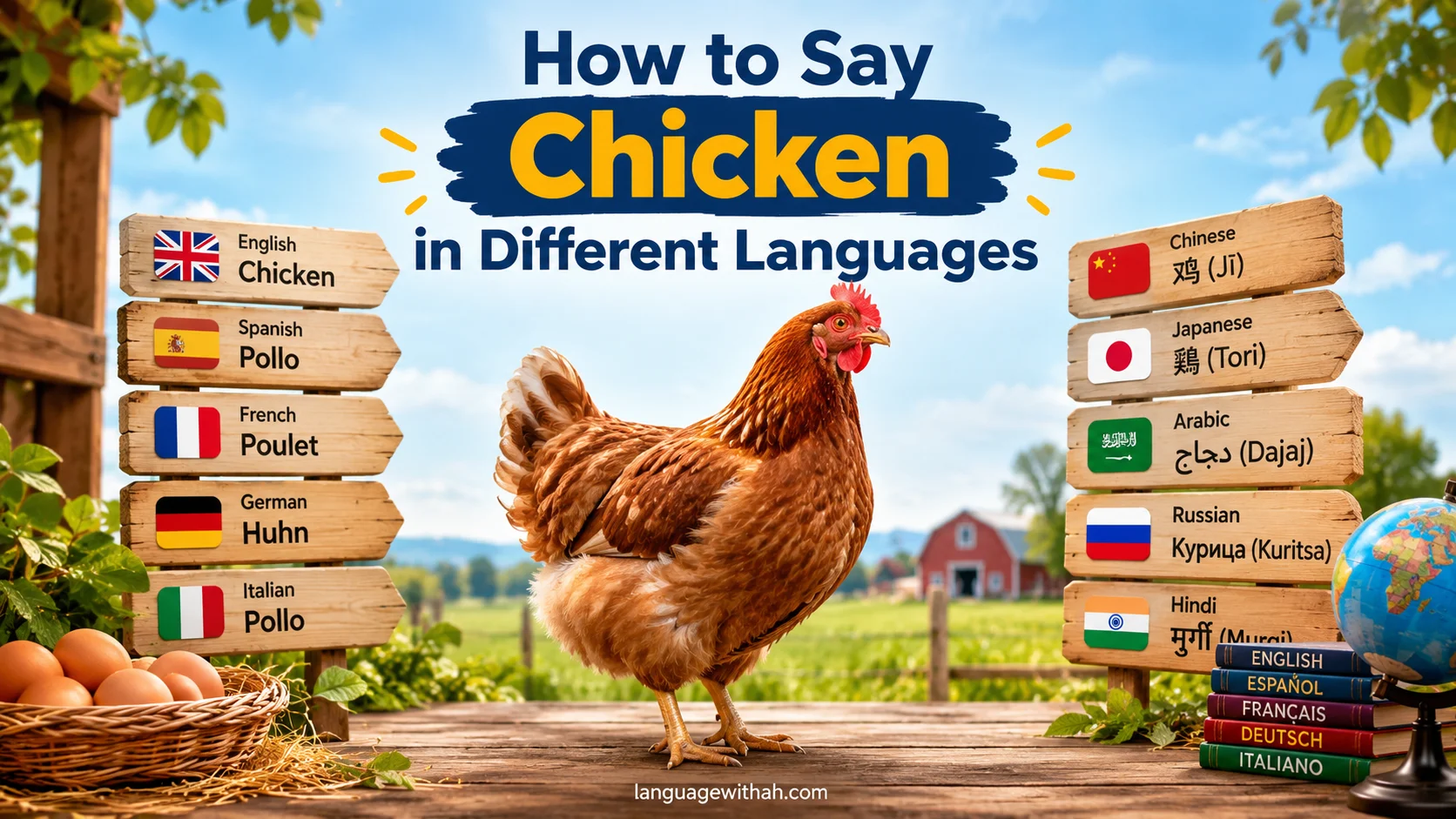
Chicken is a familiar food around the world, but the word can refer to different things depending on the context: a living bird, chicken meat, or a prepared dish. Learning how to say chicken in 70 different languages helps travelers understand menus, language learners build useful vocabulary, and curious readers discover how everyday words vary across cultures.
In English, the same word can describe both the animal and its meat. Other languages may use different words for a chicken as a living bird and for the meat served at a meal. Some also distinguish between a hen, a rooster, and a young chicken. These differences matter when ordering food, shopping at a market, following a recipe, or talking about farm animals.
This guide explores chicken translations, pronunciation, and example sentences across European, Asian, African, Middle Eastern, and other world languages. Each entry includes a representative country or region, a translation, a pronunciation guide, and a sentence demonstrating natural usage. You will also learn about regional vocabulary, writing systems, and common translation mistakes. Although many translations are straightforward, the most suitable word can depend on whether you mean the animal, the meat, or a particular chicken dish.
Interesting Facts About Chicken
- One word can have several meanings: In English, chicken can refer to the bird, its meat, or, informally, a person who is afraid.
- Animal and food vocabulary may differ: French distinguishes poulet, commonly used for chicken meat or a young chicken, from poule, a hen.
- Some languages distinguish sex: Words for a hen and a rooster are often different from the general word for chicken.
- Writing systems vary widely: Chicken can be written with Latin letters, Cyrillic letters, Chinese characters, Japanese kana and kanji, or other scripts.
- Food vocabulary reflects local usage: A translation used when discussing farm animals may not be the most natural choice on a restaurant menu.
- Pronunciation is not always obvious: Words such as Spanish pollo and Italian pollo look similar, but their pronunciation differs.
- Regional vocabulary matters: A word can be widely understood yet have alternatives that are more familiar in a particular country or dialect.
What Does Chicken Mean?
Chicken is a domesticated bird raised for its eggs and meat. The word also refers to the bird’s meat when used as food.
For example:
- The animal: “The chicken is walking around the farm.”
- The food: “We are having chicken for dinner.”
- A specific bird: “The hen laid an egg.”
- A prepared dish: “I ordered grilled chicken at the restaurant.”
The distinction is important when translating the word. Some languages use a general term for the bird and meat, while others favor a different term depending on the situation. In this guide, the main translation is generally the ordinary word for chicken as an animal or food, with context explained where necessary.
Why Can Chicken Have Different Translations?
The word chicken in different languages does not always correspond to one exact word in every situation. Translation depends on several factors:
- Context: Talking about a farm animal is different from ordering chicken at a restaurant.
- Gender and age: A hen, rooster, chick, and mature chicken may each have a distinct name.
- Regional dialect: Speakers in different countries may use different everyday terms.
- Formality: A word used in farming or cooking may differ from a casual expression.
- Grammar: Some languages change word endings according to number, grammatical gender, or sentence structure.
- Writing and pronunciation: A language may use a different script, and its spelling may not indicate pronunciation in the same way English does.
For practical communication, choose the word that fits your intended meaning rather than relying on a literal, word-for-word translation.
European Languages
Europe has many languages with distinct histories, grammatical systems, and food traditions. Although some chicken translations look similar, their pronunciation and everyday usage can differ. The following entries use common terms for chicken as a bird or food, with notes where a distinction is especially useful.
| 🌍 Language | Country/Region | Translation | Pronunciation | Example Sentence |
| English | UK, US, Australia, and others | Chicken | CHIK-in | The chicken is in the garden. |
| American English 🇺🇸 | United States | Chicken | CHIK-in | We had chicken for dinner. |
| British English 🇬🇧 | United Kingdom | Chicken | CHIK-in | The chicken is ready to serve. |
| Australian English 🇦🇺 | Australia | Chicken | CHIK-in | We cooked chicken on the barbecue. |
| Spanish | Spain, Mexico, Latin America | Pollo | POH-yoh | Quiero pollo para cenar. — I want chicken for dinner. |
| French | France, Belgium, parts of Canada | Poulet | poo-LAY | Nous mangeons du poulet. — We are eating chicken. |
| German | Germany, Austria, Switzerland | Huhn | hoon | Das Huhn ist im Garten. — The chicken is in the garden. |
| Italian | Italy, Switzerland | Pollo | POL-loh | Mangio pollo a pranzo. — I eat chicken for lunch. |
| Portuguese | Portugal, Brazil | Frango | FRAHN-goo | Vou preparar frango. — I am going to prepare chicken. |
| Dutch | Netherlands, Belgium | Kip | kip | We eten kip. — We are eating chicken. |
| Swedish | Sweden, Finland | Kyckling | SHÜK-ling | Vi äter kyckling. — We are eating chicken. |
| Norwegian | Norway | Kylling | CHÜL-ling | Vi spiser kylling. — We are eating chicken. |
| Danish | Denmark | Kylling | KÜL-ling | Vi spiser kylling. — We are eating chicken. |
| Finnish | Finland | Kana | KAH-nah | Kana on pihalla. — The chicken is in the yard. |
| Icelandic | Iceland | Kjúklingur | KYOO-kling-ur | Ég borða kjúkling. — I eat chicken. |
| Irish | Ireland | Sicín | shi-KEEN | Tá sicín agam don dinnéar. — I have chicken for dinner. |
| Welsh | Wales | Cyw iâr | KOO-ee YAHR | Mae cyw iâr ar y fferm. — There are chickens on the farm. |
| Polish | Poland | Kurczak | KOOR-chak | Jem kurczaka. — I am eating chicken. |
| Czech | Czechia | Kuře | KOO-zheh | Jím kuře. — I am eating chicken. |
| Slovak | Slovakia | Kura | KOO-rah | Máme kura na večeru. — We have chicken for dinner. |
| Ukrainian | Ukraine | Курка (kurka) | KOOR-kah | Курка у дворі. — The chicken is in the yard. |
| Russian | Russia and other Russian-speaking communities | Курица (kuritsa) | KOO-ree-tsah | Курица во дворе. — The chicken is in the yard. |
| Romanian | Romania, Moldova | Pui | poo-ee | Mănânc pui. — I am eating chicken. |
| Hungarian | Hungary | Csirke | CHEER-keh | Csirkét eszem. — I am eating chicken. |
| Greek | Greece, Cyprus | Κοτόπουλο (kotópoulo) | koh-TOH-poo-loh | Τρώω κοτόπουλο. — I am eating chicken. |
| Bulgarian | Bulgaria | Пиле (pile) | PEE-leh | Ям пиле. — I am eating chicken. |
| Croatian | Croatia | Piletina | pee-leh-TEE-nah | Jedem piletinu. — I am eating chicken. |
| Serbian | Serbia and neighboring communities | Пилетина (piletina) | pee-leh-TEE-nah | Једем пилетину. — I am eating chicken. |
| Slovenian | Slovenia | Piščanec | pee-SHAH-nets | Jem piščanca. — I am eating chicken. |
| Lithuanian | Lithuania | Vištiena | veesh-tee-EH-nah | Valgau vištieną. — I am eating chicken. |
| Latvian | Latvia | Vista | VEES-tah | Es ēdu vistu. — I am eating chicken. |
| Estonian | Estonia | Kana | KAH-nah | Ma söön kana. — I am eating chicken. |
English varieties: American, British, and Australian
The standard word chicken is the same in American, British, and Australian English. There is no need to invent separate translations for these varieties.
Pronunciation and expressions surrounding the word can vary, however. For example, barbecue chicken is a familiar food expression in Australia, while roast chicken is widely used in both British and American English.
European cultural and vocabulary notes
- French: Poulet is commonly used for chicken meat, while poule specifically refers to a hen. Coq means rooster.
- German: Huhn refers to a chicken or hen in general usage; Hähnchen is commonly used for a chicken served as food.
- Spanish: Pollo is the usual general term for chicken, while gallina means hen and gallo means rooster.
- Italian: Pollo is the common word for chicken, particularly in food contexts; gallina refers to a hen.
- Portuguese: Frango commonly refers to chicken as food or a young chicken. Galinha generally means hen.
- Polish: Kurczak commonly refers to chicken, especially a young bird or food. Kura means hen.
These distinctions help readers choose a more precise word when discussing animals, recipes, or meals.
Asian Languages
Asia contains a wide range of language families and writing systems. Some languages distinguish the living bird from chicken meat, while others use a general term that works in everyday conversation. The table below includes native scripts wherever applicable and uses practical romanization or pronunciation guides.
| 🌍 Language | Country/Region | Translation | Pronunciation | Example Sentence |
| Mandarin Chinese | China, Taiwan, Singapore | 鸡 (jī) | jee, high-level tone | 我吃鸡肉。 (Wǒ chī jīròu.) — I eat chicken. |
| Cantonese | Hong Kong, Guangdong | 雞 (gai1) | gai, high level tone | 我食雞肉。 (Ngo5 sik6 gai1 juk6.) — I eat chicken. |
| Japanese | Japan | 鶏 (とり, tori); 鶏肉 (とりにく, toriniku) for meat | TOH-ree; toh-ree-nee-koo | 鶏肉を食べます。 (Toriniku o tabemasu.) — I eat chicken. |
| Korean | South Korea, North Korea | 닭 (dak); 닭고기 (dalgogi) for meat | dak; dal-go-gi | 저는 닭고기를 먹어요. (Jeoneun dalgogireul meogeoyo.) — I eat chicken. |
| Hindi | India | मुर्गा/मुर्गी (murga/murgi); चिकन (chikan) for food | MOOR-gah / MOOR-gee / CHIK-an | मुझे चिकन पसंद है। — I like chicken. |
| Urdu | Pakistan, India | مرغی (murghi); چکن (chicken) for food | MOOR-ghee; CHIK-en | مجھے چکن پسند ہے۔ — I like chicken. |
| Bengali | Bangladesh, India | মুরগি (murgi) | MOOR-gee | আমি মুরগি খাই। — I eat chicken. |
| Punjabi | Pakistan, India | ਮੁਰਗੀ (murgī) / مرغی (murghi) | MOOR-gee | ਮੈਂ ਮੁਰਗੀ ਦਾ ਮਾਸ ਖਾਂਦਾ ਹਾਂ۔ — I eat chicken meat. |
| Gujarati | India | મરઘી (marghī); ચિકન (chicken) for food | mar-GHEE; CHIK-en | મને ચિકન ગમે છે. — I like chicken. |
| Marathi | India | कोंबडी (kombadi); चिकन for food | kom-BAH-dee; CHIK-an | मला चिकन आवडते. — I like chicken. |
| Tamil | India, Sri Lanka, Singapore | கோழி (kōḻi); கோழி இறைச்சி for meat | KOH-zhee; KOH-zhee ee-RAI-chchee | எனக்கு கோழி இறைச்சி பிடிக்கும். — I like chicken meat. |
| Telugu | India | కోడి (kōḍi); చికెన్ for food | KOH-dee; CHIK-en | నాకు చికెన్ ఇష్టం. — I like chicken. |
| Kannada | India | ಕೋಳಿ (kōḷi); ಕೋಳಿ ಮಾಂಸ for meat | KOH-lee; KOH-lee MAHN-sah | ನನಗೆ ಕೋಳಿ ಮಾಂಸ ಇಷ್ಟ. — I like chicken meat. |
| Malayalam | India | കോഴി (kōzhi); കോഴിയിറച്ചി for meat | KOH-zhee; KOH-zhee-IR-ach-chee | എനിക്ക് കോഴിയിറച്ചി ഇഷ്ടമാണ്. — I like chicken meat. |
| Nepali | Nepal | कुखुरा (kukhurā) | koo-KHOO-rah | मलाई कुखुराको मासु मन पर्छ। — I like chicken meat. |
| Sinhala | Sri Lanka | කුකුළා (kukulā); කුකුළු මස් for meat | koo-koo-LAH; koo-koo-loo mas | මම කුකුළු මස් කනවා. — I eat chicken. |
| Thai | Thailand | ไก่ (gài) | gai, low tone | ฉันกินไก่ (chăn gin gài). — I eat chicken. |
| Vietnamese | Vietnam | Gà | gah, with a falling-rising tone in northern pronunciation | Tôi ăn thịt gà. — I eat chicken. |
| Indonesian | Indonesia | Ayam | AH-yam | Saya makan ayam. — I eat chicken. |
| Malay | Malaysia, Brunei, Singapore | Ayam | AH-yam | Saya makan ayam. — I eat chicken. |
| Filipino/Tagalog | Philippines | Manok | mah-NOK | Kumakain ako ng manok. — I eat chicken. |
| Burmese | Myanmar | ကြက် (kyet); ကြက်သား for meat | chet; chet-tha | ကြက်သား စားတယ်။ — I eat chicken. |
| Khmer | Cambodia | មាន់ (moan); សាច់មាន់ for meat | moan; sach moan | ខ្ញុំញ៉ាំសាច់មាន់។ — I eat chicken. |
| Lao | Laos | ໄກ່ (kai) | kai, low tone | ຂ້ອຍກິນຊີ້ນໄກ່. — I eat chicken. |
| Mongolian | Mongolia | Тахиа (takhia) | tah-KHEE-ah | Би тахианы мах иддэг. — I eat chicken meat. |
| Kazakh | Kazakhstan | Тауық (tauyq) | tah-OO-uhk | Мен тауық етін жеймін. — I eat chicken meat. |
| Uzbek | Uzbekistan | Tovuq | toh-VOOK | Men tovuq go‘shti yeyman. — I eat chicken meat. |
Asian cultural and vocabulary notes
- Mandarin Chinese: Jī (鸡) means chicken as a bird. Jīròu (鸡肉) specifically means chicken meat and is usually the more precise term for food.
- Japanese: Tori (鳥 or 鶏, depending on context) can refer to a bird or chicken. Toriniku (鶏肉) clearly means chicken meat.
- Korean: Dak (닭) means chicken as an animal, while dalgogi (닭고기) means chicken meat.
- Hindi and Urdu: The words murga and murghi distinguish a rooster and a hen. The borrowed word chicken is also common in food-related conversation, especially in urban settings.
- Punjabi: Vocabulary and script vary by region. Punjabi is commonly written in Shahmukhi in Pakistan and Gurmukhi in India.
- Thai: The word gài is tonal, so its tone is part of its pronunciation.
- Indonesian and Malay: Both use ayam. The word is broadly understood in both languages, though sentence structure and other vocabulary may differ.
- Tamil, Telugu, Kannada, and Malayalam: The general animal term and the term for meat may differ, so a food-specific expression can be clearer in a recipe or restaurant.
Read More: How to Say Clothes in Different Languages
African Languages
Africa is home to thousands of languages and many regional varieties. Chicken vocabulary differs across language families, and the word for the living bird may differ from the term for its meat. The examples below represent selected languages and regions rather than the continent’s full linguistic diversity.
| 🌍 Language | Country/Region | Translation | Pronunciation | Example Sentence |
| Swahili | Tanzania, Kenya, East Africa | Kuku | KOO-koo | Ninakula kuku. — I am eating chicken. |
| Afrikaans | South Africa, Namibia | Hoender | HOON-der | Ek eet hoender. — I eat chicken. |
| Zulu | South Africa | Inkukhu | een-KOO-koo | Ngidla inkukhu. — I eat chicken. |
| Xhosa | South Africa | Inkukhu | een-KOO-koo | Nditya inkukhu. — I eat chicken. |
| Amharic | Ethiopia | ዶሮ (doro) | DOH-roh | ዶሮ እበላለሁ። — I eat chicken. |
| Yoruba | Nigeria, Benin | Adìẹ | ah-DEE-eh | Mo ń jẹ adìẹ. — I am eating chicken. |
| Igbo | Nigeria | Ọkụkọ | aw-KOO-kaw | Ana m eri ọkụkọ. — I am eating chicken. |
| Hausa | Nigeria, Niger, West Africa | Kaza | KAH-zah | Ina cin kaza. — I am eating chicken. |
| Somali | Somalia, Djibouti, Horn of Africa | Digaag | dee-GAAG | Waxaan cunayaa digaag. — I am eating chicken. |
| Shona | Zimbabwe | Huku | HOO-koo | Ndiri kudya huku. — I am eating chicken. |
| Sesotho | Lesotho, South Africa | Khoho | KHOH-hoh | Ke ja khoho. — I eat chicken. |
| Setswana | Botswana, South Africa | Koko | KOH-koh | Ke ja koko. — I eat chicken. |
| Kinyarwanda | Rwanda | Inkoko | een-KOH-koh | Ndarya inkoko. — I eat chicken. |
| Malagasy | Madagascar | Akoho | ah-KOO-hoo | Mihinana akoho aho. — I eat chicken. |
African cultural and vocabulary notes
- Swahili: Kuku is commonly used for chicken as an animal and in food contexts. Nyama ya kuku means chicken meat.
- Afrikaans: Hoender refers to a chicken or chickens, while hoendervleis specifies chicken meat.
- Zulu and Xhosa: Both use inkukhu, although pronunciation, sentence patterns, and related vocabulary differ between the languages.
- Yoruba: The tone marks in adìẹ are important because Yoruba is tonal.
- Hausa: Kaza is a common term for chicken; context helps distinguish the bird from a prepared meal.
Middle Eastern Languages
The Middle East includes Arabic, Persian, Hebrew, Kurdish, Turkish, and other distinct language traditions. Arabic has a widely used formal standard alongside regional dialects, while other languages also have local vocabulary differences. The table favors common, understandable words and distinguishes animal terms from food terms where useful.
| 🌍 Language | Country/Region | Translation | Pronunciation | Example Sentence |
| Arabic (Modern Standard Arabic) | Middle East and North Africa | دجاج (dajāj) | da-JAAJ | أتناول الدجاج. — I eat chicken. |
| Persian (Farsi) | Iran | مرغ (morgh) | morgh, with a guttural ending | من مرغ میخورم. — I eat chicken. |
| Hebrew | Israel | עוף (of) | ohf | אני אוכל עוף. — I eat chicken. |
| Kurdish (Kurmanji) | Türkiye, Iraq, Syria, Iran | Mirîşk | mee-REESH-k | Ez mirîşk dixwim. — I eat chicken. |
| Turkish | Türkiye, Cyprus | Tavuk | tah-VOOK | Tavuk yiyorum. — I am eating chicken. |
| Armenian | Armenia and Armenian-speaking communities | Հավ (hav); հավի միս for meat | hav; hah-VEE mees | Ես հավի միս եմ ուտում։ — I am eating chicken meat. |
Middle Eastern cultural and vocabulary notes
- Arabic: Dajāj (دجاج) is a broadly understood word for chicken. Dajājat al-laḥm is not normally needed to specify chicken meat; the simple word dajāj is commonly used for food. Regional dialects may use other everyday forms.
- Persian: Morgh means chicken or hen and is commonly used when discussing chicken as food. Goشت مرغ (goosht-e morgh) explicitly means chicken meat.
- Hebrew: Of (עוף) is a general term for poultry and can mean chicken in food contexts. Tarnegol (תרנגול) refers to a rooster, while tarnegolet (תרנגולת) refers to a hen.
- Turkish: Tavuk is the ordinary word for chicken and is common in food vocabulary. Tavuk eti means chicken meat.
- Kurdish: Kurdish has several varieties. The Kurmanji term shown here should not be assumed to represent every Kurdish dialect.
- Armenian: Hav means hen or chicken, while havi mis means chicken meat.
Other World Languages
Some languages are best included in a separate section because their main regions do not fit neatly into the categories above. These examples also show how chicken vocabulary appears in Indigenous languages, creoles, and an international constructed language.
| 🌍 Language | Country/Region | Translation | Pronunciation | Example Sentence |
| Māori | New Zealand | Heihei | HAY-hay | Ka kai au i te heihei. — I eat chicken. |
| Samoan | Samoa and Pacific communities | Moa | MOH-ah | Ou te ʻai i le moa. — I eat chicken. |
| Tongan | Tonga | Moa | MOH-ah | ʻOku ou kai moa. — I eat chicken. |
| Hawaiian | Hawaiʻi | Moa | MOH-ah | ʻAi au i ka moa. — I eat chicken. |
| Quechua | Andean regions of South America | Wallpa | WAHL-pah | Wallpa aychata mikuni. — I eat chicken meat. |
| Guarani | Paraguay and surrounding regions | Ryguasu | ruh-gwah-SOO | Akaru ryguasu ro’o. — I eat chicken meat. |
| Haitian Creole | Haiti | Poul | pool | Mwen manje poul. — I eat chicken. |
| Esperanto | International constructed language | Kokido | koh-KEE-doh | Mi manĝas kokidon. — I eat chicken. |
Notes on additional languages
- Māori: Heihei is the everyday word for chicken. The phrase te mīti heihei can be used to specify chicken meat.
- Samoan and Tongan: Both use moa, but the grammar and pronunciation of complete sentences differ.
- Hawaiian: Moa means chicken. The meaning of a sentence depends on its particles and surrounding words.
- Quechua: Quechua has several varieties, and vocabulary can differ between regions. Wallpa is used for chicken in a number of varieties.
- Guarani: Ryguasu refers to chicken, while so’o refers to meat in relevant food contexts. The example uses ro’o as a form for meat in the expression.
- Haitian Creole: Poul can refer to chicken as an animal or food.
- Esperanto: Kokido means chicken; the ending changes to kokidon when it is the direct object of the sentence.
Quick Reference: Chicken in Different Languages
Use this compact table to find the common translation quickly. For food-specific contexts, remember that some languages use a separate word for chicken meat.
| Language | Translation |
| English | Chicken |
| Spanish | Pollo |
| French | Poulet |
| German | Huhn |
| Italian | Pollo |
| Portuguese | Frango |
| Dutch | Kip |
| Swedish | Kyckling |
| Norwegian | Kylling |
| Danish | Kylling |
| Finnish | Kana |
| Icelandic | Kjúklingur |
| Irish | Sicín |
| Welsh | Cyw iâr |
| Polish | Kurczak |
| Czech | Kuře |
| Slovak | Kura |
| Ukrainian | Курка (kurka) |
| Russian | Курица (kuritsa) |
| Romanian | Pui |
| Hungarian | Csirke |
| Greek | Κοτόπουλο (kotópoulo) |
| Bulgarian | Пиле (pile) |
| Croatian | Piletina |
| Serbian | Пилетина (piletina) |
| Slovenian | Piščanec |
| Lithuanian | Vištiena |
| Latvian | Vista |
| Estonian | Kana |
| Mandarin Chinese | 鸡 (jī) |
| Cantonese | 雞 (gai1) |
| Japanese | 鶏 (tori); 鶏肉 (toriniku) for meat |
| Korean | 닭 (dak); 닭고기 (dalgogi) for meat |
| Hindi | मुर्गा/मुर्गी (murga/murgi) |
| Urdu | مرغی (murghi) |
| Bengali | মুরগি (murgi) |
| Punjabi | ਮੁਰਗੀ (murgi) |
| Gujarati | મરઘી (marghi) |
| Marathi | कोंबडी (kombadi) |
| Tamil | கோழி (kōḻi) |
| Telugu | కోడి (kōḍi) |
| Kannada | ಕೋಳಿ (kōḷi) |
| Malayalam | കോഴി (kōzhi) |
| Nepali | कुखुरा (kukhurā) |
| Sinhala | කුකුළා (kukulā) |
| Thai | ไก่ (gài) |
| Vietnamese | Gà |
| Indonesian | Ayam |
| Malay | Ayam |
| Filipino/Tagalog | Manok |
| Burmese | ကြက် (kyet) |
| Khmer | មាន់ (moan) |
| Lao | ໄກ່ (kai) |
| Mongolian | Тахиа (takhia) |
| Kazakh | Тауық (tauyq) |
| Uzbek | Tovuq |
| Swahili | Kuku |
| Afrikaans | Hoender |
| Zulu | Inkukhu |
| Xhosa | Inkukhu |
| Amharic | ዶሮ (doro) |
| Yoruba | Adìẹ |
| Igbo | Ọkụkọ |
| Hausa | Kaza |
| Somali | Digaag |
| Shona | Huku |
| Sesotho | Khoho |
| Setswana | Koko |
| Kinyarwanda | Inkoko |
| Malagasy | Akoho |
| Arabic | دجاج (dajāj) |
| Persian | مرغ (morgh) |
| Hebrew | עוף (of) |
| Kurdish (Kurmanji) | Mirîşk |
| Turkish | Tavuk |
| Armenian | Հավ (hav) |
| Māori | Heihei |
| Samoan | Moa |
| Tongan | Moa |
| Hawaiian | Moa |
| Quechua | Wallpa |
| Guarani | Ryguasu |
| Haitian Creole | Poul |
| Esperanto | Kokido |
How to Choose the Right Translation
The best translation of chicken depends on what you want to communicate. Before using a foreign-language word, consider these practical tips:
- For restaurant menus: Use the word for chicken meat, such as pollo in Spanish, poulet in French, or ayam in Indonesian.
- For farm animals: Choose the general animal term, such as Huhn in German or kuku in Swahili.
- For recipes: Use the vocabulary commonly found in cooking instructions. Some languages distinguish chicken meat from a whole bird.
- For regional communication: Check whether the word is familiar in the country or community where you plan to use it.
- For pronunciation: Listen to a reliable recording when possible, especially for tonal languages such as Mandarin, Thai, and Yoruba.
- For precise descriptions: Use a more specific word when referring to a hen, rooster, or chick.
Learning tip: Memorize the translation alongside a complete example sentence. This makes it easier to remember how the word works in real conversation.
Common Mistakes When Translating Chicken
Even a familiar word can become confusing when translated without context. Avoid these common mistakes:
- Confusing the animal with the meat. In Japanese, tori can refer to a bird or chicken, while toriniku specifically means chicken meat.
- Assuming one word works everywhere. Regional vocabulary and dialects can affect everyday usage.
- Ignoring grammatical changes. Some languages change a word’s form depending on its role in a sentence.
- Using English pronunciation rules. Spanish pollo, French poulet, and German Huhn each follow different pronunciation patterns.
- Ignoring tones. In tonal languages, a change in pitch can affect meaning.
- Confusing related animals. A hen, rooster, and chick may have different names even when a general word for chicken is available.
- Using an animal term when ordering food. A food-specific term may communicate your intention more clearly.
The safest approach is to learn the word, its pronunciation, and one natural sentence together.
Why Learn Chicken in Different Languages?
Learning everyday vocabulary such as chicken in different languages offers practical benefits beyond memorizing translations.
- Travel more confidently: Recognize chicken on menus, at markets, and in grocery stores.
- Build useful vocabulary: Everyday food words provide a starting point for learning recipes, ingredients, and meal-related expressions.
- Communicate more clearly: Know when a word refers to a living bird and when it means meat.
- Understand cultural differences: Discover how languages categorize familiar objects and foods differently.
- Personalize conversations: Use another language when discussing meals with friends, family, or international colleagues.
- Improve pronunciation: Practice unfamiliar sounds, tones, and writing systems.
- Develop multilingual skills: Connecting a word with examples helps you see how vocabulary and grammar work together.
Food vocabulary is especially useful because eating and cooking are everyday activities. Even one correctly used word can make a conversation easier and more engaging.
FAQs:
How do you say chicken in different languages?
Chicken has different translations around the world. Examples include pollo in Spanish, poulet in French, Huhn in German, pollo in Italian, jī (鸡) in Mandarin Chinese, ayam in Indonesian, and kuku in Swahili.
What is the most natural translation of chicken?
There is no single translation that works in every language. The natural choice depends on whether you mean the animal or its meat. For example, poulet is common in French food contexts, while poule refers specifically to a hen.
Is chicken the same word for the bird and its meat?
Not always. English uses chicken for both, but other languages may distinguish between them. Japanese uses tori for a chicken or bird in appropriate contexts and toriniku for chicken meat.
How do you say chicken in Spanish?
The general Spanish word is pollo, pronounced approximately POH-yoh. For example, Quiero pollo para cenar means “I want chicken for dinner.” Gallina means hen, and gallo means rooster.
How do you say chicken in French?
The common word is poulet, pronounced approximately poo-LAY. For example, Nous mangeons du poulet means “We are eating chicken.” The word poule refers to a hen.
Conclusion:
Learning how to say chicken in 70 different languages is a useful way to explore everyday vocabulary, pronunciation, and cultural differences. From pollo in Spanish to ayam in Indonesian and kuku in Swahili, these translations show how languages express a familiar concept in different ways.
The most important lesson is that a translation should fit its context. The word for a living chicken may differ from the word used for chicken meat on a menu, and regional vocabulary can influence which expression sounds natural. Paying attention to pronunciation, grammar, and cultural context will help you use these words more confidently.














1 thought on “How to Say Chicken in Different Languages”