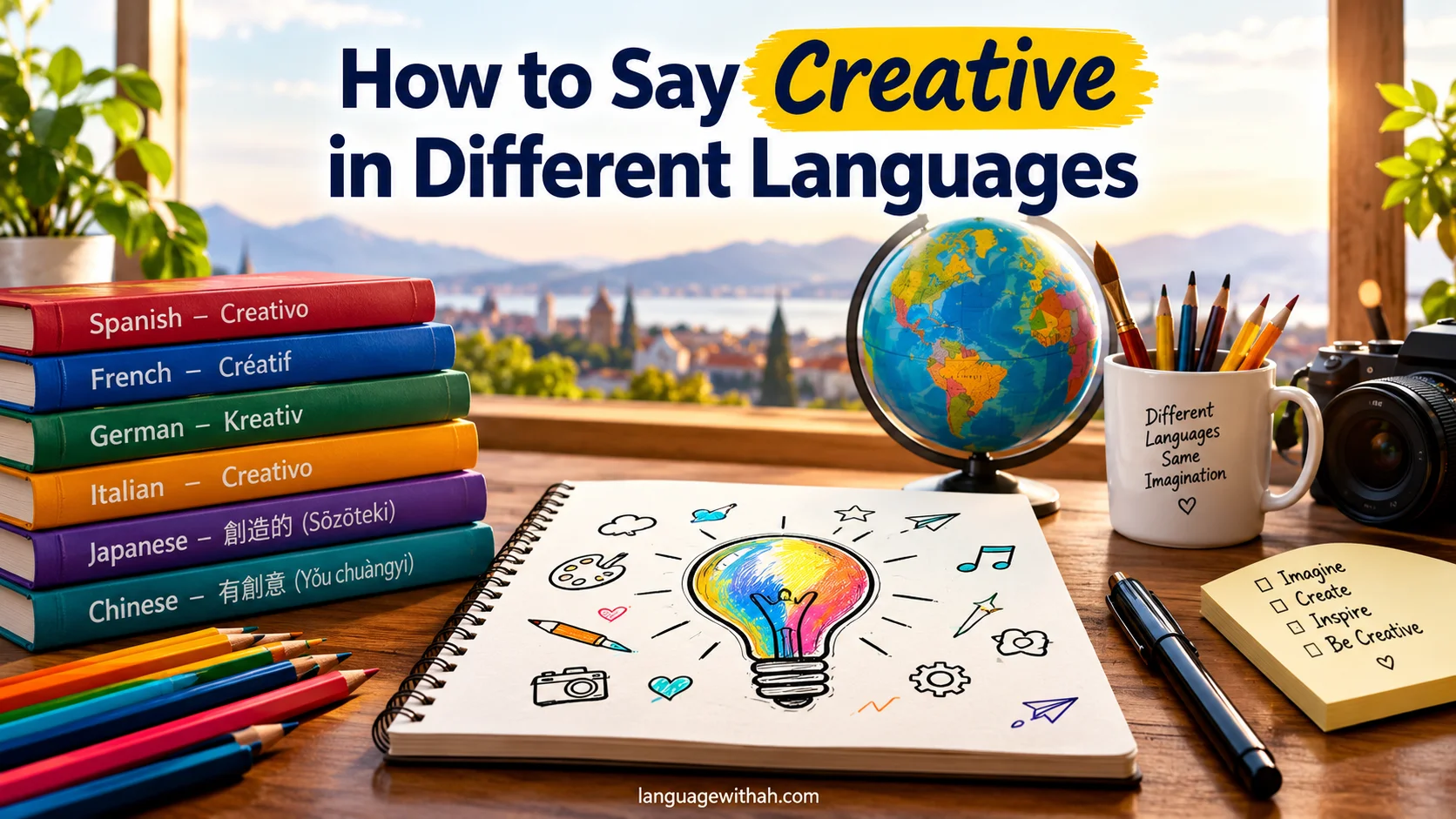
Being creative means using imagination, original thinking, and fresh ideas to make something new or approach a problem differently. The word can describe an artist designing a painting, a student finding an unusual solution, a writer developing a story, or a team discovering a better way to work. Learning how to say creative in different languages helps you describe these qualities when talking with people from different cultures.
Although many languages have a direct equivalent for creative, the most natural translation can depend on the situation. A word used to describe an artistic person may differ slightly from one used for an inventive idea, a clever solution, or an imaginative project. Some languages also change adjectives according to grammatical gender, number, or sentence structure.
This guide explores creative in different languages, with translations, pronunciation guides, and example sentences to help you understand how the word is used. It covers languages from Europe, Asia, Africa, the Middle East, and other parts of the world. Whether you are learning vocabulary, preparing a multilingual message, traveling, studying a foreign language, or describing someone’s talents, these translations can help you communicate more thoughtfully. Remember that context, regional usage, and grammar matter just as much as the dictionary meaning.
Interesting Facts About Creative
- Creative describes a quality, not just an occupation. Artists, scientists, teachers, business owners, and students can all be creative.
- Creativity can involve problem-solving. In many contexts, describing a solution as creative means it is original, imaginative, or unexpectedly effective.
- Translations do not always share the same word roots. Languages may use adjectives related to creating, inventing, imagining, or being resourceful.
- Grammar can change the form of the word. French, Spanish, Italian, and several other languages may require different adjective forms depending on gender or number.
- The same word can have different associations. Depending on context, creative may suggest artistic talent, innovation, imagination, or unconventional thinking.
- Pronunciation depends on the language. A familiar-looking word may have different vowel sounds, stress patterns, or consonants in another language.
- Cultural context matters. A compliment about someone’s creativity can refer to artistic expression, practical ingenuity, or the ability to develop new ideas.
What Does Creative Mean?
Creative means having or using the ability to produce original ideas, imaginative work, or new solutions. It is an adjective that describes people, activities, ideas, designs, and many other things.
For example:
- A creative person: Someone who regularly develops original ideas or expresses themselves imaginatively.
- A creative idea: A fresh or unusual thought that may be useful, interesting, or inspiring.
- A creative project: Work that involves imagination, design, storytelling, music, art, or another form of original expression.
- A creative solution: An inventive way to solve a problem.
- Creative thinking: The process of exploring possibilities and making connections between ideas.
The word does not necessarily mean that something is artistic. A mechanic who invents a practical repair, a cook who combines ingredients in a new way, and a student who finds an original approach to a difficult question can all be described as creative.
Why Can Creative Have Different Translations?
The English word creative has several closely related meanings, so its translation depends on what it describes.
- Context: An artistic person and an inventive engineering solution may call for slightly different wording.
- Formality: A formal presentation may use a more technical term than an everyday conversation.
- Gender and number: Some languages change adjectives to agree with the person or object being described.
- Regional variation: Speakers may prefer different synonyms or expressions in different countries.
- Cultural conventions: A word associated with artistic imagination may not carry exactly the same associations as one associated with innovation.
- Literal versus natural translation: A dictionary equivalent may be grammatically correct but not the most natural choice in a particular sentence.
- Spoken versus written language: Everyday speech, academic writing, advertising, and professional communication may favor different expressions.
In the tables below, the translations primarily describe imagination, originality, or the ability to create. Where the word changes form, a common masculine or citation form is generally shown, with important variations noted separately.
European Languages
European languages include Romance, Germanic, Slavic, and other language families. Many have familiar-looking equivalents of creative, while others favor words associated with imagination or originality. The adjective may also change according to grammatical gender or number.
The examples below use the word in a natural sentence rather than translating it in isolation alone.
| 🌍 Language | Country/Region | Translation | Pronunciation | Example Sentence |
| English | International | Creative | kree-AY-tiv | She is very creative. |
| American English 🇺🇸 | United States | Creative | kree-AY-tiv | He is a creative thinker. |
| British English 🇬🇧 | United Kingdom | Creative | kree-ay-TIV | She has a creative mind. |
| Australian English 🇦🇺 | Australia | Creative | kree-ay-tiv | That is a creative idea. |
| Spanish | Spain, Latin America | Creativo / creativa | kree-ah-TEE-boh / bah | Ella es muy creativa. — She is very creative. |
| French | France, Belgium, Canada | Créatif / créative | kray-ah-TEEF / teev | Elle est très créative. — She is very creative. |
| German | Germany, Austria, Switzerland | Kreativ | kray-ah-TEEF | Sie ist sehr kreativ. — She is very creative. |
| Italian | Italy, Switzerland | Creativo / creativa | kreh-ah-TEE-voh / vah | Maria è creativa. — Maria is creative. |
| Portuguese | Portugal, Brazil | Criativo / criativa | kree-ah-TEE-voo / vah | Ela é muito criativa. — She is very creative. |
| Dutch | Netherlands, Belgium | Creatief | kray-ah-TEEF | Zij is erg creatief. — She is very creative. |
| Swedish | Sweden, Finland | Kreativ | kreh-ah-TEEV | Hon är kreativ. — She is creative. |
| Norwegian | Norway | Kreativ | kreh-ah-TEEV | Hun er kreativ. — She is creative. |
| Danish | Denmark | Kreativ | kreh-ah-TEEV | Hun er kreativ. — She is creative. |
| Finnish | Finland | Luova | LOO-oh-vah | Hän on luova. — They are creative. |
| Icelandic | Iceland | Skapandi | SKAH-pan-di | Hún er skapandi. — She is creative. |
| Irish | Ireland | Cruthaitheach | kroo-HEE-hakh | Tá sí cruthaitheach. — She is creative. |
| Welsh | Wales | Creadigol | kreh-ah-DIG-ol | Mae hi’n greadigol. — She is creative. |
| Polish | Poland | Twórczy / twórcza | TFOOR-chih / chah | Ona jest twórcza. — She is creative. |
| Czech | Czechia | Tvořivý / tvořivá | TVOR-zhee-vee / vah | Je velmi tvořivá. — She is very creative. |
| Slovak | Slovakia | Tvorivý / tvorivá | TVOH-ree-vee / vah | Je veľmi tvorivá. — She is very creative. |
| Ukrainian | Ukraine | Творчий (tvorchyi) | TVOR-chiy | Вона творча. — She is creative. |
| Russian | Russia and other Russian-speaking communities | Творческий (tvorcheskiy) | TVOR-chehs-kee | Она творческая. — She is creative. |
| Romanian | Romania, Moldova | Creativ / creativă | kreh-ah-TEEV / uh | Ea este creativă. — She is creative. |
| Hungarian | Hungary | Kreatív | KREH-ah-teev | Ő kreatív. — They are creative. |
| Greek | Greece, Cyprus | Δημιουργικός / δημιουργική (dimiourgikós / dimiourgikí) | thee-mee-oor-yee-KOS / kee | Είναι πολύ δημιουργική. — She is very creative. |
| Bulgarian | Bulgaria | Творчески (tvorcheski) | TVOR-chehs-kee | Тя е творческа личност. — She is a creative person. |
| Croatian | Croatia | Kreativan / kreativna | kreh-ah-TEE-vahn / nah | Ona je kreativna. — She is creative. |
| Serbian | Serbia and neighboring regions | Креативан / креативна (kreativan / kreativna) | kreh-ah-TEE-vahn / nah | Она је креативна. — She is creative. |
| Slovenian | Slovenia | Ustvarjalen / ustvarjalna | oos-tvar-YAH-len / nah | Ona je ustvarjalna. — She is creative. |
| Lithuanian | Lithuania | Kūrybingas / kūrybinga | koo-REE-bing-gahs / gah | Ji kūrybinga. — She is creative. |
| Latvian | Latvia | Radošs / radoša | RAH-dosh / shah | Viņa ir radoša. — She is creative. |
| Estonian | Estonia | Loov | LOHV | Ta on loov. — They are creative. |
| Albanian | Albania, Kosovo | Krijues / krijuese | kree-YOO-ess / eh | Ajo është krijuese. — She is creative. |
| Catalan | Catalonia, Valencia, Balearic Islands | Creatiu / creativa | kreh-ah-TEE-oo / vah | Ella és creativa. — She is creative. |
| Galician | Galicia, Spain | Creativo / creativa | kreh-ah-TEE-voh / vah | Ela é creativa. — She is creative. |
English varieties: What changes?
American, British, and Australian English use the same spelling, creative, and broadly the same meaning. Pronunciation and accent differ, but there is no need to learn three separate translations. The stress falls on the second syllable in all three varieties.
Cultural and grammatical notes
- In Spanish, French, Italian, Portuguese, and Romanian, adjective endings can change with gender. For example, Spanish creativo becomes creativa when describing a feminine noun or person.
- In German, Dutch, Swedish, Norwegian, and Danish, kreativ or creatief is a familiar adjective, although pronunciation differs.
- In Finnish, luova conveys creativity or an ability to create, making it a useful natural alternative to an international loanword.
- In Polish and other Slavic languages, forms related to creativity and creation may sound more natural in some artistic contexts than a borrowed equivalent.
Read More: How to Say Curious in Different Languages
Asian Languages
Asia contains a wide variety of language families, scripts, and grammatical systems. Some languages use a single adjective, while others express creativity through a descriptive phrase. The translations here focus on a person or thing showing originality, imagination, or creative ability.
| 🌍 Language | Country/Region | Translation | Pronunciation | Example Sentence |
| Mandarin Chinese | China, Taiwan, Singapore | 有创意的 (yǒu chuàngyì de) | yoh chwàng-ee duh | 她是一个很有创意的人。— She is a very creative person. |
| Cantonese | Hong Kong, Guangdong | 有創意嘅 (jau5 cong3 ji3 ge3) | yau tsong yee geh | 佢係一個好有創意嘅人。— They are a very creative person. |
| Japanese | Japan | 創造的な (sōzōteki na) | soh-zoh-teh-kee nah | 彼女は創造的な人です。— She is a creative person. |
| Korean | South Korea, North Korea | 창의적인 (chang-uijeogin) | chang-ui-juh-gin | 그녀는 창의적인 사람이에요. — She is a creative person. |
| Hindi | India | रचनात्मक (rachnātmak) | ruh-chuh-naat-muk | वह रचनात्मक है। — They are creative. |
| Urdu | Pakistan, India | تخلیقی (takhleeqi) | takh-lee-kee | وہ تخلیقی صلاحیت رکھتی ہے۔ — She has creative ability. |
| Bengali | Bangladesh, India | সৃজনশীল (srijonshil) | sree-jon-sheel | সে সৃজনশীল। — They are creative. |
| Punjabi | India, Pakistan | ਰਚਨਾਤਮਕ (rachnātmak) / تخلیقی (takhleeqi) | ruh-chuh-naat-muk / takh-lee-kee | ਉਹ ਰਚਨਾਤਮਕ ਹੈ। — They are creative. |
| Gujarati | India | સર્જનાત્મક (sarjanātmak) | sur-juh-naat-muk | તે સર્જનાત્મક છે. — They are creative. |
| Marathi | India | सर्जनशील (sarjanshīl) | sur-jun-sheel | ती सर्जनशील आहे. — She is creative. |
| Tamil | India, Sri Lanka, Singapore | படைப்பாற்றல் மிக்க (padaippāṟṟal mikka) | puh-dai-paar-rul mik-kuh | அவள் படைப்பாற்றல் மிக்கவள். — She is creative. |
| Telugu | India | సృజనాత్మక (srujanātmaka) | sroo-juh-naat-muh-kuh | ఆమె సృజనాత్మకంగా ఉంటుంది. — She is creative. |
| Kannada | India | ಸೃಜನಶೀಲ (srujanashīla) | sroo-juh-nuh-shee-luh | ಅವಳು ಸೃಜನಶೀಲೆ. — She is creative. |
| Malayalam | India | സർഗാത്മക (sargātmaka) | sur-gaat-muh-kuh | അവൾ സർഗാത്മകയാണ്. — She is creative. |
| Nepali | Nepal | सिर्जनात्मक (sirjanātmak) | seer-juh-naat-muk | उनी सिर्जनात्मक छिन्। — She is creative. |
| Sinhala | Sri Lanka | නිර්මාණශීලී (nirmāṇaśīlī) | neer-maa-nuh-shee-lee | ඇය නිර්මාණශීලීයි. — She is creative. |
| Thai | Thailand | สร้างสรรค์ (sâang-sǎn) | saang-san, with tones | เธอเป็นคนสร้างสรรค์ — She is a creative person. |
| Vietnamese | Vietnam | Sáng tạo | sahng taow, with tones | Cô ấy rất sáng tạo. — She is very creative. |
| Indonesian | Indonesia | Kreatif | kreh-ah-teef | Dia sangat kreatif. — They are very creative. |
| Malay | Malaysia, Brunei, Singapore | Kreatif / berdaya cipta | kreh-ah-teef / ber-dah-yuh chip-tah | Dia seorang yang kreatif. — They are a creative person. |
| Filipino/Tagalog | Philippines | Malikhain | mah-lik-HAY-in | Malikhain siya. — They are creative. |
| Burmese | Myanmar | တီထွင်ဖန်တီးနိုင်သော (ti-htwin-hpan-ti-nai-thaw) | tee-twin phan-tee-nai-thaw | သူက တီထွင်ဖန်တီးနိုင်သူပါ။ — They are an inventive, creative person. |
| Khmer | Cambodia | ច្នៃប្រឌិត (chnai-prœt) | chnai-pruh-dit | គាត់ជាមនុស្សច្នៃប្រឌិត។ — They are a creative person. |
| Lao | Laos | ສ້າງສັນ (sāng san) | saang-san | ລາວເປັນຄົນສ້າງສັນ. — They are a creative person. |
| Mongolian | Mongolia | Бүтээлч (bүteelch) | boo-teelch | Тэр бүтээлч хүн. — They are a creative person. |
| Kazakh | Kazakhstan | Шығармашыл (shyğarmashył) | shuh-ghar-ma-shuhl | Ол шығармашыл адам. — They are a creative person. |
| Uzbek | Uzbekistan | Ijodkor | ee-jod-kor | U ijodkor inson. — They are a creative person. |
Cultural and grammatical notes
- Mandarin Chinese has several natural options. 有创意的 emphasizes having ideas or originality; 有创造力的 emphasizes creative ability.
- In Japanese, 創造的な works as an adjective before a noun. 独創的な often emphasizes originality or an individual, distinctive approach.
- In Korean, 창의적인 is useful for creative thinking, while 창조적인 can emphasize creating or producing something.
- In Hindi and Urdu, the vocabulary for creativity is often built around creation or creative ability. The surrounding sentence may need to change according to gender and grammar.
- Thai, Vietnamese, and Lao use tone-sensitive pronunciation. English approximations are only a starting point, not a substitute for listening to native speech.
African Languages
Africa is home to thousands of languages, with different grammatical structures and traditions of expression. The word creative may be translated using terms associated with creating, inventing, imagination, or resourcefulness. The examples below represent selected languages and do not represent the continent’s full linguistic diversity.
| 🌍 Language | Country/Region | Translation | Pronunciation | Example Sentence |
| Swahili | Tanzania, Kenya, East Africa | Ubunifu | oo-boo-NEE-foo | Ana ubunifu mkubwa. — They have great creativity. |
| Afrikaans | South Africa, Namibia | Kreatief | kree-ah-TEEF | Sy is baie kreatief. — She is very creative. |
| Zulu | South Africa | Oqanjiwe / onobuciko* | oh-kwan-jee-weh / oh-noh-boo-chee-koh | Unobuciko obukhulu. — They have great artistic skill. |
| Xhosa | South Africa | Uyilo / onobuchule* | oo-yee-loh / oh-noh-boo-choo-leh | Unobuchule bokwenza izinto ezintsha. — They have the ability to make new things. |
| Amharic | Ethiopia | ፈጠራዊ (fet’erawi) | feh-teh-rah-wee | እሷ ፈጠራዊ ነች። — She is creative. |
| Yoruba | Nigeria, Benin | Aláṣàdá / oníṣẹ̀dá* | ah-lah-shah-dah / oh-nee-sheh-dah | Ó ní ìmọ̀ tuntun àti ìṣẹ̀dá. — They have fresh ideas and creativity. |
| Igbo | Nigeria | Onye okike* | oh-nyeh oh-kee-keh | Ọ bụ onye okike. — They are a creator or creative person. |
| Hausa | Nigeria, Niger, West Africa | Mai ƙirƙira | my keer-kee-rah | Shi mutum ne mai ƙirƙira. — He is an inventive person. |
| Somali | Somalia, Horn of Africa | Hal-abuur leh | hal-ah-boor leh | Waa qof hal-abuur leh. — They are a creative person. |
| Shona | Zimbabwe | Ane unyanzvi | ah-neh oon-yahn-zvee | Ane unyanzvi hwekugadzira zvinhu zvitsva. — They have the skill to create new things. |
| Sesotho | Lesotho, South Africa | Boqapi | boh-KAH-pee | O na le boqapi. — They have creativity. |
| Setswana | Botswana, South Africa | Boitlhamedi | boyt-lah-MEH-dee | O na le boitlhamedi. — They have creativity. |
| Kinyarwanda | Rwanda | Ubuhanga bwo guhanga | oo-boo-HAHN-gah bwoo goo-HAHN-gah | Afite ubuhanga bwo guhanga. — They have creative ability. |
| Malagasy | Madagascar | Mamorona / mahay mamorona | mah-moo-ROO-nah / mah-hai mah-moo-ROO-nah | Mahay mamorona zavatra vaovao izy. — They can create new things. |
Some entries above are descriptive expressions rather than one-to-one adjective equivalents. In particular, Zulu, Xhosa, Yoruba, and Igbo wording can vary according to whether the intended sense is artistic, inventive, or generally imaginative. For publication, these entries should be checked with fluent speakers for the exact dialect and context.
Cultural and language notes
- In Swahili, ubunifu is a noun meaning creativity or innovation. A sentence about someone’s creative ability may sound more natural than forcing the noun into an adjective form.
- In Afrikaans, kreatief is a straightforward adjective used in everyday and professional contexts.
- In several African languages, a short descriptive phrase can express the idea of being creative more naturally than a direct adjective borrowed from English.
- African languages vary greatly even within the same country. A translation should be checked against the intended language variety and audience.
Middle Eastern Languages
The Middle East includes Arabic, Persian, Hebrew, Kurdish, Armenian, Turkish, and other languages with distinct histories and grammatical systems. Words for creative may emphasize innovation, artistic ability, or the capacity to produce something original.
| 🌍 Language | Country/Region | Translation | Pronunciation | Example Sentence |
| Arabic (Modern Standard Arabic) | Middle East, North Africa | إبداعي (ibdāʿī) | ib-daa-ee | إنها شخصية إبداعية. — She is a creative person. |
| Persian (Farsi) | Iran, Afghanistan, Tajikistan (with regional language varieties) | خلاق (khalāq) | kha-LAAGH | او فردی خلاق است. — They are a creative person. |
| Hebrew | Israel | יצירתי (yetzirati, masculine) / יצירתית (yetziratit, feminine) | yet-see-rah-TEE / yet-see-rah-TEET | היא יצירתית. — She is creative. |
| Kurdish (Kurmanji) | Kurdish-speaking regions of Türkiye, Iraq, Syria, Iran | Afirîner | ah-fee-ree-NEHR | Ew kesekî afirîner e. — He is a creative person. |
| Turkish | Türkiye, Cyprus | Yaratıcı | yah-rah-tuh-juh | O yaratıcı bir insan. — They are a creative person. |
| Armenian | Armenia, Armenian-speaking communities | Ստեղծագործ (steghtsagorts) | stehgh-tsah-GORTS | Նա ստեղծագործ մարդ է։ — They are a creative person. |
Cultural and grammatical notes
- Arabic: إبداعي is a useful adjective for creative work, ideas, and approaches. The form may change to agree with the noun, and regional dialects may favor different wording in conversation.
- Persian: خلاق is commonly used for a creative or inventive person. It can describe artistic talent as well as original thinking.
- Hebrew: The adjective changes form according to grammatical gender. The masculine form is יצירתי and the feminine form is יצירתית.
- Kurdish: Kurdish has several varieties, including Kurmanji and Sorani. The example above is specifically Kurmanji, not a universal form for all Kurdish speakers.
- Turkish: Yaratıcı can describe both a creative person and an inventive idea, depending on the sentence.
Other World Languages
These languages add useful perspectives from the Pacific, the Americas, and international language learning. Some express the idea of creativity through an adjective, while others use a descriptive form.
| 🌍 Language | Country/Region | Translation | Pronunciation | Example Sentence |
| Māori | Aotearoa New Zealand | Auaha | ow-AH-hah | He tangata auaha ia. — They are a creative person. |
| Samoan | Samoa, Pacific communities | Fatufatuaʻi | fah-too-fah-too-AH-ee | O ia o se tagata fatufatuaʻi. — They are a creative person. |
| Tongan | Tonga | Fakakaukau foʻou* | fah-kah-kow-kow foh-OOH | ʻOku ne maʻu ha ngaahi fakakaukau foʻou. — They have new ideas. |
| Hawaiian | Hawaiʻi | Hoʻokumu / noʻeau* | hoh-oh-KOO-moo / noh-EH-ow | He kanaka noʻeau ʻo ia. — They are a skilled or ingenious person. |
| Quechua | Andes, including Peru and Bolivia | Kamayuq* | kah-mah-YOOK | Descriptive wording varies by Quechua variety. |
| Guarani | Paraguay, neighboring regions | Apopyre | ah-poh-puh-REH | Ha’e tapicha apopyre. — They are a creative person. |
| Haitian Creole | Haiti | Kreyatif | kreh-yah-TEEF | Li se yon moun kreyatif. — They are a creative person. |
| Esperanto | International constructed language | Kreema | kreh-EH-mah | Ŝi estas kreema. — She is creative. |
Some of these expressions have broader meanings or are descriptive rather than exact adjective equivalents. Māori auaha is a useful word for creativity and innovation; Hawaiian noʻeau emphasizes skill or ingenuity; and Tongan and Quechua wording should be confirmed with a speaker of the specific variety before use in permanent or formal text.
Quick Reference: Creative in Different Languages
This compact list gathers the principal translations from the regional sections. Where the language uses gendered forms or a descriptive expression, the most relevant forms are shown together.
| Language | Translation |
| English | Creative |
| American English | Creative |
| British English | Creative |
| Australian English | Creative |
| Spanish | Creativo / creativa |
| French | Créatif / créative |
| German | Kreativ |
| Italian | Creativo / creativa |
| Portuguese | Criativo / criativa |
| Dutch | Creatief |
| Swedish | Kreativ |
| Norwegian | Kreativ |
| Danish | Kreativ |
| Finnish | Luova |
| Icelandic | Skapandi |
| Irish | Cruthaitheach |
| Welsh | Creadigol |
| Polish | Twórczy / twórcza |
| Czech | Tvořivý / tvořivá |
| Slovak | Tvorivý / tvorivá |
| Ukrainian | Творчий |
| Russian | Творческий |
| Romanian | Creativ / creativă |
| Hungarian | Kreatív |
| Greek | Δημιουργικός / δημιουργική |
| Bulgarian | Творчески |
| Croatian | Kreativan / kreativna |
| Serbian | Креативан / креативна |
| Slovenian | Ustvarjalen / ustvarjalna |
| Lithuanian | Kūrybingas / kūrybinga |
| Latvian | Radošs / radoša |
| Estonian | Loov |
| Albanian | Krijues / krijuese |
| Catalan | Creatiu / creativa |
| Galician | Creativo / creativa |
| Mandarin Chinese | 有创意的 |
| Cantonese | 有創意嘅 |
| Japanese | 創造的な |
| Korean | 창의적인 |
| Hindi | रचनात्मक |
| Urdu | تخلیقی |
| Bengali | সৃজনশীল |
| Punjabi | ਰਚਨਾਤਮਕ / تخلیقی |
| Gujarati | સર્જનાત્મક |
| Marathi | सर्जनशील |
| Tamil | படைப்பாற்றல் மிக்க |
| Telugu | సృజనాత్మక |
| Kannada | ಸೃಜನಶೀಲ |
| Malayalam | സർഗാത്മക |
| Nepali | सिर्जनात्मक |
| Sinhala | නිර්මාණශීලී |
| Thai | สร้างสรรค์ |
| Vietnamese | Sáng tạo |
| Indonesian | Kreatif |
| Malay | Kreatif |
| Filipino/Tagalog | Malikhain |
| Burmese | တီထွင်ဖန်တီးနိုင်သော |
| Khmer | ច្នៃប្រឌិត |
| Lao | ສ້າງສັນ |
| Mongolian | Бүтээлч |
| Kazakh | Шығармашыл |
| Uzbek | Ijodkor |
| Swahili | Ubunifu |
| Afrikaans | Kreatief |
| Zulu | Onobuciko (artistic; context-dependent) |
| Xhosa | Onobuchule (skilled; context-dependent) |
| Amharic | ፈጠራዊ |
| Yoruba | Aláṣàdá (creator; context-dependent) |
| Igbo | Onye okike (creator; context-dependent) |
| Hausa | Mai ƙirƙira |
| Somali | Hal-abuur leh |
| Shona | Ane unyanzvi |
| Sesotho | Boqapi |
| Setswana | Boitlhamedi |
| Kinyarwanda | Ubuhanga bwo guhanga |
| Malagasy | Mahay mamorona |
| Arabic | إبداعي |
| Persian | خلاق |
| Hebrew | יצירתי / יצירתית |
| Kurdish (Kurmanji) | Afirîner |
| Turkish | Yaratıcı |
| Armenian | Ստեղծագործ |
| Māori | Auaha |
| Samoan | Fatufatuaʻi |
| Tongan | Fakakaukau foʻou (new ideas) |
| Hawaiian | Noʻeau (skilled, ingenious) |
| Quechua | Kamayuq (variety-dependent) |
| Guarani | Apopyre (verify by variety) |
| Haitian Creole | Kreyatif |
| Esperanto | Kreema |
How to Choose the Right Translation
The best translation of creative depends on what you want to describe and who will read or hear it.
- For a person: Choose a natural adjective that describes someone’s imagination or originality. In Spanish, for example, use creativo or creativa according to grammatical gender.
- For an idea: Choose wording that emphasizes originality or inventiveness. Mandarin Chinese 有创意的 is useful for describing something that shows creative thinking.
- For artwork: Consider whether the language distinguishes artistic skill from general creativity.
- For professional writing: Use a form appropriate for a presentation, portfolio, résumé, or business discussion.
- For a casual conversation: Prefer everyday wording rather than an overly technical expression.
- For a tattoo or permanent design: Confirm the exact spelling, grammar, and intended meaning with a qualified speaker before committing to the text.
Practical tip: Translate the complete sentence, not just the word. The best adjective may change depending on the noun it describes.
Common Mistakes When Translating Creative
Translating creative is relatively straightforward in many languages, but several mistakes can affect accuracy.
- Translating word for word: A dictionary equivalent may not fit naturally into every sentence. Look at how the target language expresses the full idea.
- Ignoring grammatical gender: Spanish creativo and creativa, for example, are not interchangeable in every grammatical context.
- Confusing creativity with artistic talent: Creativity includes problem-solving, original ideas, invention, and many activities beyond the arts.
- Mixing regional varieties: A translation in one variety of Arabic or Kurdish should not automatically be treated as universal across the language.
- Overlooking pronunciation: Correct spelling does not guarantee correct pronunciation. Pay attention to stress, vowel sounds, and tones.
- Using an unnatural synonym: A word meaning inventive, artistic, or resourceful may be suitable in one situation but not another.
- Assuming one translation works everywhere: Context, sentence structure, audience, and regional conventions can all influence the best wording.
Why Learn Creative in Different Languages?
Learning how to express creative in different languages can expand your vocabulary and help you communicate more precisely.
- Communicate across cultures: Describe someone’s ideas, talents, and work when speaking with people who use another language.
- Improve language learning: Comparing translations helps you recognize adjectives, sentence structures, and grammatical patterns.
- Give meaningful compliments: Describing a person as creative can acknowledge their imagination and originality.
- Travel and connect: Knowing useful descriptive vocabulary can make conversations with local people more engaging.
- Write multilingual content: Use appropriate expressions in educational materials, creative projects, presentations, and social media.
- Understand cultural nuance: Explore how different languages express the related ideas of innovation, artistic ability, and original thinking.
The main benefit is not memorizing dozens of isolated words. It is understanding how people express a shared idea through different linguistic systems.
FAQs:
1. How do you say creative in different languages?
The word has different translations depending on the language. Examples include creativo in Spanish, créatif in French, kreativ in German, luova in Finnish, 創造的な in Japanese, and خلاق in Persian.
2. What is the most natural translation of creative?
There is no single translation that works for every language. The most natural option depends on whether you are describing a person, an idea, a work of art, or an inventive solution.
3. Can the translation of creative change by country?
Yes. Speakers of the same language may use different vocabulary or expressions across countries and regions. These differences can reflect dialect, local usage, and context.
4. Why do some languages have multiple translations for creative?
Because creative can describe imagination, artistic expression, originality, or the ability to invent. Different words may emphasize different aspects of these meanings.
5. Does pronunciation change between regions?
Yes. Accents and pronunciation patterns vary. English, Spanish, Arabic, and Chinese all have regional differences, although the extent and type of variation differ by language.
Conclusion:
Learning how to say creative in different languages reveals how a shared human quality can be expressed through many different words and grammatical structures. From Spanish creativo and French créatif to Japanese 創造的な and Swahili ubunifu, each language offers its own way of describing imagination, originality, and the ability to develop fresh ideas.
The most useful translation depends on the situation. A word that describes an artistic person may not be the best choice for an inventive business solution or a new scientific approach. Context, grammar, pronunciation, and regional variation all help determine which expression sounds natural.





1 thought on “How to Say Creative in Different Languages”